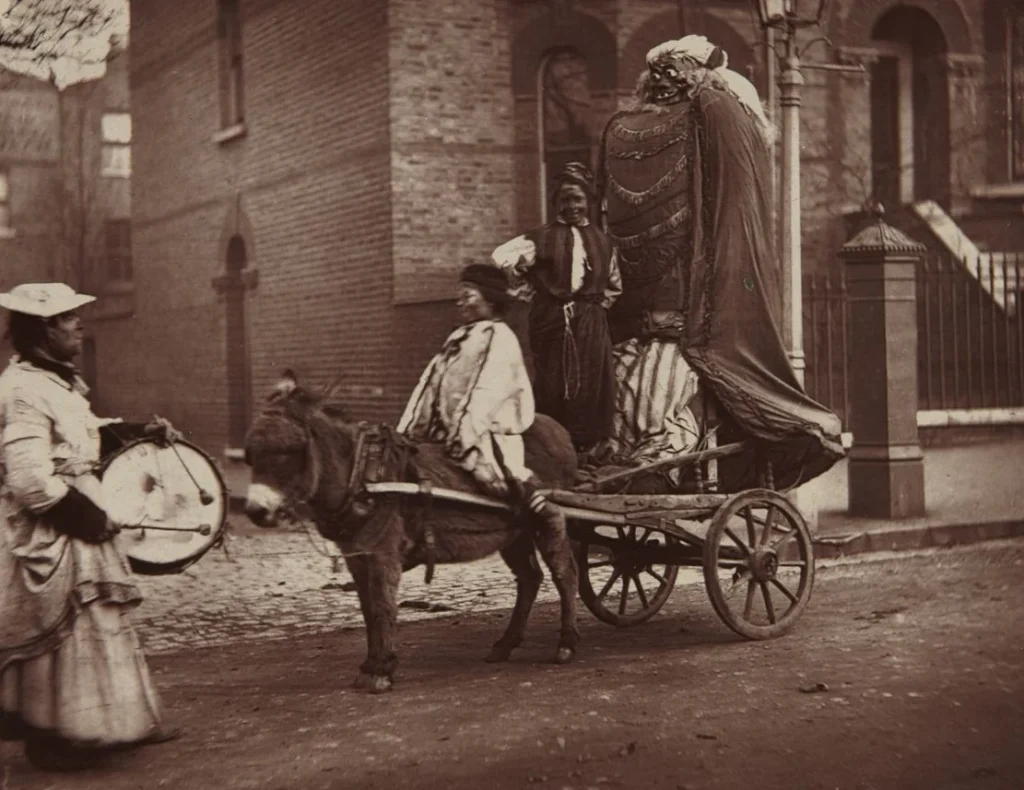
John Thomson’s photograph November Effigies shows a London street entertainment that seems to have required rather more people and equipment than the familiar business of sticking an old jumper on a straw-filled Guy. A masked figure towers over a donkey cart, wearing a fringed, tasselled cloak above a striped skirt. Alongside walks a drummer in a long pale dress and straw hat.
The accompanying writer, Adolphe Smith, was thoroughly unimpressed. In his 1877 account of November effigies for Street Life in London, he sneered at the awkwardly constructed Guy and the man dressed in women’s clothes. He was no kinder about the entertainment itself.
Yet Smith also recognised that the organiser had a serious financial interest in attracting a crowd. The figure in Thomson’s photograph represented an investment, made by somebody who could scarcely afford to waste one. Its clothes might look like rubbish to a respectable observer and still be worth recovering when the procession was finished.
These Victorian Guys were built for a celebration associated with burning an effigy, but the people who dressed them sometimes had every reason to keep them away from the flames.
Building a spectacle with very little money
Smith traced the development of the commercial Guy Fawkes exhibition to the ‘No Popery’ agitation following the establishment of Roman Catholic dioceses in England. Figures of Cardinal Wiseman, the Pope and Guy Fawkes appeared together in processions, while crowds shouted anti-Catholic slogans and showered the exhibitors with pennies.
The hostility was profitable. Costermongers and other street traders saw that a large, impressive Guy could attract more money than a small one. According to Smith, organisers saved for weeks beforehand and spent considerable sums preparing their displays. A procession might include musicians, clowns and boys dressed to accompany the effigy.
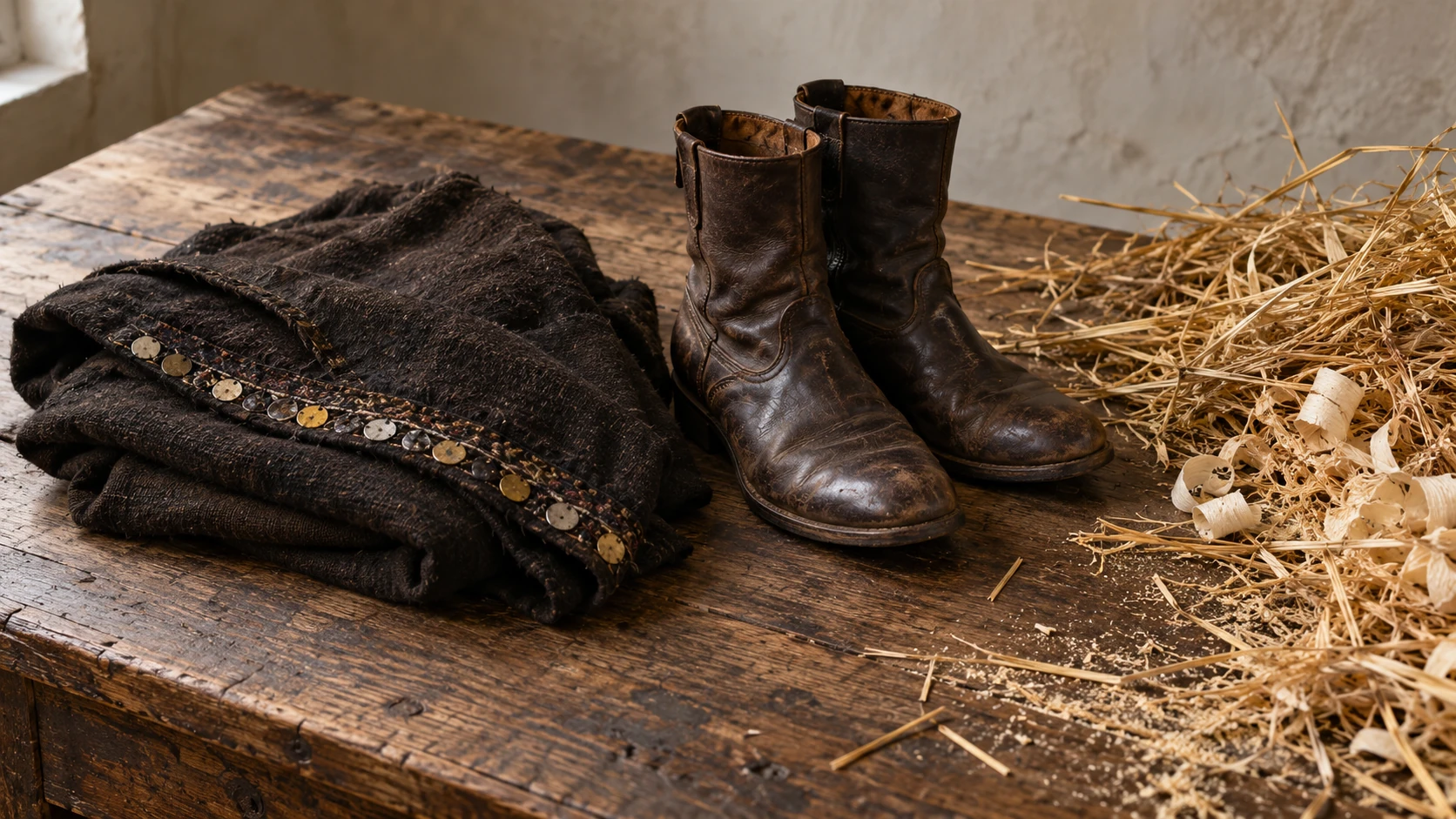
The difficulty was that these were people with limited means. Smith specifically identifies paper and spangles as important parts of the costumes.
A spangle is a small reflective ornament attached to a surface to make it glitter. In traditional goldwork, the Royal School of Needlework distinguishes a spangle, made from flattened wire, from a sequin punched out of a sheet. Smith may have used the word loosely, but the effect was the same: a little reflective decoration could make modest materials considerably more conspicuous.
Paper could do equally ambitious work. In Henry Mayhew’s London Labour and the London Poor, volume III of the 1861–62 edition, a seventeen-year-old boy described helping to dress a Guy in an extraordinary mixture of old clothing and paper ornaments. The figure wore a cap made from paper resembling silk velvet, decorated with tinsel bows. Its coat was pasted with coloured decorations and pictures of theatrical characters, which the boys bought for a halfpenny a sheet plain or a penny coloured. They bought the plain versions and coloured them themselves.
They cut red paper into narrow strips, curled it with scissors and arranged it like a feather. Other coloured papers became bows, stars and decorative pieces.
The exact identity of the velvet-like paper is unclear, but its purpose is obvious enough. It gave a cheap cap the appearance of something more luxurious. The exhibitors were building visual impressions from whatever they could obtain.
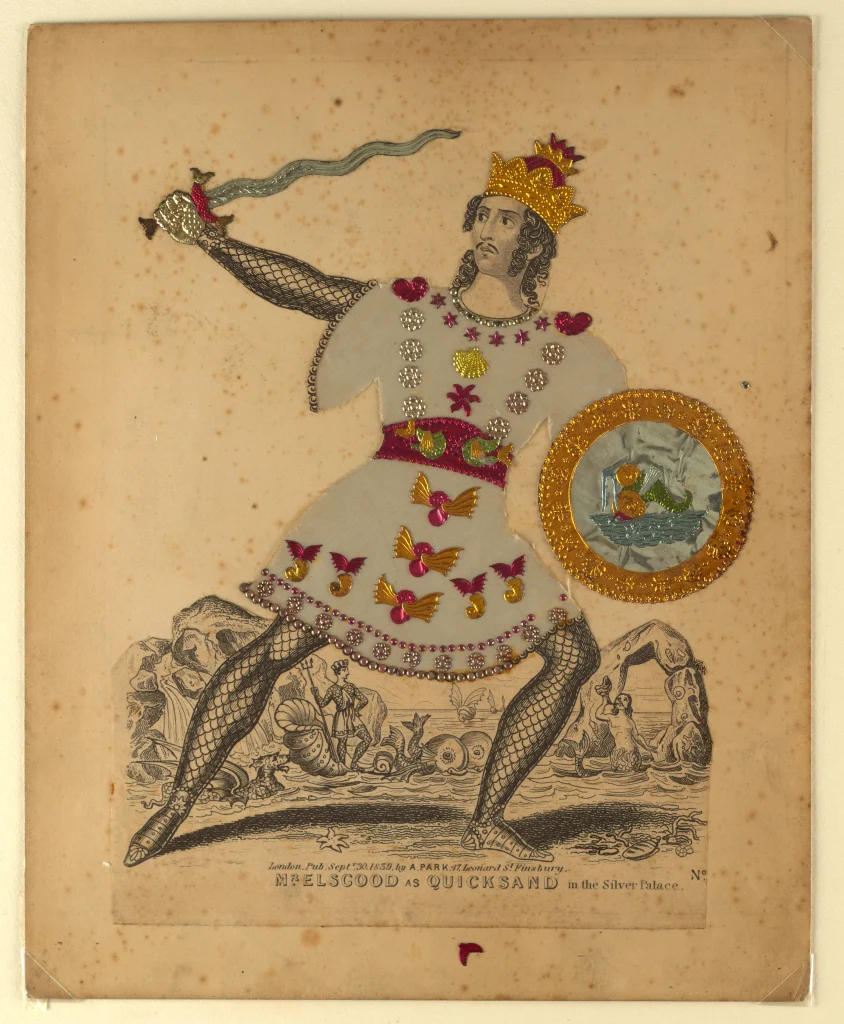
Another of Mayhew’s interviewees, an experienced Guy-builder who ordinarily traded in crockery and second-hand goods, understood this perfectly. He made wooden supports, stuffed figures with sawdust and shavings, designed their clothing and did the sewing himself. He even bought old theatrical breeches in Petticoat Lane.
One of his elaborate four-figure exhibitions included a king in a scarlet cloak, soldiers wearing armour made partly from paper, and a Guy dressed in black velvet with a red cloak and lace-trimmed red boots. The builder remembered spending nearly £4 on the production.
Thomson’s photographed Guy was a different exhibition, recorded decades later. But the two accounts reveal the same principle: the more convincing the spectacle, the more it might persuade people to part with their money.
What a Guy could earn
Smith reckoned the organiser of the exhibition in Thomson’s photograph might take about thirty shillings on the first day, another pound on 6 November, and ten or fifteen shillings on the seventh.
The Guy could still earn money two days after Bonfire Night. Burning an elaborate construction on the evening of the fifth would have brought that particular business opportunity to a rather abrupt conclusion.
Those takings were not all profit. The organiser first had to recover the expense of making the figure, paying for materials and arranging the entertainment. Smith said the boys helping with the procession might receive a shilling to eighteenpence each per day.
He reported the argument that the boys enjoyed themselves, whereas the adults carried the financial risk. It is an awfully convenient arrangement when the person doing the cheering is also the person receiving the smallest share.
Mayhew’s builder described one elaborate production that took six weeks to prepare in spare hours. It involved several figures, a cart, performers and a drummer. For people working in street trades, several days of successful collections could make a considerable difference during a difficult season.
And a large collection on the first day was no guarantee of a profitable exhibition. An expensive Guy still had to survive long enough to earn the rest.
When the investment was torn apart
Smith describes processions being attacked and costly effigies torn to pieces, destroying the organisers’ hopes of recovering their expenditure. He blamed much of this violence on Irish residents.
The financial consequence was straightforward. A broken effigy could no longer attract the crowds its maker had spent money preparing for.
Mayhew’s young interviewee described another sort of danger: groups of lads who attacked Guys and their attendants to steal money and sometimes clothing. If one of the attackers had holes in his boots and spotted a sound pair on an effigy, the Guy could find itself unexpectedly barefoot.
A costume valuable enough to steal was plainly valuable enough to worry about losing.
The trade responded by changing what it displayed. According to Smith, organisers discovered that an effigy of another unpopular public figure could attract an audience while presenting less risk of attack. During the Crimean War, Emperor Nicholas of Russia became a popular subject. In later years, figures representing Madame Rachel and Mrs Prodgers were also paraded and burnt.
Mayhew’s builder had already demonstrated considerable flexibility. He described an Emperor Nicholas tableau with military clothing, a Russian helmet and elaborate paper decoration. He had also seen an exhibition featuring Miss Nightingale and two soldiers, although he disliked the idea of turning a woman he admired into a Guy.
The costume that came back next year
Mayhew’s builder described keeping a wax mask for five years. On another occasion, he bought a Russian helmet for a shilling and later refused an offer of five or six shillings for it because he still found it useful.
His Guy Fawkes appeared again wearing the same black-velvet costume and red boots used in an earlier display. He could change the surrounding figures, the historical scene and the theatrical arrangements while retaining clothing that had already cost money.
Some finished Guys were sold to other entertainers, who might eventually burn them. Mayhew’s builder remembered selling his own to the Albert Saloon, until that establishment lost interest in buying them. There was money to be made from the figure after the street procession, provided somebody still wanted it.
Otherwise, he had a very straightforward method of preserving the expensive parts. He removed the sawdust and shavings and saved the clothes for another year.
Decades later, Smith described the same habit. The clothes were too precious to burn, and the spangles could be used again the following year.
Mayhew’s builder had his own arrangement: “I make a kind of private bonfire in our yard with the sawdust and shavings.”
Leave a Reply