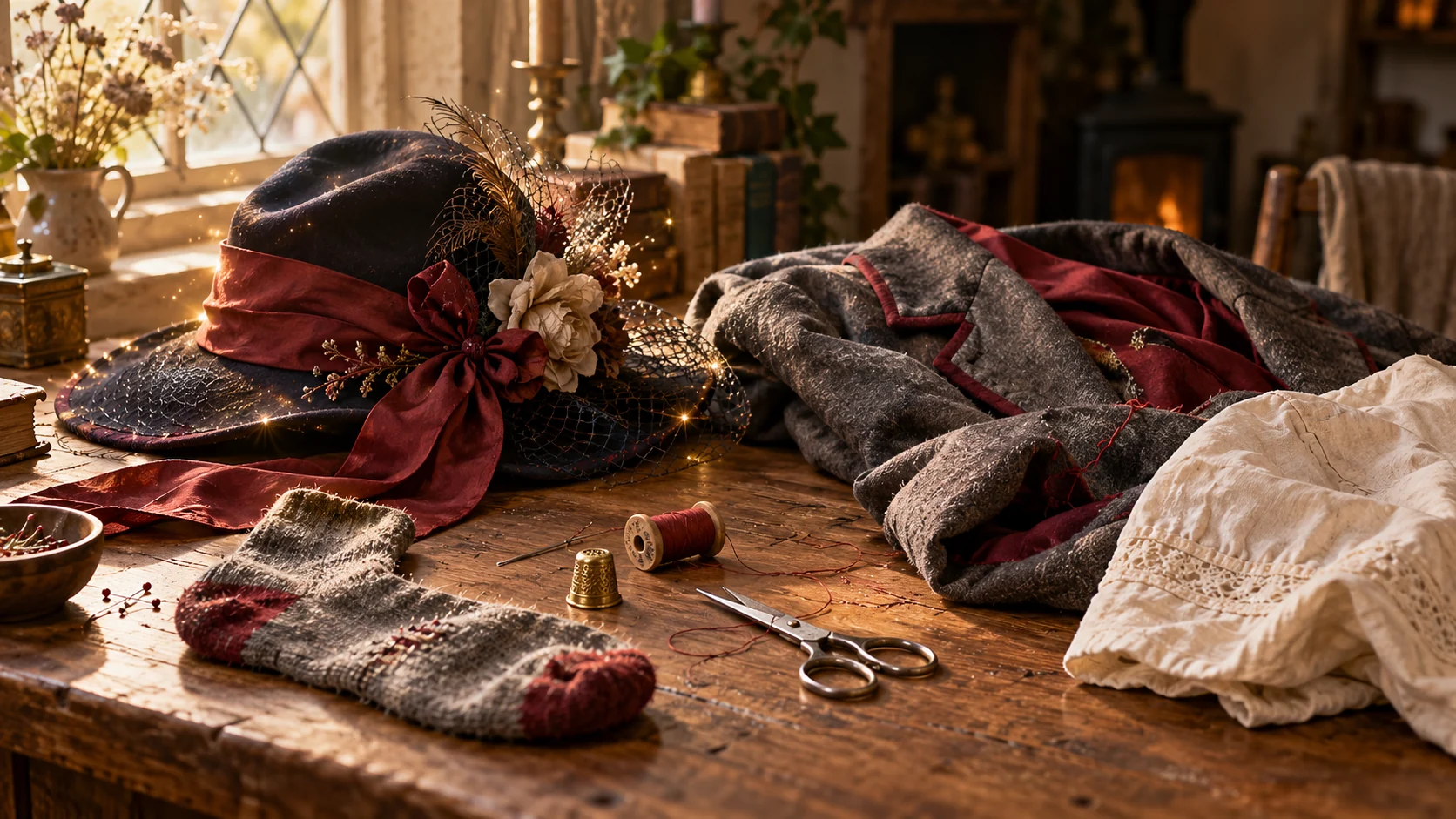
Sophie Hatter spends a good deal of her early life sewing roses onto bonnets. She lines hats with silk, arranges ribbons and talks to her work because there is nobody particularly interesting to talk to in the hat shop. It is a modest occupation for someone living in a country where seven-league boots and cloaks of invisibility are perfectly real possibilities. Sophie has no idea that she is doing magic.
Somewhere in a very different fantasy world, a house-elf named Dobby is forbidden to receive so much as a sock. He can perform astonishing magic of his own, but a piece of clothing from his master would change his circumstances more completely than any spell he casts.
Diana Wynne Jones’s Howl’s Moving Castle and J. K. Rowling’s Harry Potter and the Chamber of Secrets approach magic from very different directions. Yet both give ordinary clothing a peculiar amount of power. A hat can acquire a little of its maker’s intentions. A repaired suit can interfere with somebody else’s romantic prospects. A dirty sock can end a life of servitude.
Sophie Hatter, an extraordinarily ordinary hatter
Sophie isn’t particularly thrilled with her future. As the eldest of three sisters, she believes that she is destined to be the least successful, and circumstances seem determined to agree with her.
Her younger sisters are sent out to pursue their fortunes. Sophie remains at the family hat shop in Market Chipping, working under her stepmother, Fanny. She knows the business, understands the materials and is perfectly capable of the work. None of this makes her especially happy.
In Chapter 1 of Howl’s Moving Castle, Jones gives her a small alcove at the back of the shop, where she spends her days trimming hats. Millinery trimming is the skilled work of adding decoration to a hat, rather than shaping its basic form. As Heritage Crafts explains in its account of millinery, trimming is a distinct technique, and the trade includes specialist work with fabric flowers, feathers and veiling.
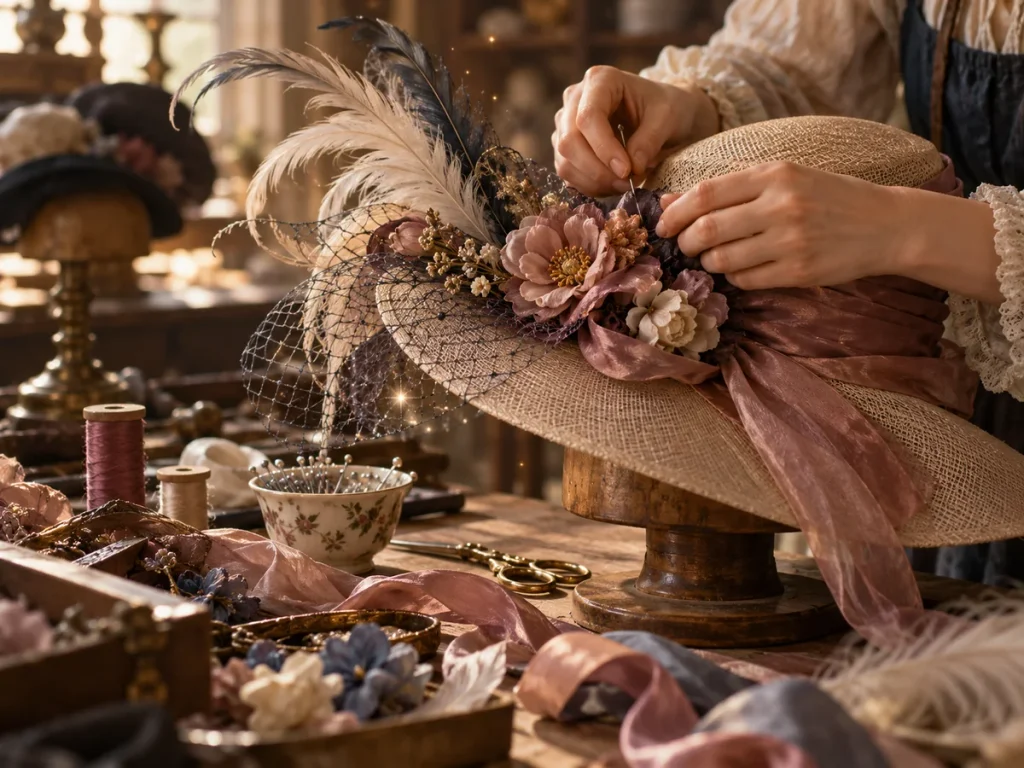
Sophie does rather a lot of it. There are silk linings to sew, flowers to arrange and bonnets to prepare for customers. When business becomes particularly busy, she continues working into the evening. She also talks to the hats.
These conversations begin as a way of entertaining herself. She gives the hats personalities, compliments them and imagines the sort of futures their wearers might enjoy. It is an excellent habit for a lonely young woman and a potentially alarming one for a business whose customers expect an ordinary purchase.
As the novel develops, Sophie realises that some of the hats have influenced the lives of the people who bought them. Her words have been doing more than keeping her company.
There is something wonderfully unfair about this. Sophie has a gift capable of changing other people’s fortunes while remaining convinced that her own fortune has already been decided. She can imagine a future for a hat more readily than she can imagine a different future for herself.
Those carefully chosen decorations are already products of skill, time and taste. Now the finished hats can carry something their maker never meant to sell.
A customer might admire the roses or the silk lining. She has very little reason to suspect that the woman who stitched them has been talking to her new hat.
The suit that was enchanted in the mending
The contrast between Sophie’s work and Howl’s magic becomes especially sharp when a sleeve tears.
Sophie has been vigorously cleaning Howl’s castle, much to his irritation. Their argument eventually drives him to retreat towards the house, and his trailing blue-and-silver sleeve catches on a piece of rusty metal.
It tears. Sophie offers to mend it.
Howl regards her offer with disbelief, then takes the damaged sleeve between his fingers and draws the fabric through them. The tear disappears. No needle, thread or even a particularly difficult spell is required.
Jones gives Sophie a wonderfully deflating realisation:
“Wizards clearly had no need to work in the ordinary way.”
Howl has just demonstrated that he can repair a garment without doing any of the work Sophie would ordinarily perform. He can restore the cloth while she would still be locating her thread. From his perspective, her offer appears unnecessary. Yet he soon gives her more sewing.
After Sophie settles into the castle, she finds Michael’s clothes in need of attention and takes out her thimble, scissors and thread. Howl eventually provides her with an old grey-and-scarlet suit to mend, too.
Magic has not eliminated the household’s ordinary labour. Howl can dispense with it when he likes, while Sophie is still expected to spend time on it.
The arrangement is particularly irritating because Sophie is considerably less powerless than either of them understands.
When Howl gives her the suit in Chapter 6, she comments on its appearance, remarking that it seems designed to attract women. She is speaking to another garment as casually as she spoke to the hats.
Later, Mrs Pentstemmon, Howl’s former teacher, examines the suit and discovers an attraction charm. She recognises powerful magic apparently worked into the darned seams and is deeply concerned that Howl may be using such enchantments to influence women.
Darning is a repair technique in which threads are worked across a damaged area to replace or reinforce the missing fabric. It requires patient, controlled stitching. Sophie has supplied both the stitching and, without realising it, the enchantment.
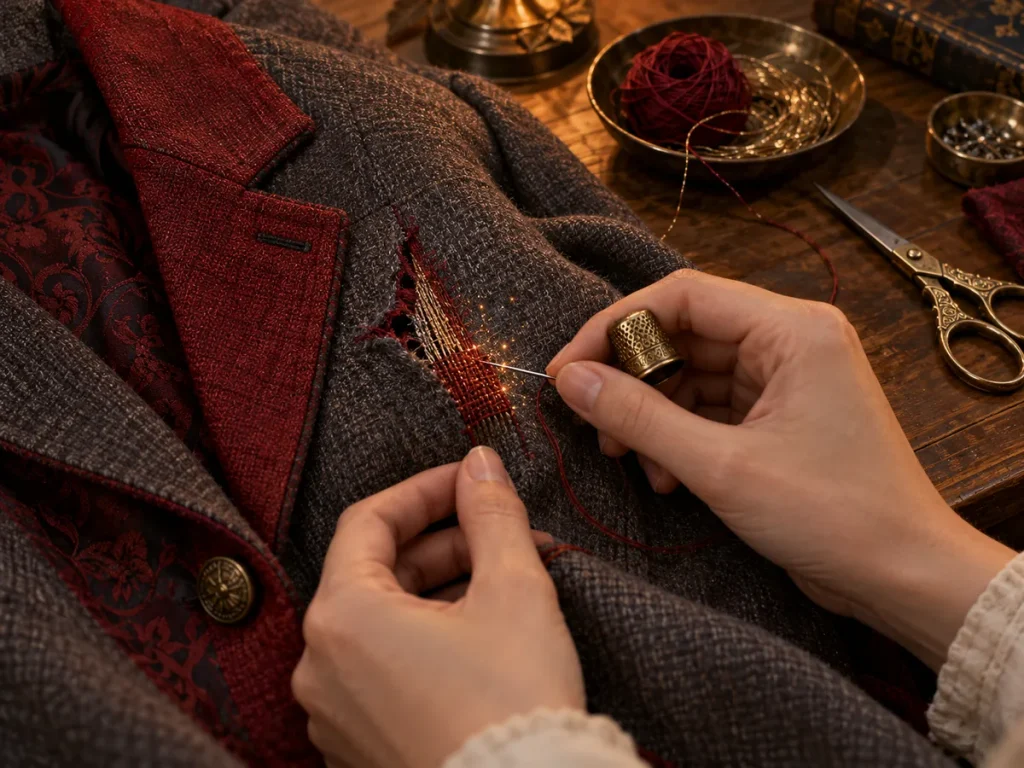
Mrs Pentstemmon initially treats the charm as evidence of Howl’s magical misconduct. During the encounter in Chapter 12, Sophie comes to recognise that she herself put it there.
Howl is the famous wizard, and the suit belongs to him. Of course an expert assumes he must be responsible for the magic.
Sophie is standing there having done the work.
The attraction charm also complicates the ordinary function of clothing. A handsome suit already influences how its wearer is received. Colour, fit, condition and fashion all affect the impression somebody makes. Howl is hardly indifferent to these matters. His appearance receives an amount of attention that would embarrass a more restrained man, though I suspect embarrassment is something he has long since mislaid.
Sophie’s charm makes that influence supernatural. The suit can affect the people who encounter its wearer, and its supposed attractiveness is no longer simply a matter of taste.
She is horrified when she understands what she has done. Her answer, eventually, is to take a pair of scissors to the grey-and-scarlet suit and cut it into seven pieces.
It is a marvellously physical response to a magical problem. Having produced an enchantment through ordinary work, Sophie tries to frustrate it through ordinary destruction.
Howl can repair cloth almost without thinking. Sophie has been making magic while thinking she is merely repairing cloth. Neither has properly understood what her work is worth.
Why Dobby is forbidden proper clothes
When Harry first encounters the house-elf, Dobby wears an old pillowcase. It is a strikingly miserable garment, and Harry eventually asks why he wears it.
The explanation arrives during Dobby’s visit to the Hogwarts hospital wing in Chapter 10. The pillowcase marks his enslavement. House-elves in his position can be freed if their masters give them clothing, and the Malfoy family takes care to prevent that from happening.
They are so careful that even giving Dobby a sock would be dangerous to their ownership of him.
Dobby possesses magical abilities that human witches and wizards cannot necessarily reproduce in the same way. He can appear and disappear in places where their movement is restricted, and he can intervene in events using his own magic. None of these abilities gives him the freedom to leave his masters.
Clothing becomes part of the machinery of control, and Dobby’s pillowcase makes the inequality visible before he explains it. The Malfoys’ fine clothes are ordinary possessions; what Dobby is forced to wear marks his lack of choice.
The sock Lucius Malfoy throws away
By the time Harry encounters Lucius Malfoy at the end of Chamber of Secrets, he understands the rule that Dobby explained earlier. He also has Tom Riddle’s ruined diary.
In Chapter 18, Harry asks Dumbledore for permission to return the diary to Malfoy. Then he removes his own filthy sock, puts the diary inside it and hurries after Malfoy and Dobby.
The choice of garment is almost offensively ordinary. Harry has not acquired a rare enchanted textile or performed a difficult piece of spellwork. He has removed something from his foot that, after his adventures in the Chamber, would be better acquainted with a washing machine.
Malfoy accepts the bundle, discovers the diary inside and angrily throws the sock away.
Dobby catches it.
Malfoy, furious at being confronted with the diary, handles the sock without considering the consequence.
His immediate response is possessive anger. He understands that Harry has arranged for him to lose someone he considered his property. Dobby, meanwhile, understands that he no longer belongs to the Malfoy family.
Sophie unintentionally enchants a garment through words spoken while she works. Harry deliberately exploits an established magical rule through the ordinary handling of a garment. In both cases, the person whose actions matter most is someone the apparent authority in the scene has underestimated.
But Dobby’s sock means something more immediate than an attraction charm. Sophie can regret what she did to Howl’s suit and attack it with scissors. Dobby has been waiting for the right to decide what happens to himself.
Once Malfoy has gone, Harry and Dobby speak for a little longer. Harry has questions, and Dobby begins answering them.
All the while, the house-elf is pulling Harry’s filthy sock onto his foot with shaking hands.
Leave a Reply