There are plenty of ways to establish who somebody is in Pride and Prejudice. Jane Austen generally manages it with a few sentences of conversation and an alarming amount of social observation. Film and television have another advantage: they can tell us something before a character has opened their mouth. Consider the clothes.
The BBC’s 1995 adaptation and Joe Wright’s 2005 film both distinguish the Bennets from their wealthier acquaintances, and the fashionable from the decidedly settled. Yet they take different approaches. Dinah Collin’s costumes for the television series frequently express character through fabric, colour and ornament within a broadly shared Regency fashion. Jacqueline Durran’s designs for the film also draw on clothes belonging to different years.
Between the late 1790s and the early 1810s, the high waist remained fashionable while skirts, sleeves and trimming changed around it. A dress could make an impression through its expense, its cut or simply how recently its owner had acquired it.
Start with the waistline
If you want to work out roughly when an early nineteenth-century dress was fashionable, begin by finding its waistline.
On a modern dress, we generally expect the waist seam to sit somewhere near the body’s natural waist. By the end of the eighteenth century, fashionable women’s gowns increasingly placed it much higher, immediately beneath the bust. The resulting silhouette became closely associated with Regency fashion.
It is tempting to use that raised waist as a quick way of identifying an 1813 dress. Unfortunately, women had already discovered the idea considerably earlier.
Compare these two fashion plates from the Journal des Dames et des Modes, preserved by the Rijksmuseum: one dated September 1797 and another dated June 1813.
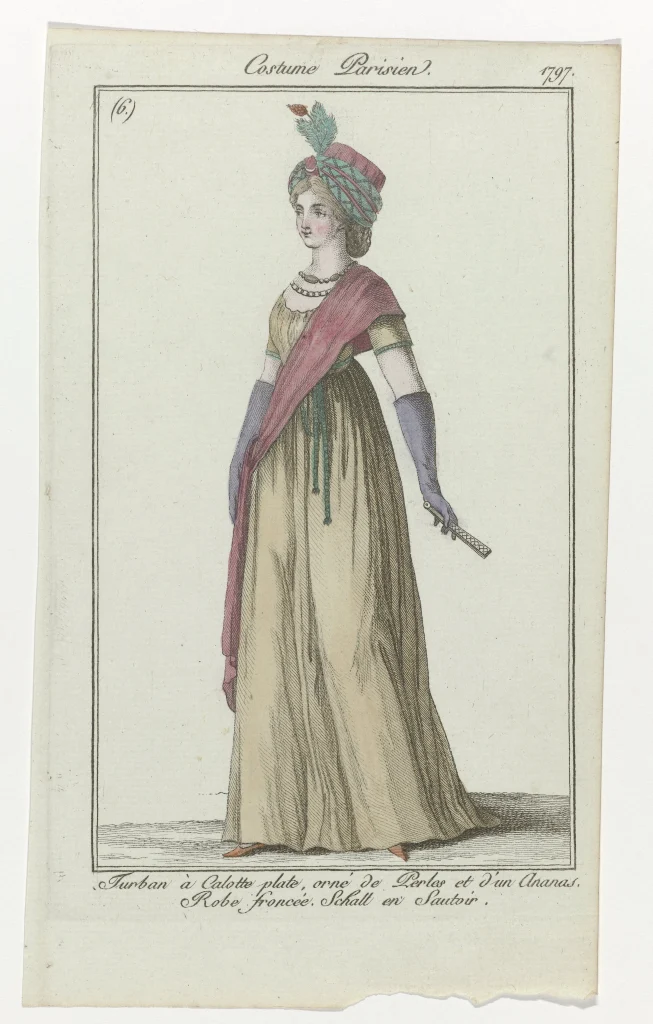
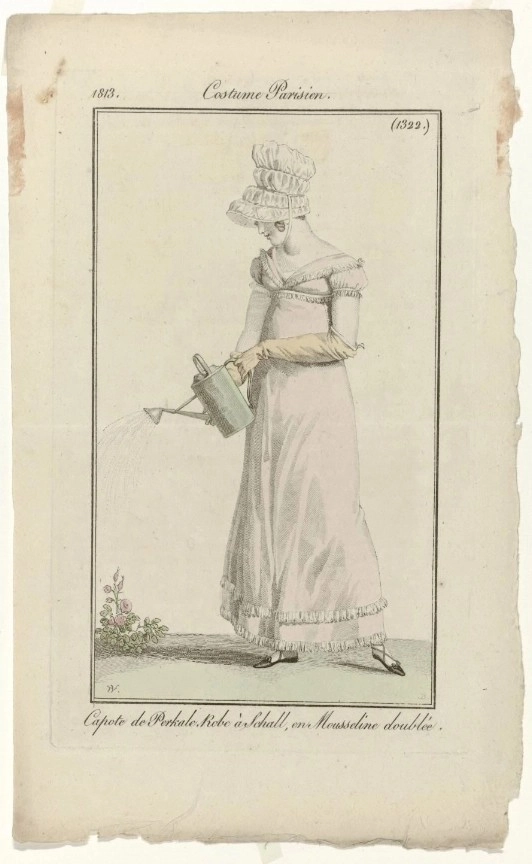
Both belong to a world in which the waist has moved upwards. The earlier figure wears a gathered, short-sleeved dress with a long shawl crossing her chest diagonally, while the later example has short puffed sleeves decorated with fringe. Sixteen years have passed, yet the two women would hardly look like visitors from different centuries if they encountered one another.
Look beyond the waist, however, and the changing fashion becomes easier to follow. According to the Museum at FIT’s Fashion History Timeline, the narrow, relatively straight skirts fashionable around the turn of the century gradually developed greater width and a more angular shape during the 1810s. Bodice construction changed too, while sleeves and decorative trimming became increasingly elaborate.
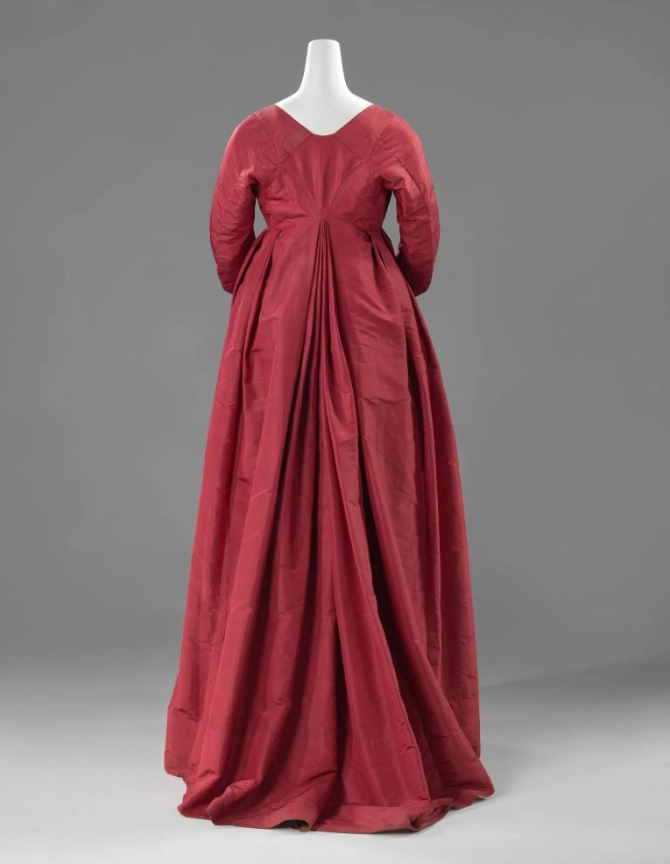
Surviving dresses make the construction easier to understand. The Rijksmuseum holds a red silk gown dated approximately 1790–1810 with a lozenge-shaped back panel: a diamond-shaped section of the gown’s back, emphasised by contrasting ornamental stitching.
Another gown, dated approximately 1811–1815, is made from blue-and-white checked cotton. Its catalogue describes twisted cotton cords decorating the neckline and cuffs, together with drawstrings running through narrow fabric casings in the skirt. A casing is a stitched channel through which a cord can pass, allowing the fabric to be gathered or adjusted.
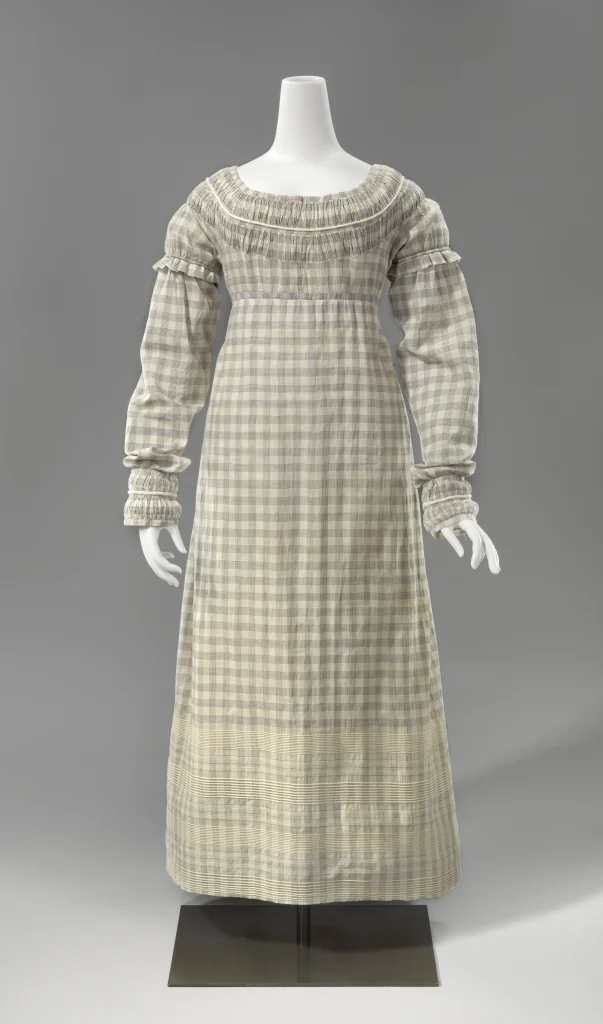
The second dress might look relatively plain at first glance, but somebody has put considerable work into its details. These garments also remind us how much construction lies beneath a fashionable silhouette. The difference between stays, corsets and bodices deserves its own explanation; for dating these dresses, the visible cut provides our starting point.
The 1995 Bennets: five sisters, five wardrobes
One of the pleasures of the 1995 Pride and Prejudice is that the Bennet sisters look as though they belong to the same household without having been issued matching outfits.
In dress historian Hilary Davidson’s examination of the production, published by Jane Austen’s House, she describes how costume designer Dinah Collin used differences in dress to establish the sisters’ personalities.
Elizabeth frequently wears warm, earthy colours. Jane’s clothes are quieter and elegant. Lydia’s necklines sit noticeably lower than Mary’s, which tend towards the opposite extreme. Even Kitty’s garments are slightly less fine than Lydia’s.
These distinctions are wonderfully economical. Mary does not need a scene explaining that she takes herself seriously when her clothes have already made an announcement on the subject. Lydia, meanwhile, is clearly unwilling to be confused with her older sister.
Their garments retain a family resemblance because the women share a social position and household. The contrast sharpens whenever the Bingley sisters appear. Collin clothes the wealthier women in richer colours, silks, feathers and jewellery, establishing a visual difference between their money and the Bennets’ comparatively modest country-gentry circumstances.
There is a historical complication here. Davidson points out that fine imported white muslin could be as expensive as silk. A comparatively plain gown was therefore perfectly capable of advertising wealth to someone who understood its quality.
Television has less time to explain the price of muslin. It can, however, give Caroline Bingley an elaborate silk dress and an impressive quantity of jewellery. The audience understands the distinction immediately.
Caroline Bingley wears the present
Caroline Bingley has money and takes considerable care that everybody notices.
The 2005 film gives Caroline another advantage: she is allowed to dress ahead of the people around her. In Focus Features’ production notes, director Joe Wright explains the decision he made with costume designer Jacqueline Durran to favour fashions associated with the period around 1797, when Austen was working on the novel’s earlier form, First Impressions, rather than the fashions of its 1813 publication. Caroline, he explains, would wear the latest fashionable creation.
Being fashionable requires more than possessing expensive things. It requires knowing which expensive things are currently desirable, obtaining them and being seen in them. Her clothes have something to prove.
Mrs Bennet has had those dresses for years
Mrs Bennet would certainly like her daughters to marry wealthy men. She is rather less concerned with achieving the latest fashionable silhouette herself.
The 1995 adaptation gives her an abundance of caps, frills and fussy accessories. Davidson identifies these details as a way of expressing her particular personality: a woman who can make even an otherwise respectable outfit appear excessively busy.
In Wright’s 2005 film, the distinction reaches further into the age of the clothes. He explains that Mrs Bennet’s dresses belong to fashions earlier than 1797.
The dates attached to fashion plates describe what was being presented as fashionable at a particular moment. They do not tell us the age of every garment hanging in somebody’s wardrobe. Clothes could survive changes in taste, and they could also be altered to accommodate them.
The London Museum records a silk dress in a style dating to approximately 1796–1800 that appears to have been remodelled from a gown and underskirt made around 1780. The older fabric had been given a newer shape, rather than simply preserved as an unchanged dress.
Mrs Bennet’s priorities lie elsewhere. With five unmarried daughters and a house that will not pass to them, there are rather more urgent subjects occupying her attention than the position of a waist seam.
Lady Catherine has no need to keep up
If Caroline Bingley dresses to demonstrate her place in fashionable society, Lady Catherine de Bourgh hardly needs the assistance.
Wright pushes her clothing further into the past than Mrs Bennet’s. Caroline must keep demonstrating that she belongs among the fashionable. Lady Catherine has already decided where everybody belongs, and she is generally quite prepared to tell them.
In the 1995 series, Davidson describes a woman whose garments are less immediately fashionable but immensely expensive. She identifies silk velvet, handmade lace and a fur tippet — a small shoulder covering — among the garments and accessories associated with Lady Catherine.
These are not the clothes of somebody struggling to maintain an appearance of importance.
Leave a Reply