Spoiler warning: This article discusses Myrtle Snow’s return in American Horror Story Season 13, episode 11, “Madison’s Happy Ending”.
Myrtle Snow has been sent to Hell, and somebody has decided that the appropriate punishment is a permanent job at JCPenney.
In the eleventh episode of American Horror Story: 13, Ben DeSoto discovers her working in a department store in Branson, Missouri. The customers are hopeless. One insists on buying an outfit Myrtle considers hideous. Another wants a headband. Someone else has decided that clip-on earrings are a good idea. Myrtle offers her expert opinion with increasing desperation, and not one of these people has the decency to take it.
According to TheWrap’s account of the episode, the punishment is specifically designed around her inability to influence anyone’s fashion choices. Eternal damnation, apparently, has a customer-service department.
At one point, Myrtle declares, “Fashion should never be practical or comfortable.”
A wonderful thing to say, and a thoroughly stupid thing to believe. I will happily defend an inconvenient garment when its beauty justifies the trouble. I draw the line at pretending discomfort is proof of artistic merit. A shoe that makes walking miserable hasn’t achieved some higher form of elegance. It has made walking miserable.
Still, the scene gets something important about Myrtle exactly right. She doesn’t merely enjoy clothes. She has opinions about them so powerful that being forced to watch other people dress badly constitutes torture.
Having returned to Coven, I can understand why.
A wardrobe that has never quite left the 1970s
Myrtle’s wardrobe contains an almost unreasonable amount of fabric. Long skirts, patterned blouses, enormous scarves, gloves, lace and extravagant outer layers seem to accumulate around her. Where most of the witches in Coven favour black, Myrtle treats black as a useful background against which something much louder can happen.
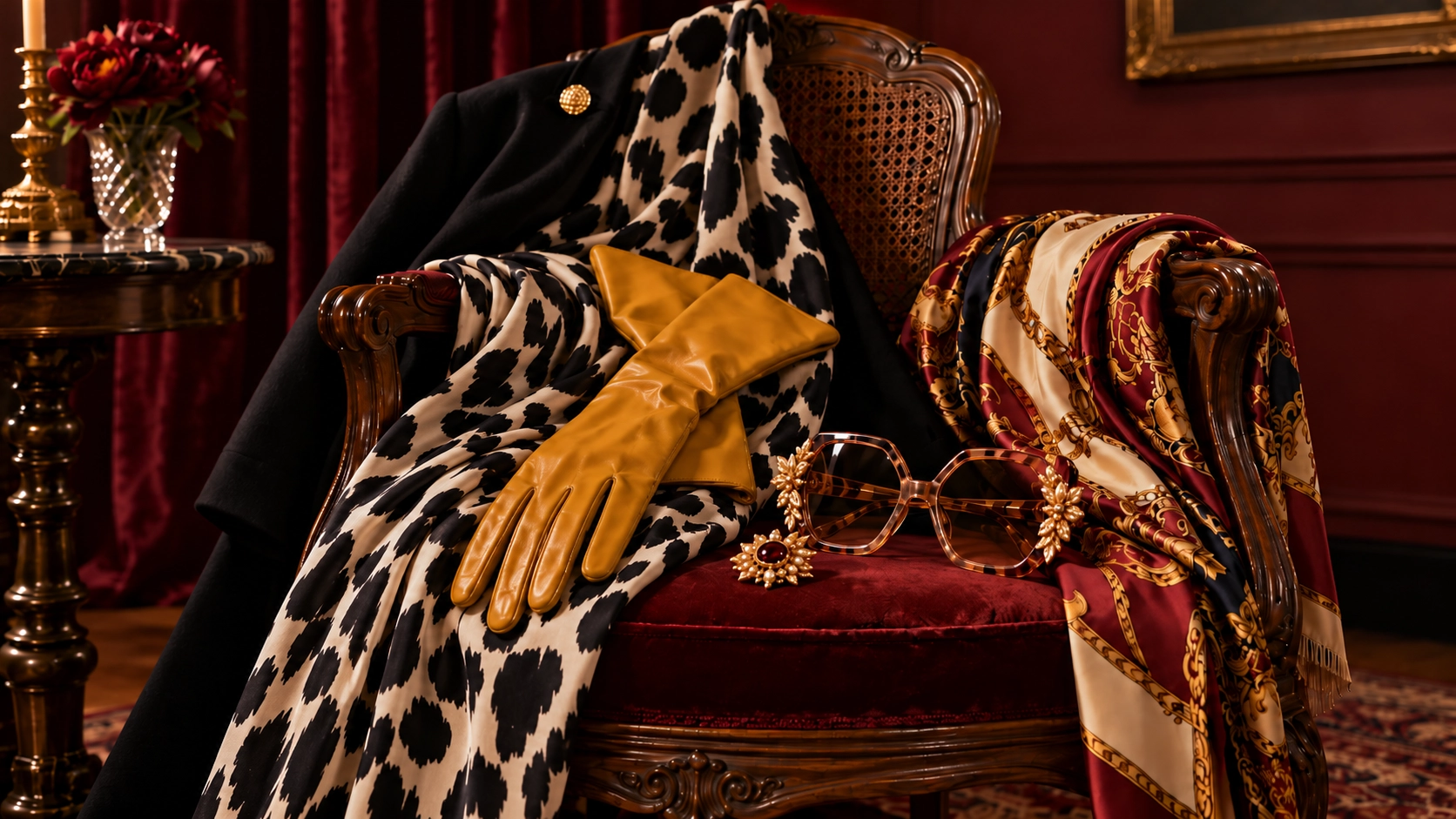
The clearest example is her black-and-white spotted outfit with bright yellow leather gloves, photographed in TV Ate My Wardrobe’s January 2014 feature. The dark outer layer establishes a fairly severe outline, while the spotted fabric gives it movement and interest. Then the gloves arrive and make the entire arrangement considerably less respectable.
They are excellent gloves.
Their colour is doing real work. Against the black and white, the yellow is unmistakable, and because it appears on her hands, it becomes conspicuous whenever she gestures. I would probably have bought those gloves myself and subsequently discovered that I owned nothing quite suitable to wear with them. Myrtle would have regarded that as a failure of the remaining wardrobe.
The original design was deliberate. In a 2018 interview with W Magazine, costume designer Lou Eyrich explained that Ryan Murphy imagined Myrtle as a woman who had been dressing the same way since high school. The costume team began with maxi skirts — skirts extending towards the ankle or floor — then layered patterns, gloves and lace around them.
Eyrich also told Vanity Fair in 2014 that Murphy had asked for a more eccentric character, without allowing the clothing to become silly.
That distinction is important. Myrtle’s clothes would be much less interesting if everything were simply enormous. Their success depends upon the relationship between the pieces: a long, recognisable silhouette beneath the changing patterns; controlled areas of dark colour interrupted by something vivid; elaborate neckwear balanced against a comparatively plain outer layer.
Sometimes the outfit becomes rather crowded. Patterned fabric, dramatic jewellery, bright gloves and a substantial scarf can all make a legitimate claim to attention, but they cannot all be the most important object in the room. Myrtle occasionally looks as though she has accepted every invitation to a party and brought every hostess a present.
I still admire the overall result. Her taste has recognisable habits. Even the most eccentric outfit looks like something she chose for herself.
When the witches returned in Apocalypse, Eyrich and co-designer Paula Bradley searched for surviving costumes from Coven, though they could not recover everything. The character’s distinctive wardrobe survived the transition regardless. More recently, Eyrich confirmed during an October 2026 New York Comic Con costume panel that Myrtle’s scorpion pin was one of the original pieces reused for Season 13.
There is something rather satisfying about a character so resistant to changing her style having an actual accessory survive across productions.
Gloves, spectacles and jewellery that demand an audience
Myrtle understands the value of an accessory better than almost anybody in American Horror Story.
The spectacles are emphatic, the gloves rarely anonymous, and her scarves have little interest in lying quietly around her neck. Even when the clothes beneath are comparatively restrained, some accessory usually insists that the outfit has unfinished business.
Myrtle’s jewellery, however, is as much an expression of her taste in designers as it is a part of her appearance.
In Coven, episode 11, “Protect the Coven”, she offers Zoe what she describes as her only valuable possession: a sapphire-and-topaz harvester ant commissioned from Joel Arthur Rosenthal. She also announces that only Lee Radziwill or herself could do it justice.
Poor Zoe. Apparently even borrowing an insect requires the correct social credentials.
There are two real fashion references here worth understanding.
JAR is the name used by Joel Arthur Rosenthal, an American-born jeweller working in Paris. His designs frequently take inspiration from flowers, insects and other natural forms, often using unusually vivid combinations of gemstones.
The Metropolitan Museum of Art’s 2013 exhibition, Jewels by JAR, explains his use of pavé setting: small stones placed so closely together that they form an almost continuous jewelled surface. Carefully graded colours can make those surfaces appear surprisingly painterly.
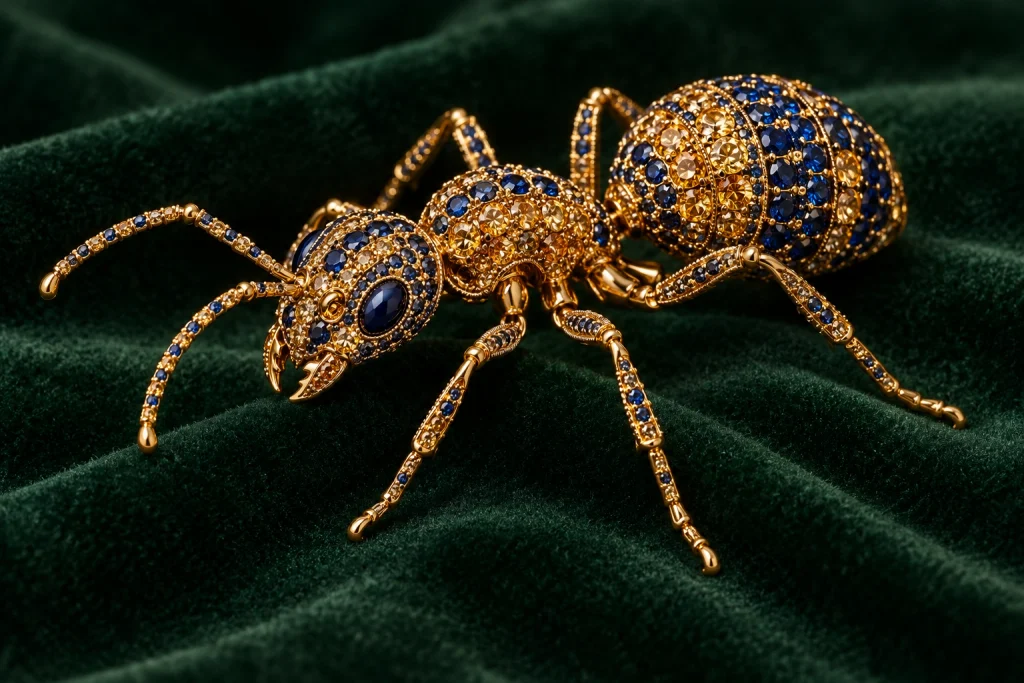
That is rather more interesting than simply calling something expensive jewellery. The attraction is in the intricacy of the work and the unexpected treatment of an ordinary natural form. An ant is hardly the most conventional inspiration for a precious ornament, although I can see why Myrtle would prefer one to a tasteful little diamond pendant.
Then there is Lee Radziwill, the American socialite, interior decorator and younger sister of Jacqueline Kennedy Onassis. As British Vogue records in its retrospective of her clothes, Radziwill was admired for her polished, carefully controlled personal style.
That makes Myrtle’s remark rather funnier. Radziwill’s elegance often depended upon restraint, while Myrtle’s own jewellery philosophy appears to favour precious insects capable of stopping conversation.
The two women have very different visual instincts. Myrtle recognises in Radziwill someone with sufficient confidence to wear an extraordinary object without being overwhelmed by it.
It is one of her more sensible judgements.
Diane von Furstenberg, Halston and the limits of Myrtle’s good taste
In that same Coven conversation with Zoe, Myrtle recalls a romance with Egon von Furstenberg. She has very little bitterness about having been abandoned, because Egon subsequently married Diane von Furstenberg, whose creation of the wrap dress Myrtle considers the greatest invention of the century.
The autobiography may be fictional, but the dress is real.
Diane von Furstenberg introduced her signature wrap dress in 1974. Its defining construction is straightforward: one front panel crosses over the other and the garment fastens with a tie at the waist, allowing the wearer to adjust the fit. The original became particularly associated with printed jersey, a knitted fabric with enough give to move comfortably with the body.
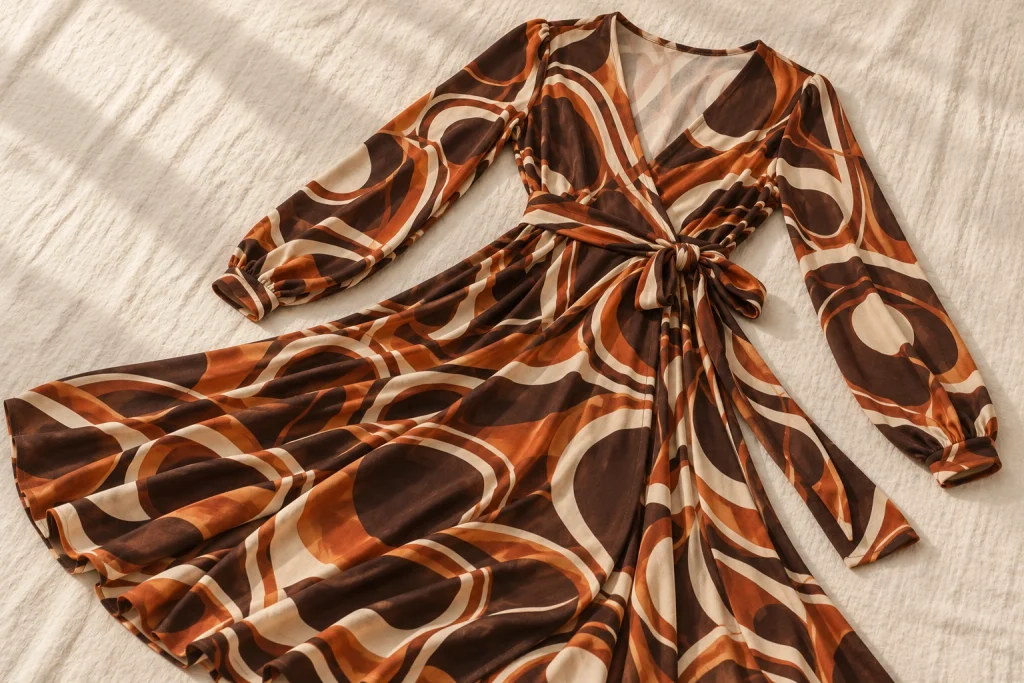
It was attractive, practical and comparatively uncomplicated to wear. The DVF brand’s own history identifies ease of movement and everyday functionality as central to the dress’s appeal.
Which makes Myrtle’s later declaration about fashion never being comfortable rather difficult to defend. Her favourite invention is celebrated partly because it allows somebody to get dressed without an assistant, a complicated fastening system or a minor injury.
I like the wrap dress enormously as a design achievement. It gives the waist definition without requiring a rigid structure, uses fabric movement rather than excessive construction, and accommodates different degrees of formality through material and print. Its elegance survives ordinary activity. Myrtle, when she is admiring Diane, appears to understand this perfectly.
Her opinion of Halston, however, is much less generous.
In Coven, episode 12, “Go to Hell”, Myrtle criticises Zoe for returning to the Academy by comparing her decision to Halston’s relationship with JCPenney. She accuses him of having sold his brand to the department store and abandoned his destiny.
This is fashion snobbery with an historical error attached.
Roy Halston Frowick, known professionally as Halston, was an enormously influential American designer whose clothing helped define a particular form of relaxed 1970s glamour. His designs frequently used fluid fabrics, clean lines and clever draping — the arrangement of cloth into a garment’s shape rather than relying entirely upon rigid tailoring.
He had already sold his business to the Norton Simon conglomerate in 1973. His separate licensing agreement with JCPenney was signed in 1982, and the more affordable Halston III collection launched in June 1983.
Those dates are established by contemporary reports in The Washington Post: Nina Hyde covered the newly signed agreement in September 1982, while Kathleen Sterritt reported on the collection’s launch in June 1983.
The commercial consequences were real. Luxury department stores objected to the association with a mass-market retailer, and Halston’s name subsequently became entangled in increasingly difficult corporate arrangements. Vogue‘s history of the designer documents that decline.
Yet Myrtle’s implication that the JCPenney agreement was inherently a disgrace deserves resistance.
Halston wanted to make his designs available to a larger public. In the 1982 Washington Post interview, he discussed clothing that could work for ordinary activities and different parts of everyday life. The aim was an accessible wardrobe with recognisable design principles.
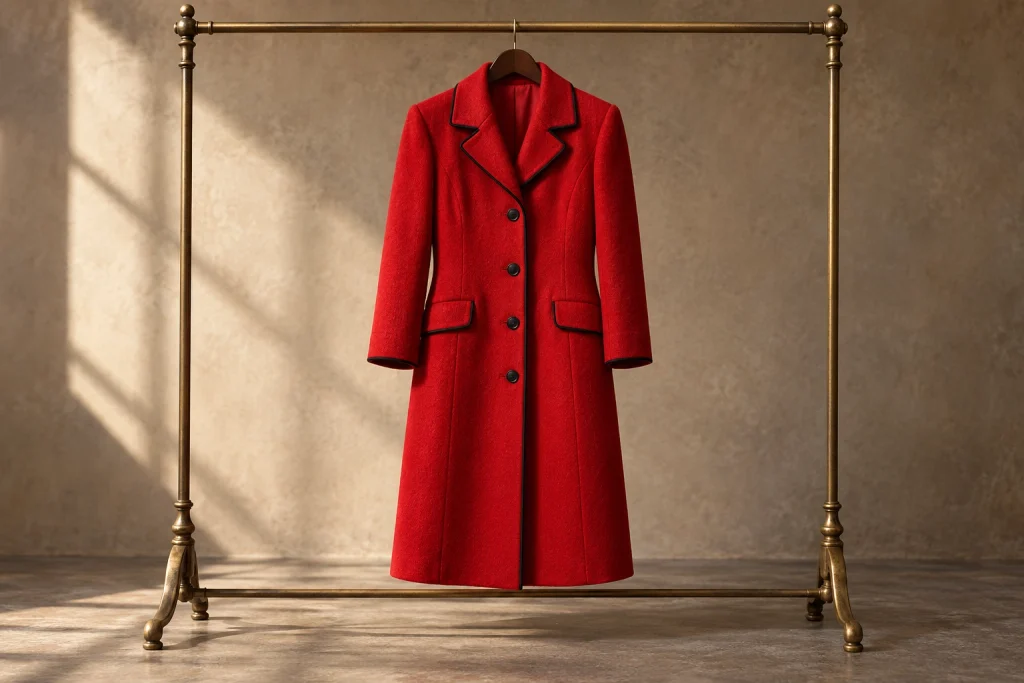
Sterritt’s contemporary review of Halston III even singled out some attractive-sounding garments: red wool coats with black piping — narrow fabric trim that follows an edge or seam — alongside well-cut trousers, blazers and knitwear.
I would quite happily examine one of those red coats. Black piping against red wool can give a simple garment a very precise outline. It is a design detail worth judging on its own merits, regardless of whether the label once sat in an expensive shop.
Myrtle seems to regard accessibility as evidence of aesthetic surrender. I cannot agree. A beautifully designed coat does not become ugly because its purchaser lacks a sufficiently distinguished address.
And there is an especially delicious consequence to her hostility. In Season 13, after all her contempt for Halston’s commercial decision, Myrtle finds herself condemned to spend eternity working at JCPenney.
I cannot establish that the writers intended this as a callback to her earlier speech. I hope they did. It is an unusually specific form of poetic justice.
Tom Ford’s Gucci and Rei Kawakubo: Myrtle hasn’t stopped paying attention
Myrtle’s own wardrobe is firmly attached to an earlier aesthetic, but her fashion references are not confined to one decade.
Season 13 gives us two particularly revealing examples.
While suffering through her department-store punishment, Myrtle fantasises about Tom Ford-era Gucci. Later, when Ben offers to take her anywhere, she requests a front-row seat at a Rei Kawakubo Comme des Garçons fashion show, preferably with Victoria Beckham beside her.
These choices reveal considerably more than another speech about the importance of taste.
Tom Ford became Gucci’s creative director in 1994 and remained until 2004, as confirmed by the Council of Fashion Designers of America. His Gucci collections became famous for a sleek, provocative form of glamour: satin shirts, sumptuous velvet tailoring, low-slung trousers and a confidence that could make a remarkably simple ensemble look almost indecently expensive.
British Vogue‘s account of Ford-era Gucci explains that appeal through the tension between polished construction and deliberately sensual styling.
I can understand Myrtle’s admiration, although her own approach is considerably more decorative. Ford’s strongest Gucci outfits often depended on stripping the composition down to a few exquisitely judged pieces. Myrtle tends to arrive with several opinions about what else could be added.
Rei Kawakubo represents something more challenging still.
The Japanese designer founded Comme des Garçons and became celebrated for fashion that questions conventional silhouettes, proportions and even what a garment is supposed to be. Her designs can distort familiar forms, create sculptural shapes around the body or deliberately reject the usual requirements of flattering dress.
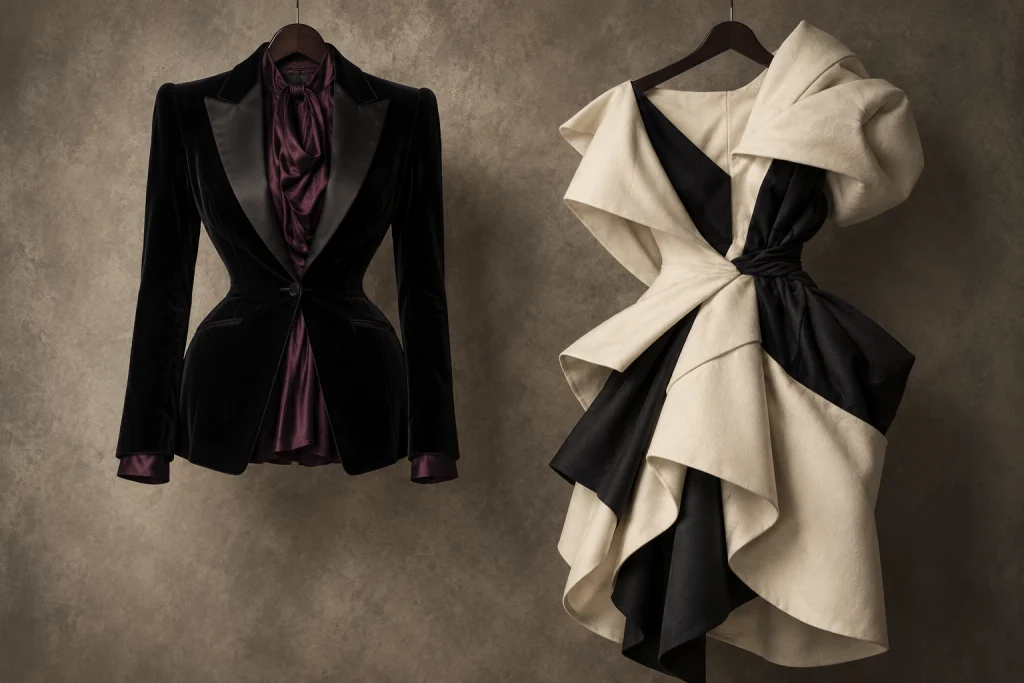
The Metropolitan Museum of Art’s 2017 exhibition, Rei Kawakubo/Comme des Garçons: Art of the In-Between, examined that work through contrasts such as fashion and anti-fashion, clothing and objects, presence and absence.
I find this a particularly interesting choice for Myrtle. Her own wardrobe contains plenty of eccentricity, but its foundation is usually quite recognisable: long skirts, blouses, coats, scarves and gloves. Kawakubo’s experiments can challenge the very forms Myrtle has spent her life arranging so extravagantly.
And she wants to be in the front row.
That gives her taste some welcome depth. She is capable of recognising an extraordinary fashion idea without needing to adopt its entire design language herself. A fixed personal wardrobe has not prevented her from following designers whose work looks very little like her own clothes.
Myrtle knows the names, recognises their different contributions and has formed opinions strong enough to outlast death.
The red gown and one final fashion reference
For all Myrtle’s elaborate everyday dressing, I think her finest outfit in Coven is one of her simplest.
At the end of “The Seven Wonders”, she prepares to be burned at the stake for the murders she has committed. She insists upon accepting the punishment, believing that Cordelia’s leadership must begin without the hypocrisy of excusing her.
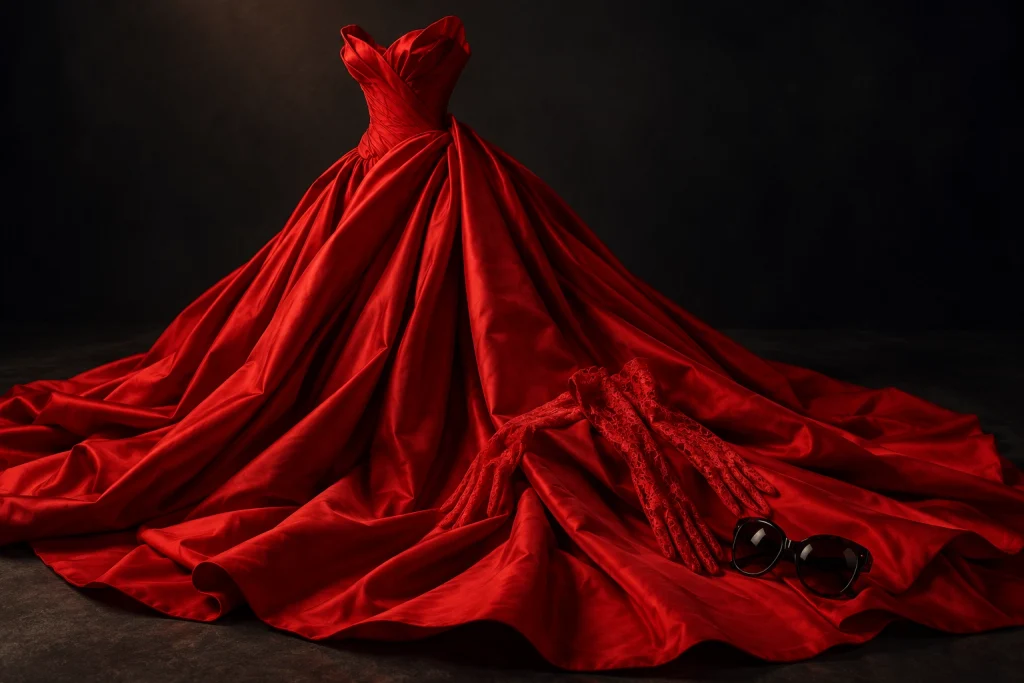
She wears a sweeping red gown, accompanied by red lace gloves and dark glasses.
The colour does almost everything.
Where an ordinary Myrtle outfit might contain several different prints and contrasting accessories, this one commits to a continuous expanse of red. The matching gloves extend the colour towards her hands, and the dark glasses supply a small, severe interruption.
It is wonderfully judged. The gown has enough volume to be theatrical, while the absence of competing patterns lets its silhouette and colour command the scene.
There is a grim appropriateness to the choice. Myrtle has already survived one burning, and now she intends to submit to another. Her dress is entirely deliberate. Even in a moment when she has relinquished control over her future, she has insisted upon deciding what she will wear.
It also contains one final joke about fashion.
Costume designer Lou Eyrich later told Glamour that the script’s final designer reference initially caused a problem. The costume team thought they needed a gown by the named fashion house, but the budget would not allow it. Ryan Murphy explained that the line was simply Myrtle being Myrtle.
They searched New Orleans for something sufficiently eccentric and eventually found the right dress online.
And so Myrtle stands before the flames, dressed for her own execution, and offers one final word:
“Balenciaga!”
The gown was Carolina Herrera.
Leave a Reply