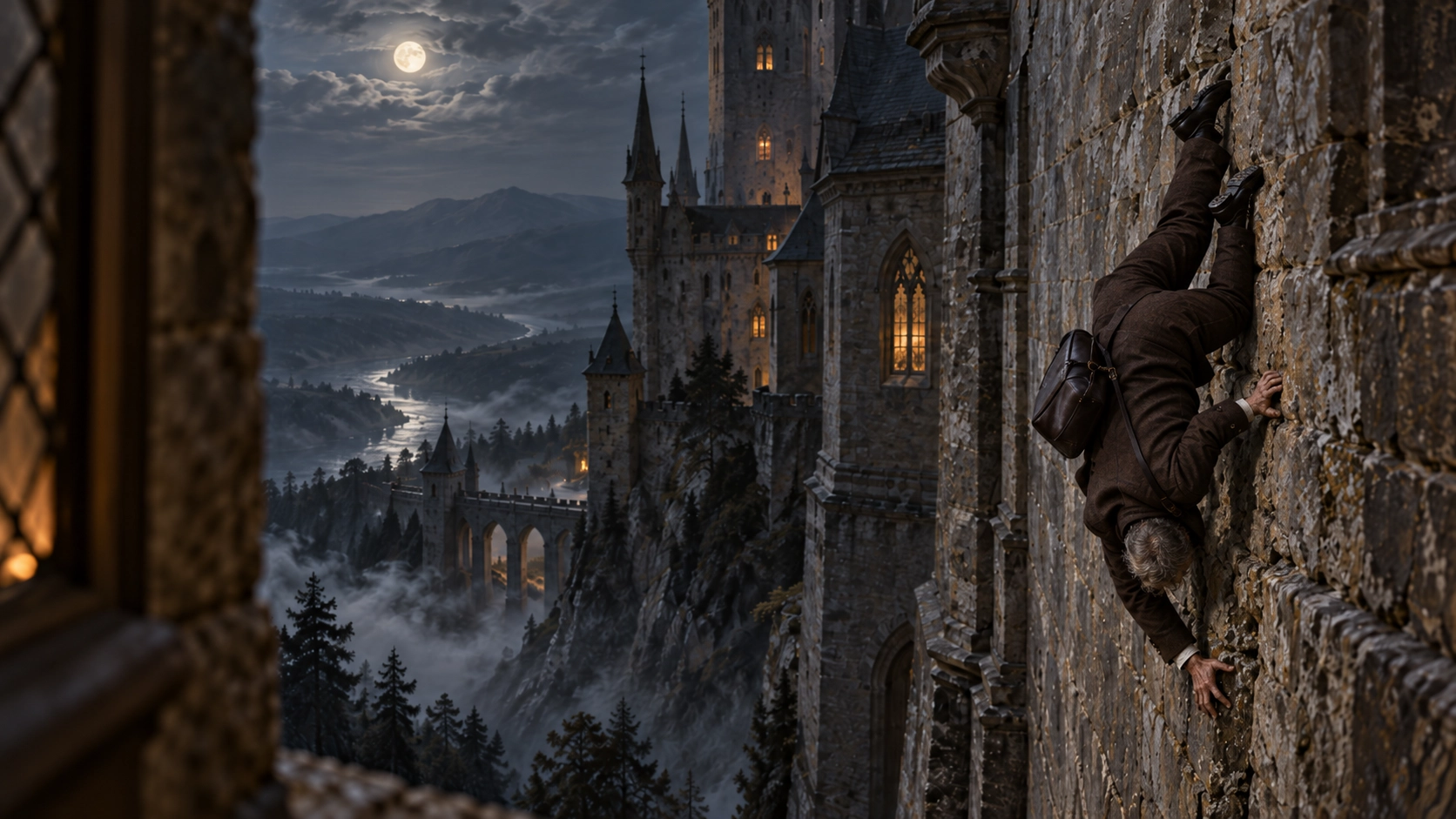
On 24 June, Jonathan Harker watches a figure emerge from a window of Castle Dracula and begin its descent down the wall. He recognises the clothes immediately. They are the travelling suit he wore on his journey to Transylvania.
The man inside them is Count Dracula. (Chapter IV.)
The Count wants to look ordinary
When Jonathan first arrives at the castle, Dracula is dressed entirely in black. Stoker describes a tall, elderly man with a white moustache, standing in the doorway holding a silver lamp. There is no elaborate evening suit, embroidered waistcoat or theatrical high collar. The black clothing is striking largely because it is so complete: Stoker notes the absence of even a speck of colour. (Chapter II.)
Dracula is an aristocrat accustomed to authority. In his own castle, he expects to be obeyed, and his appearance belongs to that position. But he is already planning a very different existence in England.
His library is full of books about English history, politics, customs and everyday life. He studies the language obsessively, asking Jonathan to correct even the smallest errors in his pronunciation. The Count knows that arriving in London with money and property will not automatically give him the position he enjoys at home.
“I am content if I am like the rest,” he tells Harker. (Chapter II.)
It is a revealing ambition from a man who has spent centuries being anything but ordinary. Dracula wants the freedom of passing unnoticed, without surrendering his sense of superiority. He is prepared to study English manners in considerable detail, apparently regarding a foreign accent as a more pressing problem than the fact that he has to sleep in a box of earth.
Clothing becomes part of the same concern with outward identity. Before Dracula can live among the English, he needs to understand how an Englishman presents himself. Conveniently, he has one staying in his castle.
Jonathan Harker’s clothes disappear
By 19 May, Jonathan understands that he is a prisoner. Dracula has required him to write three letters announcing his supposed departure: one saying his work is nearly finished, another that he is leaving, and a final letter claiming he has already reached Bistritz. The Count dictates their dates, ending with 29 June. (Chapter IV.)
Jonathan knows what this means. His friends and employer are being prepared to believe that he has left the castle, whether he manages to escape or not.
Then, on 31 May, he discovers that his belongings have been searched.
His papers have vanished: railway notes, memoranda, writing materials and his letter of credit. He examines his portmanteau — a travelling case used to carry clothes — and the wardrobe where he has stored his garments.
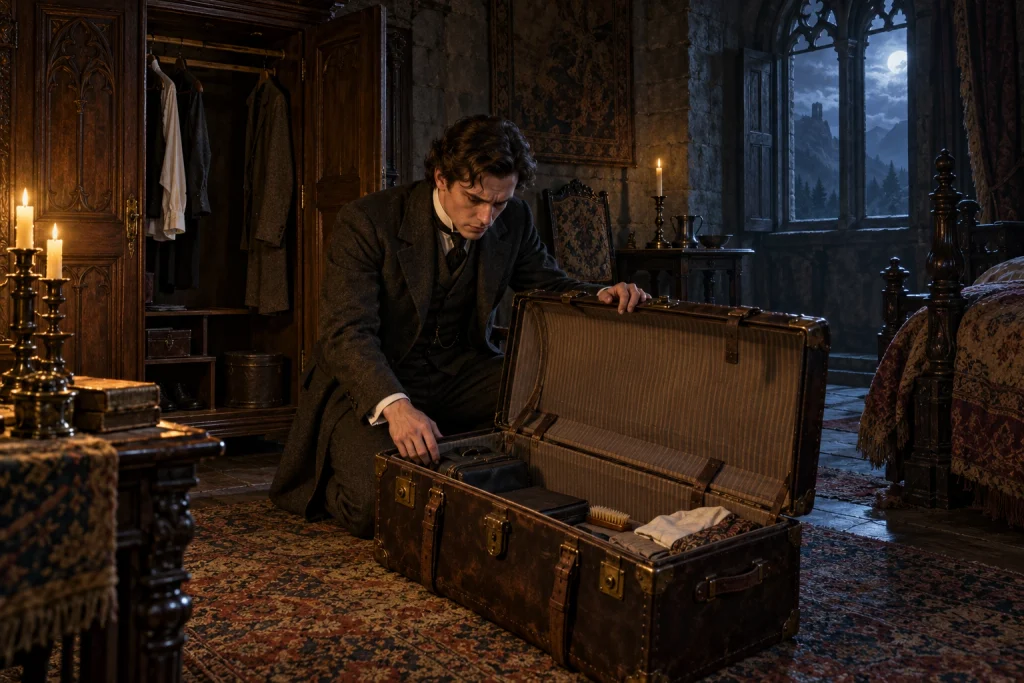
His travelling suit is missing. So are his overcoat and rug. (Chapter IV.)
The losses are thoroughly practical. Without his papers, Jonathan has lost information and financial resources that might help him get home. Without his travelling clothes, he has lost the outfit in which he arrived, the one intended to see him through the journey back.
There is something particularly unpleasant about the thoroughness of it. Dracula has taken the correspondence that might explain Jonathan’s movements, the documents that might help him escape and the clothes he would wear while doing so.
He has also left Jonathan with no satisfactory explanation. A missing letter of credit is alarming enough, but a stolen suit seems an oddly domestic addition to the crimes of a supernatural aristocrat. Jonathan suspects another scheme without yet knowing what it is.
The explanation arrives in June.
Dracula goes out as Jonathan Harker
The suit has become a disguise.
On 24 June, Jonathan discovers that the Count has taken his travelling clothes for himself. Dracula also carries the bag previously seen in the castle with the three vampire women, a much more sinister piece of luggage than anything belonging to his prisoner. (Chapters III–IV.)
Harker immediately understands what the disguise might accomplish.
He imagines people in nearby towns and villages seeing the Count and believing that Jonathan has been moving freely through the district. Worse, he fears that whatever crimes Dracula commits while wearing those clothes might be blamed upon him.
In Harker’s words, “any wickedness which he may do shall by the local people be attributed to me.” (Chapter IV, 24 June.)
The possibility is horrible enough.
A suit is not usually treated as a particularly intimate possession. It can be altered, sold, handed down or borrowed. Yet clothes help establish who somebody is in the ordinary transactions of life. They provide a recognisable outline, suggest occupation and social position, and allow strangers to make assumptions without having to ask many questions.
Jonathan’s travelling suit belongs to a young English solicitor conducting business abroad. It is presumably suitable for that purpose, although Stoker never tells us its colour, cut or fabric. Nothing about the suit needs to be extraordinary.
The Count has imprisoned the man who owns it and can now wear his outward identity into the world.
What makes this more disturbing is the accompanying correspondence. Dracula has already dictated a version of Jonathan’s movements in letters intended for people back home. Now he has acquired the clothes that could make those movements appear plausible to people near the castle.
On 29 June, the date of Jonathan’s final dictated letter, Dracula leaves again wearing his prisoner’s clothes. Harker understands this second departure as another attempt to support the false story that he has gone. (Chapter IV, 29 June.)
The outfit and the paperwork are working together. Jonathan has been given a departure date without the freedom to depart, while Dracula has the freedom to leave wearing Jonathan’s clothes.
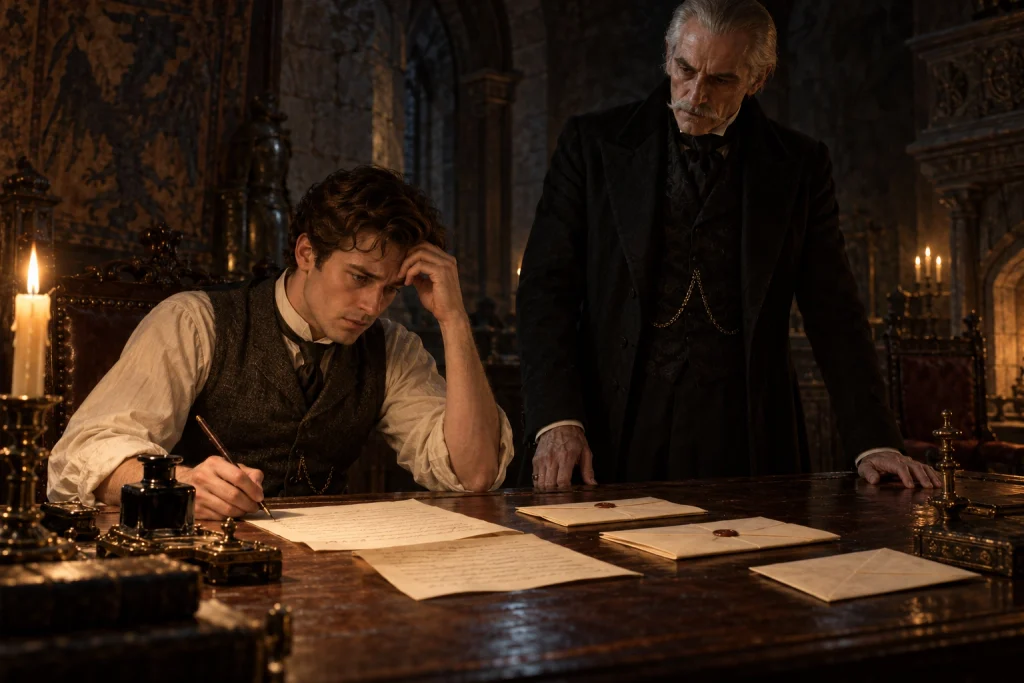
There is no elaborate transformation, no spell that changes one man into another. Dracula simply takes what belongs to his prisoner and carries on with his business. Jonathan remains locked inside, knowing that his own name and appearance may be used to explain things he has never done.
That is a much nastier use for a suit than making its wearer look imposing.
What Dracula wears in London
Once the novel moves to England, the descriptions of Dracula’s clothing become surprisingly selective.
At the Zoological Gardens, a tall stranger strongly resembling the Count attracts the attention of a wolf keeper. The man wears white kid gloves — fine gloves made from soft goatskin — and speaks politely enough while displaying a rather unsettling interest in the animals. (Chapter XI.)
In September, Mina and Jonathan encounter Dracula on Piccadilly. Mina describes a tall, thin man with a black moustache, pointed beard and conspicuously sharp teeth. She says nothing about his clothes. (Chapter XIII.)
Jonathan recognises him despite his changed appearance. He believes the Count has grown younger, and the recognition nearly overwhelms him. The body looks different, but Jonathan knows whom he is seeing.
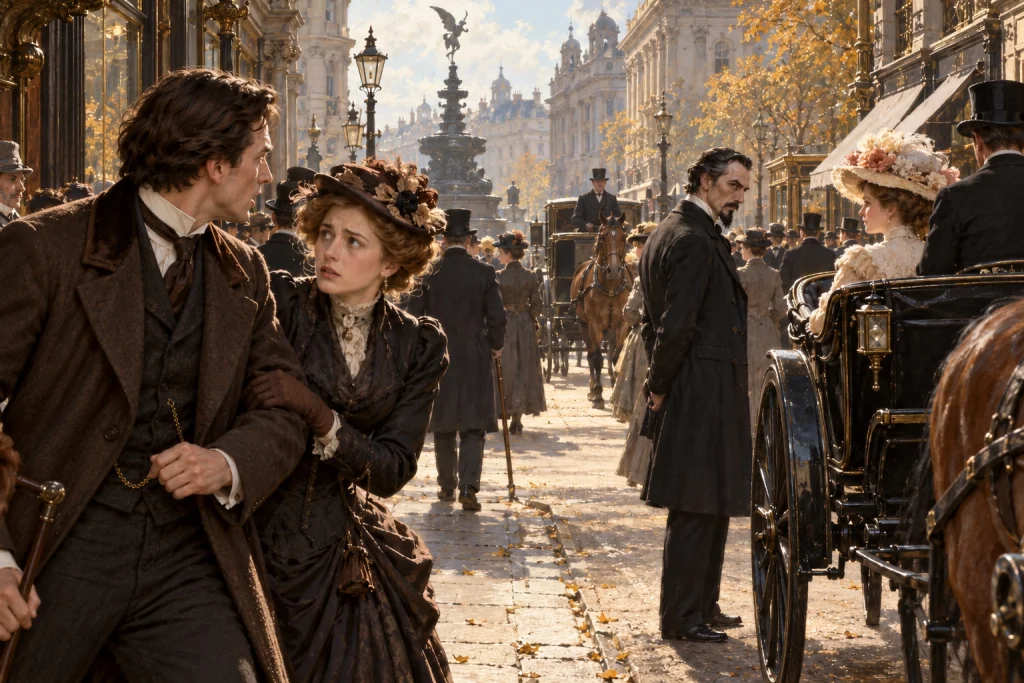
The scene returns to identity without repeating the castle disguise. Jonathan is now free and accompanied by Mina, yet he encounters the same man whose control over his life had seemed impossible to escape. Dracula no longer needs Jonathan’s travelling suit to produce that terror.
Later, during the attack on Mina, Dr Seward describes the Count dressed in black, a return to the severe appearance recorded at the castle. (Chapter XXI.)
Finally, there is the straw hat.
When Van Helsing investigates Dracula’s departure aboard the Czarina Catherine, witnesses at Doolittle’s Wharf describe a tall, pale stranger dressed in black, with a straw hat that they consider unsuitable for him and the occasion. (Chapter XXIV.)
After centuries of existence and considerable effort studying English life, the Count has apparently made one unfortunate decision in the millinery department.
The hat deserves its moment. But it is a small detail in a novel that gives us surprisingly little information about Dracula’s everyday wardrobe. We know he favours black on several occasions. We know he can wear gloves, acquire a straw hat and, when it serves him, help himself to another man’s clothes.
The cloak that became Dracula’s cape
There is a cloak in Stoker’s novel. In Chapter III, Harker watches Dracula crawl down the castle wall with the garment spreading around him like enormous wings. It is an extraordinary image, but it is not quite the familiar stage costume.
That came later. According to the Derbyshire Record Office, Hamilton Deane’s stage adaptation, first performed in Derby on 15 May 1924, gave Dracula his elegant evening dress and flowing theatrical cape. The cape had a practical purpose: it helped conceal the mechanics of the Count’s disappearance through a trapdoor.
That is a useful trick onstage, but it offers little guidance on whether a cape can replace a coat in everyday life.
Theatre gave Dracula an outfit that audiences could recognise instantly.
Stoker had already found something more disturbing: a vampire wearing the clothes of a man who could not leave the castle.
Leave a Reply