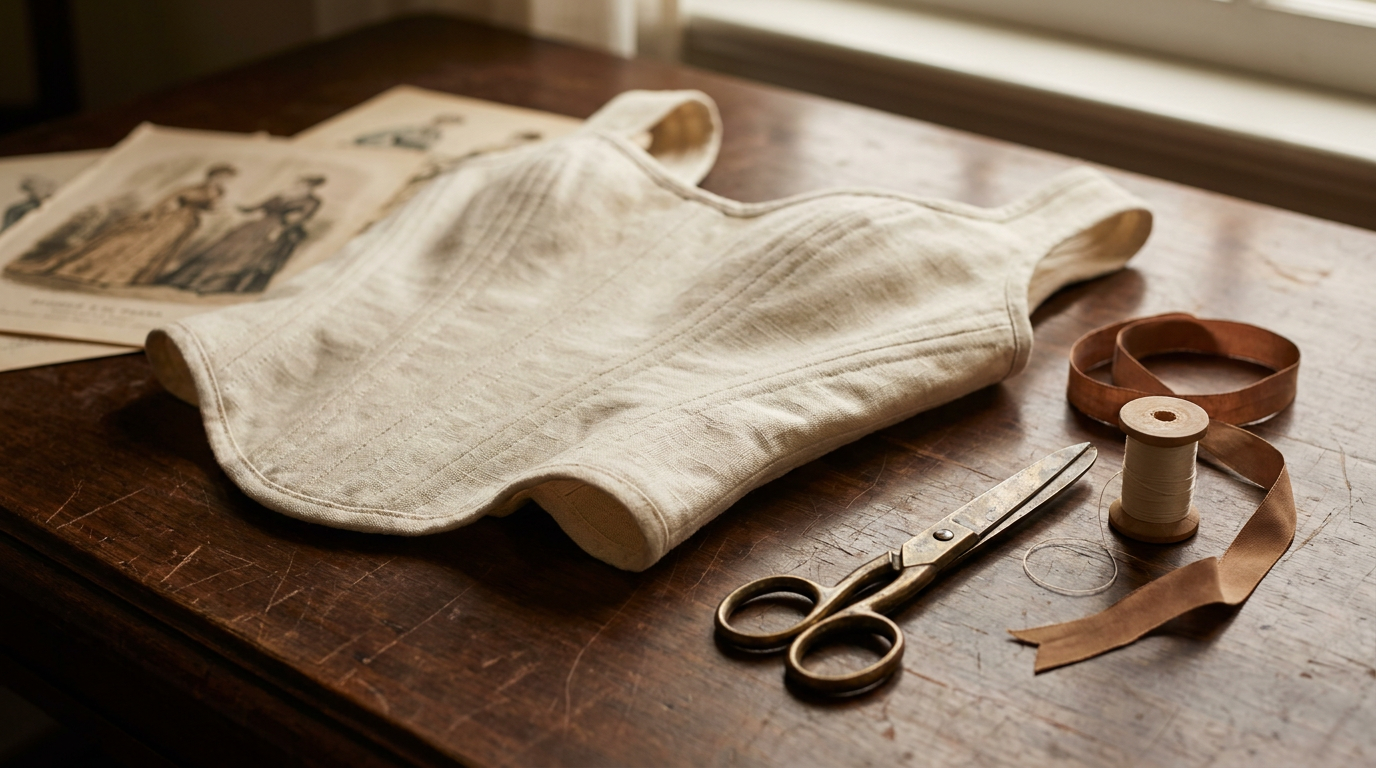
A fitted top with lacing up the back can be sold as a corset. Add a pointed waist and somebody may call it a bodice. Put roughly the same shape in a museum collection and it might be stays.
The tempting solution is to assign each word its own century and be done with it. Unfortunately, the clothes refuse to cooperate.
The Metropolitan Museum of Art has a British Corset dated to about 1780 and American Stays dated to about 1835. LACMA owns a garment from the 1730s or 1740s catalogued, with admirable refusal to choose sides, as Woman’s Corset (Stays).
There was a broad historical shift in vocabulary, but not a clean handover. For somebody buying clothing now, the label is therefore only the beginning. The more useful questions are physical: what forms the garment, what stiffens it, what opens it, and is all that lacing actually doing anything?
A bodice can simply be part of the dress
Start with the easiest word, because even this one has managed to acquire complications.
In ordinary modern use, a bodice is the upper part of a dress. Cambridge Dictionary gives that as its principal definition, while also recording an older use for a close-fitting piece of women’s underwear.
The Smithsonian’s Mary Lincoln’s Dress makes the first meaning particularly clear. The museum describes a purple velvet skirt with a separate daytime bodice, worn during the Washington winter social season of 1861–62; an evening bodice belonged to the ensemble as well. The bodice is the upper garment. Calling it one tells us where it belongs in the outfit, not that it must perform the same structural job as a corset.
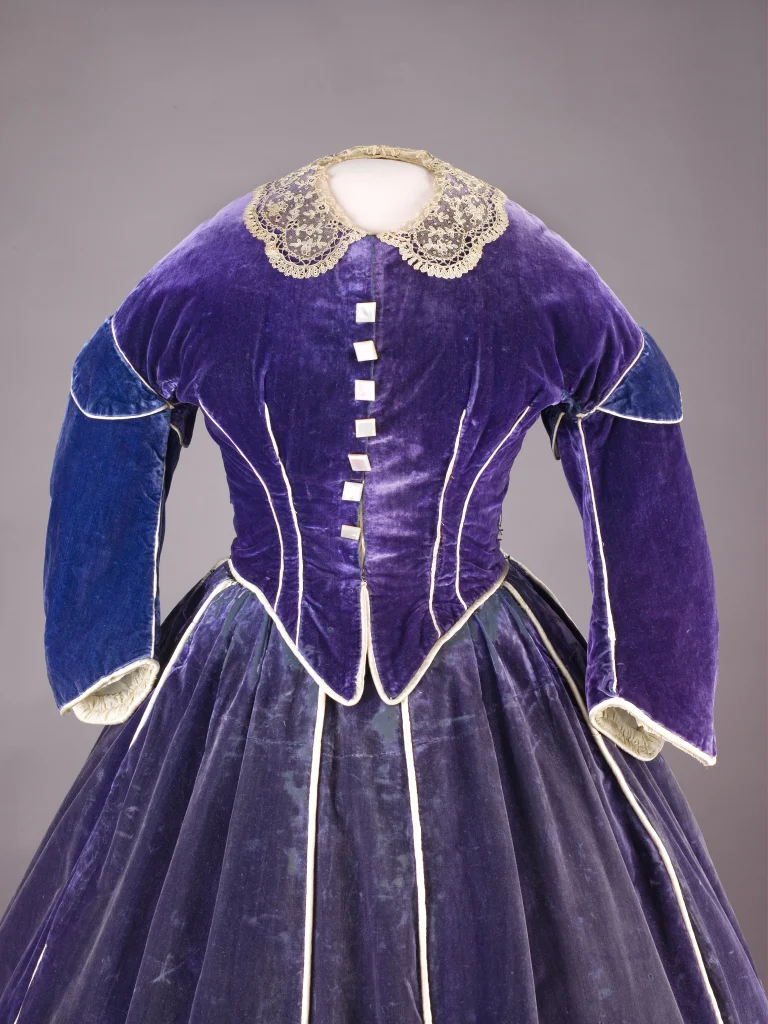
That distinction matters when buying modern clothes. A dress can have a boned bodice. A separate top can be sold as a bodice. Neither fact automatically makes it a corset.
Historically, the word reaches further than that neat modern definition, so I would not use bodice as a structural diagnosis by itself. Norah Waugh’s Corsets and Crinolines begins its history with whaleboned bodies and laced bodices before moving through stays and later corsets. Clothing terminology has been untidy for considerably longer than online shops have been helping.
Stays did not turn into corsets at midnight in 1800
There is still a useful broad chronology. Waugh organises the period from 1670 to the end of the eighteenth century around stays, then the nineteenth century to 1925 around corsets. As an overview of changing fashions, that makes sense. As a rule for identifying one garment, it is too tidy.
The Fashion History Timeline at the Museum at FIT describes the awkward transition particularly well. In the 1810s, stays more often referred to stiff, heavily boned structures like those of the eighteenth century, while corset could describe a lighter garment with little or no boning. As corsets supplanted stays, however, the two words were increasingly used interchangeably.
Museum catalogues preserve the mess. The Rijksmuseum calls a light-blue silk garment from 1740–60 a korset. It is described as probably stiffened with wood and laced at both front and back.
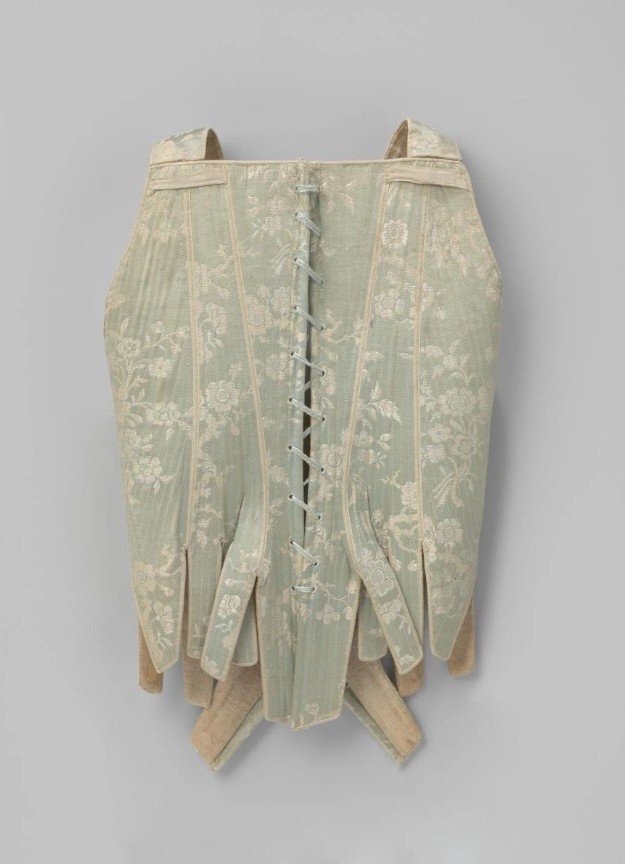
Date helps. Silhouette helps. Construction helps more. None of them gives us a magic year in which everybody agreed to change the label.
Boning tells you how the garment is being supported
Modern corset making still commonly involves boning — narrow stiffening elements incorporated into the garment to help it hold its intended shape. Heritage Crafts lists boning, binding and busks among the characteristic structures added during corset construction, followed by grommets and laces.
That does not mean every corset contains the same quantity or material of boning.
The Symington Collection in Leicestershire has a splendid pair of counter-examples. A busk-front corset from about 1890 contains 42 strips of cane and four tempered steels beside the back lacing. An example from 1899/1900 contains no boning apart from flat steels supporting that lacing; instead, strong eight-ply string cording runs vertically and across the hips, while a spoon busk and a second steel support stiffen the front.
One corset is bristling with cane. The other manages much of the job with cord.
That is why “is it boned?” is useful but insufficient. In a second-hand listing, I would treat parallel stitched channels as a clue that deserves a closer look, particularly when they correspond with the shape and seams of the garment. A photograph alone may not tell you what is inside every channel or how sound it remains.
A seller writing boned has given you a claim. A clear inside photograph gives you something to inspect.
A busk is more specific than a pointed front
A busk is a stiff element placed down the centre front of a corset or pair of stays. In earlier examples it could be a single removable strip rather than the opening metal fastening many modern buyers now picture.
The Smithsonian has a mid-nineteenth-century Corset and Whalebone Scrimshaw Busk. Its collection record describes this sort of busk as a corset stiffener inserted into a matching sleeve in the garment. Another Smithsonian Woman’s Corset, 1810–1820 was constructed around a long removable piece of wood or bone that slipped into a centre-front pocket.
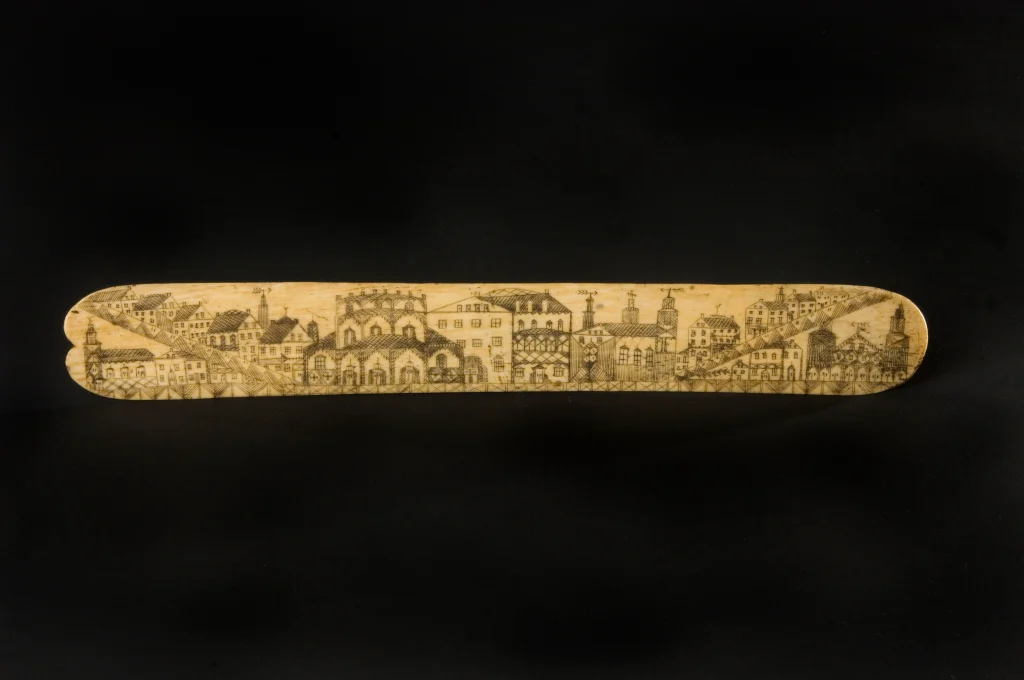
Later corsetry also developed busks that formed part of the front opening, but the useful buying point is the same: look at what the centre front physically contains.
A pointed centre seam is not a busk. A row of decorative hooks is not evidence of one. If a listing calls something a busk-front corset, the photographs should show enough of the centre-front construction to make that claim intelligible.
And absence of a busk does not automatically disqualify a garment from being a corset. We are identifying construction, not administering an entrance examination.
Functional lacing has to join something
Lacing attracts the eye, which is presumably why clothing companies keep putting it on things whether it has a job or not.
On the Smithsonian’s Woman’s Corset, 1810–1820, the distinction is obvious. The back is made to lace through nine pairs of eyelets along two separate edges. Adjusting that lacing changes the relationship between those edges and therefore the fit of the garment.
The Symington examples also show that the area around functional lacing may need its own reinforcement: both use tempered steel at the back lacing even though the rest of their internal structures differ dramatically.
That gives us a useful visual test when photographs are all we have. Follow the cord or ribbon rather than admiring it.
Does it pass through reinforced holes or grommets along two actual opening edges? Can those edges move towards or away from one another? Is there visible structure beside them? Those are signs that the lacing participates in fastening or adjustment.
If the ribbon zigzags across a continuous panel of intact cloth, it may simply be decoration. Nothing terrible has happened. Decorative lacing is allowed to exist. It has merely declined the structural responsibilities implied by the marketing department.
What second-hand photographs can actually tell you
This is where the terminology becomes useful rather than historical housekeeping.
If I were considering a second-hand corset, bodice or corset-style top, I would want to see the whole front and back, the inside, the centre-front fastening and a close view of the lacing. Those photographs answer different questions.
The full views tell you where the actual openings are. The inside can reveal stiffening channels, lining, seam construction and reinforcement that disappears completely from the glamorous outside photograph. The centre front may show a busk or another fastening. The lacing close-up shows whether the eyelets or grommets are pulling out of shape, whether the cloth around them is fraying and, most importantly, whether the lacing joins an opening at all.
This is a different problem from finding the garment in the first place. I have already tested what happens when second-hand search vocabulary starts behaving badly in The Search Box Is Not an Oracle; once the garment is on screen, stop arguing with the search box and inspect the object.
Photos also have limits. They cannot establish comfort. They may not reveal what material the boning is made from. They cannot tell you how flexible an internal support has become, whether a hidden end is beginning to work through its channel, or how the garment behaves once tension is applied.
The Rijksmuseum’s pink silk-and-cotton corset from 1905–10 is useful precisely because the catalogue can tell us what a marketplace photograph could not: that it contains boning, has a front hook fastening and uses laces. The image lets us look. The record tells us what we are looking at.
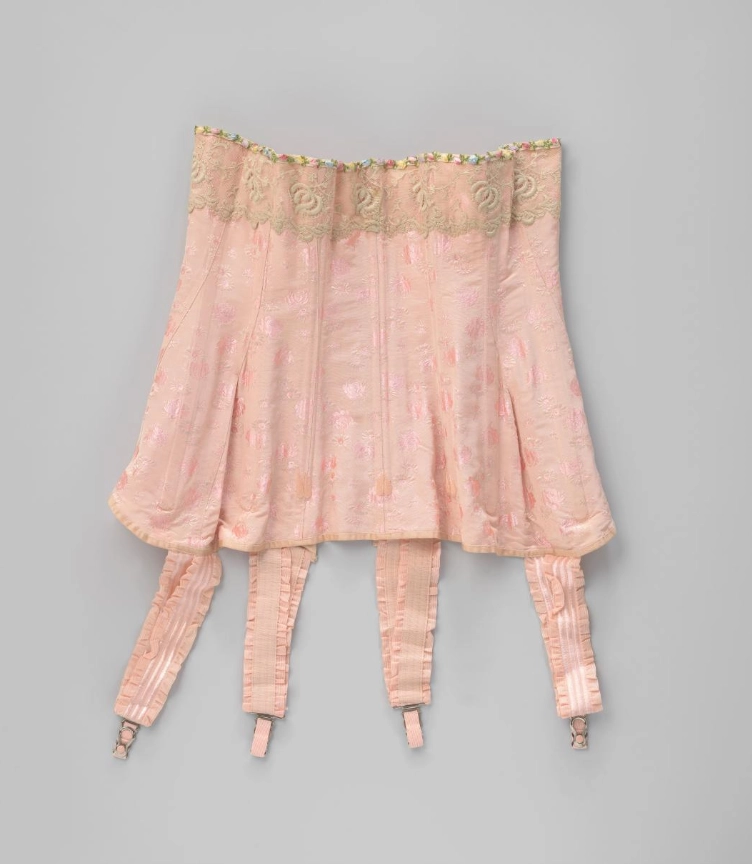
For an ordinary second-hand purchase, the lesson is not that the seller needs to produce a museum catalogue. It is that missing photographs create missing information. If the internal construction matters to what you want from the garment, asking to see it is considerably more useful than another photograph of the front.
“Corset-style” is sometimes the most accurate description
A modern top can borrow the visible vocabulary of corsetry without reproducing historical corset construction. Panel seams, a pointed lower edge, lacing, hook fastenings and a close fit can all contribute to the effect.
There is nothing inherently inferior about that.
If you want a soft top that gives an outfit the line and detail of a corset without behaving like one, a corset-style top may be exactly right. If you are paying more because a listing implies substantial internal construction, the photographs should show some.
That is the distinction worth keeping. Bodice, stays and corset have all carried different meanings across time, and historical objects do not line themselves up obediently behind three modern definitions. Construction gives us firmer ground.
If the only thing doing structural work is the word corset in the title, you have your answer.
Leave a Reply