In my guide to fashion aesthetics, I gave what I thought was a satisfyingly neat piece of advice:
Learn the aesthetic name to navigate. Learn the garment names to shop.
I still like the sentence.
Unfortunately, I tried it.
The theory was simple enough. Search whimsigoth or castlecore while you are working out what you like; once you know that what you actually want is a velvet dress, a linen shirt or a particular sleeve shape, search for the garment instead. Second-hand sellers cannot be expected to know which internet aesthetic has claimed their old blouse this week.
So I opened Vinted and Depop and started running the same ideas through different searches. Some behaved beautifully. Some produced a smaller and tidier selection of the wrong clothes. Vinted answered elven shirt with an Elite Eleven vest.
A note on the searches: I ran these on 21 September 2026. Listings, rankings and location pools change, so treat them as dated examples rather than tests of either platform; I discarded any comparison that stopped being like-for-like.
Start with the word you actually have
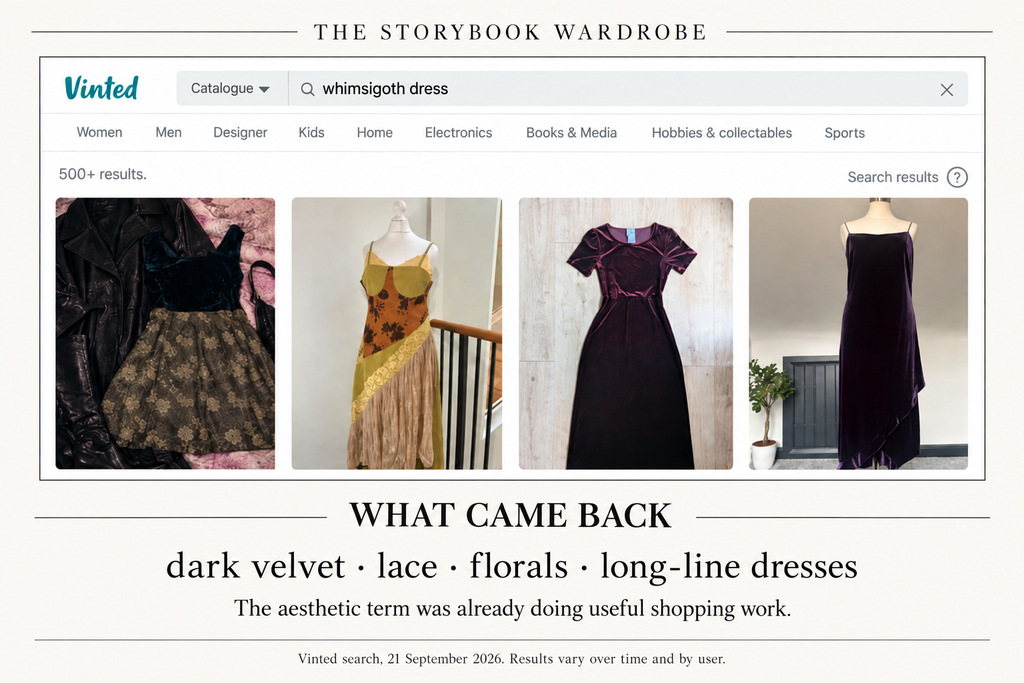
Suppose the only useful description in your head is whimsigoth dress. Search that.
My Vinted search for exactly that phrase showed 500+ results, and the first screen was quite good: dark velvet, lace, long hems, florals and dresses with enough movement or oddness to belong comfortably in the territory.
The supposedly vague aesthetic word was doing useful shopping work already. That matters because my old advice treated aesthetic terminology rather like stabilisers: learn whimsigoth, then graduate to the proper names of clothes and stop embarrassing yourself.
There is no reason to abandon a search that is already finding what you mean. Clothing vocabulary becomes useful when the results give you a reason to change something.
So the first practical step is simply to inspect what came back. Are the clothes too costumey, too plain, the wrong shape, the wrong material or not clothes at all? If the answer is “actually, these are quite good”, you have learnt something too.
Aesthetic words can also shift between marketplaces. I searched castlecore dress on both marketplaces. Vinted returned 252 results, with the visible clothing leaning towards Regency references, prairie shapes, lace and pinafores. Depop returned 13, with the visible set leaning towards goth-alt and lolita clothing, costume and merchandise. The same aesthetic word gathered noticeably different clothes around itself. The label did not produce one stable visual meaning, which is all I needed to know.
Then I tried to translate an elf
Elven shirt was much less obliging.
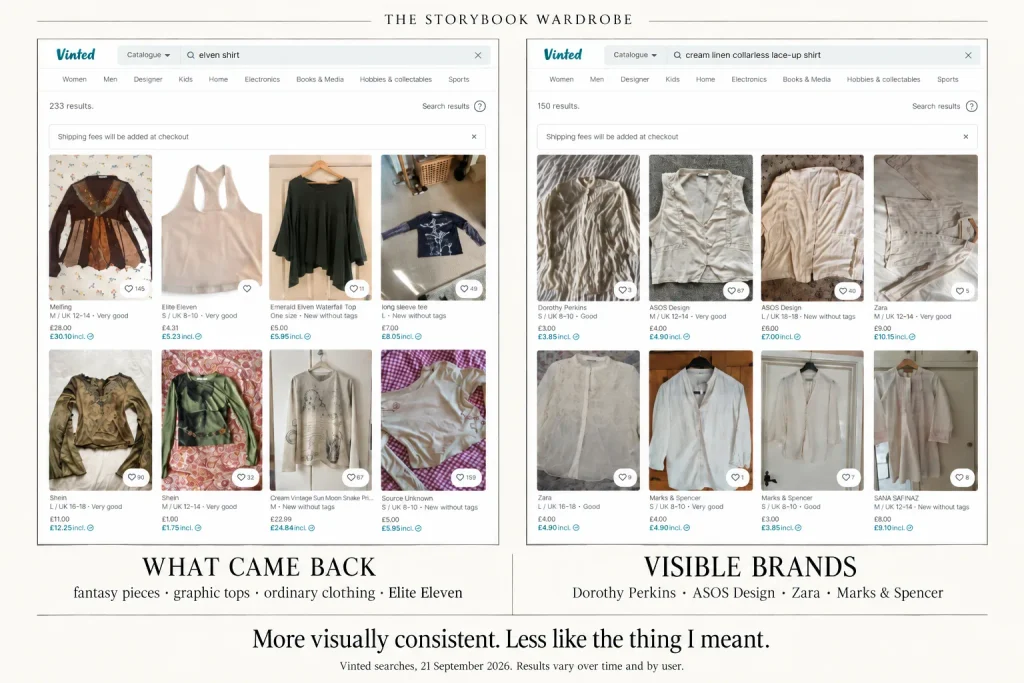
Vinted returned 233 results, but the visible selection wandered between overt fantasy clothing, graphic tops, ordinary garments and an Elite Eleven vest. The phrase had retained plenty of fantasy association without telling the search very much about the shirt I had in mind.
So I translated it into physical description: cream linen collarless lace-up shirt.
That gave me 150 results on Vinted. The first screen was suddenly much more coherent: pale shirts and blouses, embroidery, lace and linen-looking textures. Visible brands included Dorothy Perkins, ASOS Design, Zara and Marks & Spencer.
The fantasy had gone.
This was where the old rule stopped working. The second search was more literal about the garment but less faithful to what I had wanted from it. Describing the garment only works when the description carries the character.
Cream, linen, collarless and lace-up were all defensible observations. Together they still described a fairly ordinary family of shirts. Removing elven removed some of the muddle, but it also removed information that those physical words had failed to replace.
Sometimes the ordinary description carries everything
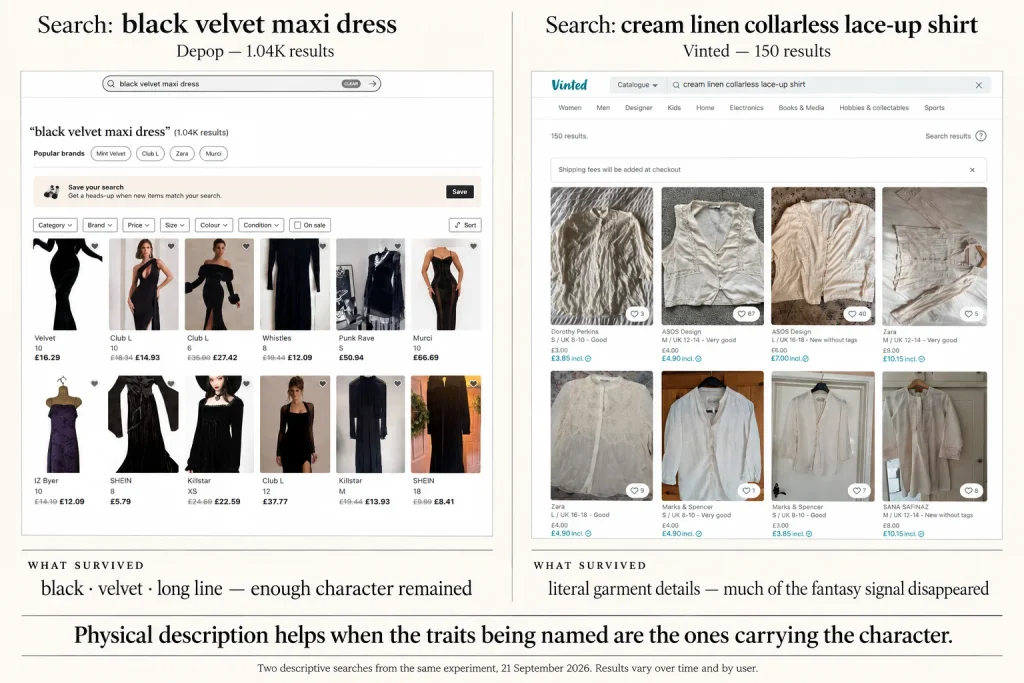
Then I searched black velvet maxi dress.
There is no fantasy terminology in that phrase: just colour, material, length and garment. Yet it retained far more character. Vinted showed 500+ results and Depop showed 1,040 in the comparable UK search. On Depop’s first screen were Killstar and Punk Rave alongside Club L and Murci; the clothes ranged from overtly gothic to ordinary eveningwear, but the dark, dramatic direction survived perfectly well.
Here the physical attributes were already doing the aesthetic work. Black changes the visual field. Velvet supplies a particular depth and surface. Maxi gives the garment a long line. Remove a fantasy label and those qualities remain.
Compare that with the cream linen shirt. Linen may contribute texture and lacing may hint at something older, but the combination still describes an enormous quantity of perfectly ordinary clothing. A Marks & Spencer shirt can satisfy the wording without having the slightest interest in accompanying anybody into a forest.
That gives me a much more useful question when translating a reference: which qualities are carrying its character? Keep those, and ordinary garment language may be enough. Translate the wrong qualities and you can describe the object accurately while losing the reason you wanted it. I used the same test again when building a Halloween outfit from real clothes, separating the garments and details carrying the mood from the things that merely identified the costume.
A proper clothing term can sharpen your eye
This does not make clothing terminology useless. It changes what I expect it to do.
Take the bishop sleeve: teaching material from the Board of Intermediate Education, Andhra Pradesh describes it as a long sleeve, fuller at the bottom than the top and normally gathered into a cuff.
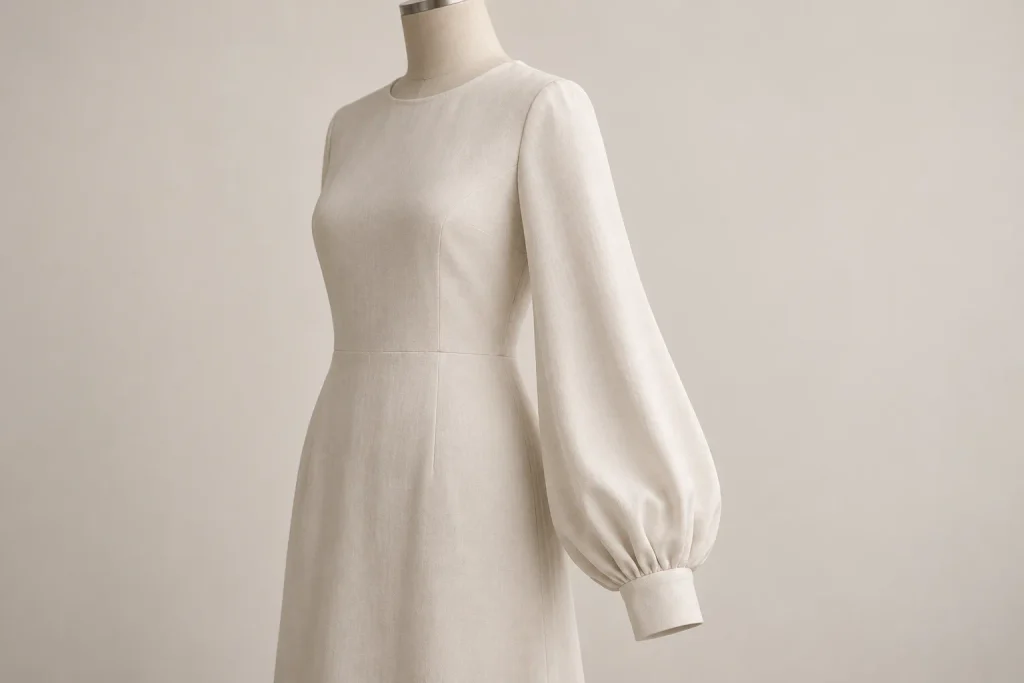
I tested the term by adding bishop sleeve to black velvet maxi dress on Vinted. The shorter search showed 500+ results; the longer one showed 164.
The visible results did not become a parade of bishop sleeves. That does not tell us that bishop sleeve somehow broke the search: the control was already loose, with a pink floral dress and a polka-dot midi appearing despite my having typed black and maxi. What the comparison does show is that adding the specialist term substantially narrowed the visible pool without making the first screen consistently match that sleeve shape.
The term still helped me: I now knew precisely which distribution of fullness I was looking for, whether the seller used the name or not. That is a better reason to learn it.
The same applies to corsets, bodices and stays: the name is useful once you know which physical details — boning, busks, lacing and construction — the word is asking you to inspect.
Search, inspect, change one thing
The method I would use now is iterative rather than translational:
- Start with the language you genuinely have. It might be whimsigoth dress, elven shirt, velvet maxi dress or an ordinary garment name. There is no prize for making the first search sound knowledgeable.
- Inspect what came back before editing the query. Work out what is wrong: wrong garment, too much costume, too ordinary, right silhouette but wrong material, or simply too much unrelated rubbish.
- Change one thing. Replace an aesthetic word, alter the garment noun, add or remove a material, or try one physical feature. Changing one element lets you see what the new wording actually did.
- Inspect again. Pay attention to what you lost as well as what improved. A tidier result page can be further from the clothes you meant.
- Let the photograph take over when the words have reached their limit. Categories and filters can handle size, price, colour and condition; browsing can recover garments whose sellers used vocabulary you would never have guessed.
Depop now makes the last point unusually literal: its iOS Visual Search accepts a photograph instead of text, and Depop says it compares qualities including shape, colour, pattern and overall style. Even the marketplace has a route for the moment when you can see the thing perfectly well and cannot think what to call it.
If you would rather begin with brands already designing this territory deliberately, I have also compared eight fantasy-inspired clothing brands for everyday wear.
On a charity-shop rail, the words disappear
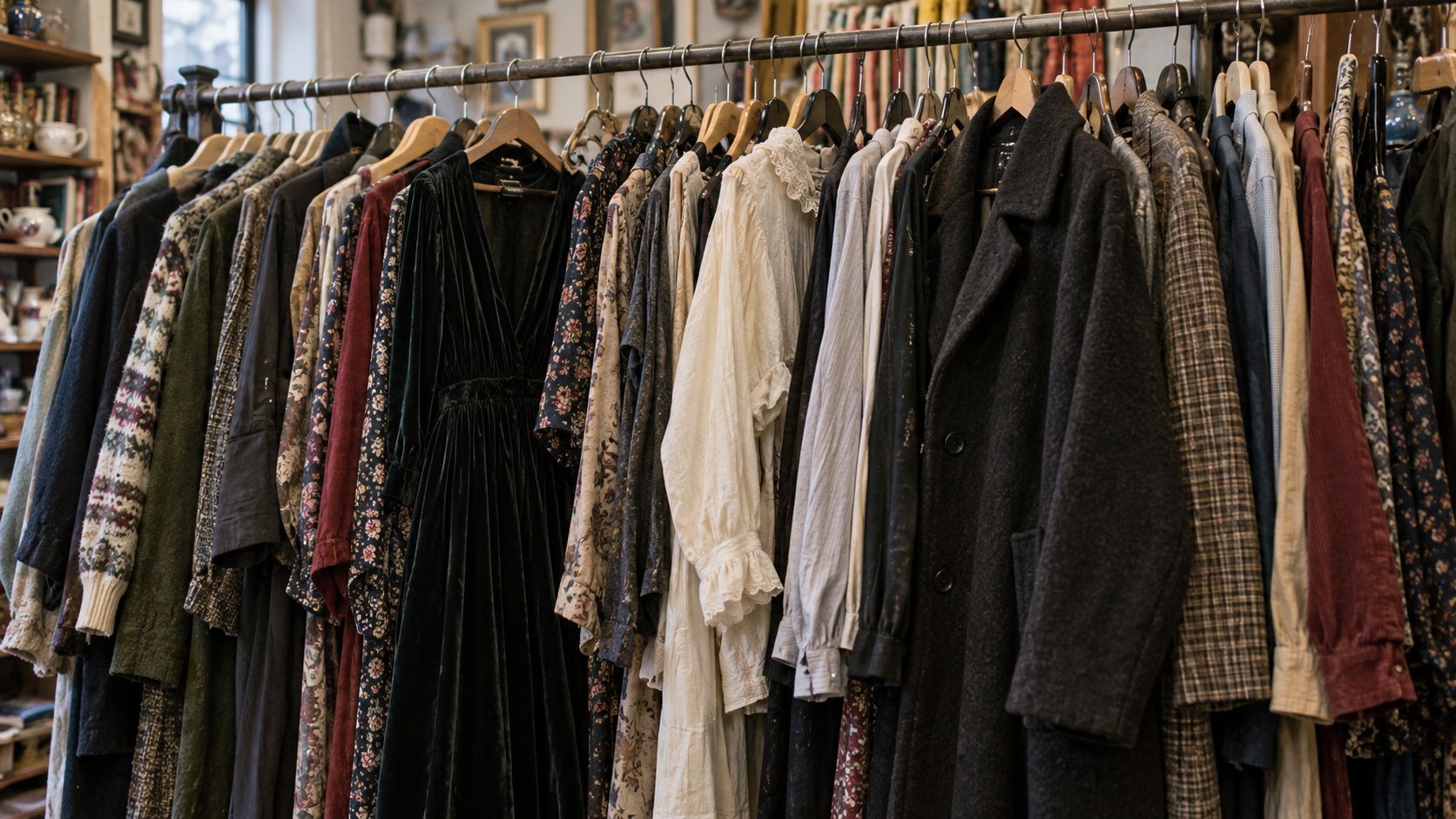
A physical shop removes most of this vocabulary problem. There is no search box between you and the garment, and nobody needs to have called the rail castlecore before you are allowed to find something castlecore on it.
That means the same skill becomes more direct: identify what attracted you to the reference and look for the physical effect.
I already use this when building a storybook wardrobe without looking like costume: work out what the reference is physically doing before you look for the garment that might reproduce it. On a charity-shop rail, that becomes much more literal. You can look for length, weight, movement, fullness or surface without needing the seller to have supplied the right aesthetic word.
Try the same thing with whatever reference sent you shopping. Perhaps the attraction is a long uninterrupted line, cloth moving around the legs, fullness low in the sleeve, a severe neckline, a surface that changes in the light or a fitted upper half against a fuller skirt. Those are all qualities you can recognise before you know the proper name for them.
This is why what charity shops actually have can still be useful even when most of the rail is ordinary high-street clothing. A Laura Ashley dress does not need somebody to label it whimsigoth before its cut, cloth or movement can belong in the wardrobe you are building. The label might help you find it online. On the rail, you have the thing itself.
The fitting room is where the photograph runs out
A search result can suggest movement. A hanger can suggest proportion. Neither tells you quite what happens once your shoulders, arms and ordinary clothes become involved.
Online, of course, you do not get the fitting room before you pay. Comparing the seller’s measurements with a similar garment you already own gives you more to work with; my guide to measuring clothes for buying and selling online shows exactly where to take them.
Put the garment on and test the effect you came looking for.
Walk in the coat if you wanted sweep. Move your arms if the sleeve is the point. Add the layer you would normally wear over the blouse. Sit down in the trousers. Look at the cloth from the side as well as straight into the mirror.
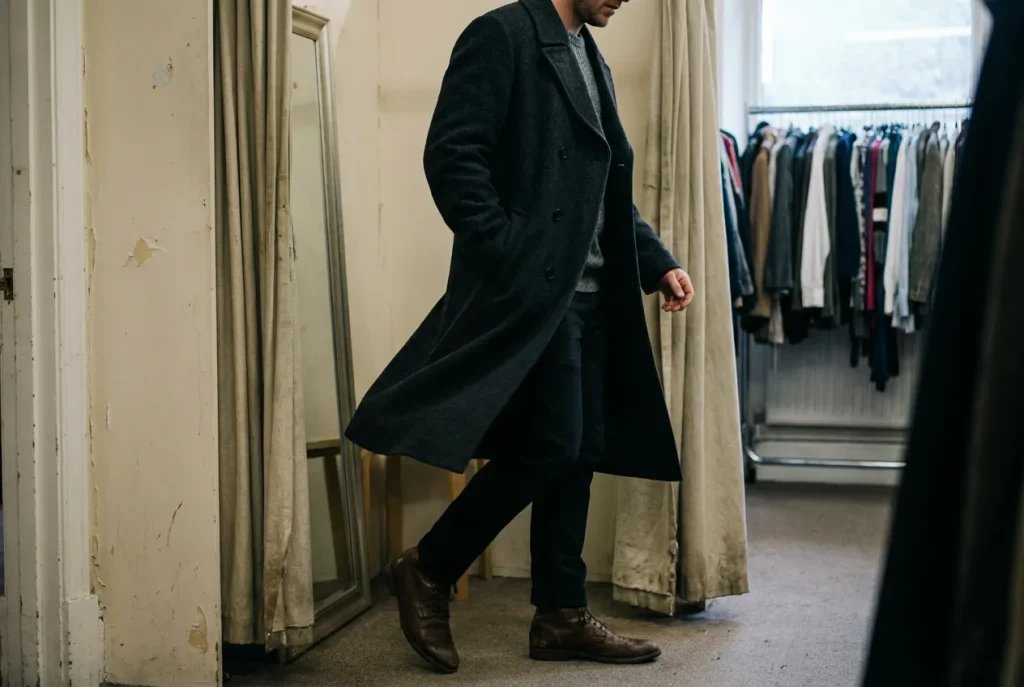
Then return to the less romantic questions: does it fit, is the condition acceptable, can you care for it, and is the feature you loved still useful once the garment has to participate in your actual life?
Fantasy can get something as far as the fitting room. Then you have to raise your arms.
Leave a Reply