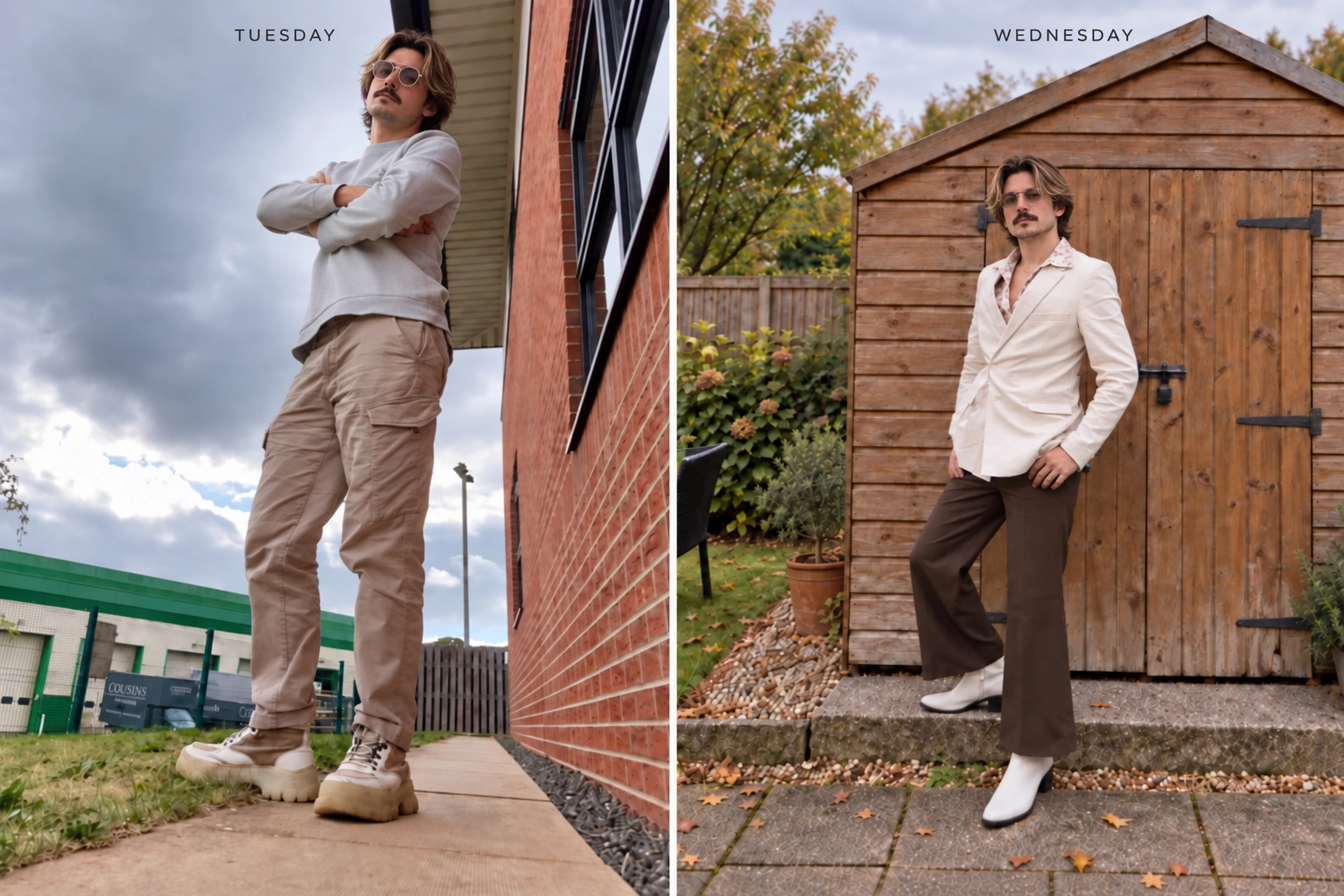
I told my sister that tomorrow I was going to dress cunty.
It was not a particularly sophisticated intervention. Since September began I had been feeling a bit flat, and at roughly the same time I had stopped making much effort with my clothes. Summer is my favourite season and I never enjoy the point where it starts withdrawing itself, particularly when the weather remains muggy enough to make the clothes I actually want from autumn feel slightly ridiculous.
I could not work out whether dressing down was a symptom of feeling low, whether dressing down was helping to keep me there, or whether two unrelated things had simply happened at once.
Tuesday did not clarify matters.
I wore a pale sweatshirt, stone cargo trousers and chunky trainers. Nothing was wrong with any of it. The clothes fitted, the colours worked together and I looked perfectly presentable. No vintage, no interesting collar, no particular silhouette I was excited about. I had dressed to get dressed.
Then I went to work, came home, cleaned the kitchen, did laundry, went shopping and spent about three hours making a leek and chicken gratin. So much for the theory that an uninspiring outfit had rendered me incapable of functioning.
If anything, Tuesday was annoyingly productive. The clothes had apparently done nothing to stop me behaving like somebody with their life together. I just did not particularly feel like one.
Wednesday morning happened before the good part of Wednesday
The next morning I got up earlier and dressed properly. I wore a vintage Italian blouse with a cream ground, muted red and green print and a long pointed collar; a pale Bolongaro Trevor jacket; my chocolate-brown flares; and white heeled Zara boots I bought second-hand on Vinted.
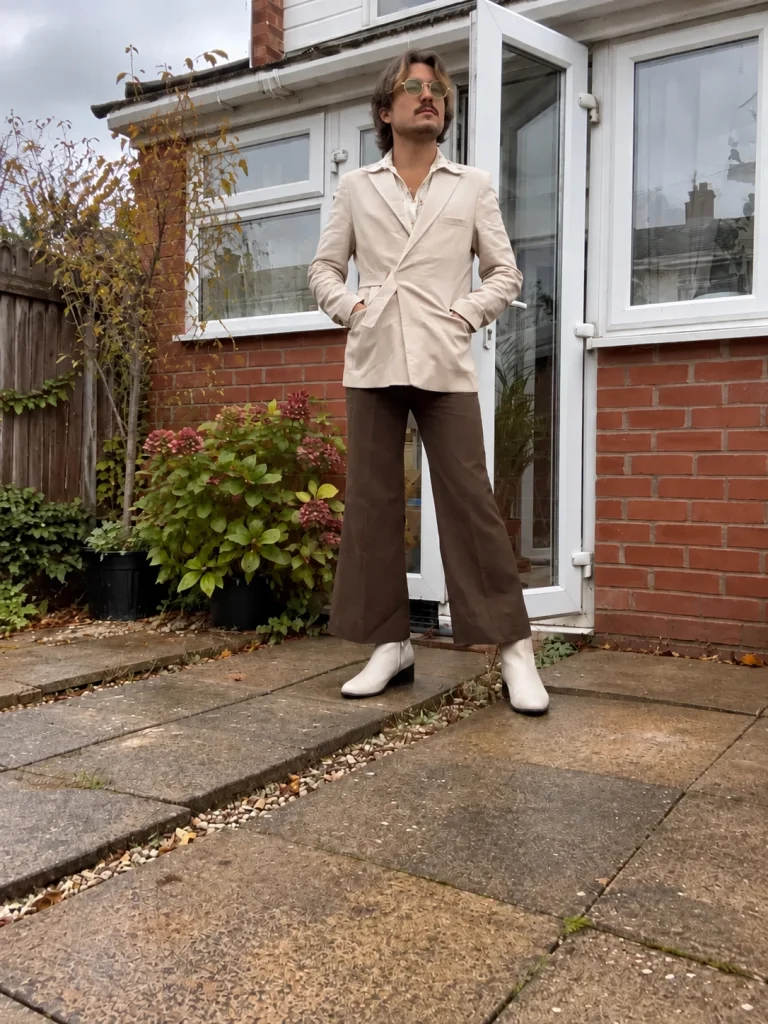
The flares have already survived the office, a dramatic shirt and an article about trouser fit.
The blouse was originally sold as womenswear, which is interesting only insofar as it has the collar I wanted and fits me. Retail departments are useful for finding things. They are less useful as instructions for what happens after you have found them.
The outfit also solved my irritating September problem without requiring autumn-weight clothes. It looked more autumnal because of the browns, cream and muted print, but it was not heavy autumn clothing. The jacket is predominantly cotton and the trousers are a polyester-viscose blend rather than thick wool. I could dress for the season I wanted without actually dressing for cold weather that had not arrived.
I felt different almost immediately. Before the lunch quiz. Before winning anything. Before D&D that evening. I felt more comfortable, more chatty and more powerful. Not powerful in the sense that I expected anybody to hand me control of a minor European country, but in the much more ordinary sense that whatever appeared during the day felt manageable.
The order matters. The quiz could not have caused how I felt that morning because it had not happened yet. Neither could D&D. Both could still have mattered because I knew they were coming, and the rest of the day eventually supplied several other reasons to be cheerful, but the first change I noticed arrived while I was getting dressed.
That does not prove the clothes caused it. It does stop me dismissing them afterwards as irrelevant.
I had been using “comfortable” too narrowly
The comfort was the bit I had not expected. I have a strange tolerance for things other people call uncomfortable. I wear shoes around the house. James thinks this is weird. He is probably representing the majority view, but I simply like being properly clothed.
A sweatshirt and trainers therefore do not automatically represent the summit of physical freedom to me. Nor do heeled boots automatically make an outfit arduous.
Tuesday’s clothes were physically undemanding. Wednesday’s involved a jacket, a blouse with an enormous collar, flared trousers and a heel. Yet Wednesday was the day on which I kept thinking, I feel comfortable.
I realised I had been collapsing two different experiences into one word.
There is physical comfort: whether something pinches, rubs, restricts movement, makes you too hot or demands constant adjustment.
Then there is the other thing, for which I do not have a grand theory: looking down and recognising yourself in what you are wearing.
That is also what interests me about Jane Eyre’s clothes: Rochester can offer her beautiful things and still make her feel less like herself.
I could not find a standard psychological model that neatly divides clothing comfort into those two boxes, and I am not going to manufacture one because the article would look more authoritative with a diagram.
There is, however, a substantial research territory around clothing and the self. In a 2014 critical review of the social psychology of dress, Kim Johnson, Sharron Lennon and Nancy Rudd examined research on clothing as a stimulus for self-attribution and behaviour, alongside wider relationships between dress, the body and self-perception. That gives what I noticed some research context without giving it a ready-made name.
The famous lab coat explains rather less than the headline does
In 2012, researchers Hajo Adam and Adam Galinsky introduced the phrase enclothed cognition for their proposal that clothing could influence psychological processes through both its symbolic meaning and the physical experience of wearing it.
Their famous experiments involved lab coats. In one experiment, participants wearing a coat associated with doctors made fewer errors on a Stroop task, where they had to identify the ink colour of a colour word while ignoring the word itself. It is a beautifully portable finding: wear something that symbolises competence; become more competent. Almost too portable.
In 2019 Devin Burns and colleagues published a preregistered direct replication across four US universities, setting out their methods and analysis plan in advance rather than deciding them after seeing the results. They used three times as many trials per participant and more than three times as many participants as the original experiment, but found no effect of wearing the lab coat on the same task. Their conclusion went further than simply finding no effect in this replication: their analysis suggested that, if the effect exists, it was too small for the original study design to have detected reliably.
That did not end research on clothing and cognition. A later meta-analysis — a study that combines results across earlier studies — by C. Blaine Horton Jr, Adam and Galinsky examined 105 effects from 40 studies across 24 articles. It found serious reasons for concern about the replicability of the earlier research, while finding stronger evidential value among effects published after 2015.
That is more encouraging, but two of the three authors are Adam and Galinsky, the researchers behind the original theory. It is important evidence, but not independent confirmation from an entirely separate research group.
The useful lesson from the lab coat is how much neater an appealing psychological finding can sound in summary than it remains in the literature. Clothes may participate in how people think, feel and behave. The evidence is interesting enough to keep studying and messy enough that I am not awarding my white boots causal powers on the strength of one Wednesday.
September gets me down without needing scientific certification
I dislike summer ending.
I dislike the evenings beginning to feel different, I dislike realising the clothes I have been wearing for months are about to become impractical, and I particularly dislike the transitional period when I am mentally ready for autumn but the temperature is still telling me to behave myself.
It happens to me every year. I went looking to see how comfortably that personal pattern fitted the wider evidence on seasonal mood, and the answer was: not especially.
A 2019 systematic review — a structured synthesis that identifies and assesses relevant studies using predefined methods — led by Simon Øverland examined 41 studies of seasonality and depressive symptoms. The review excluded studies that explicitly asked participants about seasonality, because the authors were concerned that memory and confirmation bias could influence the answers.
Only 13 of the included studies suggested more depression in winter. The rest found no seasonal pattern, patterns outside winter, or results too inconclusive to settle the question. The authors found some support for seasonal variation in clinical depression but challenged the much broader idea that the general population predictably slides into lower mood at regular points in the year.
I rather like that result. September still bums me out. I do not need to recruit everybody else to make it true.
Nor does seasonality explain the Tuesday-to-Wednesday contrast on its own. The season had not changed between Tuesday evening, when I was apparently capable of industrial-scale domestic competence while dressed like a trip to a retail park, and Wednesday morning in the flares.
Then Wednesday started supplying other explanations
By lunchtime the experiment had become considerably less controlled. We had been put into teams for a quiz at work. I started this job in July, so having something properly social and competitive to do with colleagues still felt new. My quiz team won. We did not win delicately.
Later that evening I had D&D. The previous week’s session had been cancelled, and I had introduced a new character at the end of the session before that, then spent weeks waiting to actually play them.
There was also an espresso martini involved. We occasionally add another D and call it D&D&D. The final D is drinks.
Lisa Starr and Rachel Hershenberg followed 157 young adults for 14 days and found that, among participants reporting more depressive symptoms at the start of the study, anticipating positive experiences was associated with larger reductions in depressed mood. The sample deliberately included more participants with depressive symptoms, and the study was observational, so it cannot tell me whether looking forward to D&D caused anything on Wednesday morning.
The work quiz complicates the picture for a different reason: social interaction. Jessie Sun, Kelci Harris and Simine Vazire studied everyday social interaction using both participants’ reports and recordings of their actual interactions. Across 256 people and more than 3,000 observations, more frequent social interaction was associated with greater well-being both in the moment and on average, with aspects of conversational and relational quality also showing associations. The association does not establish which way causation runs, or whether something else influenced both. Nobody was specifically required to annihilate three rival quiz teams over lunch.
By the end of the day I had several perfectly credible reasons to feel good. I had put effort into dressing for the first time in weeks, had a genuinely fun thing happen at a relatively new job and spent the day talking more. I had won something, which unfortunately works on me, and finally got to play the new character I had been looking forward to.
Trying to award percentages to any of those would be nonsense.
Tuesday keeps the conclusion honest
Wednesday was probably my best day of September so far. The easy article would say that I dressed better and therefore felt better. It would have a clean mechanism, an uplifting conclusion and very little respect for what actually happened.
Tuesday prevents it.
On Tuesday I dressed plainly and got an extraordinary amount done. On Wednesday I dressed deliberately and felt unusually capable before the day itself began rewarding me.
Those are not the same result. I still do not know whether the clothes improved my mood. I do know I had spent several weeks treating getting dressed as though it were merely one more piece of morning administration. Apparently, for me, it is not.
I care about choosing a silhouette and an absurd collar. I care about wearing the trousers I have now apparently written about four times because they make other clothes look better. More than anything, I care about seeing an outfit in the mirror and recognising the decisions in it.
That is enough. That evening I sat down in the cream jacket, chocolate flares and white boots to spend several hours pretending to be somebody else.
I had spent the day feeling rather more like myself.
Leave a Reply