Jane Eyre spends so much of her own novel calling herself plain that it is easy to treat her clothes as negative space. Dark dress, neat hair, probably something grey, move along.
Charlotte Brontë is rather less vague. Jane notices clothes. She cares how she looks. She owns a best dress, chooses jewellery, has preferences about colour and reacts very strongly indeed when somebody else tries to improve her.
What changes through Jane Eyre is not whether clothes matter to her. It is how much control she has over them.
At Lowood, plainness is imposed. At Thornfield, she learns to make that simplicity exact. Her silver-grey dress shows that she enjoys looking well when the occasion calls for it. Then Rochester starts talking jewels, satin and enough enthusiasm to make a bridal stylist quietly lock the door, and Jane discovers that refusing clothes can express just as much as choosing them.
That makes her wardrobe useful now. Building a storybook wardrobe from Jane does not require a governess dress, a bonnet or an unexplained quantity of grey wool. What Jane offers is a way of deciding how much of yourself a garment is allowed to replace.
Lowood: plainness before Jane gets to choose it
Jane’s first real wardrobe is an institutional one.
When she reaches Lowood, the girls are “uniformly dressed in brown stuff frocks”. The uniform belongs to the school’s larger system of deprivation and discipline; later Mr Brocklehurst lectures about sobriety and condemns “costly apparel”, shortly before his own splendidly dressed family appears in velvet, silk, fur and elaborately arranged hair.
So I would be careful about making Jane’s early plainness virtuous. She has barely been given a choice.
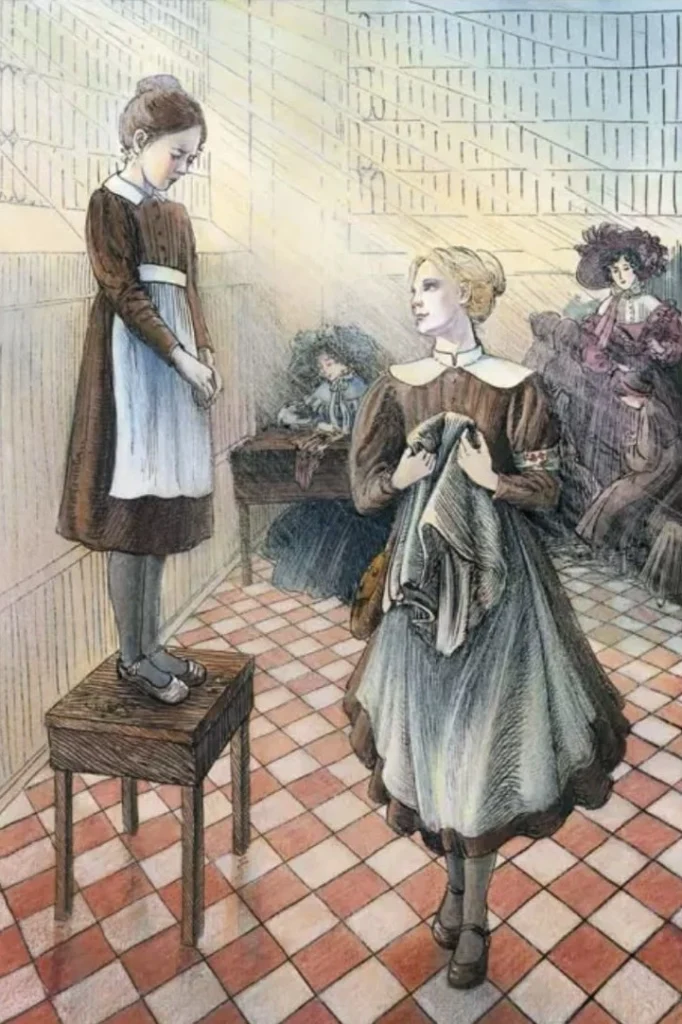
On a vastly more ordinary scale, I recognise the useful part of that experience. My mum picked all my clothes when I was a child. By the time I was old enough to become interested in fashion, I did not have the money to march out and replace everything anyway. I did not yet know what I liked particularly well. I knew with absolute clarity that I hated corduroy and camo.
There is something useful in that sequence. Personal style does not always begin with a fully formed vision of yourself striding magnificently through a shop. Sometimes it begins with no, not that.
If your clothes are constrained by budget, work, school, family expectations or simply what you already own, find the variable you can genuinely control. It might be trouser shape, how high a neckline sits, whether you prefer a close or loose layer, the shoes under an otherwise prescribed outfit, or the one accessory you buy for yourself.
A restricted wardrobe need not pretend to be a creative opportunity. Sometimes it is merely restricted. But dislike is still information, and it can be the first piece of taste that is actually yours.
The black frock and white tucker: precision can do the work ornament usually does
Jane makes the distinction herself when she arrives at Thornfield.
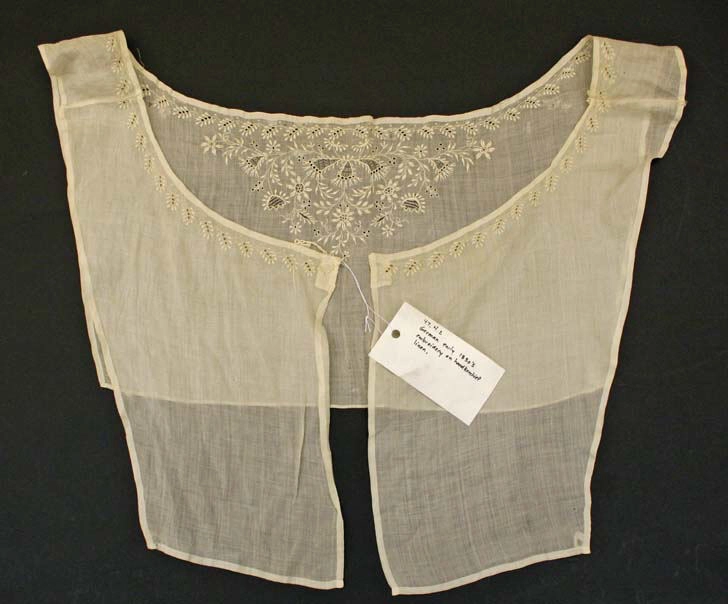
She says she is “obliged to be plain” because everything she owns has been made with “extreme simplicity”, but immediately adds that she is naturally concerned with neatness and wants to look as well as she can. Then she dresses in a black frock which, “Quakerlike as it was”, has “the merit of fitting to a nicety”, and adjusts her clean white tucker. The tucker itself is not new to her: Lowood’s uniform had already put every girl in a brown dress “surrounded by a narrow tucker about the throat”.
That fit matters.
The dress is simple, but Jane does not describe it as shapeless, careless or indifferent. It fits exactly. Her hair is smooth. The white at the neckline is clean. The interest comes from precision rather than abundance.
The tucker is worth naming because it is easy to skate straight over the word. Brontë does not give enough construction detail to identify Jane’s exact version, but the London Museum describes an 1830 chemisette or “tucker” as a bib-like garment worn to cover the upper chest, commonly in white muslin or cambric. It allowed a light, clean-looking section of fabric to appear at the neckline without requiring the whole visible garment to be made from it.
That is much more useful for modern dressing than buying a reproduction tucker.
Think about edges: where a dark garment meets skin, shirt, knitwear or another layer. A clean white shirt collar under a dark jumper does it. So does a narrow cream layer showing at the neck of a charcoal jacket, or a dark dress whose neckline is sharp enough that it does not need jewellery to rescue it.
Then look at fit. Jane’s black frock is not interesting because black is inherently tasteful. It is interesting because the simplicity leaves nowhere for poor proportion to hide.
If you want restraint without looking unfinished, spend your attention on the shoulder, waist, hem, trouser break, sleeve length or whatever line determines whether that particular garment looks deliberate. Ornament can distract. Plain cloth has to get on with the job.
The silver-grey dress and pearl brooch: Jane does, in fact, like clothes
The silver-grey dress prevents the whole argument becoming tediously virtuous.
When Jane is required to join Rochester’s house guests at Thornfield, she puts on her “best dress”, the silver-grey one originally bought for Miss Temple’s wedding. She smooths her hair and adds her “sole ornament”, a pearl brooch.
That is not somebody who believes caring about appearance is beneath her. Jane wants to look appropriate to the occasion. She owns something specifically better than her ordinary clothes. She wears jewellery. She simply does not require six competing demonstrations of finery before she considers herself dressed.
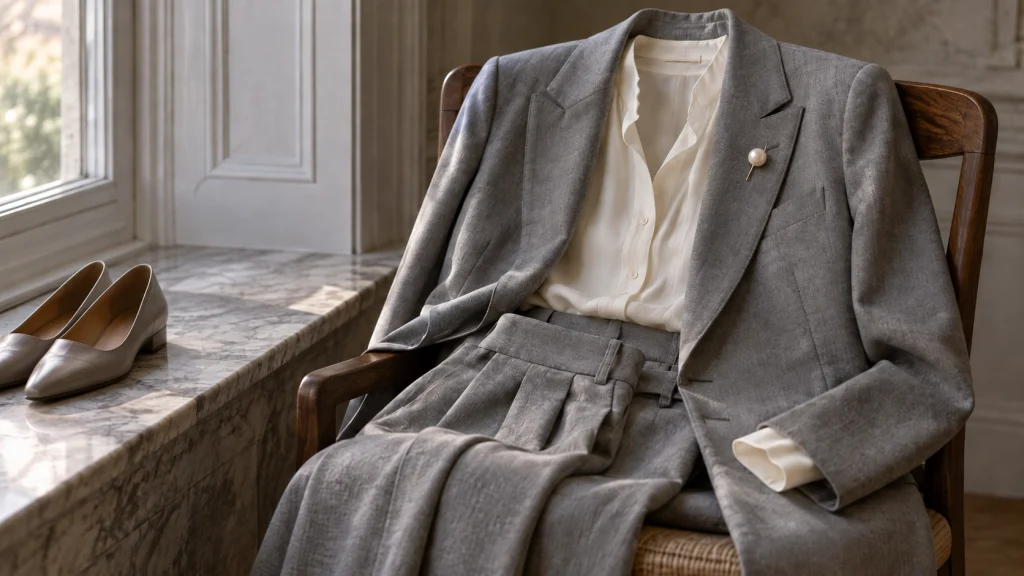
The useful modern version is to have a best expression of your existing taste, rather than an occasion outfit belonging to another species.
If your normal clothes are knitwear and trousers, that might mean sharper trousers, a finer knit and the coat whose line you particularly like. If you wear dresses, it might be the one whose cut and cloth already make it feel finished before accessories arrive. Denim can become darker and cleaner; an ordinary shirt can become silkier, crisper or better fitted. The category does not have to change merely because the invitation did.
Then give one detail enough room to matter.
Jane uses a pearl brooch. Yours could be a ring, watch, brooch, scarf, tie, earrings or an excellent belt buckle. Restraint works rather better when one thing has clearly been selected than when everything has merely been omitted.
There is a difference between an edited outfit and getting dressed before the kettle has boiled.
Millcote: Rochester attempts an unsolicited rebrand
Then Rochester decides Jane needs upgrading.
Before they even reach the shops, he tells her that family jewels will be sent from London. He talks about a diamond chain, bracelets, rings, satin, lace, roses in her hair and a “priceless veil”. Jane’s answer is much less interested in the merchandise: then he won’t know her, and she will be “a jay in borrowed plumes”. When he calls her an angel a few lines later, she is blunter still: “I will be myself.”
This becomes wonderfully concrete at Millcote.
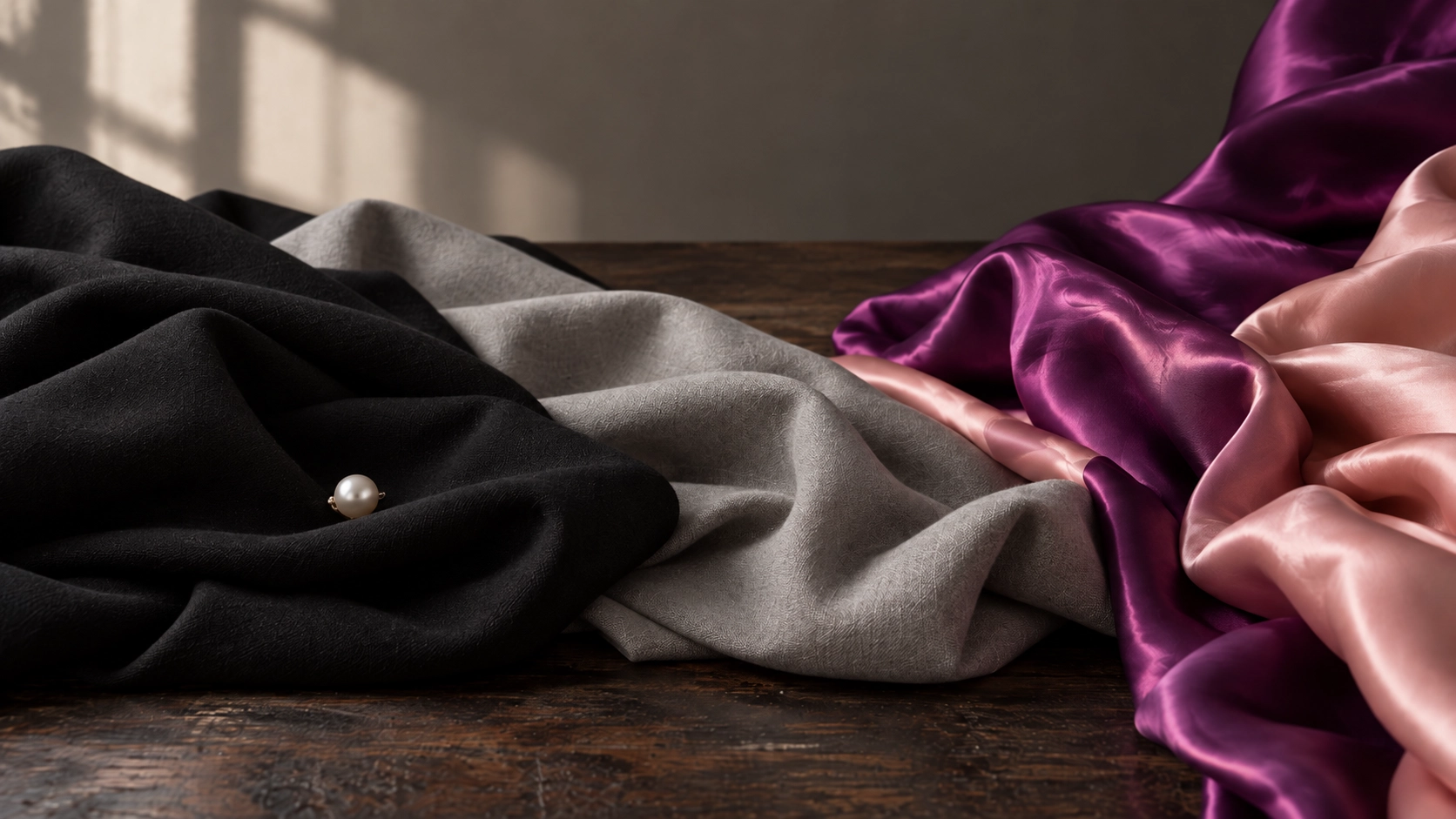
Rochester orders Jane to choose six dresses. She talks him down to two. He then decides that apparently she cannot be trusted with those either and picks a brilliant amethyst silk and superb pink satin himself.
Jane refuses them.
After what she describes as infinite difficulty, she gets them exchanged for black satin and pearl-grey silk. The shopping continues into a jeweller’s, and the accumulating gifts leave her with a sense of “annoyance and degradation”. In the carriage she thinks that she cannot bear being “dressed like a doll”.
She is, for the record, wearing lilac gingham at the time — gingham is a cotton cloth usually woven in a checked or striped pattern. A moment later she threatens to be married “in this lilac gingham” and suggests Rochester make himself a dressing-gown out of the pearl-grey silk.
Rochester is a dreadful personal shopper, but not because amethyst and pink are ugly. They could be magnificent.
His problem is that he has begun dressing an idea.
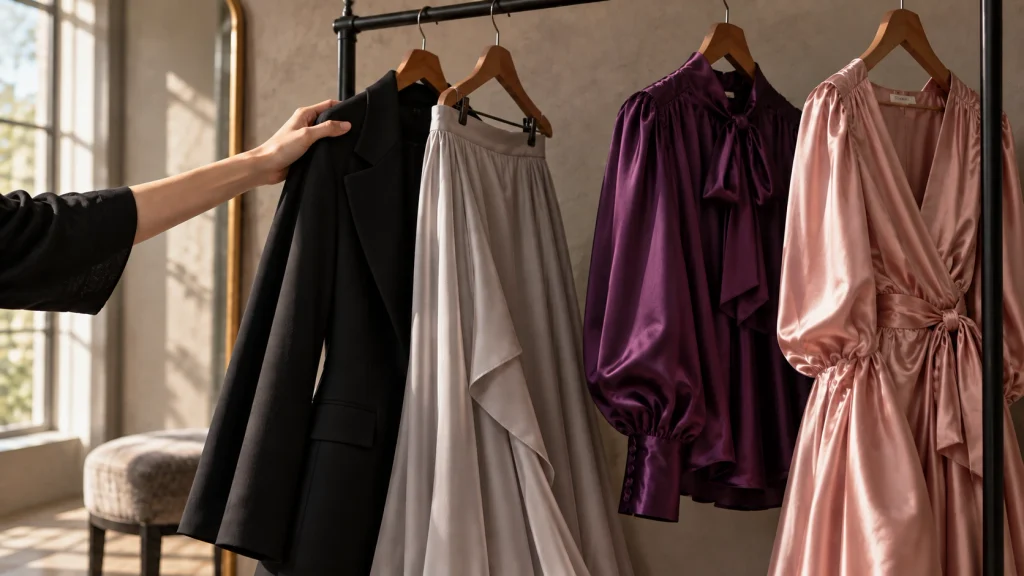
He wants Jane’s elevation to be visible. He has already promised to give her every privilege he would give a peer’s daughter. Jane hears something rather different: the woman he loves is being covered over by evidence of what he can afford to give her.
The financial part matters too. Jane starts thinking about independence. Soon afterwards she insists that she will continue working as Adèle’s governess, earning her thirty pounds a year and furnishing her own wardrobe from it. She explicitly refuses to become Rochester’s “English Céline Varens”, recalling the cashmeres and diamonds he had previously described giving Céline.
Her clothes have become part of the terms on which she intends to enter the marriage.
That gives us a much better modern test than simply copying her palette:
Whose satisfaction is this garment serving?
Sometimes another person has excellent taste. Sometimes the gift is beautiful. Sometimes the thing they would like to see you in genuinely suits you.
None of that obliges you to enjoy becoming their project.
Pay attention when a garment arrives attached to an instruction: more respectable, more glamorous, more masculine, more feminine, more grown-up, more flattering, more like the person somebody assumes you ought to be. Inspect that instruction as carefully as you would inspect the seams.
You may keep the clothes and reject the premise. You may alter them. You may like the amethyst after all.
The veil: formalwear does not require a personality transplant
Rochester has one final attempt at extravagance before the wedding.
Jane has prepared a plain, unembroidered veil for herself. Rochester secretly sends to London for something much richer and more expensive instead, and Jane immediately reads it as another attempt to “masque” his “plebeian bride in the attributes of a peeress”.
The costly veil is later torn in two during the night before the wedding. On the wedding morning, Sophie fastens Jane’s own plain veil to her hair instead: “the plain square” after all.
You could hardly ask Brontë to underline it harder without somebody entering with a ruler.
Occasionwear is precisely where other people’s expectations tend to become loud. Weddings are the obvious example, but the same thing happens at formal parties, ceremonies and any event carrying a vague threat that you ought to make more of an effort.
More effort does not have to mean becoming less recognisable.
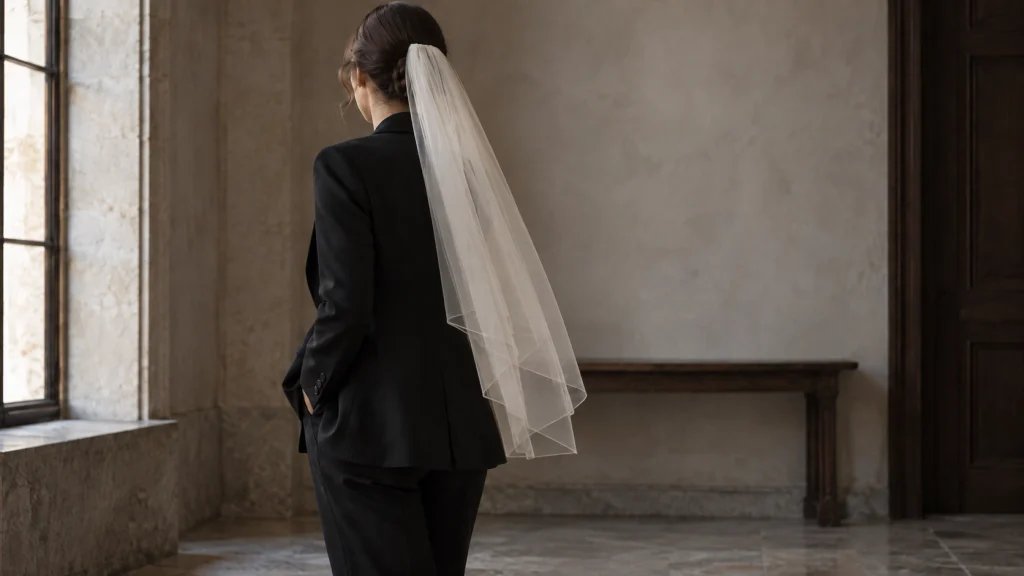
If your clothes normally depend on clean lines, make those lines better. In a suit, that may mean being unusually exact about shoulder line, lapel width, trouser rise and length. In a dress, it may mean neckline, waist placement and how much volume you actually want in the skirt. Those are different constructions solving the same problem: formality should sharpen the proportions you already enjoy rather than importing somebody else’s.
Cloth and finish can raise the register too. Better drape, a little lustre, sharper pressing, one piece of jewellery, polished shoes or a more deliberate texture can make an outfit feel special without requiring it to shout about being special.
I hated camo when somebody else chose it for me. I like it now.
Camo did not improve morally in the intervening years. The choice changed hands.
Leave a Reply