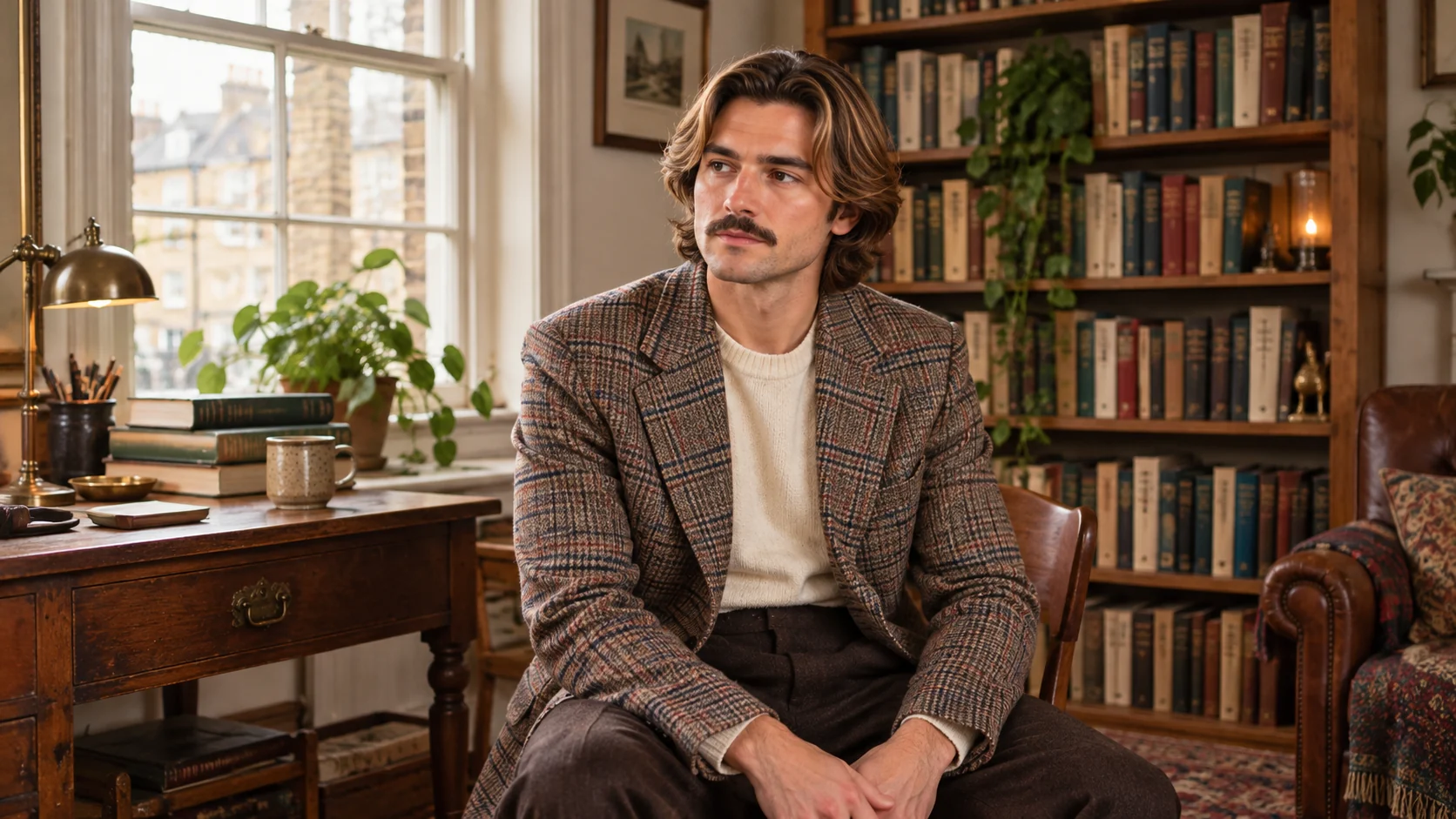
I can recognise a herringbone coat from across a charity shop. That doesn’t mean I could always have explained what the threads were doing to make it look that way.
Most of us learn fabric patterns by appearance. We recognise the checks on a gingham shirt, the jagged shapes of houndstooth and the curling decoration of paisley. The cloth itself receives rather less attention.
Which is a shame, because some of the most interesting distinctions are happening at thread level. A check might be made by arranging coloured yarns on a loom. A zigzag might come from the weave itself. Another design might have been printed onto fabric after it was made.
There are also several patterns with perfectly good names that nobody thought to introduce us to. Tattersall and shepherd’s check have been turning up on clothes for years without the courtesy of a name badge.
When coloured threads make the pattern
A woven fabric begins with two sets of threads. The warp runs lengthways through the loom, while the weft crosses it. Their arrangement determines the weave.
In plain weave, each thread alternates over and under the threads crossing it. It’s the simplest way of making woven cloth, and it can produce patterns without requiring any complicated changes to the structure.
Give the loom different coloured yarns, arrange them in groups, and the pattern begins to appear.
Gingham: three tones from two yarn colours
Traditional gingham is a checked cotton cloth usually woven with alternating groups of dyed and undyed yarns in both the warp and weft.
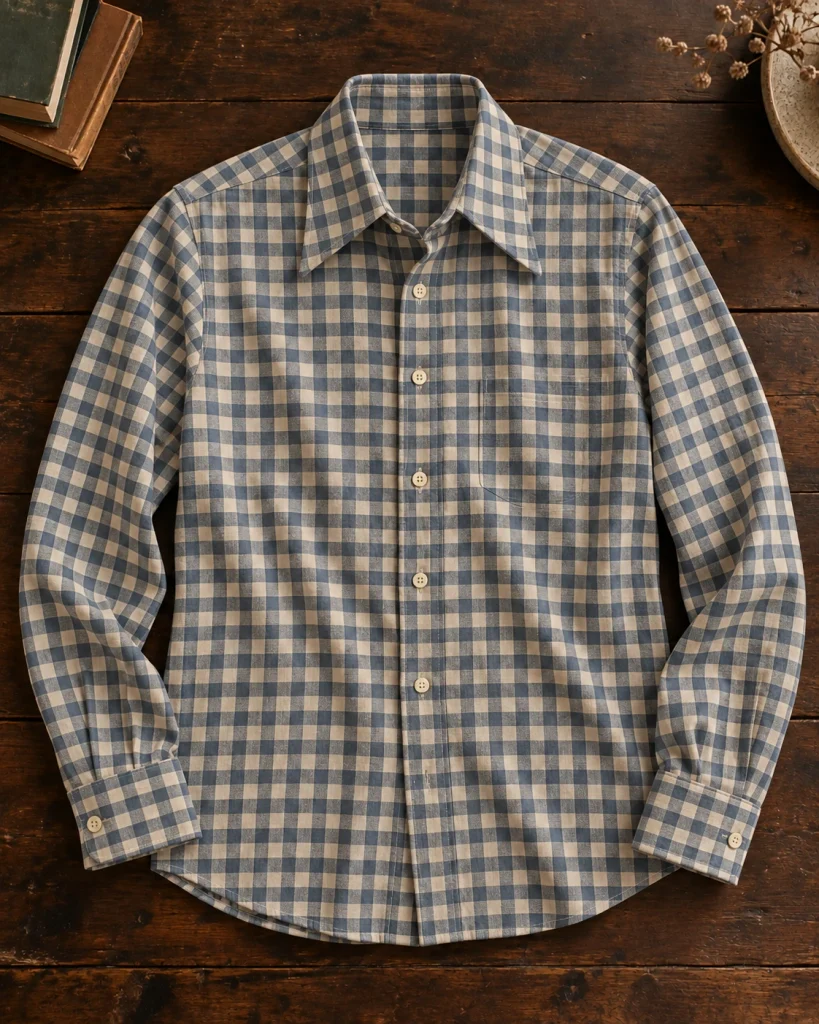
Imagine blue and white threads. Where blue crosses blue, the fabric looks darker. Where white crosses white, it looks pale. At the intersections, blue and white combine visually to produce a lighter blue.
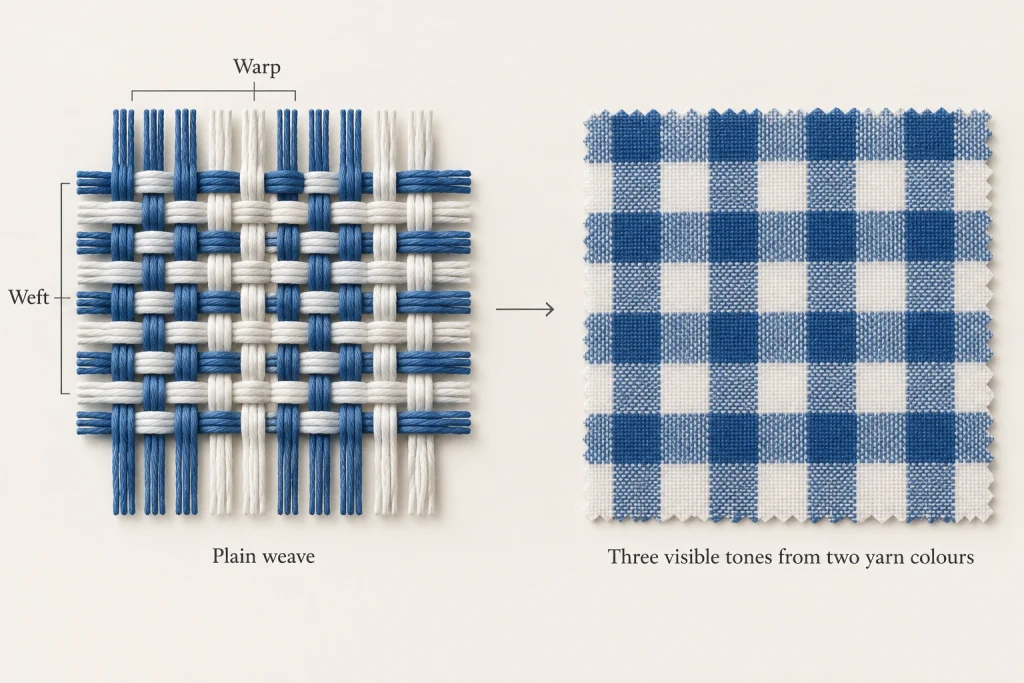
What looks like three colours in a neatly arranged grid can therefore be produced using only two yarn colours. The checks are established before the cloth is finished, simply through the order in which the threads meet.
Tattersall: the check you’ve probably seen without knowing its name
A cream shirt with fine red and blue lines crossing at regular intervals. Perhaps green and brown instead, or two different shades of blue.
That’s Tattersall, a check formed from narrow intersecting lines, usually against a pale background.
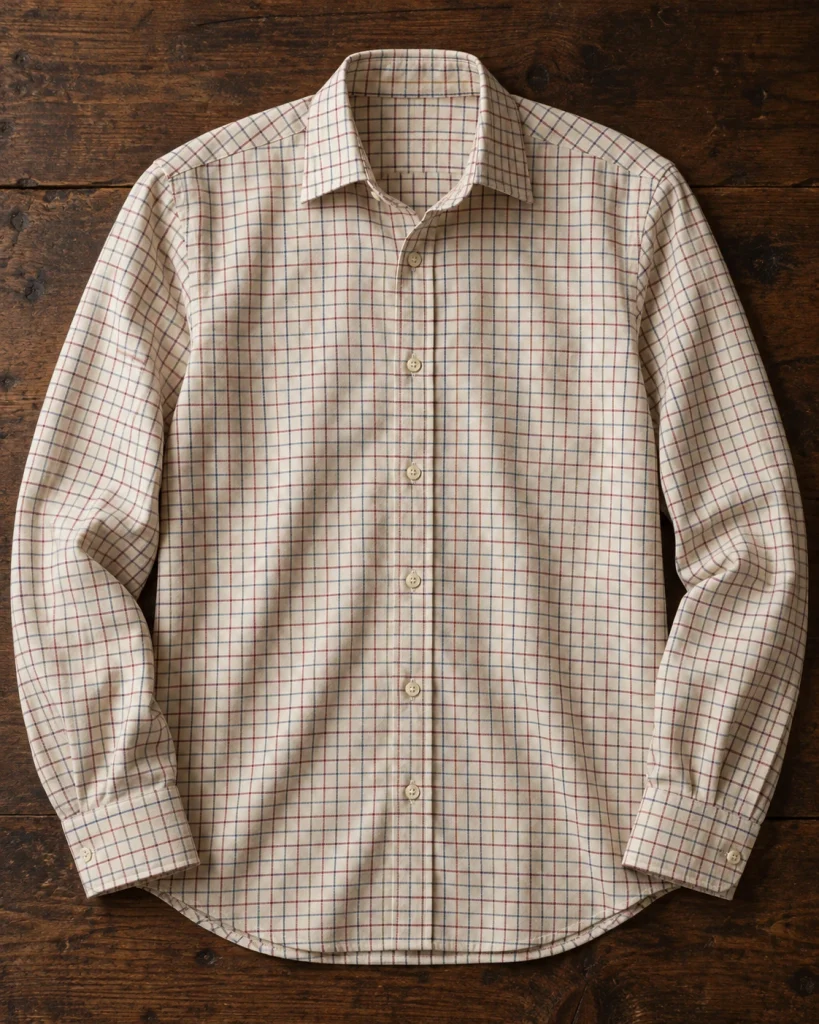
The name comes from Tattersall’s horse-auction business in London, where checked horse blankets were associated with the company. The Vintage Fashion Guild explains that early examples used woollen twill, while modern cotton shirting is commonly plain-woven.
I think Tattersall is one of the best patterns to hunt for second-hand. A good one gives a shirt interest without demanding that the rest of the outfit rearrange itself in tribute. The lines are fine enough to sit comfortably beneath knitwear, while the coloured intersections become more noticeable when the shirt is worn alone.
A cream Tattersall shirt with a generous pointed collar would be considerably more appealing to me than another generic blue business check.
It’s also a useful search term. Sellers may simply describe the garment as checked, but knowing the proper name gives you another way to look. As I found in The Search Box Is Not an Oracle, a precise clothing term tells you what you’re looking for, whether or not the seller used it.
When the weave alone creates the design
Coloured yarns aren’t always necessary. Some patterns emerge from changes in how the threads pass over and under one another, creating visible differences in texture or the way light catches the cloth.
Herringbone: the pattern in my £40 coat
My charcoal herringbone wool-blend coat cost £40 when I bought it second-hand in August. I covered the buying decision in How to Buy a Second-Hand Wool Coat, but the cloth deserves a closer look.
Herringbone is made by reversing the direction of a twill, a weave whose staggered thread arrangement produces diagonal ribs. Those diagonals change direction at intervals, forming the familiar broken zigzag.
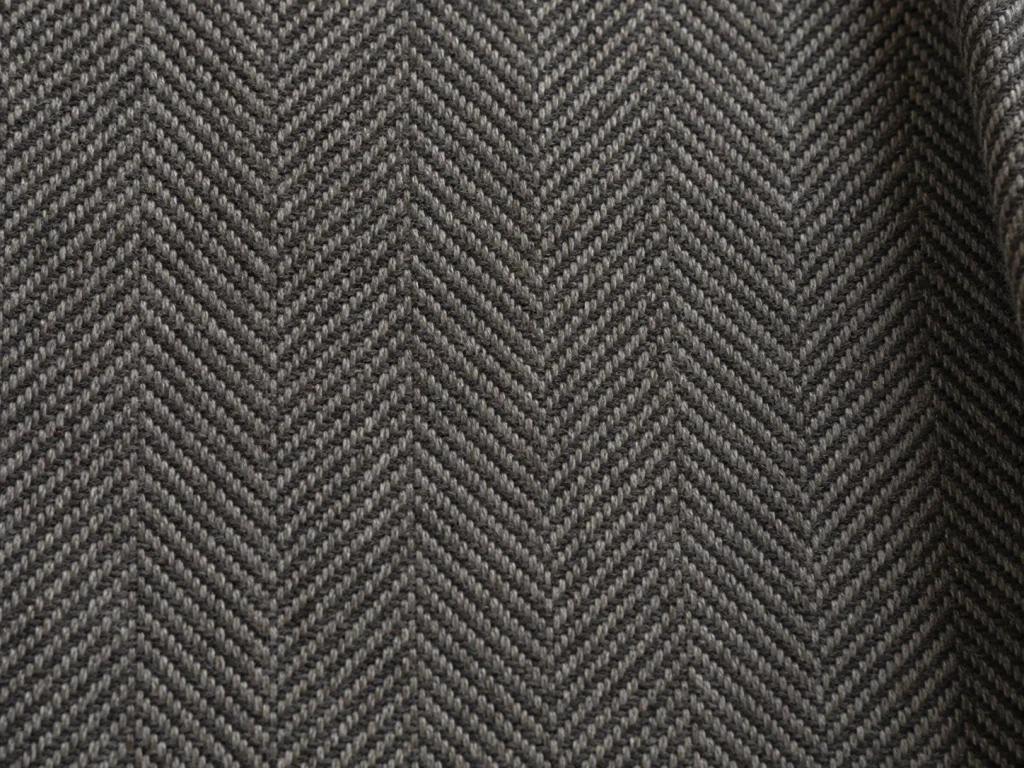
Look closely at the coat and the lines are part of the cloth’s structure. They aren’t decoration applied to its surface.
The important distinction is that herringbone can retain its characteristic pattern when every yarn is the same colour. Contrasting threads may emphasise the zigzag, but the weave produces it.
My charcoal coat is a good example of why I like the pattern. From a distance it reads as dark, substantial outerwear. Closer up, the surface has movement and detail. It offers texture without the visual busyness of a bold check, which is exactly what I want from a coat intended to work with several different outfits.
Single-colour damask also uses its weave to create a design, traditionally through contrasting satin-based areas whose different lustres reveal the pattern as the light moves.
The question to remember is simple: would the pattern still be visible if every thread were the same colour?
For herringbone and damask, yes.
When colour and weave work together
Now we arrive at checks that depend on two things happening simultaneously: the structure of the cloth and the arrangement of contrasting yarns.
Remove the colour differences from traditional examples and the familiar checks disappear, even though the underlying weave remains.
Houndstooth and shepherd’s check
Houndstooth is a jagged check traditionally created by arranging groups of contrasting yarns in a two-over, two-under twill weave.
Rather than meeting in ordinary square blocks, the dark and light threads produce little pointed shapes, as though the edges of each check have been pulled into teeth.
The Weavers’ Company describes a traditional arrangement using four dark and four light threads in both directions, though larger groupings are also used.
At a smaller scale the design may be called puppytooth, which is a far more charming name than most tailoring terminology deserves.
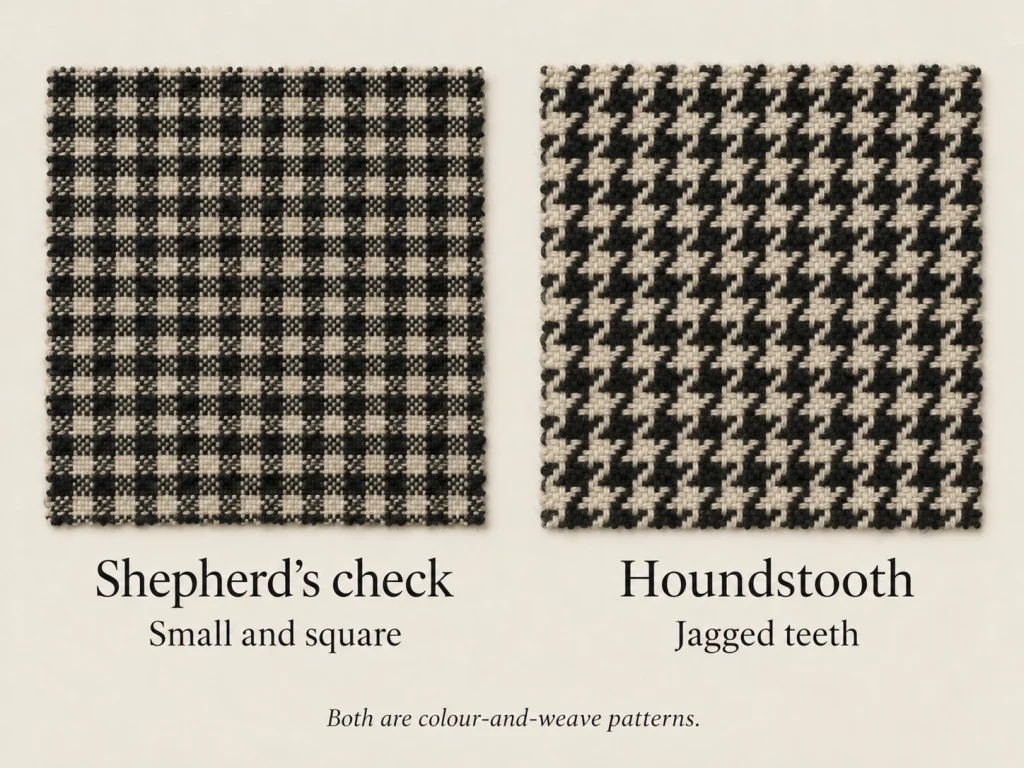
I like small houndstooth. In subdued colours it gives a jacket or pair of trousers some visual movement without dominating the garment. Enormous black-and-white houndstooth, on the other hand, is ugly. The jagged shapes become so emphatic that the cloth seems to flicker whenever the wearer moves. A coat in that pattern would exhaust me before I reached the end of the street.
Shepherd’s check is closely related, traditionally formed from groups of contrasting yarns in a 2/2 twill. It is often recognised by its comparatively regular checked appearance, although the terminology overlaps with dogtooth and houndstooth.
The useful difference is visual: shepherd’s check reads as small and square, houndstooth as conspicuous jagged teeth.
Neither traditional design would retain its characteristic black-and-white check if the yarns were all the same colour.
Glen check and Prince of Wales check
A glen check looks almost like several checks sharing the same piece of cloth.
At first glance, you might see an ordinary grey jacket. Move closer and the design becomes more elaborate: small checks, larger checks and alternating bands where the dark and light threads appear in different proportions.
Traditional twill versions combine groups of four dark and four light yarns with smaller groups of two dark and two light, arranged through both warp and weft. The changing sequences produce different areas within the larger check. Harriet C. Douglas describes this construction in Twills, Tweeds and All-Wool Fabrics, published by the Shuttle-Craft Guild in 1949.
Without those colour differences, the familiar glen-check design would disappear.
A common use of Prince of Wales check describes a glen-check design with an additional coloured overcheck: a larger, usually finer grid crossing the existing checks. The terms are also used more broadly in tailoring, reflecting their related histories.
Permanent Style’s account of Prince of Wales cloth at Henry Poole traces how the original Scottish estate check was adapted into different colours and scales, with later additions including contrasting overchecks.
For second-hand tailoring, I would actively look for a grey or brown glen-check jacket with a restrained burgundy or blue overcheck. That extra colour can give the jacket a relationship with the rest of an outfit: a burgundy jumper, brown boots or a shirt that picks up the faint blue line.
The overcheck needs restraint. I have no interest in a jacket with such a loud grid that it appears to have been used for plotting a military campaign.
You can describe the underlying check and the extra coloured lines separately, rather than calling the whole thing plaid and hoping the search results understand your intentions.
Paisley: one motif, several methods
Paisley takes us into a different sort of textile history.
The familiar curved, tapering motif is often called a buta in the Indian subcontinent, or boteh in Persian. It appeared on elaborate Kashmiri shawls long before the Scottish town gave it its familiar English name. The Cooper Hewitt, Smithsonian Design Museum documents that connection and the intricate shawl-weaving traditions of Kashmir.
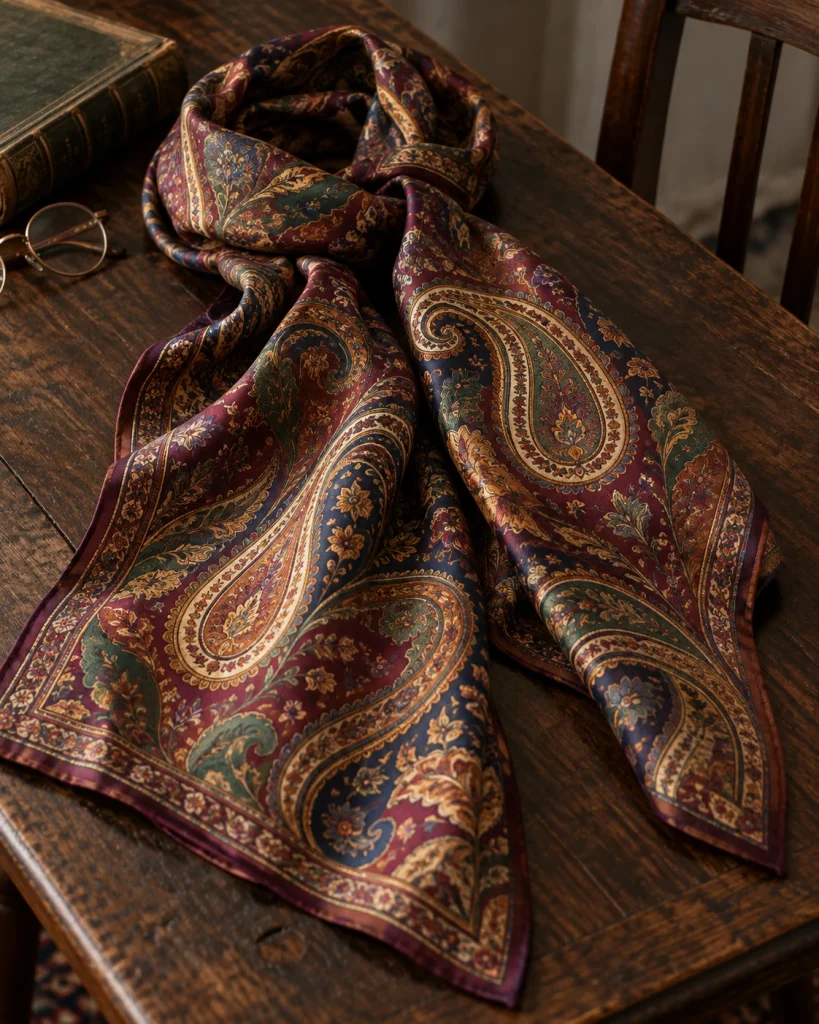
By the eighteenth century, these shawls had reached Europe, where their expense encouraged British manufacturers to make copies. According to Heriot-Watt University’s textile archive, Edinburgh weavers began producing Kashmir-inspired shawls in 1767, and by 1808 work was being outsourced to Paisley, where Jacquard looms made increasingly complex woven designs possible. A Jacquard mechanism uses punched cards to control the warp threads individually, allowing elaborate figures to be woven into cloth.
By the 1830s, production in Paisley had overtaken other British centres. The town became so closely associated with the shawls that its name attached itself to the design.
I enjoy paisley when the shapes are large enough to appreciate and the colours have some depth. A richly patterned scarf in burgundy, green and gold has considerably more to offer than a tiny, repetitive paisley print scattered across a shiny shirt. The latter often looks as though somebody asked a computer to make the fabric more interesting and then neglected to inspect the result.
You can weave a paisley design into cloth or print it onto finished fabric. A scarf covered in those familiar curved forms might therefore have a construction quite different from another scarf carrying the same design.
The name identifies what you’re looking at. The cloth tells you how it was made.
The second-hand test: follow a single thread
There is a surprisingly useful way to investigate a woven-in check.
If an accessible seam allowance has an already-loose strand of the fabric’s own yarn, gently draw it free and examine its length. Don’t confuse it with the thread used to stitch the seam, and don’t pull intact threads out of a shop’s garment to satisfy your curiosity.
In a conventional yarn-dyed check, the individual threads were coloured before weaving. A blue thread remains blue along its length, and a white thread remains white. Their arrangement creates the design.
On fabric with a printed check, the decoration was applied after weaving. A single thread passing through different parts of the print may therefore carry several colours along its length.
The University of Tennessee Extension’s 4-H textile-identification activity teaches this method of examining individual fabric threads. It offers a practical distinction between yarn-dyed checks and printed patterns, although deliberately multicoloured yarns, such as space-dyed yarns, can also change colour along their length.
Turning the cloth over provides another clue. Yarn-dyed checks often show their colour arrangement on both faces, while some prints appear paler on the reverse. But printing dyes can penetrate the cloth, and duplex printing applies corresponding designs to both sides. A figured weave such as damask may reverse the relationship between figure and background, while a lining can prevent you seeing the reverse at all.
On a second-hand rail, these observations help you decide whether you’re looking at a conventional yarn-dyed check or something that requires closer examination. On an online listing, where you cannot touch the garment, they also tell you which detail photographs might be worth requesting.
I still wouldn’t let an interesting weave distract me from the ordinary business of buying clothes. A spectacular Prince of Wales check with dreadful shoulders can remain on somebody else’s rail.
Leave a Reply