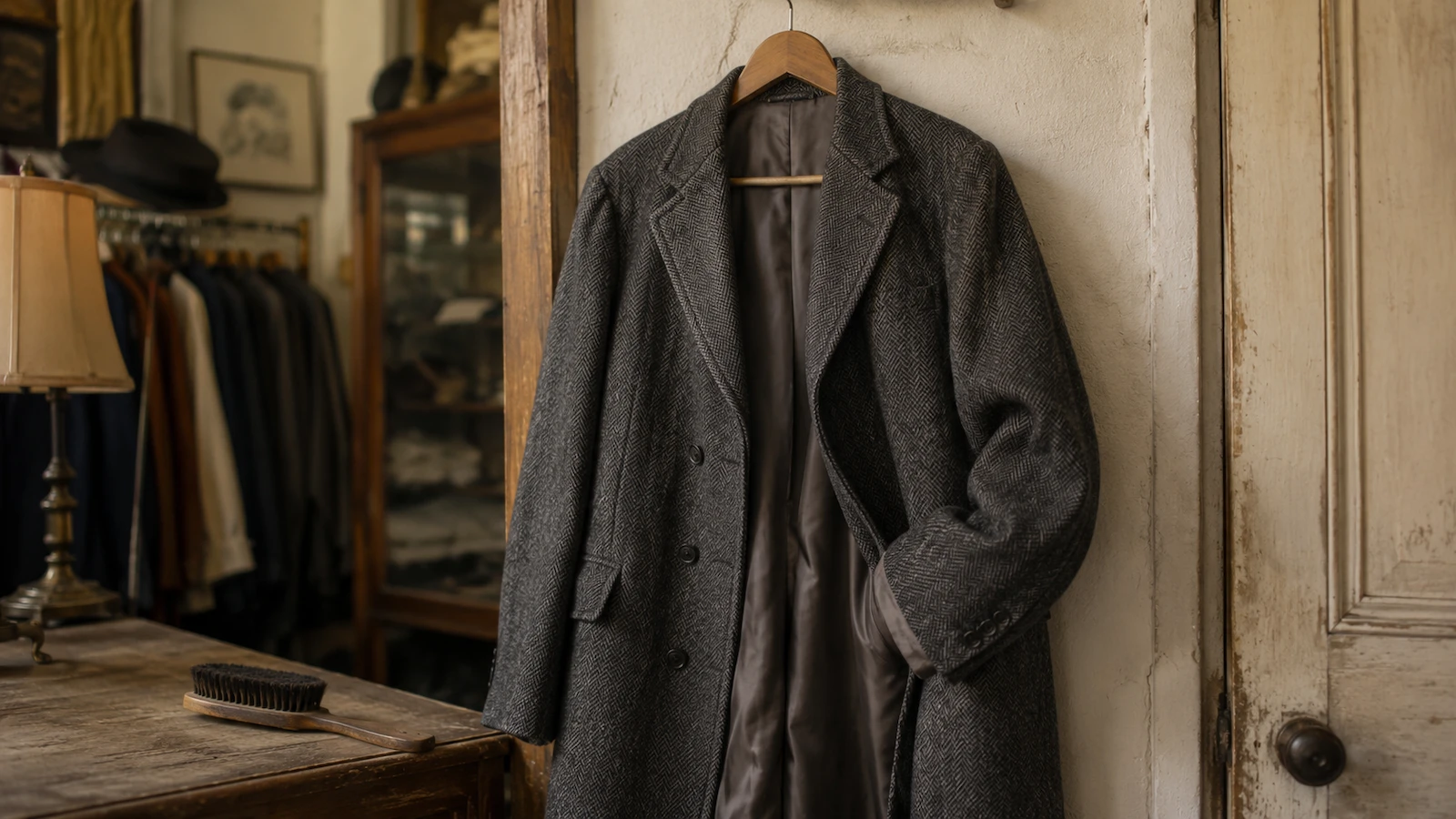
A few days ago, I left a wool coat in a charity shop.
It had done almost everything required to make me unreasonable about it: dark cloth, proper length, good lapels and enough weight to feel like an actual winter coat rather than a decorative approximation of one.
Then I put it on.
The shoulders were wrong.
The coat was not bad. It was simply somebody else’s coat, despite the ten minutes I had already spent mentally brushing it, repairing it and wearing it through November.
That near-miss stayed with me, so at the weekend I went back into town with a much narrower brief. I worked through three charity shops and one small second-hand shop, handled every plausible coat I found and tried on five of them.
I came home with one.
This article is deliberately about wool, wool-blend and tweed coats. Leather, waxed cotton, shearling and down have their own ways of failing, and trying to cover all of them would produce an article so heavily caveated that nobody would reach the changing room.
The question I was trying to answer was simpler:
Are the parts that are difficult to change already right, and are the parts that are wrong actually repairable?
That is a much better buying test than whether the coat looks expensive on the hanger.
From across the room, decide only whether it is worth walking over
The first coat was camel. Of course it was.
Long, clean shape, broad lapels, The sort of colour that makes you imagine dark trousers and a coffee in hand.
From several feet away, it looked excellent. That is all the first look is for: whether I like the length, general silhouette, colour and cloth enough to investigate further. I do not want to decide that I have found the coat before I have touched it.
Second-hand clothes become dangerous when imagination gets ahead of evidence.
I have written before about what charity shops actually have on the rails, which is rarely what the internet promises.
Up close, the camel coat had a slightly polished cuff and noticeably more wear around the pocket openings. Neither would necessarily have bothered me on its own, but when I ran my fingers over the cloth the worn areas felt thinner than the surrounding fabric.
That is different from a coat merely looking used. Softened wool can be lovely. A bit of surface fluff can be brushed. A few pills are annoying rather than terminal. Cloth that is actually becoming thin at the points that get handled every day has already told you where the next problem is likely to appear.
I put the camel coat back.
No tragedy occurred.
On the hanger, inspect the places winter will attack again
A coat can hide an impressive amount of information while hanging politely.
I start with the places that have already done the most work: cuffs, pocket mouths, elbows, hem, collar edges and fastenings. I lift the sleeves, turn back the collar and look at the cloth from more than one angle rather than accepting whatever the shop lighting has decided to reveal.
With tweed, texture itself is not damage. A nubbly surface, colour variation or visible weave is part of the point. What I am looking for is something different: broken threads, a pulled seam, an actual hole or an area where the cloth has become substantially thinner than the rest.
Then there is the fibre label. I like wool; this will surprise nobody. I do not, however, think 100% wool is a certificate of moral or structural superiority. I would rather buy a sound wool-blend coat with good cloth than a pure-wool one whose cuffs are halfway to transparency.
The label tells me what the garment contains. The garment tells me what has happened to it.
That distinction matters particularly with second-hand clothes because you are not buying a specification sheet. You are buying whatever remains after somebody else has worn, stored, cleaned and occasionally ignored it.
I have a broader guide to making second-hand clothes look expensive if you want the full cloth-and-construction inspection. With a winter coat, I am harsher: it has to cope with bags, pockets, rain, sleeves rubbing against desks and doors, and my repeated decision to put far too many things in one pocket.
A weak point is going to get another winter of the same treatment.
Try it on over the clothes you will actually wear underneath
For this outing I deliberately wore a mid-weight jumper.
Trying on a winter coat over a T-shirt is optimistic to the point of sabotage. A coat can look wonderfully neat in the mirror when there is nothing underneath it, then become a restrictive shell the first time you add knitwear.
I want enough room to button it comfortably, move my arms forwards, reach up, sit down and put my hands in the pockets without the entire garment travelling with me.
The second promising coat was navy and much plainer than the camel one. The cloth was in better condition and the lining looked respectable. From the front, standing still, it was probably the most sensible coat I tried all afternoon.
Then I reached forwards and the armholes and upper back tightened immediately.
I could wear it. I just could not do very much while wearing it.
Sleeve length can often be altered. Body width can sometimes be altered. Even shoulder work is technically possible in the hands of somebody skilled enough. That does not make every alteration equally sensible.
If a coat feels wrong through the shoulders, armholes or upper back before I have even left the shop, I need a very good reason to turn it into a tailoring project.
I did not have one.
The navy coat went back too.
Now look inside, where optimism usually goes to die
The outside gets the photograph. The inside gets the repair bill.
Turn the coat open and look properly at the lining, pocket bags, seams, underarms and hem. Check where the lining meets the sleeves and where pockets have been pulled repeatedly by hands, keys, phones and whatever else previous owners considered reasonable cargo.
This was where the coat I eventually bought became interesting.
It was charcoal herringbone, single-breasted and long enough to fall just below my knee. On the hanger it looked slightly neglected rather than impressive. There was lint on one sleeve and one button was loose.
Neither bothered me.
The outer cloth was sound. The cuffs still had their surface, the pocket edges were intact, and I could not find holes beneath the collar, around the hem or in the folds of the fabric.
Inside, there was a short opening in the lining seam beside one pocket. That bothered me considerably less than a worn patch in the outer wool would have done.
A seam can be sewn. Missing cloth is a different negotiation.
This is also where I check second-hand wool for anything suspicious before allowing it into the rest of my wardrobe. I already have a separate guide to storing wool clothes and preventing moth damage, but the buying-stage version is simple: look beneath collars, around seams, inside pockets and along concealed folds rather than glancing at the front and deciding everything is probably fine.
I have limited wardrobe space. I do not need to introduce a biological subplot.
Buy repairs you understand
There is a difference between repairable and worth repairing.
Almost astonishing things can be done to coats by a good alterations specialist. Sleeves can be shortened, bodies reshaped, linings replaced and even shoulders altered.
That is useful information, not permission to buy any wreck you happen to find attractive.
My own hierarchy is fairly unsentimental. A loose button does not frighten me, nor does a straightforward opening in a lining seam, a dropped hem or another small repair whose boundaries I can see. A completely exhausted lining makes me stop and think. Major shoulder work makes me think considerably harder. Outer cloth worn thin over a broad area usually makes the decision for me.
If a coat needs specialist work, I would rather know what that work is before buying it. For an expensive or particularly unusual second-hand coat, that may mean asking an alterations professional whether the job is realistic and getting an actual quote rather than inventing a reassuring number in my head.
A £20 coat requiring £100 of work is not necessarily a bad purchase if the finished coat is worth that total to you. It is, however, a £120 decision.
The charity-shop price tag does not get to pretend otherwise.
The coat that came home with me
The charcoal herringbone fitted properly over my jumper. The shoulders sat where they needed to, I could button it without compressing the knitwear underneath, and I could reach forwards, sit down and put my hands in the pockets without something pulling elsewhere.
The label confirmed a wool blend, which was useful information but not the reason I bought it.
I bought it because the hard-to-change parts were right.
It cost me £40.
That mattered because its faults were boring: one loose button and one short opening in a lining seam, both things I understood before I paid for it. I was buying a £40 coat with two small jobs attached, not a £40 coat plus an unknown tailoring problem hiding in the shoulders.
Boring faults are underrated.
At home, I gave the coat another inspection in better light, brushed the surface and secured the button. I closed the little lining seam rather than waiting for it to become a much more ambitious lining seam.
For cleaning and future care, the coat’s own label gets the final say; my beginner’s guide to clothing care covers the routine I use for airing, brushing, storing and dealing with small repairs before they spread.
The useful thing about buying second-hand is that wear gives you evidence. The coat does not have to be pristine, and I do not particularly want it to be. What I want is remaining life: sound cloth at the places that will rub again, a shape that works over actual winter clothes, shoulders and armholes that already belong to me, and faults whose scale I understand.
You cannot stand in a charity shop and prove that a coat will survive another three winters. You can avoid buying one that is already halfway through its last.
The herringbone coat is now hanging in my wardrobe: brushed, button secure, lining closed and looking considerably more intentional than it did on the rail.
This does create the traditional difficulty that my wardrobe remains exactly the same size no matter how persuasive I find another coat.
Something may eventually have to leave.
I have decided not to think about that today.
Leave a Reply