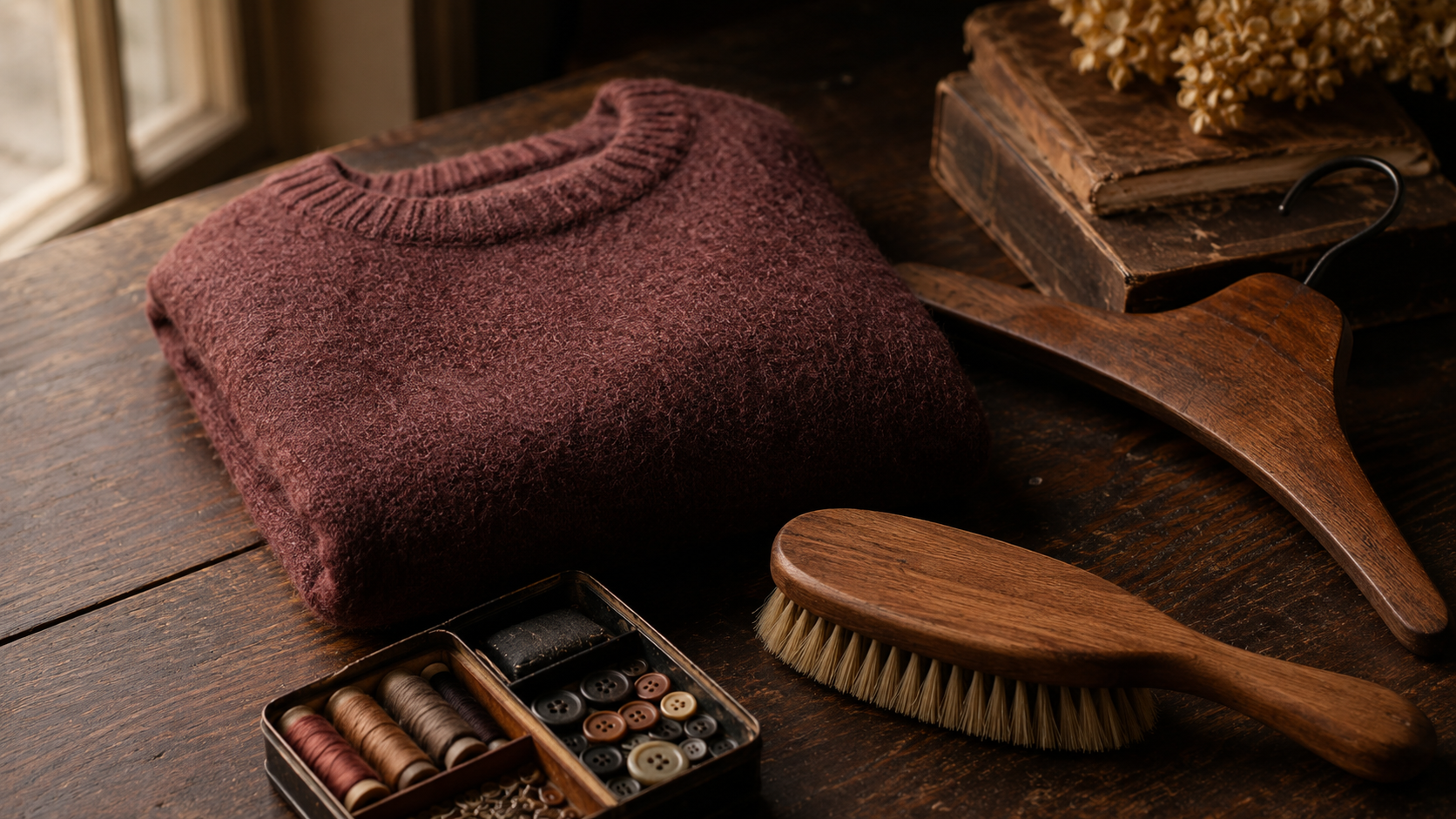
Clothing care is mostly a series of small decisions made before anything goes wrong.
Read the care label. Look at the garment itself. Notice what it is made from, how it is constructed, where it is dirty and whether the problem actually needs washing at all. Then use the gentlest suitable method and deal with small faults before they become expensive ones.
That is the basic system. You do not need a shelf of specialist products or a laundry room large enough to acquire its own postcode. You need enough attention to distinguish a jumper that needs airing from one that needs washing, a loose button from a failing seam, and ordinary wear from damage that is beginning to spread.
This guide covers the everyday version: washing, drying, pressing, storage, small repairs and the point at which a garment should leave your hands and go to somebody who knows more than you do.
Begin with the label and the garment itself
Before cleaning anything, read the care label from beginning to end. Do not look only at the washing temperature. Drying, ironing, bleaching and professional-cleaning symbols matter too.
Treat the instructions as the limit of what the garment is designed to tolerate, not a challenge to see how close you can sail to disaster. A jumper labelled for a gentle wool wash does not benefit from a hotter cycle merely because the washing machine is already full.
The fibre label is useful, but it does not tell the whole story. Two wool garments may require different care because one is knitted and unlined while the other is tailored, fused, lined or decorated. Construction can matter as much as fibre.
Before proceeding, check for:
- loose buttons or fastenings;
- open seams and fallen hems;
- stains, marks or discolouration;
- worn cuffs, elbows and pocket edges;
- fragile beading, embroidery or trim;
- damaged lining;
- signs of moth activity;
- areas where the colour may not be stable.
Repairing or identifying a problem before washing is much easier than discovering it after the machine has enlarged it.
When the care label is missing
Older and second-hand clothes do not always arrive with a readable care label. When that happens, uncertainty should make the treatment less invasive, not more inventive.
Start by inspecting the complete garment. Look at the outer cloth, lining, interfacing, trim, buttons, zips, embroidery, coatings and anything else that may react differently to water, heat or cleaning products. GINETEX notes that care instructions apply to the most sensitive part of the textile article, including colouring, finishing, accessories and applications, which is why fibre content alone cannot tell you how a garment should be cleaned.
Comparing the cloth with garments you already know can still be useful. So can asking a previous owner what they remember about its care. Treat both as evidence about the garment’s history rather than instructions you have independently verified.
For an unlabelled piece, begin with low-risk care where appropriate: air it, brush a sturdy surface gently, empty the pockets and deal cautiously with loose dust or debris. Do not move from “this feels like wool” to “therefore it can go through my usual wool cycle”.
If the unlabelled garment is specifically a wool jumper, my guide to washing a wool jumper without a care label works through when cautious hand washing is reasonable and when I would stop.
Valuable vintage clothing, structured tailoring, unstable colour, unfamiliar finishes and garments made from several different materials deserve specialist advice before you introduce water, heat, solvents or stain treatments.
Keep notes only when they are useful
Most clothes do not need a maintenance record. For unusual vintage pieces, missing-label garments or anything with a complicated repair or cleaning history, keep a short note somewhere you will actually look — your phone is enough. Record the thing you are likely to forget: what treatment worked, what caused a problem, who repaired it, or which instruction needs checking before the garment is cleaned again.
Care for clothes between washes
A useful care routine begins when you take the garment off, not when the laundry basket is full.
Before putting something away:
- empty the pockets;
- remove detachable belts, brooches or heavy accessories;
- check the underarms, collar, cuffs and hem for dirt or damage;
- allow damp or warm clothing to air before returning it to the wardrobe;
- brush sturdy woven cloth where appropriate;
- hang or fold the garment according to its construction;
- put anything needing repair somewhere you will actually see it again.
Do not return a damp coat to a crowded wardrobe. Let it dry completely in moving air and away from direct heat. Heavy knitwear should be folded once dry rather than left hanging from its shoulders under its own weight.
Whether the garment then needs washing depends on what has happened to it. Clothes worn directly against the skin will generally need cleaning sooner than coats, jackets and some trousers, but there is no useful universal timetable. Look at soiling, odour, perspiration, stains, weather, length of wear and the garment’s care instructions.
When an outer layer is still clean, dry and free from odour, airing, brushing or appropriate spot care may be enough before it goes back into use. Washing less often only works when it is replaced by attention; leaving dirt untreated for longer is not conservation.
If the problem is specifically wood smoke, my guide to getting bonfire smoke smell out of clothes explains why the odour lingers and when airing should give way to washing.
Those small maintenance jobs are also what help make second-hand clothes look more expensive in practice; that guide deals with the visible reset rather than the whole care system.
Before machine washing:
- empty every pocket;
- fasten zips and hooks that could catch;
- turn suitable garments inside out;
- use a laundry bag for delicate or easily snagged pieces where appropriate;
- choose a detergent suitable for the garment and wash type;
- follow the cycle and temperature on the care label;
- leave enough room in the drum for the clothes to move properly.
Do not combine unfamiliar stain removers, bleaches or household cleaners in the hope that greater chemical enthusiasm will produce greater cleanliness. Use products only as directed and for their intended purpose.
If the label says dry clean only, treat that as the garment’s care instruction rather than a suggestion to be negotiated with. Point out stains or damaged areas when handing the garment over so the cleaner knows where the problem is.
Be cautious with stains and hot water
Stains are one of the places where instinct is least reliable. More heat, more rubbing and a stronger product can all make the problem worse.
Identify the stain where you reasonably can, check the garment’s care instructions and use guidance intended for that combination of stain and fabric. University of Georgia Extension makes the point repeatedly in its stain-removal guidance: treatment varies by substance, the care label still governs what the garment can tolerate, and cleaning products should be tested on an inconspicuous area first.
Temperature is part of that diagnosis. Coffee and tea are commonly rinsed promptly with cool water, while egg stains should not be treated with hot water because heat can set the protein. Other oily or dairy-based stains may call for warmer treatment when the fabric permits it. There is no single water temperature that is safest for every unidentified mark.
For a fresh spill, remove excess solid material carefully and blot rather than scrub. Work from the outside of the mark towards the centre where practical, and avoid spreading the stain across a larger area.
Test any treatment somewhere inconspicuous before committing to the visible part of the garment. If the stain is unknown, the fabric is delicate or the first cautious attempt changes the colour, texture or finish, stop and get specialist advice rather than escalating at random.
Do not introduce heat from an iron or tumble dryer merely because the mark looks stubborn. Heat is useful only when the treatment calls for it and the garment can safely tolerate it.
Treat drying as part of the cleaning process
A successful wash can still be spoiled during drying.
Remove garments promptly when the cycle ends and smooth sturdy pieces back towards their intended shape before they dry. Straighten collars, cuffs and seams rather than leaving them twisted or crushed.
Follow the drying instruction on the care label as carefully as the washing instruction. GINETEX distinguishes between tumble drying and natural methods such as line drying and flat drying, with the symbol specifying what the complete garment is designed to tolerate.
Heavy knitwear often needs particular support while wet. When the care instructions call for flat drying, gently reshape the garment to its normal proportions and lay it on a clean, colourfast towel or suitable drying surface. Hanging a water-heavy jumper from its shoulders can allow its own weight to pull the garment out of shape.
Use a tumble dryer only when the label permits it, and follow the indicated level of heat. If the garment is marked do not tumble dry, choose an appropriate natural drying method instead.
Whatever method you use, let the garment dry completely before putting it away. Thick seams, waistbands, cuffs and linings can remain damp after the main cloth feels dry, so check those areas before returning the piece to a drawer or wardrobe.
Press and steam with restraint
Pressing can restore shape and remove creases, but heat, moisture and pressure all need to suit the garment.
Pressing means lowering and lifting the iron rather than sliding it continuously across the cloth. New Mexico State University Extension recommends this lower-and-lift motion because it reduces stretching and helps preserve the garment’s shape. The same guidance stresses that temperature, moisture and pressure depend on fibre, weave, texture, finish and construction.
Check the care label before using an iron or steamer, and use a pressing cloth where appropriate. Stop if the surface develops shine, flattening, puckering, colour change or any other visible alteration.
Velvet, silk, coated fabrics, unstable dyes, embellishment and structured garments deserve more caution than a beginner guide can sensibly compress into one paragraph.
Store according to the garment’s construction
Storage should support the garment rather than simply make the wardrobe look tidy.
Structured coats and jackets usually need broad hangers that support the shoulders without forcing them into an unnatural shape. Heavy knitwear generally belongs folded because its own weight can stretch the shoulders and lengthen the body. Fragile vintage pieces, weak shoulder seams and heavily embellished garments may need padded support or flat storage instead.
Leave enough room around hanging clothes that collars, lapels and sleeves are not crushed permanently against their neighbours. A wardrobe packed solidly enough to give every jacket somebody else’s shoulder line is not doing much useful preservation.
Before putting clothes away for a season:
- clean or professionally clean them as appropriate;
- make sure they are completely dry;
- empty every pocket;
- fold or support them according to their construction;
- inspect the storage area for damp or pest activity;
- check stored garments periodically rather than abandoning them until winter.
Clothes-moth larvae are the damaging stage, and undisturbed animal-fibre textiles are particularly vulnerable. Keep wardrobes and drawers clean, inspect folds and concealed areas, and disturb stored clothes from time to time — my moth guide covers prevention, diagnosis and treatment in detail.
Lavender or cedar can make a cupboard smell pleasant, but neither replaces cleaning, inspection or treatment where there is active moth activity.
Repair small faults before they become expensive ones
A missing button, opening seam or fallen hem is usually cheaper and easier to deal with while the surrounding cloth is still sound.
Do the jobs you can do competently. Sew on a button, secure a loose hem or close a simple seam when the fabric and construction make that straightforward. If the cloth itself is tearing, the lining is shredding rather than merely opening at a seam, or the repair affects fit and structure, the job has changed.
If the cloth itself is worn but still sound enough to reinforce, my guide to visible mending shows how I patched thinning denim from behind and stitched through both layers.
That distinction matters with linings in particular. A short seam opening can be routine; worn-through cloth, widespread tearing or failure around several stress points can mean the lining itself is approaching the end of its useful life. I go through that judgement in when a split coat lining is actually worth repairing.
Alterations deserve the same caution. I once bought a pair of second-hand flares that were far too long, then had them shortened to the point where they actually worked with the shoes I owned. That was a small, contained change with a predictable result. Recutting a jacket through the shoulders is a different species of optimism.
A good tailor or alterations specialist becomes useful when the repair affects structure, fit or cloth you would rather not learn on. Explain what bothers you, ask what they think is realistically achievable, and get a price before turning a cheap second-hand find into an unexpectedly ambitious restoration project.
Shoes have their own version of this decision. Loose stitching or worn heels may be repairable; collapsing structure, badly damaged uppers or extensive sole failure can make a bargain much less interesting. My guide to buying second-hand shoes — and when not to deals with that in more detail.
Keep a small clothing-care kit
A basic clothing-care kit only needs to cover the jobs you are actually likely to do.
I would start with:
- a garment brush for suitable coats and sturdy woven cloth;
- a lint brush or roller;
- a few hand-sewing needles;
- thread in the colours you use most;
- spare buttons worth keeping;
- a pressing cloth;
- one or two laundry bags for delicate or easily snagged items.
That is enough for loose buttons, minor seams, surface lint, basic pressing and sensible machine washing.
Add specialist tools when a real garment gives you a reason to own them. A seam ripper is useful once you are actually undoing stitches. A tape measure becomes useful when alterations enter the picture. A wool comb or fabric shaver only earns space if you regularly deal with pilling, and repeated surface removal is not a substitute for understanding why a fabric keeps bobbling. My guide to what pilling actually tells you about a jumper goes into that properly.
The useful kit is the one you reach for. A drawer full of highly specialised tools that never leave their packets is simply haberdashery-themed storage.
For examples of useful clothing-care tools, along with what I would look for before buying them, see the Wardrobe Toolkit.
Know when to stop
Home care stops being the sensible choice when the uncertainty becomes more expensive than the professional advice.
I would pause and get specialist help when:
- the garment is valuable, rare or difficult to replace;
- the fibre, dye, finish or previous treatment is unknown and appears unstable;
- several materials or complicated construction make one treatment risky for another part of the garment;
- mould, serious pest activity or widespread deterioration is involved;
- a stain or damage has resisted the first appropriate treatment and further experimentation would become guesswork.
Stop immediately if a test causes colour transfer, distortion, puckering, fibre loss or a visible change to the surface. A treatment that has begun altering the garment has already supplied useful information; continuing simply to see whether matters improve is a poor experiment.
Silk, velvet, cashmere, delicate finishes and embellished garments bring their own complications. My guide to caring for velvet, silk and other delicate fabrics covers those cases in more detail.
Asking for help is part of clothing care. The useful skill is not knowing how to perform every possible treatment at home; it is recognising when the garment has exceeded what you can safely establish yourself.
There is a difference between character and neglect
Clothes can show their age without looking abandoned. Softened wool, polished leather, gentle fading and a neat repair all record use while leaving the garment clean, functional and worth wearing.
The difference usually comes down to small decisions made at the right time: airing a damp coat before it goes back into the wardrobe, folding a jumper before its shoulders stretch, sewing on the loose button while you still know where it is, and reading the label before introducing anything to hot water.
The same principle runs through building a storybook wardrobe without looking like costume. Character develops through clothes being chosen, worn and maintained with intention rather than preserved as immaculate props.
A characterful wardrobe can look thoroughly lived in. What keeps it from looking neglected is attention.