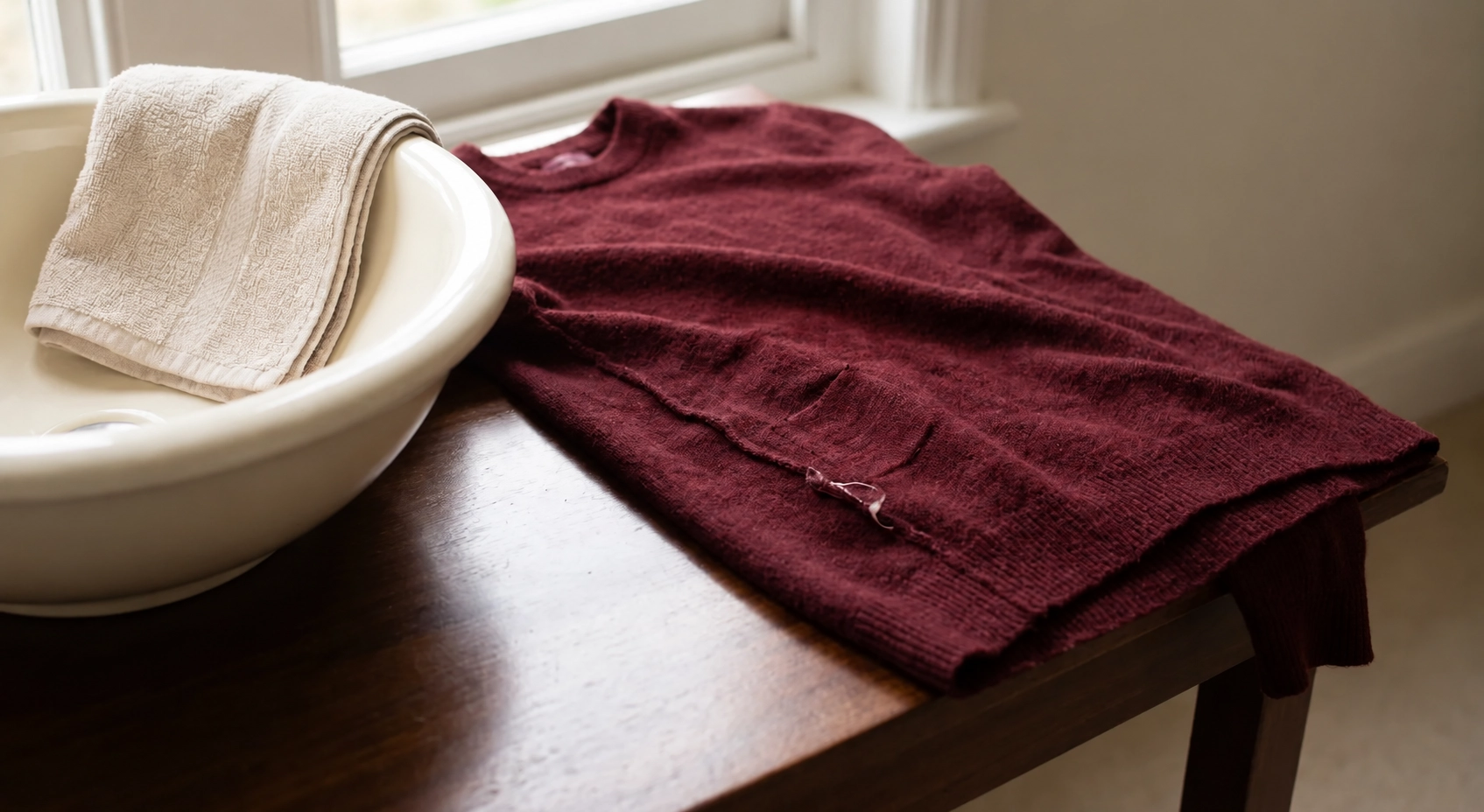
A missing care label does not turn a wool jumper into a hand-wash jumper. It removes the bit of evidence that would have told you whether the manufacturer approved machine washing, hand washing, professional cleaning or no wet washing at all.
That is particularly irritating with second-hand knitwear because the safest advice is normally also the dullest: read the label. If somebody has already cut it out, you have to replace certainty with a hierarchy of risk.
My rule is simple: do not guess your way upwards. If airing is enough, air it. If the jumper genuinely needs a full clean, cautious hand washing may be a reasonable choice for a simple wool knit — but it remains a choice made without the manufacturer’s instructions. An expensive, complicated or irreplaceable jumper deserves more caution than one you can afford to lose.
First, work out exactly what is missing
There are two useful pieces of information normally sewn into clothing: what the garment is made from and how the finished garment should be cared for. They may appear on one label or several.
The difference matters.
I have a dark bottle-green cashmere jumper that has done five winters. I bought it new for £110; its ribbing is still sound, its shape still works and it remains one of the pieces I actually want to wear. I also know what it is made from. That is useful information before I go anywhere near water.
A second-hand jumper with every label removed gives you less.
If the care instructions have disappeared but the composition label remains, you at least know whether you are dealing with wool, a wool blend or something else. If every label has gone and your only evidence is that the jumper feels rather woolly, there is another uncertainty before you even reach the sink.
Do not turn touch into laboratory analysis. Wool, acrylic and blends can all produce convincing knitwear, and appropriate care depends on more than whether a garment feels soft or hairy.
If you know the maker and exact style, it is worth looking for the original product information. Match the actual garment, not merely the brand: the same company can sell knitwear with different care requirements.
Otherwise, accept what you do not know. An absent label is missing evidence, not an invitation to invent it.
A wool cycle does not make every wool jumper machine washable
This is the first assumption I would discard.
Woolmark says machine washing is appropriate when the garment’s care claim says it is machine washable. Wool can also be processed specifically to resist shrinkage in washing; superwash is an industry term for wool given a shrink-resistant treatment so that it can be machine washed.
That means the wool setting on the washing machine tells you something useful about the machine.
It tells you nothing about whether the anonymous jumper in your hands was made for it.
Without the original care claim, I would not machine wash a wool jumper merely because the dial offers a setting with a reassuring little ball of yarn beside it.
Before washing it, ask whether it actually needs washing
This is the cheapest way to reduce the risk.
Woolmark advises airing wool garments as part of routine care, and wool often does not need washing after every wear.
A jumper that has picked up an odour, been worn once or simply smells as though it has spent several months in somebody else’s wardrobe does not automatically need to be submerged.
Air it first. Then inspect the underarms, collar, cuffs and front properly.
If the odour is bonfire smoke, my guide to getting bonfire smoke smell out of clothes explains what the smell is and when airing should give way to cleaning.
A local mark is also a different problem from a generally dirty jumper. Deal with the problem you actually have rather than promoting every spot to a full laundry event.
It is the same principle behind my beginner’s guide to clothing care: look at the garment, identify what is wrong and choose the gentlest suitable intervention rather than washing by habit.
Sometimes the correct wash cycle is none.
When I would stop rather than experiment
There is no domestic method I can honestly call guaranteed safe once the care instructions have vanished.
GINETEX, which maintains the textile-care symbol system used under ISO 3758, includes a specific do not wash instruction for garments that may be sensitive to wet treatment. The awkward fact beneath this entire article is that the missing label could have contained exactly that instruction.
I would therefore stop and consider professional cleaning when:
- the jumper is expensive enough that ruining it would genuinely matter;
- it is vintage, rare or otherwise difficult to replace;
- the fibre content is unknown as well as the care instructions;
- it contains leather, structured trim, embroidery, beads or other materials whose behaviour in water is uncertain;
- the knit is already weak, badly distorted or damaged;
- there is a serious stain requiring more than an ordinary gentle wash.
Professional cleaning is not a ceremonial reward for owning nice knitwear. Here it is simply a way of handing an unresolved cleaning problem to somebody better equipped to assess it.
A £10 second-hand jumper and the irreplaceable jumper you spent five years finding are allowed different amounts of caution.
If you decide to hand wash it, keep the process boring
For a simple wool jumper whose precise wash instructions are missing, hand washing lets you control the handling directly rather than committing the garment to a machine cycle whose suitability you cannot establish.
That does not prove the unknown jumper is washable. The following is the conservative method I would use only after deciding that the remaining risk was acceptable.
These steps follow Woolmark’s hand-washing guidance, adapted conservatively for a jumper whose original care instructions are missing.
1. Turn the jumper inside out
Do this before it goes into the water.
2. Fill a clean basin with lukewarm water
Fill the basin with clean, lukewarm water, around 30°C.
Use only a small quantity of mild, neutral detergent suitable for wool rather than a heavy-duty product.
3. Soak it for about ten minutes
Lower the jumper into the water and let it become thoroughly wet.
Leave it to soak for around ten minutes. Handle it gently rather than scrubbing one section against another.
There is no benefit in behaving as though the jumper owes you money.
4. Rinse it properly
Rinse thoroughly in lukewarm water first, then rinse again in cold water.
Keep the handling gentle while you rinse. Do not rub or wring the knit.
5. Remove the excess water before you try to dry it
Drain the basin rather than lifting a waterlogged jumper and immediately carrying it across the room.
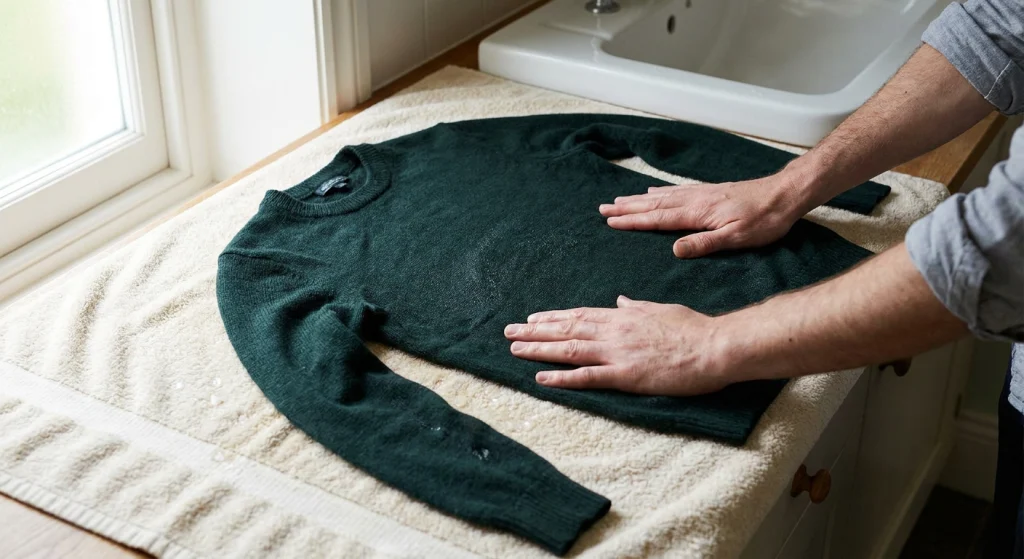
Woolmark’s sweater-care guidance recommends gently pressing water out of the garment by hand, without wringing it, then allowing it to continue draining. Once it is no longer dripping, move it flat onto a plain towel.
Support the jumper while you handle it. Wet knitwear is much heavier than dry knitwear, and this is not the moment to suspend the entire garment from one cuff while searching for somewhere to put it.
Now it is ready to dry.
Drying is part of the wash
A wet knitted jumper carries a considerable amount of water. Hanging it from the shoulders asks that extra weight to pull on a structure intended to be worn dry.
Woolmark recommends drying sweaters and other knitwear flat, away from direct sunlight and direct heat. It warns that line drying or using a hanger can allow wet knitwear to stretch and lose its shape.
Lay the jumper flat on the towel and ease the body, sleeves, cuffs and hem back towards their ordinary shape. You are arranging it, not stretching it into a new size.
Leave it flat until it is properly dry.
I would also rule out the tumble dryer when the care label is missing. Woolmark permits tumble drying only where the garment’s care claim specifically allows it. In this problem, that permission is precisely what has disappeared.
Once it is completely dry, my guide to storing wool clothes and preventing moth damage covers what happens before it goes back into the wardrobe.
What felting actually means
This is the point at which the physics earns its proper name.
Untreated wool fibres have overlapping microscopic scales on their surfaces. In water, with heat and mechanical agitation, those scales can begin to catch against neighbouring fibres. Felting is the resulting entanglement: the fibres lock together, the fabric becomes denser and the garment can shrink. Woolmark describes that process as irreversible.
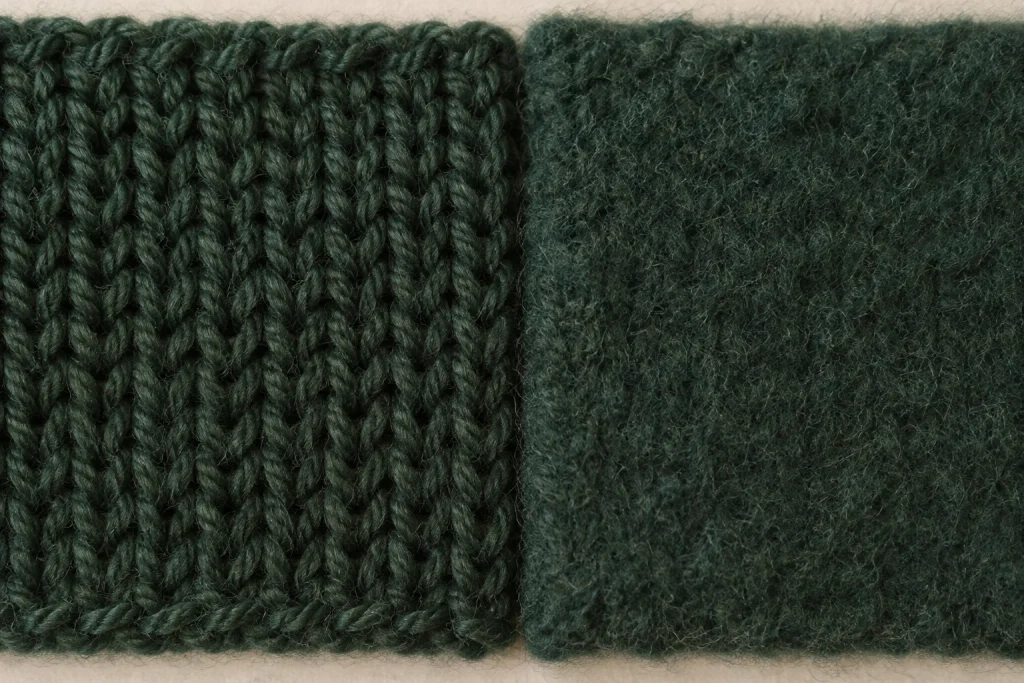
That is different from a jumper simply drying a little out of shape.
Minor distortion in washable knitwear can sometimes be corrected while the garment is damp by easing it back towards its intended shape. Woolmark recommends reshaping sweaters during flat drying for exactly that reason.
A heavily felted jumper has undergone a physical change in the fibre structure.
This is where internet laundry advice develops an alarming confidence in hair conditioner, stretching and various domestic rituals. Those methods may make a slightly distorted garment more wearable; they do not reverse severe felting.
Prevention was the useful trick.
The missing label changes the decision
With an intact label, wool care is pleasantly bureaucratic. Read the instruction and follow it.
Without one, there is no honest universal replacement. You can reduce the uncertainty: establish the fibre if possible, find the exact manufacturer’s instructions if they still exist, air rather than wash when that solves the problem, and do not assume that the presence of a wool cycle grants the jumper machine-washability.
If you decide that a simple unidentified wool knit is worth the remaining risk, controlled hand washing gives you a cautious route. If the garment is valuable, complicated or sufficiently mysterious, stopping is also a complete answer.
That is less satisfying than discovering one secret setting that makes every wool jumper safe.
The care label may have vanished. The consequences have not.
Leave a Reply