I came home from a bonfire with a navy cotton sweatshirt that had done nothing more adventurous than spend an evening reasonably close to a fire.
At the time, the smell suited the occasion. Smoke, cold air, somebody else’s garden: all perfectly acceptable. The following morning, picking the sweatshirt up from the back of a chair made the house smell as though part of the bonfire had been brought home for administrative purposes.
There was no visible ash on it. Nothing looked dirty. It simply still smelled unmistakably of wood smoke.
That persistence is what makes bonfire smell an interesting clothing-care problem. Smoke is not one substance sitting politely on the surface waiting to be dusted off. Some of its compounds can be taken up by textile fibres and released again afterwards.
Fortunately, getting rid of them does not require turning the washing machine into a chemistry set. Start with air. If that is not enough, wash the garment according to its care label. If the garment cannot be washed at home, respect that distinction rather than improvising a wet treatment.
What the bonfire smell actually is
The US Environmental Protection Agency (EPA) describes wood smoke as a complex mixture of gases and microscopic particles produced when wood and other organic matter burn. That already makes ‘smoke smell’ a misleadingly tidy phrase: there is no single smoke substance to remove.
Work by Wang and colleagues gives us a particularly useful clothing connection. In a preliminary study using oak smoke and cotton fabric, the researchers identified 46 organic compounds in extracts from the smoke-exposed cotton. They then measured the accumulation of six volatile organic compounds associated with the oak smoke, including guaiacol and several related compounds.
So the smell on a sweatshirt the following morning is not merely yesterday’s air somehow refusing to leave. Compounds produced by the fire have reached the textile and some have remained there after the wearer has walked away from the smoke.
Why fabric keeps giving the smell back
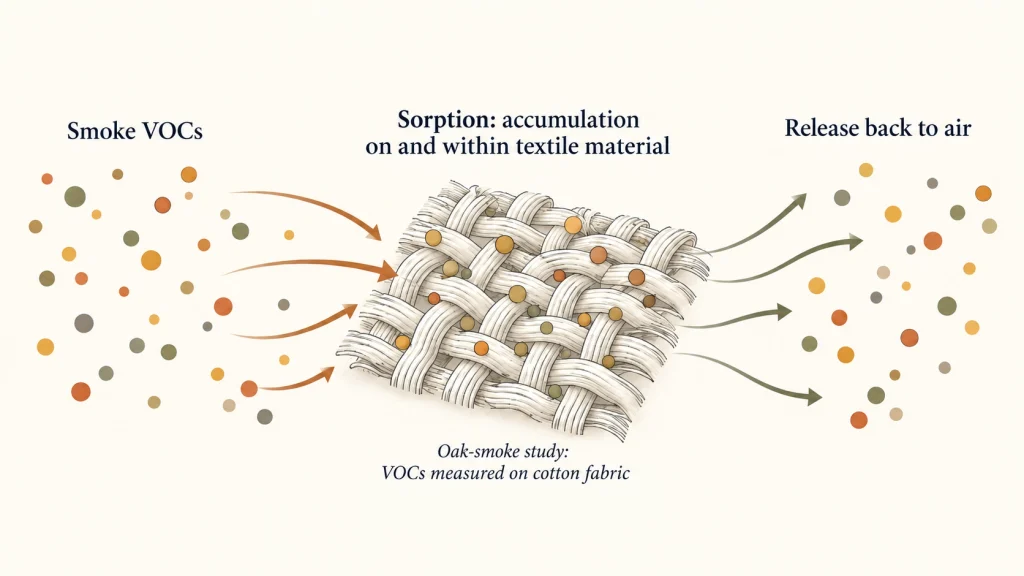
The useful term here is sorption: the reversible accumulation of chemicals on and within a material.
A 2025 study by Salthammer and colleagues measured how several semi-volatile organic compounds partitioned between air and nine different clothing textiles. The researchers describe clothing fibres as capable of accumulating chemicals and subsequently acting as a source from which those chemicals can be released again.
Wang’s oak-smoke study provides more directly relevant evidence for the uptake part of that process. The researchers measured six volatile organic compounds accumulating on cotton exposed to oak smoke; they also explain that retained compounds can later desorb — leave the fabric — and return to the surrounding air. The experiment was preliminary and concerned controlled smoke exposure rather than somebody’s sweatshirt beside a November bonfire, so it does not give us a domestic timetable.
There is an important limit here. It would be wonderfully convenient to turn all this into a league table declaring one fibre a smoke magnet and another practically fireproof from the neck down. The evidence does not justify that: Salthammer and colleagues found substantial differences between textile-and-chemical combinations, but concluded that no generally valid relationship described every interaction between a compound and a textile. Their tested chemicals were not specifically a bonfire-smoke mixture either. I would therefore choose what to wear to a bonfire on ordinary grounds — warmth, comfort, whether flying sparks would make me nervous — rather than pretending polyester, cotton or wool comes with a scientifically settled odour ranking.
Air smoky clothes before deciding they need washing
For light smoke exposure, give the garment moving air first.
Iowa State University Extension and Outreach advises laundering clothing minimally and says airing a lightly used garment can often remove odour. The American Cleaning Institute also has archived guidance specifically answering a question about clothes left smelling of smoke after a small fire; its first step is to hang the garments outdoors to air them.
Hang the garment with space around it rather than folding it into the laundry basket or returning it immediately to a crowded wardrobe. Outside is useful when the weather allows; otherwise use a genuinely ventilated indoor space. Then smell it again: if the odour has gone to a level you are happy with, there is no prize for washing it anyway. If it still smells distinctly of the bonfire, move on to the cleaning method the garment was actually designed to tolerate.
This is the same basic principle as my beginner’s guide to clothing care: identify the problem first, then use the least invasive treatment that solves it. There is no virtue in escalating merely because the washing machine is available.
If airing is not enough, read the care label and wash it properly
The next step for an ordinary washable garment is pleasingly dull. Read the complete care label: GINETEX says its symbols specify the maximum permitted treatment and apply to the complete textile article, including things such as colouring, finishes, buttons, zips and other applications. The wash symbol tells you whether domestic washing is allowed and the maximum temperature and severity of the process.
If the label permits washing, wash the garment with ordinary laundry detergent using a cycle and temperature allowed by that label. The American Cleaning Institute’s guidance likewise says washing can be fairly effective for smoke-affected fabrics, advises against overloading the machine and says to follow the care-label directions.
That is the whole intervention I would start with: no bicarbonate because a forum declared it miraculous, no vinegar merely because vinegar has acquired the domestic authority of a minor deity, and no additional substance simply to make the process look more determined. A properly conducted ordinary wash is already a cleaning process.
Check the smell before you tumble dry it
Do one small thing between the washing machine and the dryer: check the garment.
Oklahoma State University Extension advises washing smoke-affected clothes again if odour remains and not putting clothes that still smell of smoke into a tumble dryer.
Once the smell has gone, dry it by whatever method its care label permits. GINETEX’s drying symbols specify whether tumble drying is allowed and, where it is, the permitted severity of the process.
What if the garment cannot be washed?
A ‘do not wash’ symbol means precisely that. GINETEX says garments carrying it must not be washed and may be sensitive to wet treatment or unsuitable for a domestic washing machine.
Start with airing. If the smoke smell remains, do not interpret ‘do not wash’ as permission to invent a gentler-looking bath treatment at home. Look instead at the professional-care instructions on the label.
The care label may carry a professional-care symbol. GINETEX uses the circle to indicate professional dry- or wet-cleaning, with letters and bars giving the cleaner information about the permitted process and any necessary restrictions. Professional wet cleaning is not simply domestic hand-washing with better manners: its equipment, processes and finishing methods cannot be reproduced in a household washing machine.
If the complication is specifically an unlabelled wool jumper, that is a different decision altogether. I have already dealt with the missing-label hierarchy in my guide to washing a wool jumper without a care label; there is no reason to smuggle the whole wool article into this one wearing a fake moustache.
Bonfire smoke is a cleaning problem
Bonfires are excellent at atmosphere. They do not need to continue providing it from the back of a chair the following morning.
Leave a Reply