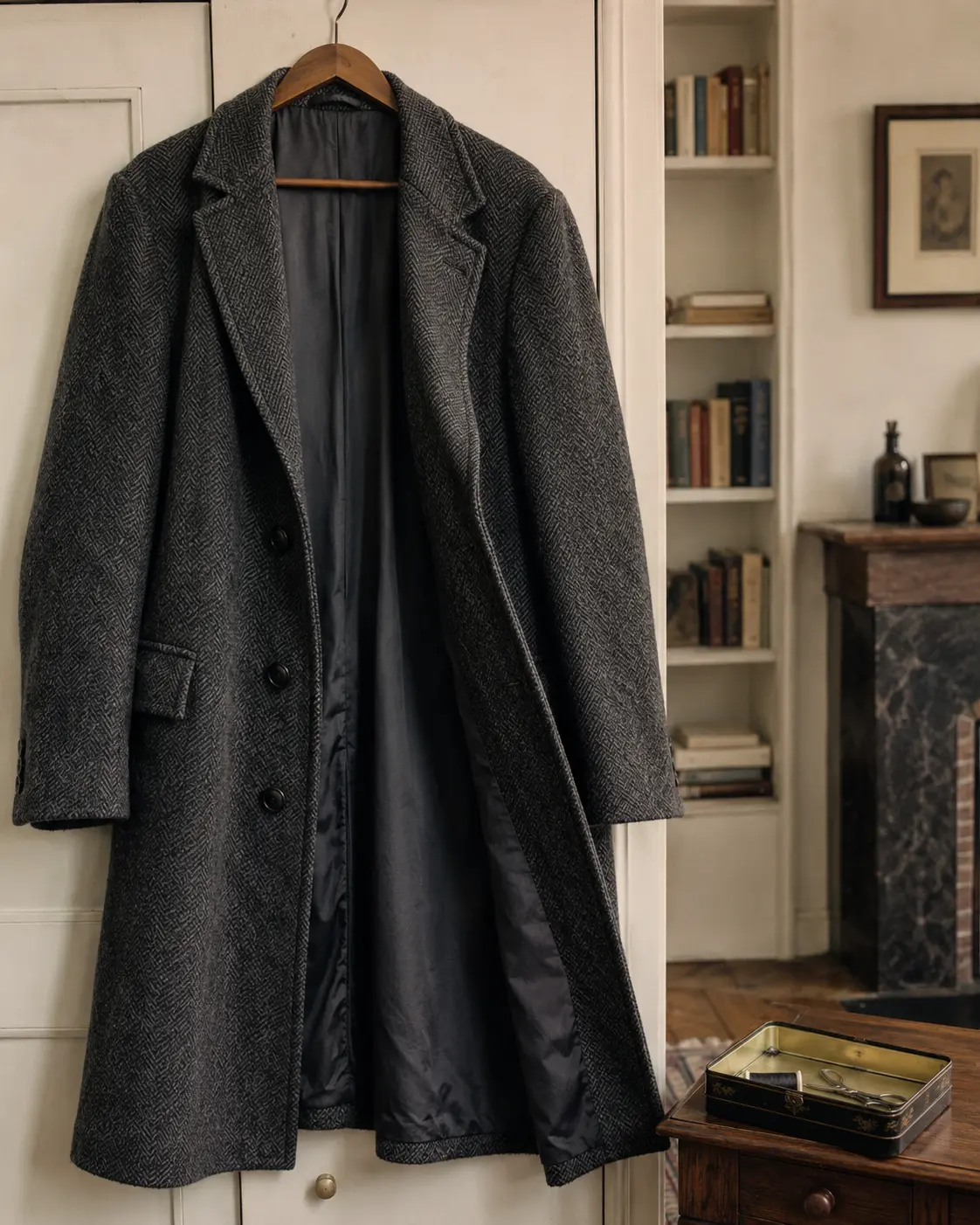
I called the split lining in my £40 herringbone coat a boring fault.
A few days earlier, I had left another wool coat in a charity shop after becoming considerably too attached to it before the evidence had finished arriving. It had wear at the cuff, a tired lining and shoulders that were not quite right. The shoulders were enough to end the discussion, but by then I had already mentally brushed the coat, repaired it and worn it through November.
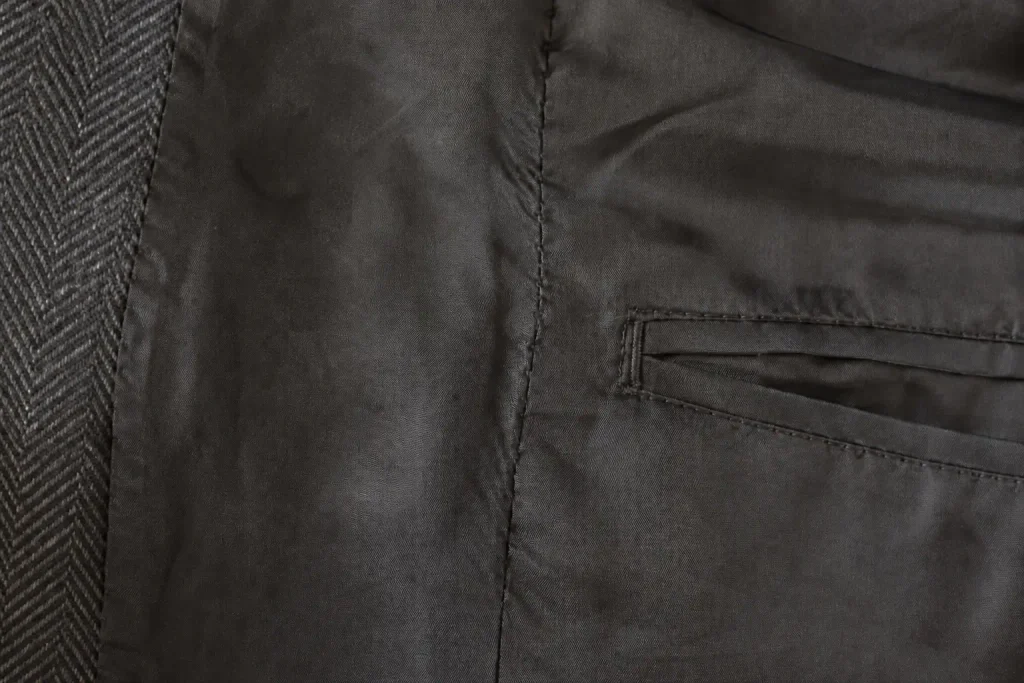
The charcoal herringbone coat was different. Its outer cloth was sound, the cuffs and pocket edges were intact, the shoulders fitted, and inside there was one short opening in the lining seam beside a pocket. I bought it, secured the loose button and closed the lining seam at home. It is now hanging in the wardrobe with the repair already done, which means this is not the exciting tale of whether I successfully learnt to use a needle. I already knew I could sew the seam.
The more useful question is why I was willing to call that particular opening boring when another tired lining made me wary.
What, exactly, has to be wrong before a split lining stops being a small repair?
The hole is not the diagnosis
A gap in a coat lining is very good at attracting attention. It is visible, untidy and tends to look as though the garment has announced a problem in capital letters.
I am more interested in what exists immediately around it.
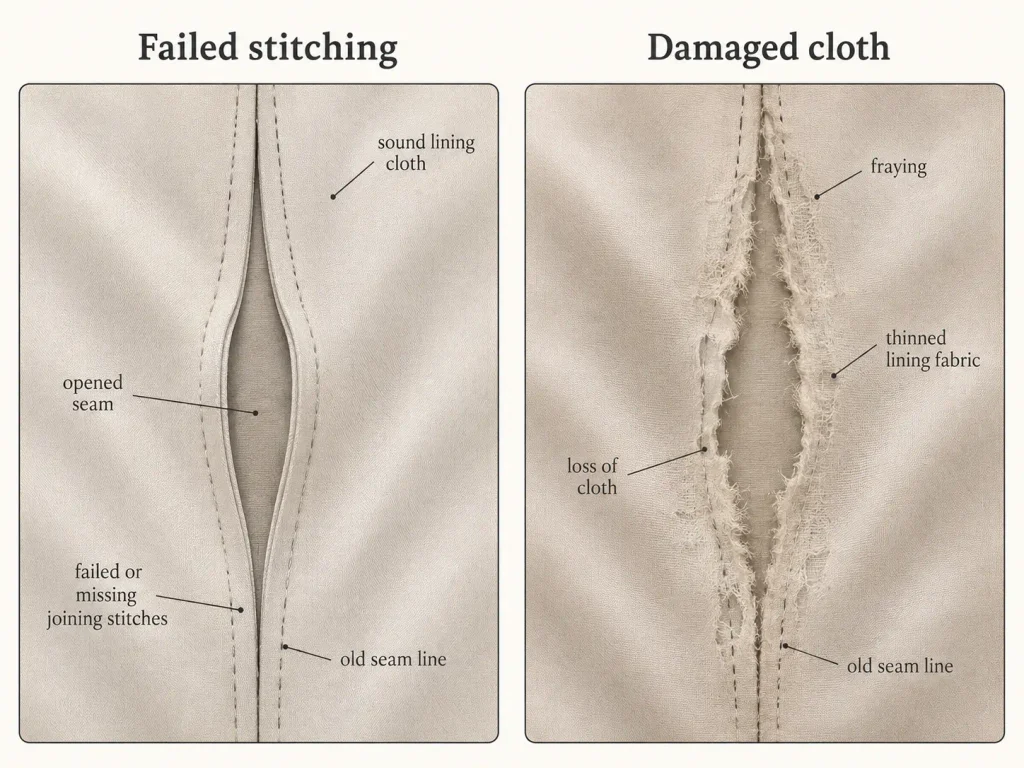
A normal sewn seam joins two pieces of cloth along an edge. If the stitching between those edges has come undone but the lining cloth itself remains intact, there is still something sound to sew back together. The opening may look dramatic because it exposes whatever sits behind the lining, but the failure can still be quite local.
That is different from an opening where the cloth itself is going.
I look for fraying that extends into the lining rather than sitting neatly at the old seam, areas that have become noticeably thin, splits through the fabric itself, or edges that no longer resemble the original folded seam because some of the material has disappeared. I am not trying to diagnose the chemical history of the fibre under charity-shop lighting. I am trying to answer a much plainer question: is the original seam still there waiting to be closed, or has the material I would need to sew begun to fail as well?
Size can be misleading here.
A reasonably long section of opened stitching with sound cloth on either side can be an intelligible job. A tiny opening surrounded by weak, shredded fabric can be the more worrying one. Measuring the hole tells me how much opening I can see. It does not tell me whether the next stitch has anything decent to hold on to.
This is where my two coats stop looking quite so similar.
The first one had more wrong with it than the lining. The cuff was worn and the shoulders were wrong, so I cannot retrospectively promote its “tired lining” into the single reason I left it behind. That would make the old article tidier and the actual decision stupider. What the lining did contribute was another piece of evidence that this was not a coat with one neat little task attached.
The herringbone coat gave me the opposite impression. Beside the pocket, the seam had opened, but I was not looking at a broad area of missing or obviously exhausted lining. The fault had visible boundaries. That was why, in the original coat guide, I could reduce the difference to one rather blunt sentence: a seam can be sewn; missing cloth requires a different negotiation.
I still think that is the useful test. I just think it deserved more than one sentence.
What I meant by a boring repair
Calling a fault boring is praise.
I do not mean that every opened lining seam is automatically easy, or that owning a sewing tin turns the inside of a coat into harmless territory. I mean that I could see the scale of the problem I was agreeing to.
The herringbone coat cost £40. Its difficult parts were already right: the shoulders sat properly, there was enough room over a jumper, I could reach forwards without the upper back tightening and the outer cloth still had substance at the cuffs and pocket edges. The visible faults were a loose button and that local lining opening.
Both had boundaries.
That matters more to me second-hand than superficial perfection. A little lint is nothing. A loose button is tedious rather than sinister. An opened seam in otherwise sound cloth gives me a job I can identify before money changes hands.
The judgement would have changed if better light at home had shown that the apparently neat opening was surrounded by cloth pulling apart. I would then have been looking at the wrong problem. Closing the visible gap might make it prettier while leaving the material beside it no stronger.
My hierarchy is therefore less “small hole, good; large hole, bad” and more:
- if the stitching has failed and the lining around it is sound, I am looking at a seam repair;
- if the lining cloth itself is damaged, I am looking at a different and potentially larger repair;
- if weakness appears across several areas, I stop pretending that each little opening is an independent nuisance.
That last judgement is deliberately mine. I do not have a repair manual in front of me that gives a universal point at which every coat should be patched, partly replaced or completely relined, and I am not going to invent one because a neat ladder of interventions would look authoritative.
My beginner’s clothing-care guide already says to catch open seams before wear and washing enlarge them. This is the more specific companion piece that advice needed.
The small repair I actually made
For my coat, I still had two sound folded edges to bring back together.
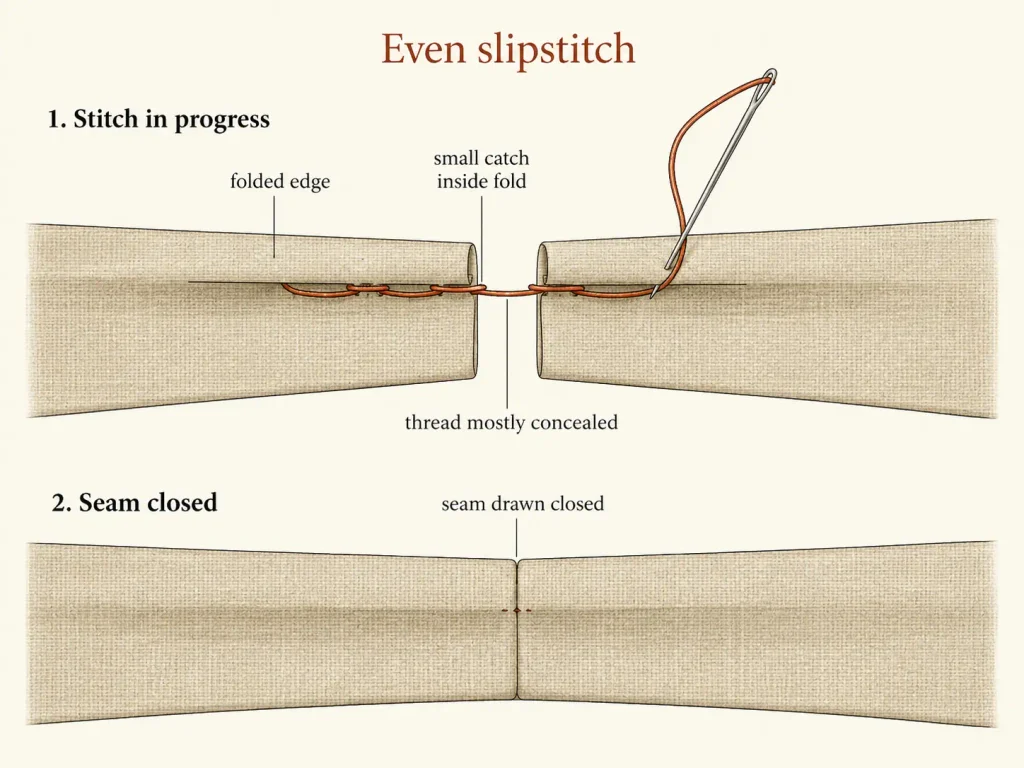
The stitch I used is a slipstitch — a nearly invisible hand stitch in which the thread runs largely beneath folded fabric edges rather than lying conspicuously across the surface. The 1976 Reader’s Digest Complete Guide to Sewing shows the even slipstitch specifically for joining two folded edges, which is the application I needed here.
That source is old enough to have strong opinions about sewing equipment and typography, but the geometry of putting a needle through two folds has not undergone a technological revolution.
I started by opening the coat flat enough that the lining was not pulling while I worked. Before sewing anything, I checked the cloth immediately beyond both ends of the opening. There was no point closing the obvious section if the fabric beside it was already thinning, fraying or beginning to pull apart.
I then brought the two original folded edges back into their natural position rather than inventing a new seam line. That matters because pulling extra lining into the repair would change the tension around the opening.
I secured the thread, then worked along the gap, taking a small catch through one folded edge and then the other. The thread travelled mostly inside the folds, alternating from side to side. I drew each section together gently as I went: enough to close the seam, not enough to gather the lining into a little row of puckers.
At the far end I secured the thread again, then let the lining lie naturally before deciding whether I was finished. A repair that looks wonderfully neat only while you are holding the cloth taut has rather misunderstood its employment.
The seam sat closed without bunching, so I stopped.
I am deliberately not giving you a universal needle size or thread weight here. The Reader’s Digest manual gives general guidance on hand-sewing needles and thread, but the supplied material does not prescribe one needle size and one thread weight for every lightweight coat lining. Mine was a straightforward repair; that does not make a number I might choose for it a rule for yours.
If the two original edges will not meet naturally, or meeting them requires pulling obviously weakened material into tension, I would stop before this procedure. The slipstitch shown here assumes there are still two usable folded edges to join.
When I stop calling it a small repair
This is the point where my confidence becomes deliberately less technical.
If I can see that the cloth itself is fraying, thinning or splitting, I no longer treat the visible opening as five minutes of sewing waiting to happen. I might still buy the coat. A very good garment can justify repair work, and an inexpensive coat does not become a bad purchase merely because money has to be spent on it afterwards.
What changes is that I no longer know the final cost or scope from looking at the gap.
That puts the garment into a different column in my head.
The herringbone coat was £40 plus two jobs I understood. A coat with a lining that appears weak across several places is the price on the label plus a repair whose size I do not yet know. Those can both be sensible purchases. They are not the same purchase.
This is also where I become much less romantic about “saving” second-hand clothes. There is no virtue in buying a coat with a repair you cannot assess merely because leaving it feels wasteful. Somebody with the right skills, budget or enthusiasm may be delighted by it. I am allowed to be delighted for them from several feet away.
For a coat I particularly loved, I would take the uncertainty to someone who repairs or alters clothing and ask what the job actually is before making grand plans for it. I already use the same rule for specialist coat alterations: I would rather get a real assessment than invent a comforting number in the shop.
And if the shoulders are wrong as well, the matter becomes wonderfully simple.
I have already met that coat.
The charcoal coat needed nothing grander. I closed the seam, put the sewing things away and hung it back in the wardrobe.
The sewing was the easy part.
The useful part happened before I threaded the needle: working out whether there was still enough good coat around the problem to make closing it worthwhile.
Leave a Reply