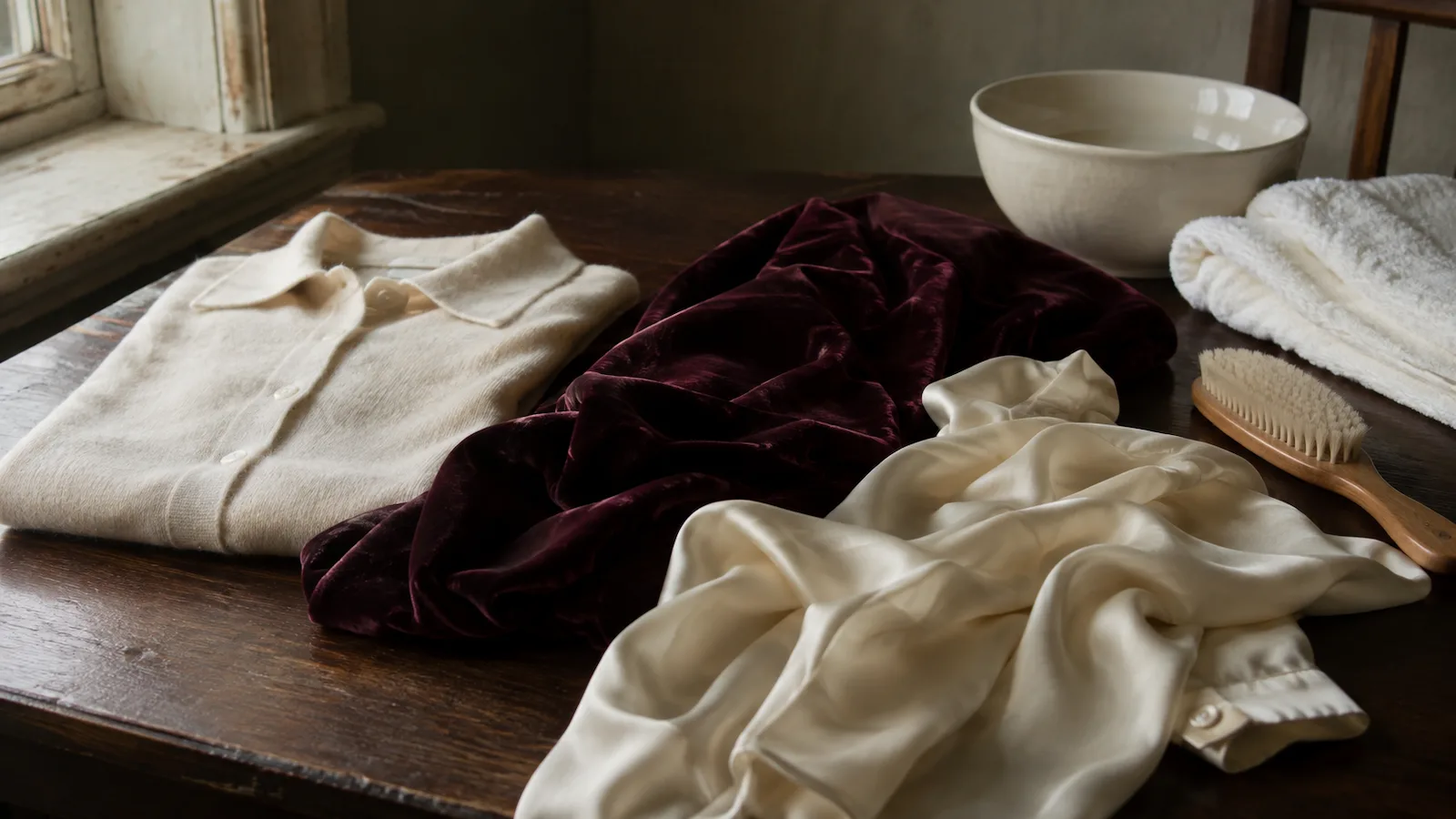
‘Delicate’ is an annoyingly vague word.
A silk blouse, velvet jacket and cashmere shirt can all qualify, but they are not delicate in the same way. Velvet has a pile that can be flattened. Silk can mark, snag or react badly to the wrong treatment. Knitted cashmere can shrink or lose its shape. Add lining, interfacing, beading or an unstable dye and the fabric itself may no longer be the most vulnerable part of the garment.
This is why I distrust the idea that delicate clothes simply belong on the washing machine’s delicates setting. Sometimes they do. Sometimes that is how a perfectly good garment acquires an entirely new silhouette.
The useful question is not “Is this fabric delicate?”
It is: what could actually go wrong with this particular garment?
Start with the garment, not the fabric name
The care label gets first refusal. That sounds terribly obvious until you have a stain in front of you and a bottle under the sink promising to remove absolutely everything short of a criminal record.
The fibre content is only part of the answer. Two silk garments can have different weaves, dyes, linings and trims. Two cashmere garments might be a soft knitted shirt and a structured woven coat. Velvet can be silk, cotton, synthetic or blended.
So before doing anything heroic, look at the complete garment.
GINETEX, the international care-labelling organisation, makes the same point formally: care symbols apply to the complete textile article, including things such as colouring, finishing, buttons, zips and other applications, and indicate the maximum treatment the item can safely withstand.
Is it lined? Tailored? Bonded? Pleated? Embroidered? Beaded? Is there a surface texture you could flatten or snag? Does the colour look likely to run? Is there a care label, and if there is, what does it actually permit?
This matters particularly with second-hand clothes because labels go missing. If you do not know exactly what something is, uncertainty is a reason to become more cautious, not more inventive.
Velvet: protect the pile
Velvet announces damage rather dramatically. Its raised pile is what gives it that shifting depth of colour when it moves. Flatten or crush part of that pile and suddenly the light catches one patch differently from the rest. The garment may still be perfectly wearable, but the mark sits there looking smug.
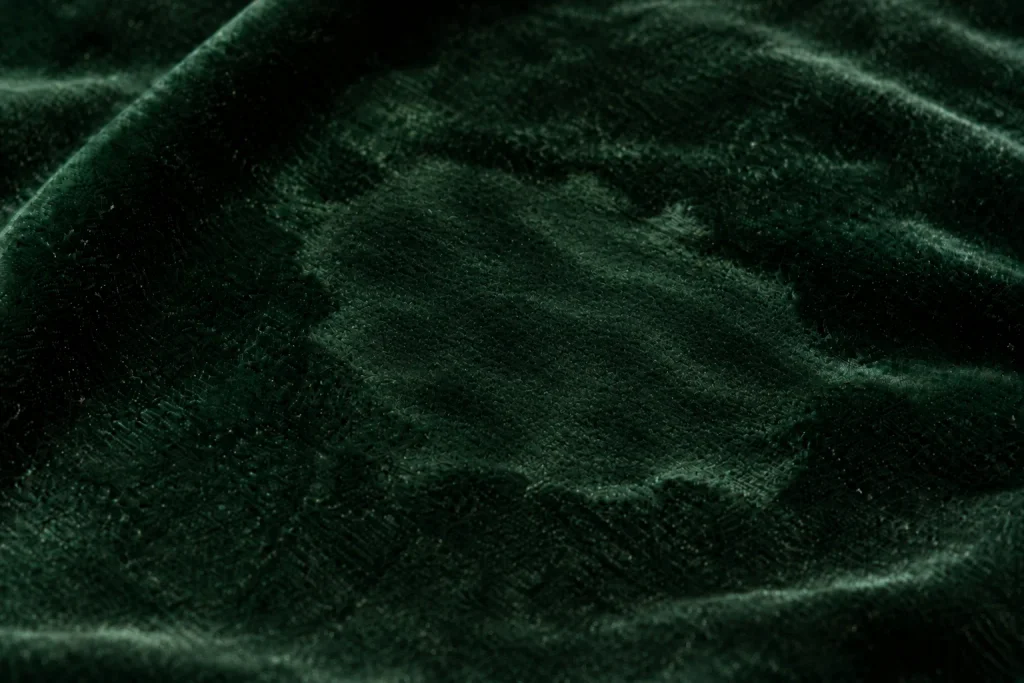
Pressure is therefore one of the things to watch. Do not attack silk velvet with an iron in the ordinary way. The silk supplier Beckford Silk warns that direct pressure can crush the pile irreversibly. For the silk velvet it sells, its method is to place the fabric face down over a towel or cloth and hover the iron over the reverse so that steam can relax the fabric without the soleplate pressing into the pile.
That is a technique for silk velvet, not permission to steam every velvet garment in the house. Fibre, construction and the garment’s own care instructions still come first.
Spills need the same restraint. Rubbing at a mark presses on the pile, so a small cleaning problem becomes a fabric problem as well.
And if the garment is silk velvet, vintage, heavily structured or labelled for professional cleaning, I would be very slow to experiment.
A cleaning bill is irritating. A permanently shiny lapel is more so.
Silk: there is no single silk rule
Silk gets some of the worst blanket advice on the internet. “Always hand wash silk.”
“Never wash silk.”
“Steam silk.”
“Never steam silk.”
All apparently universal. None especially helpful when you are holding one actual garment.
The silk supplier Pongees gives a more useful answer because its guidance distinguishes between different silk fabrics. Some can be washed on a delicate machine cycle; others should be hand washed with a mild detergent; others require dry cleaning.
It also answers the steam question: its guidance advises against using the steam function on an iron because it may leave water stains.
That sits oddly beside the velvet method above until you look at what is physically happening: steam relaxing a pile from a distance is not the same as water droplets landing on a smooth silk face, which is the mark Pongees is warning about.
“Silk” does not tell you the cleaning method.
The weave, dye, finish and construction all matter, and once silk has become a finished garment there may also be linings, trims, fastenings and other materials to consider. The distinction between fibre and construction matters when buying household textiles too; my guide to bedding materials, weaves and thread count explains it from that end. The instructions attached to the thing you actually own outrank somebody’s general enthusiasm for hand washing.
If your garment is labelled for washing at home, keep the process controlled. Use the specified temperature, an appropriate detergent and as little unnecessary friction as possible. Do not wring it simply because squeezing the water out feels efficient.
Stains are where restraint becomes especially useful. You see one small mark and suddenly there are three bottles on the counter and somebody online has suggested making a paste out of kitchen ingredients.
No.
Silk is the least forgiving fabric here, and the same water-marking Pongees warns about with steam is why anything unfamiliar gets tested somewhere hidden first. Cleaning products do not become safer when combined with confidence.
Cashmere: washing, reshaping and the pasta incident
Cashmere knitwear has another weakness: once it is wet, you need to think about shape as well as cleanliness.
Where the garment’s care instructions allow washing, gentle handling matters. Avoid aggressive rubbing and wringing, then bring the garment back into shape while it is damp and dry it flat rather than allowing the weight of wet knitwear to pull at the shoulders.
Once completely dry, I would also fold delicate knitwear rather than leave it hanging where its own weight can gradually pull it out of shape. If you are putting cashmere away for a season, it is also worth thinking about clothes moths; I have a separate guide to storing wool clothes and preventing moth damage rather than turning this one into Moth II: The Reckoning.
Johnstons of Elgin recommends hand washing its knitted cashmere in lukewarm water with a small amount of cashmere shampoo, squeezing gently rather than wringing or stretching, then reshaping the garment and drying it flat away from direct heat. Its woven cashmere guidance is different again and generally favours professional dry cleaning.
That distinction is useful. Same fibre; different garment; different treatment.
I know all of this. I would like that entered into evidence before the prosecution continues.
I have a cream cashmere shirt that I bought from Pretty in Pink for £52. The first time I wore it, a piece of pasta fell off my fork, splatted back into the sauce and decorated the shirt.
I am usually quite good with white clothes.
The shirt had no care label at all, which removed the most useful piece of information before I had even begun. Cashmere, unknown construction, no instructions: this was not an ideal moment for improvisation. I also did not have the right detergent, a stain treatment I trusted, a convenient basin or, increasingly, the patience to acquire any of them.
So the shirt sat in a corner for weeks until one day I really wanted to wear it. There comes a point in certain domestic situations where knowledge ceases to govern events. Sod it, let’s risk it.
I put it through a delicate wash with the whites.
This is not the bit where it emerged the size of a hand puppet and taught me humility.
It was fine. Obviously it was the first thing I looked for when I sifted through the washing. I pulled it out, shut the machine door because everything else could wait, laid the shirt flat and reshaped it while it was damp.
Perfect. Yay.
The gamble paid off. But that is all it did. One cashmere shirt surviving one machine wash does not establish a scientific principle known as Billy’s Pasta Exception. I was lucky, and the fact that I got away with ignoring my own advice does not make the advice wrong.
Do as I say, not as I do.
Sometimes the surface is the fragile part
Satin catches people out because we tend to talk about it as though it were one fabric.
It is not. Satin describes a particular weave and can be made from different fibres. That is why a silk satin blouse and a polyester satin skirt may look related while needing quite different care.
The smooth face is also part of what makes satin vulnerable in ordinary life. The Canadian Conservation Institute explains that satin gets its lustre from long floats — yarns that pass over several others before interlacing again — and those exposed yarns can be pulled out of alignment surprisingly easily, changing the surface and sometimes even the colour. A rough nail, zip or piece of jewellery therefore has more opportunity to do damage than the smooth appearance suggests.
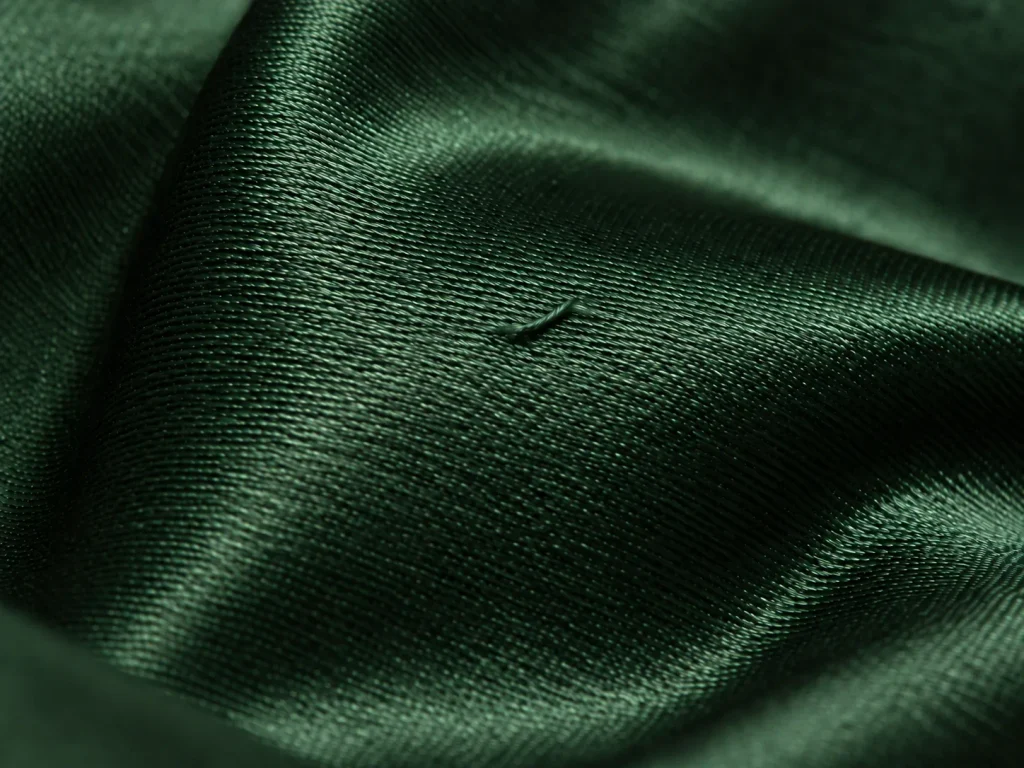
Velvet’s pile fails the opposite way, by flattening rather than snagging.
Then there are garments where the cloth is not the main problem at all.
Lace can catch. Beading can loosen. Embroidery can distort. Pleats can disappear. A lined or tailored garment may contain layers and internal structure that respond differently to washing from the outer fabric.
This is another reason I would rather look at the whole garment than make rules from the fibre name.
A composition label can tell you what fibres are present. It cannot tell you every way the finished object might take exception to what you are about to do to it.
With stains, less enthusiasm is often safer
The worst moment to discover your experimental side is immediately after dropping dinner on something expensive.
First deal with what is physically there. Lift away solids without spreading them further. Blot liquid rather than grinding it into the fibres.
Then stop long enough to look at the label. This is the stage people skip because doing something feels more productive than doing nothing. Unfortunately, applying the wrong product very efficiently is still applying the wrong product.
For the broader process of working out what a stain is, what the garment will tolerate and when home treatment has reached its limit, I cover that in my beginner’s guide to clothing care; here I am only interested in why delicate fabrics give you less room for improvisation.
Be especially suspicious of escalating treatments. If a mark has survived gentle blotting, that does not automatically mean it needs harder rubbing. If one product has failed, adding another is not necessarily progress. If you cannot identify the fabric, stain or likely reaction, you may have reached the point where continuing is simply gambling with a garment you presumably wanted to save.
And be careful with heat while you are still working out what has happened. There is little advantage in introducing another possible source of damage before you know whether the stain is actually gone.
The aim is to remove the stain without leaving behind a larger patch showing where you heroically removed the stain.
Know when to hand it over
Home care is useful because not every mark requires a professional intervention.
It is not a competitive sport. I would become much less adventurous with dry-clean-only garments, silk velvet, structured tailoring, valuable vintage silk, unstable colour, significant embellishment or anything where a failed attempt would be difficult to reverse.
The same applies when you cannot identify the stain and the garment gives you very little room for error.
There is also an odd psychology around second-hand clothing here. If something cost very little, it can feel reasonable to take a greater risk with it.
Well, it was only £12.
Yes, but if it is a vintage blouse you have never seen twice, replacing it may be considerably harder than replacing something that cost ten times as much new.
Price tells you what you paid. It does not tell you how replaceable the garment is.
Looking after delicate fabrics should make them more wearable
There is a danger with beautiful fabrics that care becomes so ceremonial you stop wearing them.
That rather defeats the point. Velvet is supposed to catch the light when you move. Silk is supposed to drape. Cashmere is supposed to feel good against you rather than spend its entire life folded safely in a drawer.
That shifting surface is one reason velvet works so well in expressive clothes; I use it as one of the examples in what a fantasy bard might actually wear in real life.
My cream cashmere shirt survived the washing machine beautifully.
I am delighted.
I am not making it house policy.
Leave a Reply