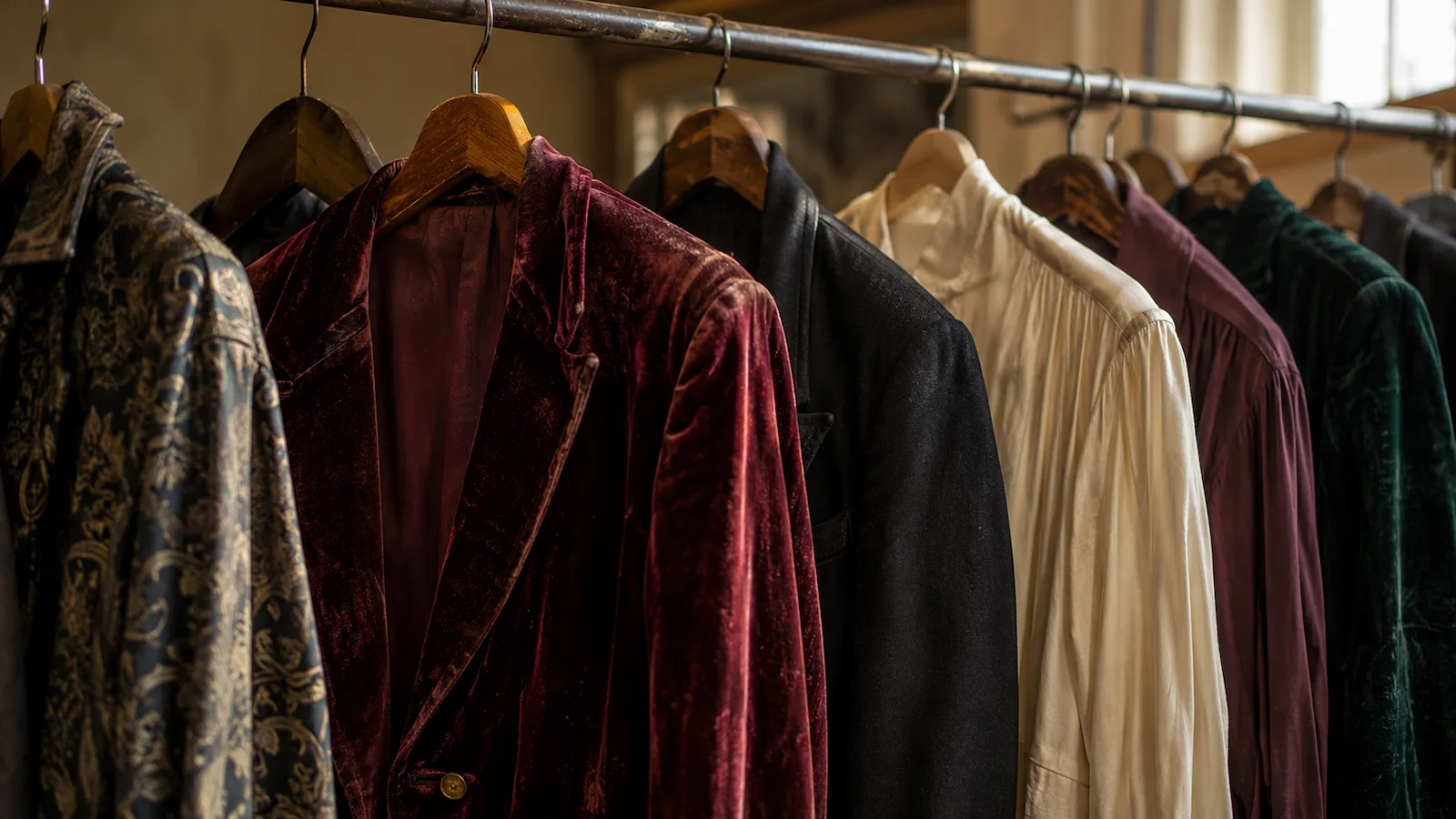
The fantasy bard is very easy to dress badly.
I play Dungeons & Dragons regularly, so I know the wardrobe that starts assembling itself the moment somebody says bard. Begin with a white shirt whose sleeves have ambitions of their own. Add an embroidered waistcoat. Put something velvet over that, preferably in burgundy. Tie a scarf somewhere it does not need to be tied, add several rings, a pendant, a feathered hat and boots with just enough curl at the toe to create uncertainty about whether a jester is involved.
You now look unmistakably like a bard.
Unfortunately, you also look as though you may be required to sing for your supper.
The obvious solution is to tone everything down. I don’t think that is quite right.
A bard is a performer. Being noticed is not an unfortunate side effect of the clothes; it is part of the point. Colour, pattern, jewellery, unusual tailoring and fabrics that react beautifully to light all belong here. A coat that enters the room half a second before its wearer is entirely acceptable.
D&D’s own rules make the wardrobe problem more practical than that. The current Bard is trained in light armour and musical instruments, and the class description imagines a life spent travelling, gathering lore, telling stories and living on the gratitude of audiences. In clothing terms, that gives the outfit two jobs: hold a room, then leave it carrying whatever the performance requires.
The challenge is not making a bard quieter. It is translating what fantasy clothing is trying to say into clothes that still make sense once the tavern becomes a pub, the lute disappears and somebody has to catch the bus home.
Start with what the fantasy clothes are actually doing
Fantasy costumes use shortcuts.
Huge sleeves suggest flourish and movement. Velvet suggests luxury. Rings, brooches and scarves imply somebody who has accumulated things. Strong colour makes the character readable from the other side of an imaginary inn. An elaborate coat tells you that this person expects to be looked at and has dressed accordingly.
Those ideas are useful. The literal garments are optional.
A modern outfit can produce much the same effect with a rust velvet blazer, an emerald blouse, a sharply cut coat, a full skirt that moves properly when you walk, wide plum trousers, an excellent patterned shirt or one particularly extravagant piece of jewellery.
The useful question is not What would a bard wear?
It is What is the fantasy version trying to communicate, and what is the least ridiculous real-world way of doing the same job?
I have since looked at the commercial side of the same problem, comparing eight current fantasy-inspired clothing brands by what kind of character they offer and how readily the clothes survive ordinary life.
Give the outfit a lead, a supporting act and an anchor
Take a burgundy velvet jacket. It already has colour, texture and a surface that changes under light. It does not also require a paisley shirt, embroidered trousers, three necklaces, a patterned scarf and boots covered in gold hardware.
The jacket has volunteered.
I find it useful to think of an expressive outfit as having a lead, a supporting act and an anchor.
The lead is what you notice first: the jacket, silk blouse, extraordinary skirt, patterned coat or very wide trousers. The supporting act reinforces it without demanding precisely the same attention. A cream shirt might pick up the pale details in a patterned jacket; an old silver brooch can echo the hardware on a coat; dark tailoring can give a floral shirt a frame.
Then there is the anchor. This is often the least exciting piece and possibly the most useful: plain boots, black trousers, a simple knit, a dark skirt, an uncomplicated coat. It gives everything else somewhere to stop.
The same principle makes pattern easier. A fine stripe can sit beneath a larger check because the two patterns operate at different scales, while a burgundy-and-cream print beneath a burgundy jacket already has a colour linking the two.
Two conspicuous pieces can get along perfectly well. What usually goes wrong is not simply too much, but too many garments simultaneously applying for the leading role.
Don’t dress the class. Dress the character.
Two D&D bards can have exactly the same class written at the top of their character sheets and still look as though they have never willingly entered the same pub.
One might be immaculate, severe and rather expensive-looking. Another might live in battered boots, old jewellery and a magnificent coat bought with money that ought to have paid for something sensible. One could favour black silk and silver; another could regard mustard yellow as a neutral.
That is more interesting than giving both of them a poet shirt.
David Bowie is useful as a real-world reference because his changing stage personas were not simply different versions of generic performer clothes. Ziggy Stardust and the Thin White Duke were deliberately distinct visual identities, part of Bowie’s repeated reinvention rather than a single permanent costume vocabulary.
The useful lesson is particularity. A bard is a class; it is not a personality.
I found the same thing again with rogues: the rogue becomes much more interesting once you stop dressing the class and ask what this particular person is actually trying to pass as.
Decide what your version is actually interested in. Perhaps it is colour. Perhaps it is severe tailoring. Perhaps it is texture, jewellery or an unreasonable commitment to sleeves. I have some sympathy with the last one.
Let fabric do some of the shouting
Bard style is one of the rare occasions when I see no reason to apologise for slightly luxurious-looking cloth. Velvet, silk, satin and richly patterned woven cloth can all earn their place in a bard wardrobe because they react strongly to light, movement or texture.
The mistake is assuming that interesting fabric automatically makes an interesting garment. A badly fitting velvet jacket remains badly fitting. A satin shirt that clings in all the wrong places does not become rakish because it shines. Brocade containing every jewel tone available to modern chemistry can still make a harmless waistcoat look as though it has escaped from a hotel curtain.
Look at the garment before becoming seduced by the cloth. Shoulders should sit where they are supposed to sit. A soft blouse or shirt should fall cleanly. Wide trousers need enough weight to hang rather than bunch unhappily around the shoes, and a long skirt ought to move without requiring constant management.
Then, particularly when buying second-hand, inspect the thing as an object rather than an apparition. Velvet has a pile — the raised, soft surface formed by cut or uncut loops of extra yarn — and wear can flatten it so the light catches differently.
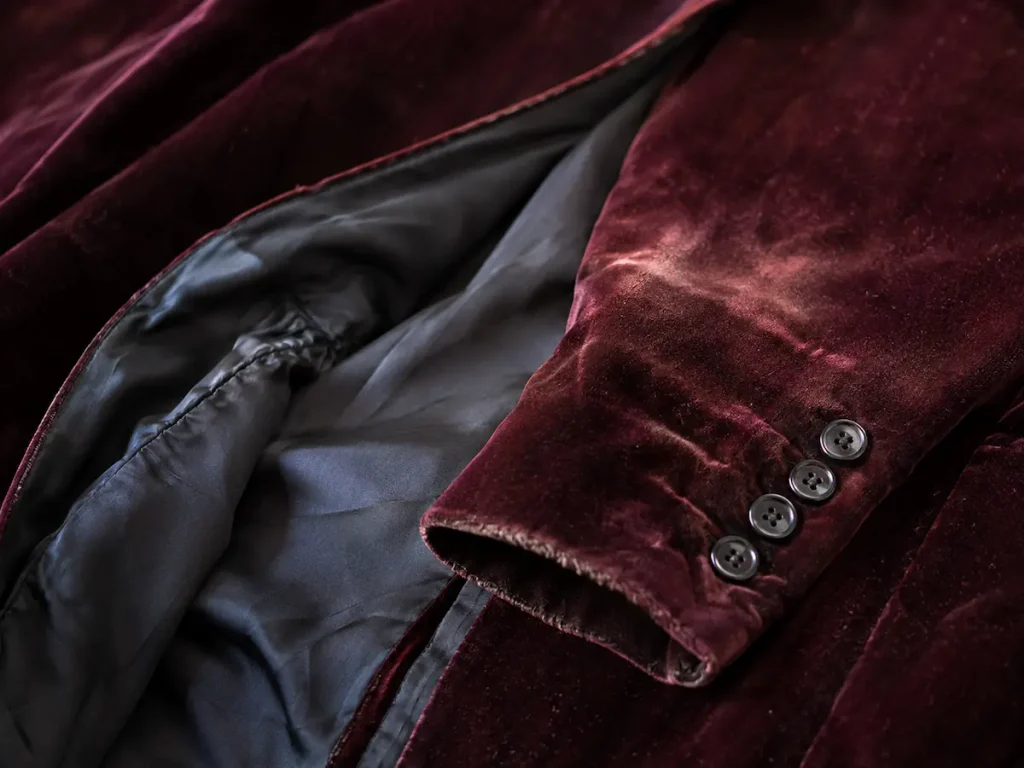
Cuffs and elbows wear. Linings can be considerably less enthusiastic about continued existence than the outer cloth. Heavy embroidery and beadwork have their own unpleasant habit of asking old fabric to carry more than it would like.
There is something particularly cruel about discovering that an extraordinary jacket’s structural integrity is being maintained largely through optimism.
Admire first. Then turn it inside out.
If the fabric is velvet, silk, satin or anything else that looks expensive enough to become vindictive when washed badly, I have a separate guide to caring for velvet, silk and other delicate fabrics.
What I look for on a second-hand rail
On a second-hand rail, I am looking for clothing that occupies an awkward middle ground: too expressive for conservative workwear, nowhere near theatrical enough to count as costume.
That is exactly the territory I want.
Coloured blazers, velvet dinner jackets, patterned waistcoats, silk blouses, evening trousers, long skirts, strange formal jackets and shirts with collars somebody actually bothered designing all have potential. You do not have to preserve the outfit the way its original owner wore it, either. A plum suit may become easier once separated. Black evening trousers can settle down an extravagant shirt. A patterned waistcoat that looks faintly alarming with its matching jacket may suddenly make sense beneath a dark overcoat.
I am not particularly interested in which side of the shop something came from. I dress as a man, but the sign above the rail has never struck me as especially persuasive. If something sold as womenswear fits me properly, suits me and works with the rest of my clothes, those facts are considerably more useful than the department somebody decided to hang it in.
Bard dressing is particularly silly territory in which to become frightened of a blouse, a heeled boot, a severe men’s overcoat or a pair of trousers because somebody once decided who was supposed to buy it.
Alteration can also be worthwhile when the garment deserves it. I would not spend heavily rescuing an ordinary blazer that is merely acceptable, but a beautifully cut velvet jacket that fits everywhere except the sleeve length presents a different calculation. Cloth, construction, condition and how often you are realistically going to wear it matter more than novelty.
Sometimes the correct bard-like act is still leaving the magnificent thing on the rail.
Turn the theatricality dial
Expressive dressing becomes easier once you stop treating it as an on-off switch. Think of theatricality as a dial: most days, one memorable thing may be enough; sometimes two expressive pieces can cooperate; and there are occasions when subtlety would simply be poor planning.
A rust velvet jacket can sit over dark trousers and an ordinary knit. A patterned shirt might take jewellery as its supporting act. At the other end of the dial, an embroidered jacket, enormous sleeve, patterned suit or genuinely extraordinary piece of vintage evening wear can have its evening out.
The lead, supporting act and anchor still apply as the volume rises. In fact, the louder the outfit becomes, the more useful the anchor is: plain trousers beneath an extravagant jacket, simple boots under very wide trousers, or an uncomplicated top with a spectacular skirt.
A full-volume outfit can be coherent. It just needs somebody to remain in charge of it.
Accessories should look accumulated, not issued
Fantasy bards often appear to have received their accessories as a complete starter set: several rings, pendant, brooch, belt, scarf, earring and possibly a feather whose provenance nobody has investigated thoroughly enough.
Real wardrobes tend to look better when those things appear to have arrived separately.
One old brooch on a velvet lapel may do more than half a dozen generic pendants. Two mismatched rings can look more personal than six matching ones. A narrow patterned scarf can change a plain coat or shirt without introducing another entire garment into the argument.
This is one place where actual accumulation helps. A brooch found in one shop, a scarf picked up months later and a ring you have owned for years will rarely match perfectly, and that is rather the point. They suggest a person acquiring things rather than an aesthetic being purchased all at once.
Fantasy explains the mismatch with journeys, taverns and mysterious gifts. Real life usually needs only time, luck and several charity shops.
No Deluxe Travelling Minstrel Accessory Set required.
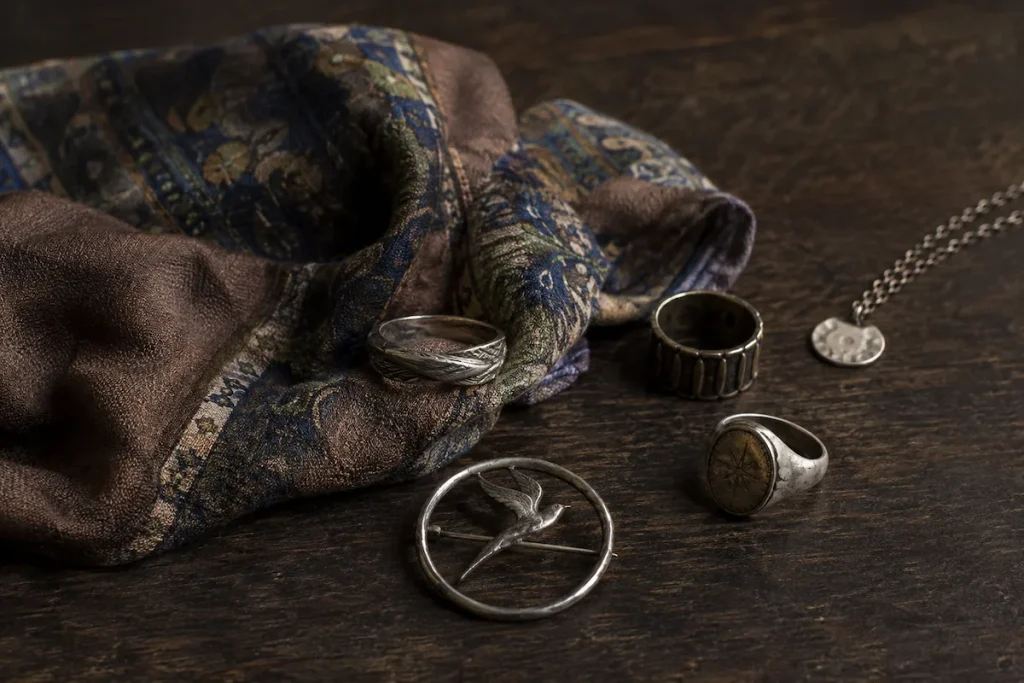
Jewellery is also one of the easiest ways to turn the theatricality dial without buying anything substantial. The same black shirt can look severe with nothing added and distinctly bard-like with a chain, two rings and a silk scarf.
There is a limit. If you can hear the outfit approaching, inspect the metalwork.
The clothes still have to survive ordinary life
Fantasy characters are rarely shown standing on a crowded train wondering where to put an elaborate sleeve.
Real wardrobes eventually encounter furniture.
Before buying something dramatic, test it against whatever happens next. Can you sit comfortably in it? Can another coat go over the sleeves? Can you carry your usual bag without trapping a brooch or chain beneath the strap? Will the necklace spend dinner attempting to enter the plate? Can you actually walk home in the boots?
If you perform, the questions become more specific. Guitar straps cross jackets. Large cuffs approach keyboards. Jewellery and instruments occasionally wish to occupy the same piece of space. Heat, movement and secure fastenings matter when clothing has to work under stage conditions.
But you do not need to be a musician for the principle to apply. The wearer always gets to overrule the aesthetic.
Eventually, every dramatic outfit reaches the part of the evening when the performance is over. The entrance has already happened. The velvet jacket is over the back of a chair, the sleeves have been pushed up and nobody is paying quite so much attention.
It can survive the applause.
Leave a Reply