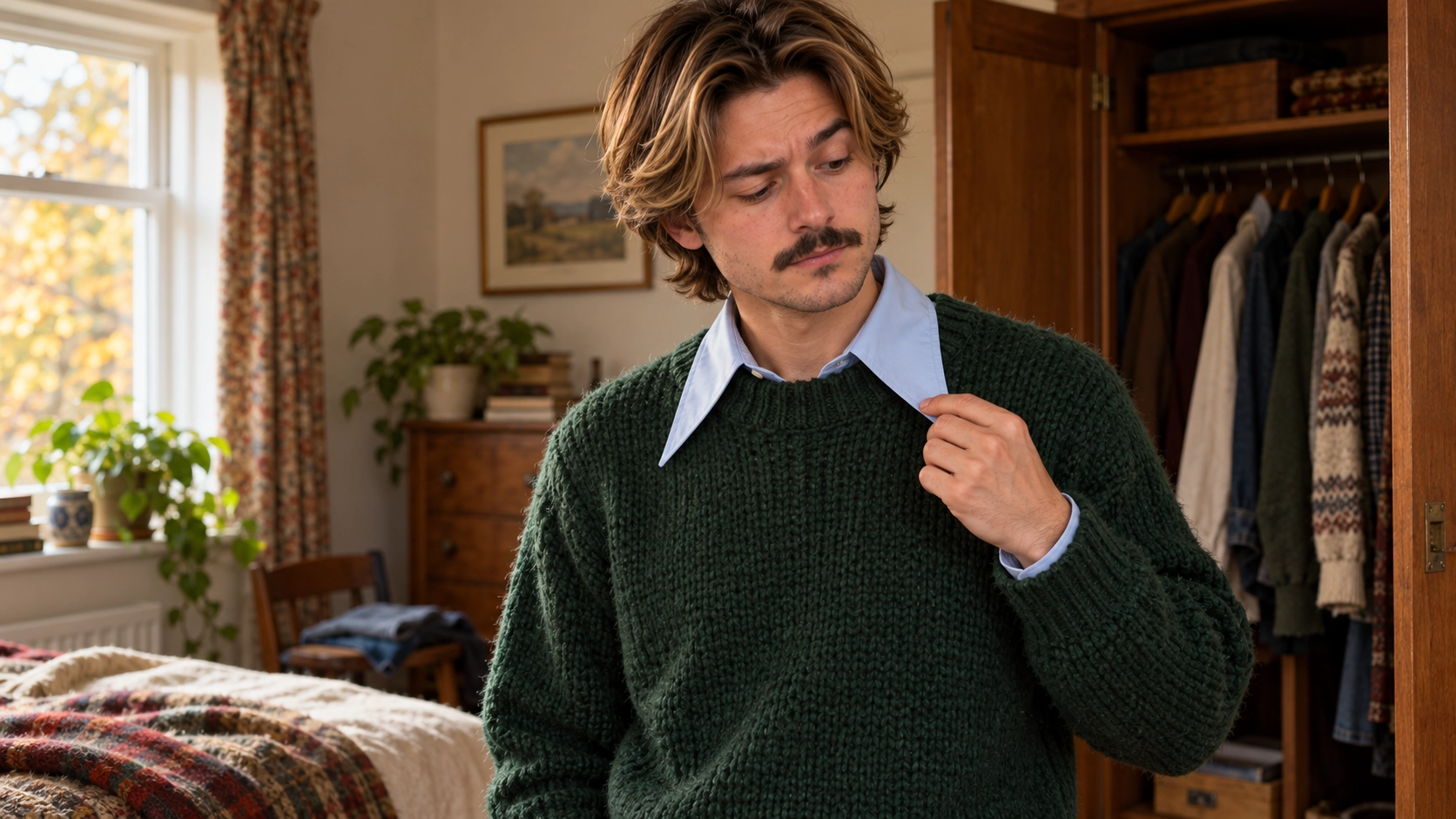
A shirt can look perfectly respectable on its own, then become a complete nuisance the moment a jumper goes over it. The collar disappears beneath the neckline, or two small points emerge at peculiar angles, apparently trying to escape.
I’ve had a small shirt collar look so wrong beneath a chunky jumper that I’ve taken the whole thing off and gone back to the wardrobe. The problem is familiar, but the answer isn’t necessarily a more restrained shirt. Sometimes an enormous collar works better.
What matters is the relationship between the collar’s size, the bulk of the knit and the shape of its opening. A modest collar that sits beautifully beneath a fine V-neck can look rather apologetic against a heavy crew neck. Meanwhile, one of the most exaggerated collars of the 1970s turns out to have a practical advantage.
The 1970s dagger collar has a reason to be enormous
I have a considerable weakness for 1970s shirt collars. The longer and sharper the points, the more interested I become. Left uncovered, some look excessive even by my standards. Beneath substantial knitwear, that extra length can suddenly make excellent sense.
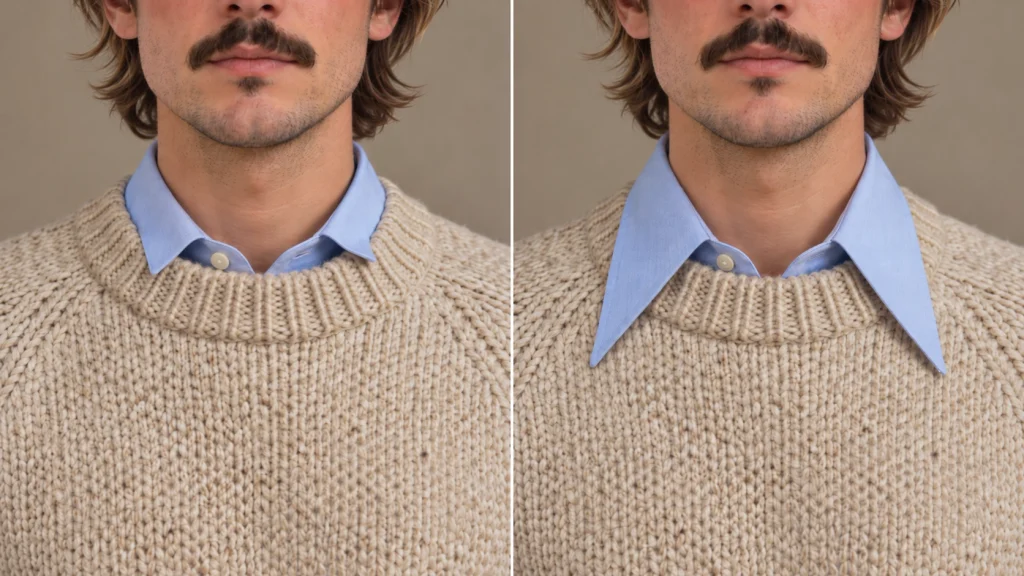
The dagger collar — a shirt collar with exaggeratedly long, sharply tapered points — has enough reach to extend beyond a substantial jumper neckline. Where a small collar might be swallowed by thick ribbing, the dagger’s points can lie across the surface of the knit and become a deliberate part of the outfit.
I’ve dealt with the broader outfit proportions in Supporting Clothes Don’t Have to Be Boring, but knitwear gives the collar a rather specific job.
Look at the cream crew neck above. Underneath, a shirt with short, narrow collar points might leave only two little corners showing. If they do not sit cleanly, they look like an accident.
Replace it with a shirt whose collar points extend well beyond the neckband. The collar has room to establish its shape. The jumper’s bulk, which overwhelmed the smaller collar, now helps balance the larger one.
This isn’t a licence to deploy the biggest collar you own against every jumper. A very fine knit can leave those dramatic points looking disproportionately large. A tight opening can force them into folds, while a collar with too much spread can refuse to lie where you want it.
The advantage is proportion, not sheer acreage. The collar works when its points have somewhere sensible to sit.
How the thickness of your jumper changes the collar
Before deciding which shirt to wear, look at the knit itself.
Machine gauge describes the spacing of needles on a knitting machine, commonly expressed in needles per inch. If a product listing calls a jumper 12-gauge, it means the machine has twelve needles per inch: generally a finer knit than one made at, say, five gauge. The Knitting & Crochet Guild explains the relationship using needle spacing in millimetres, from fine to chunky machines.
Gauge is useful, but it doesn’t tell you precisely how bulky the finished jumper will be. Yarn, stitch construction and finishing all affect the result. You still need to look at the garment.
A fine-knit jumper with a relatively flat neckband often gives a modest shirt collar enough room to remain visible. There may be no advantage in introducing anything larger.
A chunky jumper is a different proposition. Its thicker body and pronounced ribbing can make a delicate collar look undersized, especially when the neckband covers most of the points. A cable-knit adds texture as well as bulk, giving a tiny exposed collar even more to compete with.
I’d judge this by looking at the garments together rather than treating the gauge number as an instruction. A thick jumper with a generously cut neckline can accommodate a smaller collar. A fine one with a tight, high neckband can be surprisingly troublesome.
Crew necks, V-necks and where the collar actually sits
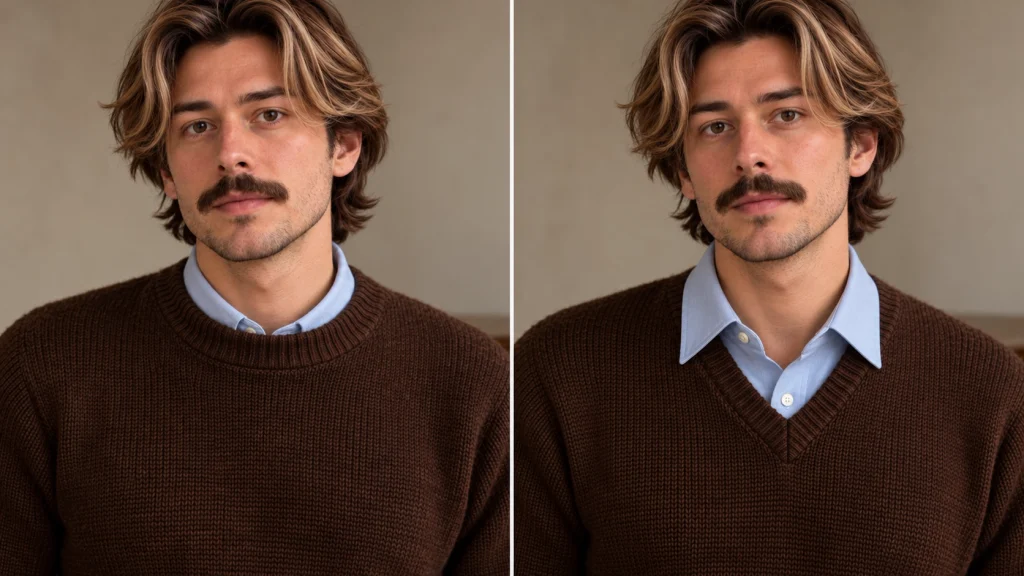
The opening decides how much of the collar is exposed and where its points can rest.
Crew necks: where small collars struggle
A thick crew-neck band sits close to the shirt collar. It’s often the trickiest shape if you want the points visible outside the knit.
You can keep a modest collar inside the jumper, with the points tucked beneath the neckline. This looks clean when the band lies comfortably over the shirt; there’s no obligation to drag every collar into view.
Alternatively, bring the points outside. With a chunky crew neck, longer points can earn their keep by reaching well past the ribbing and lying flat over the jumper. A dagger collar can look especially good here because its length is balanced by the surrounding knit.
Check how the points behave when you move. If they curl upwards or catch against the neckband when you turn your head, the combination needs adjusting however impressive it looked in the mirror. If the jumper keeps pushing the collar out of place, changing one garment is less irritating than repeatedly straightening it.
V-necks: more space for a smaller collar
A V-neck exposes more shirt front and gives the points a clearer shape to sit around. A modest point collar can look entirely deliberate without needing the reach of a dagger collar.
The depth of the V matters. A shallow opening keeps the collar relatively contained, while a deeper one shows more of the shirt. Long points can be magnificent against that space, but they can also extend further down the chest than you intended.
Look at how the collar’s angle works with the V. If the points fold, cross awkwardly or appear detached from the opening, change how the shirt sits. Bigger isn’t necessarily better when the neckline already supplies plenty of space.
Sweater vests: the 1970s combination that still works
I love a sweater vest. Americans call them sweater vests; the traditional British names for a sleeveless knitted jumper are tank top and slipover. To me, a tank top is the vest that goes under things, so I say sweater vest. Since hardly anyone wears them any more, nobody corrects me.
The terminology may be untidy, but the 1970s evidence isn’t. Patons’ No. 1 Knitting Album (1974) includes designs called both slipovers and tank tops. In Live and Let Die (1973), Solitaire wears a red knitted sweater vest over a white pointed-collar shirt, a combination described by costume writer Christopher Laverty in his Clothes on Film article.
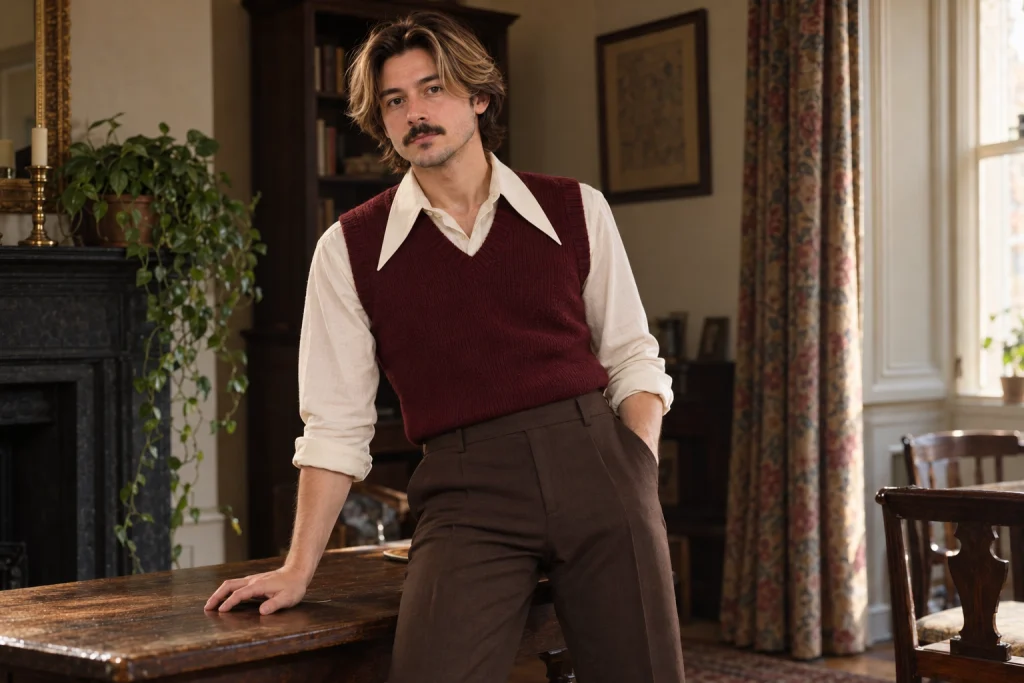
Most sweater vests have V-necks, and many are fairly fine knits. The opening frames the shirt collar without the heavier fabric of a chunky jumper. The absence of sleeves also leaves more of the shirt visible, so the collar can be a strong feature without having to carry the whole outfit.
A generous dagger collar above a knitted sweater vest is, for my money, one of the decade’s most successful combinations. But the same principle applies: a narrow opening may need smaller points, and a deep V can already provide enough space for a modest collar.
Cardigans: adjust the opening
A cardigan lets you change the space around a collar by undoing the upper buttons. Fastened high, it can crowd the points; open slightly, it can give them room to lie naturally.
Judge the arrangement with the cardigan buttoned as you’ll actually wear it. There’s little value in perfecting it while open if you’ll fasten it before leaving the house.
What to check when the collar looks wrong
Stand in front of a mirror and inspect the actual arrangement:
- Visibility: Are the points properly visible, deliberately tucked away or stranded halfway beneath the neckband?
- Shape: Do they lie flat, or curl and bunch against the ribbing?
- Scale: Does the collar look substantial enough for the knit without taking over the entire opening?
- Movement: Turn your head and sit down. Does it stay put without constant adjustment?
Try changing the way the points sit before swapping garments. If the result still looks wrong, test a different shirt or jumper already in your wardrobe.
I wouldn’t buy another shirt to rescue an awkward jumper unless I’d established that the new collar would work with more than one outfit. That is an expensive amount of devotion to a neckline.
Give the collar enough room to do its job
The dagger collar has a reputation for looking ridiculous, which is frequently deserved and part of its appeal. But put those long points over a substantial knitted jumper or a neatly cut sweater vest, and the exaggeration begins to look remarkably sensible.
Leave a Reply