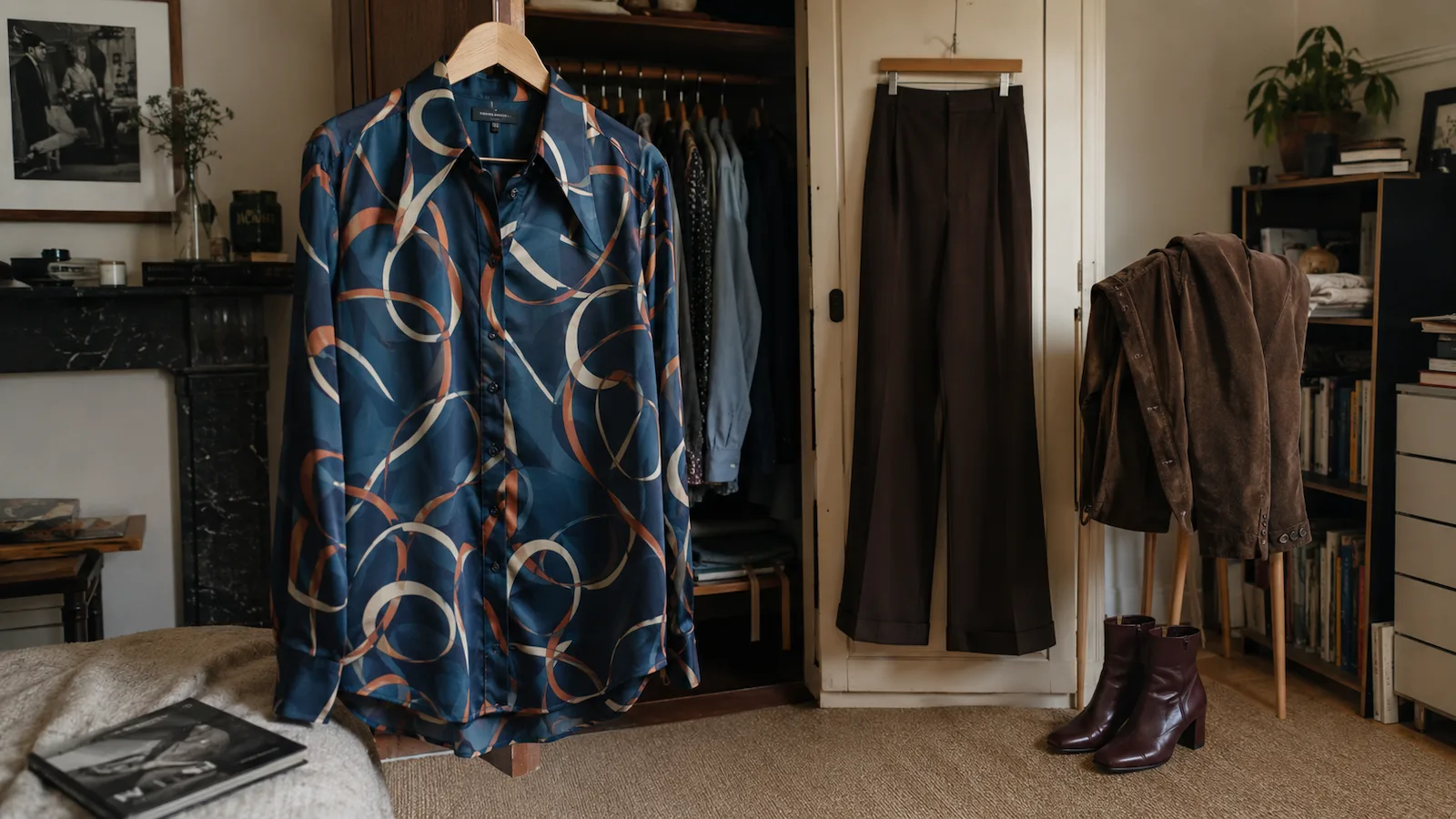
Edinburgh sent me home with six shirts. Most of them have the long, sharp points I tend to call dagger collars, which was one of the reasons I bought them in the first place. I like 1970s clothes generally, particularly the Bee Gees end of the decade, and that collar is annoyingly difficult to find without buying something that has already survived the decade in question. The original Edinburgh piece records the six shirts and how unusually easy those pointed collars were to find there.
One of the six has become the one I keep taking off the hanger.
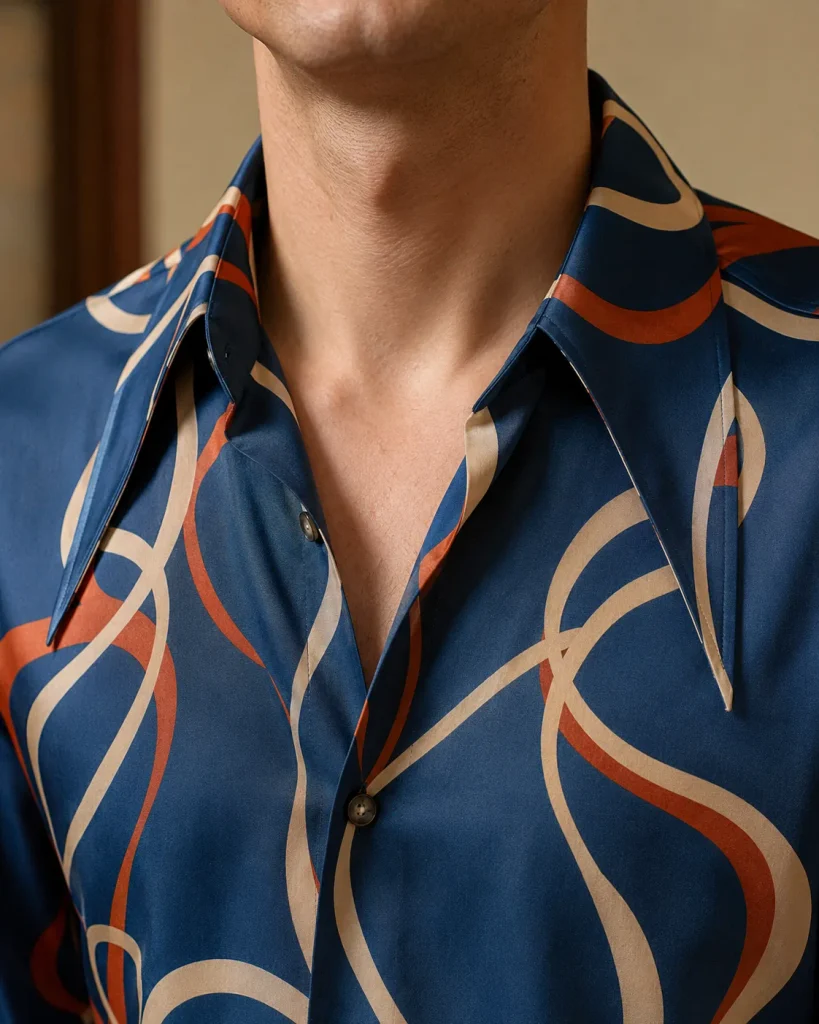
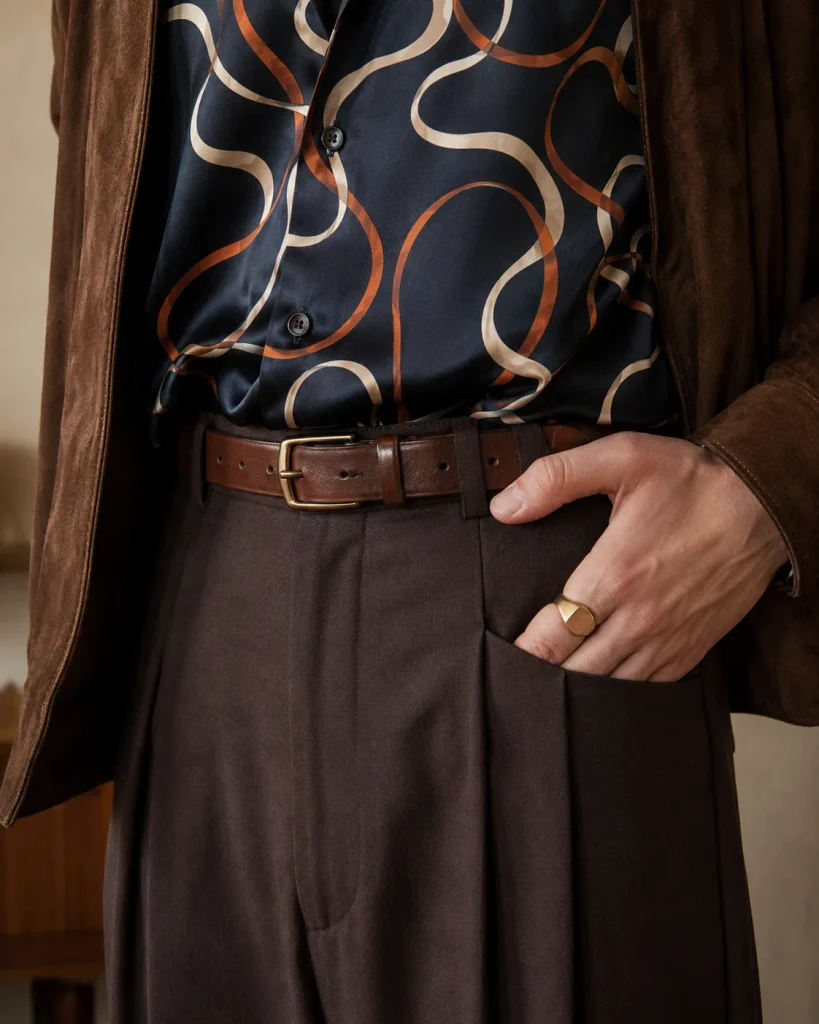
It is dark petrol blue, printed with large looping shapes in cream and rusty orange. The polyester has a soft sheen and hangs rather than stands; there is plenty of cloth through the body, full-length sleeves ending in simple button cuffs, and the sleeves are just long enough to make me wonder whether I am going to alter them or continue pretending they are deliberate.
The collar has the same exaggerated points that drew me to the other Edinburgh shirts. The older name for that shape is the Barrymore collar — a turnover collar with unusually long, tapered points, named for actor John Barrymore. Donna May Bewley’s Regional Differences of Shirt Colors, Collars and Fabrics of 1928–1931 records the Barrymore shirt on some West Coast campuses in 1928, well before the shape’s later 1970s revival.
That is all the collar history this shirt is getting.
On the hanger, the shirt seems remarkably easy. Put it on and the supporting cast immediately becomes everybody’s problem.
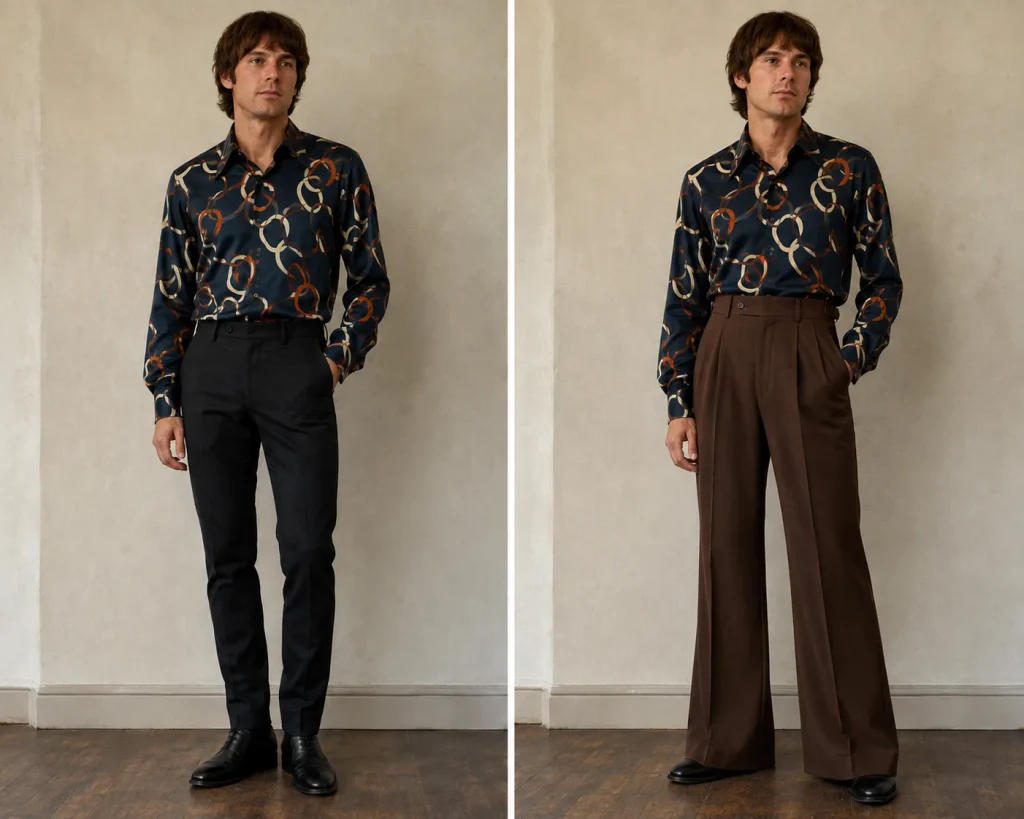
I first tried it with narrow dark trousers. The shirt occupied most of the visual space: large print, long collar, loose body, a little shine. Below the waistband, the outfit dwindled. The trousers did nothing objectionable; they simply looked as though they belonged to somebody who had not been informed what was happening upstairs.
The shirt was not asking me to apologise for it. I needed to work out what the rest of the clothes were supposed to contribute.
The trousers have to carry their half of the outfit
The standard answer to an expressive shirt is to put it with something plain.
That can work. Black trousers, straightforward shoes, very little else: the shirt gets the stage and everybody goes home at a reasonable hour. I have no objection to it except that it is often presented as the only sensible arrangement, as though the alternative to restraint is being removed from a restaurant for frightening the other diners.
The narrow trousers showed me why neutrality was not actually the issue with this shirt.
I swapped them for my high-waisted chocolate-brown trousers, the wide, slightly flared pair that have recently been doing office duty. They are hardly invisible. Standing up, they are one of the strongest shapes in the outfit.
They worked much better.
Part of it was where the shirt ended. The higher waistband gave all that loose cloth a definite place to arrive. I could tuck the shirt without leaving a long stretch of torso between an extravagant upper half and trousers beginning somewhere apologetically below it.
More important was what happened beneath the waist. The wider leg gave the lower half enough presence to answer the shirt. The hem did not taper away into nothing. The outfit now had weight at both ends.
This is where a tailoring book is more useful to me than another photograph of a beautiful man leaning against a wall. Cabrera and Meyers treat trouser rise, pleats and leg width as separate choices rather than one package labelled “wide trousers”. Elsewhere, when discussing a muslin fitting, they consider the combined visual weight of jacket and trousers and then explicitly warn that their examples are not gospel: balance still requires judgement.
That distinction matters because “wear wider trousers” is nearly as useless as “wear something neutral” if it becomes a rule.
A different pair could keep a fairly straight leg, add more room through the thigh or use a fuller leg without pleats. None of those choices automatically produces a 1970s outfit. With this particular shirt, I needed enough shape below it that the upper half stopped looking detached.
The more interesting version goes further.
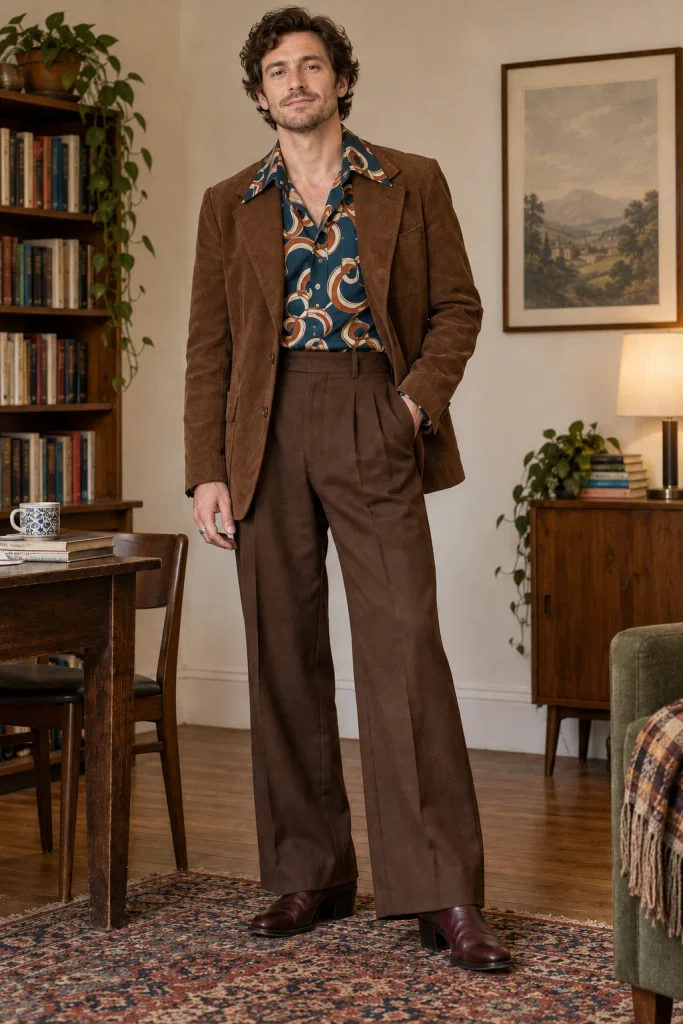
Take a strongly patterned shirt, wear it open at the neck under a brown 1970s-style suit, and give the suit genuinely wide trousers. The jacket is brown. The trousers are brown. The shirt is patterned. There is no tasteful little neutral item standing between them with a clipboard.
It can still make complete sense.
The clothes agree about scale. The shirt is expansive, the trouser leg is expansive, the jacket has enough presence to sit over both. Instead of one unusual garment being quarantined among basics, the outfit makes the case that all of this belongs together.
That is closer to the kind of dressing I actually like. I am interested in the point where clothes become noticeably particular, not in sneaking one strange collar through customs while everything else promises to behave.
Supporting clothes do not have to be boring. They have to know their job.
That does not require reconstructing a decade down to the last belt buckle. Period logic is one way to make several strong pieces agree, but scale can do the same work without every garment sharing a date. A fuller contemporary trouser can carry an old shirt without pretending the rest of the outfit came from 1974.
The useful question is whether the difference appears chosen.
With the narrow trousers, I could not quite persuade myself that it did.
With the chocolate pair, I could.
Once the trousers make sense, the rest has somewhere to stand
Shoes became much easier once I had settled the lower half.
Under a narrow trouser, a slight shoe can finish the line cleanly. Under the chocolate trousers, some of my slimmer footwear simply disappeared. There was plenty of cloth arriving at the floor and then very little happening underneath it.
My burgundy heeled boots handled that better. They have enough height and shape to remain visible beneath the wider hem, and the colour does not behave like a neutral either. Burgundy under chocolate beneath petrol blue and rusty orange sounds, written down, like the inventory from a pub carpet.
I kept the boots on.
That is the useful kind of excess: the boot is doing something the trousers need rather than introducing an entirely unrelated idea.
The jacket exposed a more physical problem.
The petrol shirt is loose through the body. Under a close-fitting jacket, the spare cloth has nowhere sensible to go. It gathers at the sides, bunches at the back and turns what looked fluid on its own into a small upholstery dispute beneath the jacket.
No amount of colour theory fixes that.
A roomier jacket changes the relationship because it accommodates the shirt before it tries to style it. There is space for the cloth to fall, and a jacket with some scale of its own can frame the collar and print without making them look as though they have burst through a smaller outfit.
That is why the brown-suit version works in my head. The jacket is not there to calm the shirt. It gives it room and continues the same broad proportion through the rest of the outfit.
Another jacket could do the opposite deliberately. Something short and severe might interrupt all that softness and make the contrast the point. I would happily try it. What I would not do is call an obviously strained jacket ‘balance’ while ridges of trapped shirt are marching across my back.
The last interesting thing is where outfits go to die
Accessories are dangerous at this stage because the difficult decisions already seem to have been made.
The shirt works with the trousers. The shoes make sense. The jacket has stopped attempting to compress the wearer into a more convenient shape. This is usually when an outfit notices an empty finger and decides what it really needs is another subplot.
I do not think the answer is a numerical rule.
The petrol shirt already gives me cream and rusty orange to work with. Brown leather can pick up some of that warmth. A ring can sit happily with the slightly louche formality of the shirt and fuller trousers. A belt can finish the waistband without pretending to be an artefact recovered from a minor kingdom.
Any of those things can be noticeable.
The question is whether the accessory develops something already present or requires the outfit to learn a new language for thirty seconds.
A large patterned shirt, full trousers and strong boots can accommodate jewellery perfectly well. Add an enormous novelty buckle, an ornate scarf, embroidered boots and three necklaces of entirely different character and I begin to suspect the outfit has been assembled by committee, with no member willing to withdraw their proposal.
That is different from simply being dressed loudly.
A loud outfit can be extremely coherent. Sometimes the quieter version is the less convincing one because the interesting garment looks stranded among clothes selected solely to avoid disturbing it.
I have still not worn the petrol shirt out.
That no longer bothers me. Buying it was easy; it had the collar I wanted, the kind of print I rarely find and exactly enough 1970s nerve to make me abandon whatever restraint I had brought into Armstrongs that day.
Learning what belongs around it has taken longer.
After the last try-on, I buttoned it, put it back on its hanger and returned it to the wardrobe.
Then I took the chocolate-brown trousers and hung them beside it.
Leave a Reply