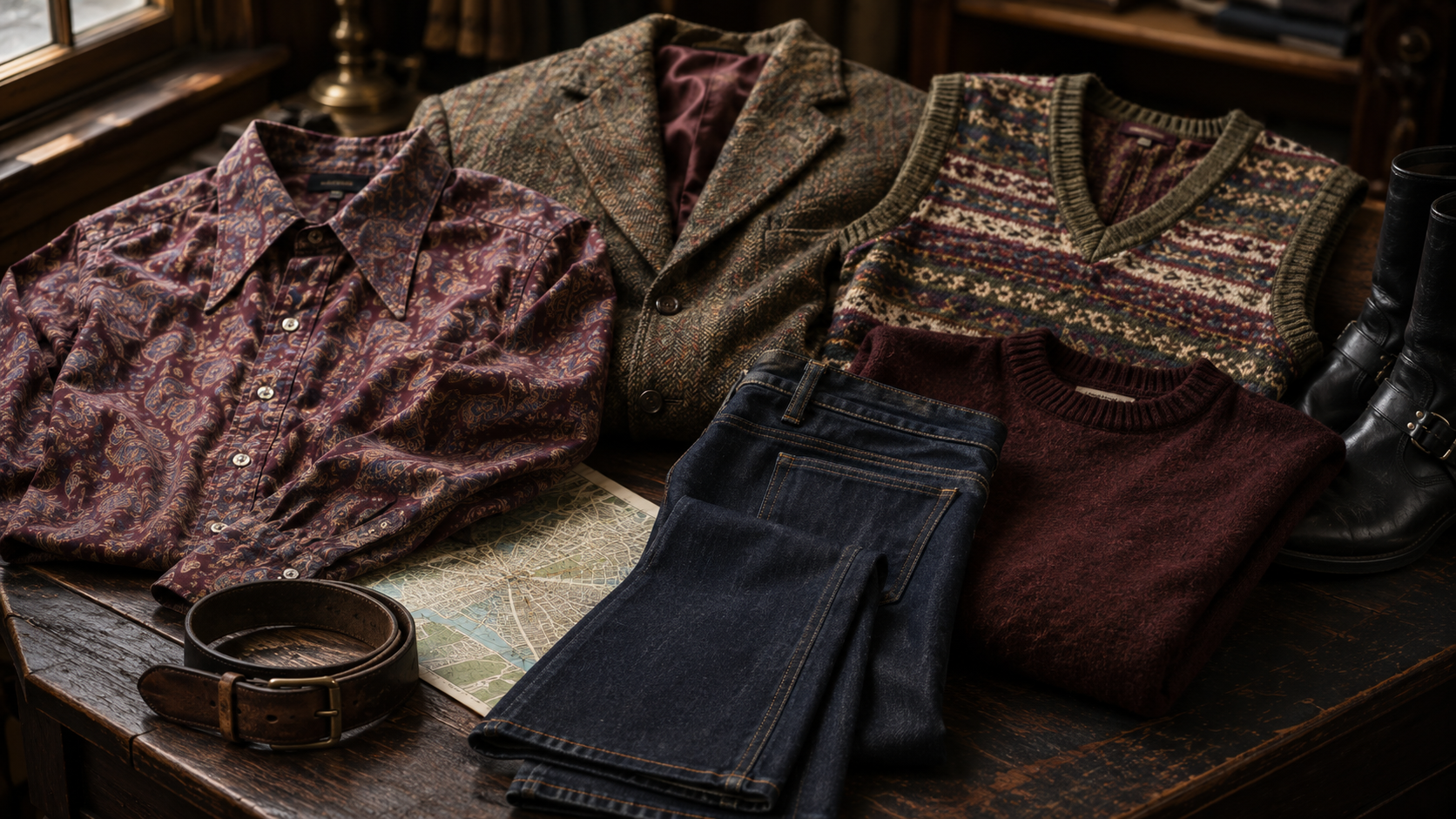
Edinburgh gave me two things I will remember for a very long time: a fiancé, after I proposed to James while we were there, and a vintage-clothing haul large enough to create a minor luggage problem.
Most guides to vintage shopping are not especially helpful when you primarily wear menswear. A shop may be beautifully arranged and full of excellent clothes, yet contain one small rail of men’s shirts somewhere behind several rooms of dresses. There is nothing wrong with that, but it is useful to know before devoting part of a short holiday to it.
I visited two Armstrongs branches and several smaller vintage shops across Edinburgh. Stock changes constantly, so this is not a promise about what will be hanging on a particular rail when you arrive. It is a first-hand account of where I found substantial menswear, where the selection was thinner and which shops I would prioritise on another visit.
If menswear is the priority and time is limited, I would start with Armstrongs: Grassmarket first, then Cockburn Street. Little Blue Door would be my next deliberate stop for colourful late-twentieth-century casual clothing. The other shops were more conditional for me, either because the menswear selection was small on my visit or because their real strength lay somewhere else.
Visited in July 2026. Stock observations in this article are from that trip. Shop locations, opening information and other current business details can change, so check the individual shop before travelling.
Armstrongs was the clear winner
I visited the Armstrongs shops on Cockburn Street and in the Grassmarket. Armstrongs currently lists four Edinburgh locations — those two, plus Teviot Place and Clerk Street — so this is a judgement on the branches I actually shopped rather than all four.
Both were excellent, although Grassmarket felt like the main event: large, densely stocked and capable of consuming rather more of an afternoon than you intended. Men’s and women’s clothing was clearly separated when I visited, and menswear did not feel like an afterthought. There were proper sections to work through rather than one apologetic rail at the back.
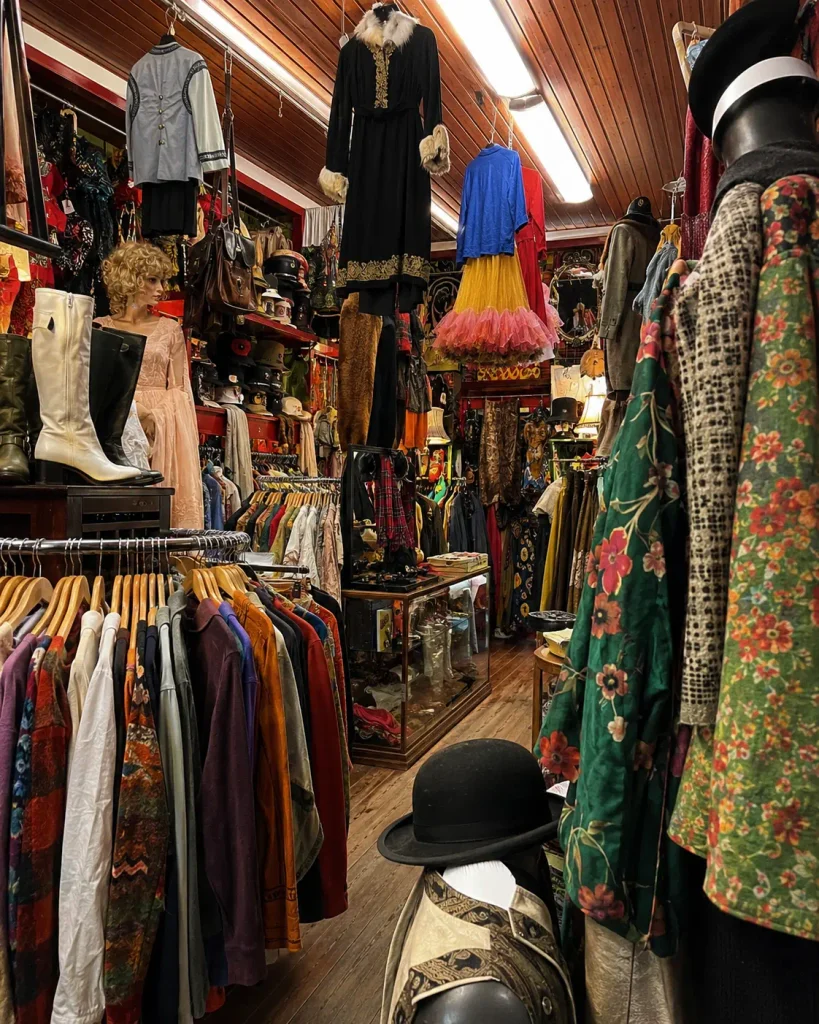
Grassmarket was crowded and theatrical without becoming impossible to shop. Clothes, boots, hats and displays seemed to occupy almost every available surface, but the rails themselves were organised well enough that I could still search properly rather than merely admire the chaos.
What I found at Armstrongs
Across the two branches, I bought twelve garments: six shirts, a jacket, a pair of flares, jeans, a sweater vest, a jumper and a T-shirt. They averaged roughly £21 each on that July trip, which I thought was excellent value for pieces I was actually going to wear.
The shirts were the particular success. Several had the long, sharply pointed collars I find frustratingly difficult to buy new, alongside plenty of less dramatic options. One of those six later became the subject of how to wear a dramatic shirt without looking like costume, where I looked properly at what those exaggerated proportions demand from the rest of an outfit.
The chocolate-brown flares from that list have since done more work than anything else I brought home — they turn up in how to dress for a desk job with character and in the dramatic shirt piece above.
One shirt very nearly belonged to a mannequin instead. A member of staff was assembling a display when I noticed it and asked whether I could try it on. I bought it. The mannequin’s revised outfit is between Armstrongs and its conscience.
The jacket that became mine
One of the most memorable finds was an orange varsity jacket covered in mismatched embroidered patches, with an unexpected cream panel across the back that hangs rather like a small cape.
The name Kirstin had been embroidered on the chest. I liked the jacket far too much to leave it behind over somebody else’s name, so I stopped at Pie in the Sky on Cockburn Street and found an Oregon Trail patch involving a wagon and an unfortunate end from dysentery.
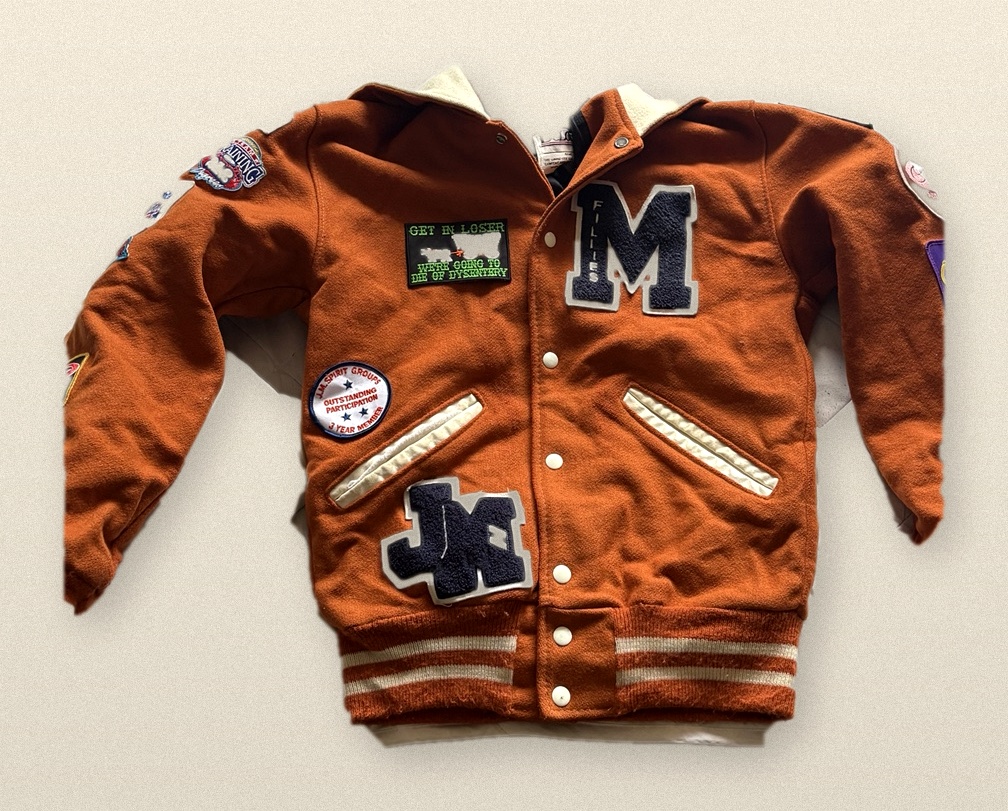
Ironing the patch over the embroidery did not make the jacket more restrained. It made it more specifically mine.
That is one of the pleasures of second-hand clothing: the garment does not always need to arrive in its final form. If the fit and basic condition are good, a contained repair or deliberate alteration can be the thing that turns an almost-right find into something you actually wear. I go further into that judgement in how to make second-hand clothes look expensive.
Armstrongs also had plenty of tweed jackets, belts and heavier footwear when I visited. Tweed is not usually the first thing I reach for, but anyone looking for traditional tailoring or a more academic wardrobe would have had considerably more to investigate than I did.
I very nearly bought a pair of motorcycle-style boots and regretted my restraint almost immediately. My other unfinished business is a kilt. I have never worn one, but I became sufficiently curious to wish I had gone back and tried one on.
Labels were secondary to the clothes
I was not shopping for particular labels. I cared more about the cut, condition and cloth, whether the price made sense for the garment in front of me, and whether I could imagine wearing it once the novelty of finding it in Edinburgh had worn off.
That is the same approach I use when building a storybook wardrobe without looking like costume: judge what the garment actually gives you before treating the name stitched inside as evidence of anything. At Armstrongs, the reward was finding unusually shaped shirts, useful knitwear and trousers I would have struggled to reproduce by shopping new.
Little Blue Door was small but carefully chosen
Little Blue Door gave me a very different shopping experience from the larger branches above. On my July visit, the shop was smaller and more selective, with a strong emphasis on colourful 1980s and 1990s clothing.
The shop’s current website describes it as a collection of handpicked 1980s and 1990s vintage run by Irish sisters Áine and Aisling from its shop on Candlemaker Row. That description matched what I found on the rails rather well.
I noticed good knitwear, fleeces, shirts, sweaters and windbreakers. There was not the same depth of menswear I had found earlier in the day, but there was enough relevant stock that I would deliberately return rather than treating it as an incidental stop.
I would put it fairly high on the list for colourful late-twentieth-century casual clothing. If the aim is older tailoring, traditional Scottish pieces or sheer quantity, I would start elsewhere.
The smaller shops were much more variable for menswear
After Armstrongs and Little Blue Door, the smaller shops became more conditional. Several had far less for me to try on during my July visit, but vintage stock moves too quickly for one afternoon’s rail count to become a permanent verdict.
Carnivàle Vintage
Carnivàle was especially satisfying to browse because the clothing was organised by period. At the Bread Street shop I visited, there was much more womenswear than menswear, but the historical organisation made it interesting even when I was not finding much to try on.
Carnivàle’s current website says it sells both menswear and womenswear from the Victorian period through to the 1990s and now lists two Edinburgh shops, on Bread Street and Albert Place. I would happily return, but for a dedicated menswear hunt I would still put Armstrongs ahead of it.
TORN Vintage
TORN was polished and closely curated, with wearable vintage rather than enormous quantities of stock. The selection I saw leaned heavily towards womenswear, so it would not be one of my first stops if menswear were the sole purpose of the day.
Its current website describes the shop as a collection of wearable, timeless vintage and places it at West Port. That broad remit suits what I saw: I would treat TORN as a shop worth browsing for an individual find rather than somewhere I could confidently expect to build most of a menswear wardrobe.
Stoodio Vintage
Stoodio felt younger and more Y2K-led when I visited. I found one menswear rail towards the back, so it was not especially productive for me, although someone looking for late-1990s or early-2000s clothing might have considerably more reason to investigate.
I would keep that as a description of my visit rather than the shop itself. Stoodio’s current official links describe the stock simply as handpicked vintage and give its present location as 45 Thistle Street; they do not make a permanent claim about the balance of menswear and womenswear.
Godiva Boutique
Godiva was the least conventional vintage stop of the four. I did not find much for myself as a menswear shopper, but vintage clothing is only part of what it does.
Its current website says it carries independent and ethical designers alongside a reworked range made in its Edinburgh studio from vintage pieces and other textiles. That makes it more useful for unusual design, accessories and one-off work than as the centre of a menswear itinerary.
Joey D is worth seeing for the upcycling
Joey D was unlike anything else I visited. The attraction was not a conventional rail of vintage menswear but what had been made from old materials in the first place.
I found reworked clothing, bags and objects assembled from things that had already had another job. The Irn-Bru cans turned into bags were particularly memorable: not subtle, obviously, but subtlety would be an odd ambition once you have decided to turn a drinks can into something with a shoulder strap.
I would visit for the making rather than for a dependable menswear haul. If you like patchwork, recycled materials and objects that have been aggressively persuaded into a second career, it is worth the detour; if you simply need three good shirts and a pair of trousers, Armstrongs is the more useful first stop.
Forever Vintage was not the right shop for me
Forever Vintage was the one shop I would personally skip on a return visit.
The selection I saw leaned heavily towards football shirts and sportswear, which is simply not what I had gone to Edinburgh hoping to find. On the day, I also found it difficult to tell at a glance where original period shirts ended and later reissues began.
The current website is much clearer than that experience suggested. Forever Vintage says its vintage shirts are checked and guaranteed as genuine period garments rather than reproductions sold as originals, while later reissues are explicitly labelled as such. Its current catalogue, for example, includes a 2004 Brazil shirt described plainly as an Official Reissue.
That distinction matters. A reissue is a later production run of an earlier design, rather than a garment actually made in the period it references. It can still be desirable, wearable and expensive; it is simply a different object.
None of that makes Forever Vintage a bad shop. It makes it a poor fit for what I was looking for. Someone collecting football shirts or branded sportswear may find far more there than I did; anyone hunting tweed, unusual tailoring, older shirts or characterful everyday menswear would still be better served by starting elsewhere.
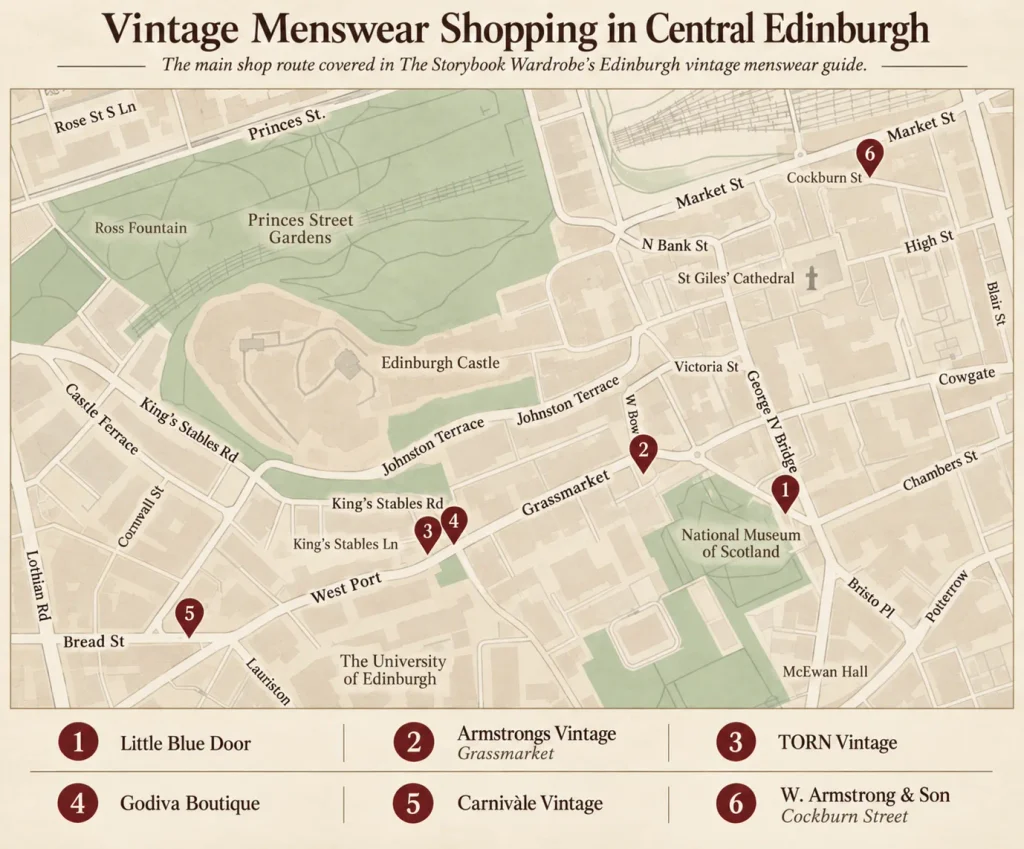
How I would plan an Edinburgh menswear vintage-shopping day
I would still make Armstrongs Vintage in the Grassmarket the first serious stop and give it the largest block of time. It was the most productive shop for me by a considerable margin, and rushing it would defeat the point.
From there, I would stay in the same part of town for a while rather than immediately walking across to the other Armstrongs. Little Blue Door is on Candlemaker Row, while TORN Vintage and Godiva sit almost beside one another on West Port. They were less productive for menswear on my visit, but geographically they make much more sense as nearby supplementary stops than as separate expeditions.
Carnivàle Vintage on Bread Street is another reasonable addition if time and stamina survive. Its period-organised stock gave me a reason to browse even when the menswear selection was thinner than I wanted.
I would then make the Cockburn Street branch of W. Armstrong & Son the other non-negotiable stop. Vintage stock is individual enough that two branches of the same business can produce completely different results, and I bought across both.
That is a route for somebody who actually wants to shop rather than collect shopfronts. I would not try to fit every place in simply because it appears in this article.
A few practical things made the day easier:
- wear clothes and shoes that are easy to change out of;
- leave actual room in your bag for purchases;
- try pieces on rather than trusting the size label;
- inspect collars, cuffs, fastenings and linings before buying; for used footwear, I use a stricter test in how to buy second-hand shoes — and when not to.
- ask when you are unsure whether something is original vintage, a later reproduction or a modern reissue;
- check current opening information before setting out.
And take a proper break. Vintage shopping stops becoming discerning surprisingly quickly once everything on the sixth rail begins to look like a perfectly reasonable purchase.
Is Edinburgh good for vintage menswear?
Yes, but I would go with priorities rather than expecting every vintage shop to carry equal amounts of menswear.
Armstrongs was comfortably the strongest part of my trip, with Grassmarket the branch I would give the most time. Little Blue Door would be my next deliberate stop for colourful 1980s and 1990s casual clothing; the smaller boutiques become more dependent on what you like and what happens to be on the rails that day.
On my next visit, I would return to Armstrongs first. I still have a kilt to try on and a pair of motorcycle boots to regret properly.