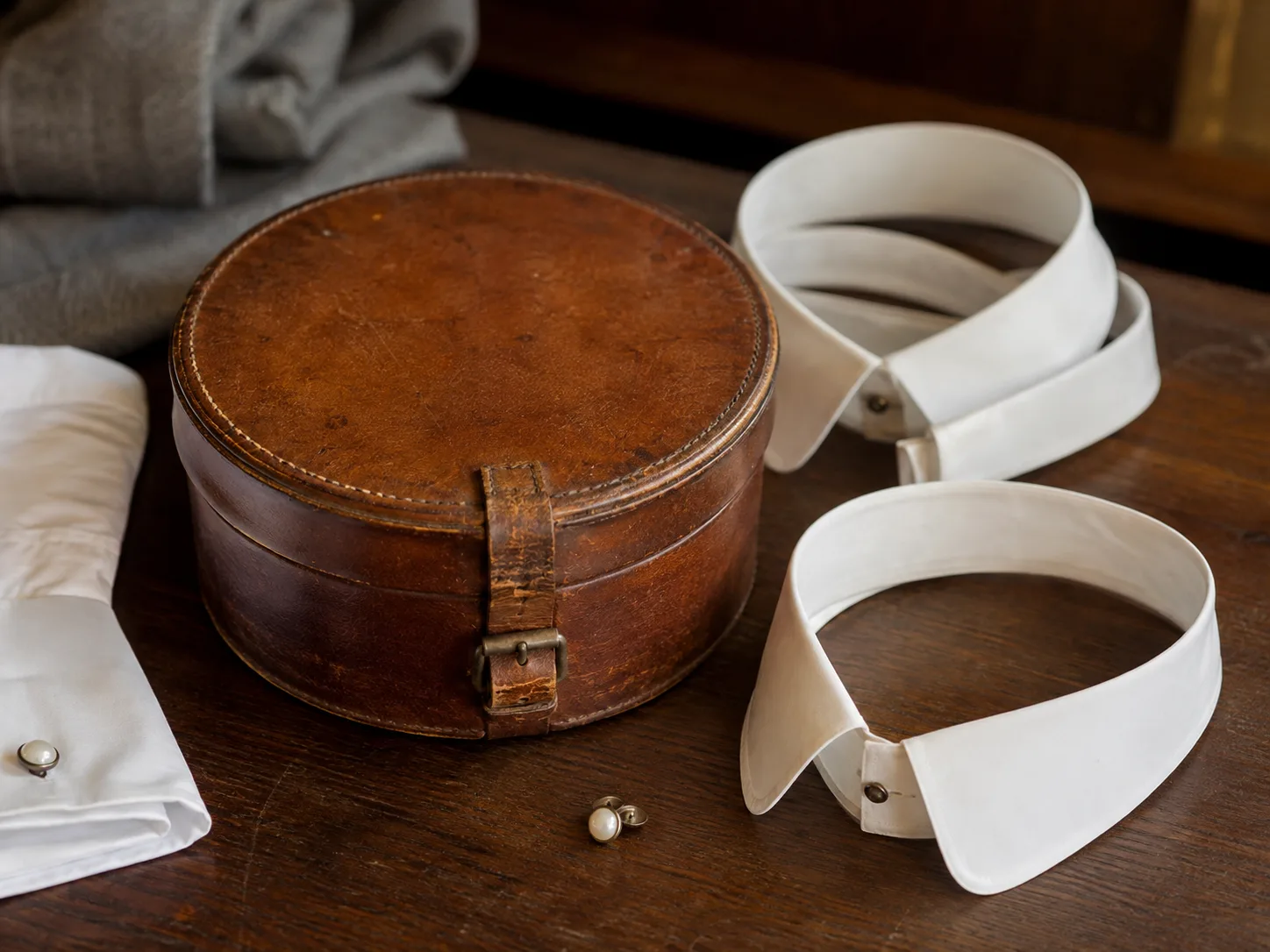
Museums Victoria has a small round leather case in its collection that looks, at first, like the sort of thing I would pick up in an antiques shop without knowing what I wanted it for.
It is brown leather with obvious stitching around the edges. A strap and buckle hold the lid down. Inside, the box is lined in pale shot silk.
It contains nine shirt collars.
Not nine shirts. Nine collars.
They are stiff and white, curved into the shape they would take around a neck and stacked inside the case.
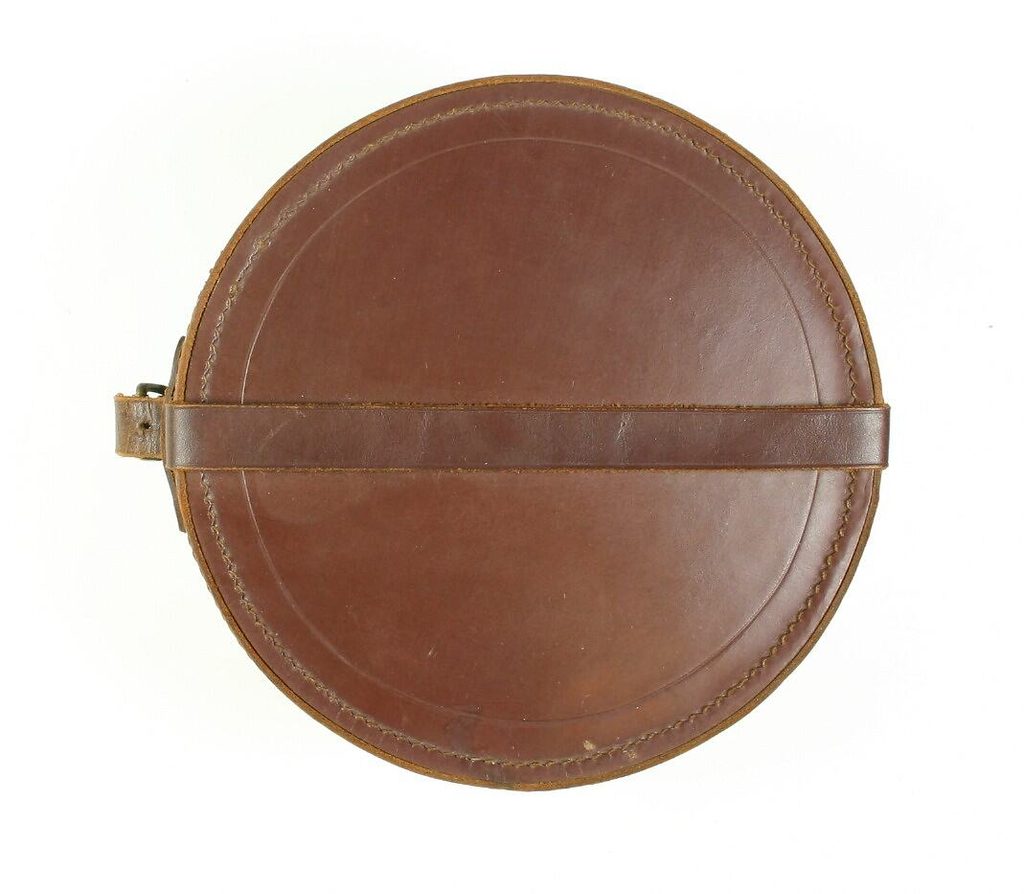
The whole arrangement is so specific that my first reaction was to assume the box must be much larger than it actually is. A comparable leather collar box in the Powerhouse collection is only about twenty centimetres across and less than eight centimetres high — closer to a broad hand-sized case than the hatbox I had pictured when I heard the words collar box.
That makes it stranger rather than less strange.
A hatbox at least has the decency to contain a hat. This is a compact piece of luggage devoted entirely to the bit of a shirt we now expect to remain attached to the rest of it.
Which leaves the obvious question.
Why would a collar need a box?
A few days ago, while writing about my petrol-blue shirt, I gave the Barrymore collar one paragraph and announced that this was all the collar history the shirt was getting.
That remains true.
I was not, apparently, finished with collar furniture.
The missing part is that collars have not always been permanently attached to shirts.
The Powerhouse dates detachable shirt collars from the nineteenth century into the early twentieth and gives the practical reason for the arrangement: separating the collar reduced the labour involved in laundering shirts and could extend the useful life of the main garment. The Metropolitan Museum of Art makes the same mechanism clearer in its record for an American linen collar from 1900–1901. Shirts could be made without attached collars and cuffs so those parts could be changed as they became soiled rather than requiring the whole arrangement to be treated as one inseparable garment.
That is enough explanation for me. I do not need to turn it into a story about our ancestors heroically battling the uniquely impossible task of washing a collar when the museum evidence does not say that.
The system simply separated the part that needed changing from the part that could carry on being worn.
Once the collar comes off, however, it creates administration.
Te Papa has a collar box from about 1910 made from wood and cloth rather than leather. In the centre is a compartment that held the collar studs, the small fasteners used to attach the separate collar to the shirt. The box was therefore not merely somewhere to stop stiff collars being flattened at the bottom of a drawer; it could keep the hardware required to make the system work with them.
Museums Victoria’s example contains nine removable collars.
That does not tell me somebody stood in front of the wardrobe every morning considering nine separate neckwear personalities.
It proves that multiple removable collars were stored together. I do not have his morning routine, and I am not going to manufacture one because it would make the next paragraph tidier.
Several stiff collars. Small fasteners. A need to keep the lot together without crushing them.
Of course they had a box.
Detachability made the collar the variable part
The nine collars in the Museums Victoria box are described as wing collars — stiff standing collars whose two pointed front ends turn down like small wings.
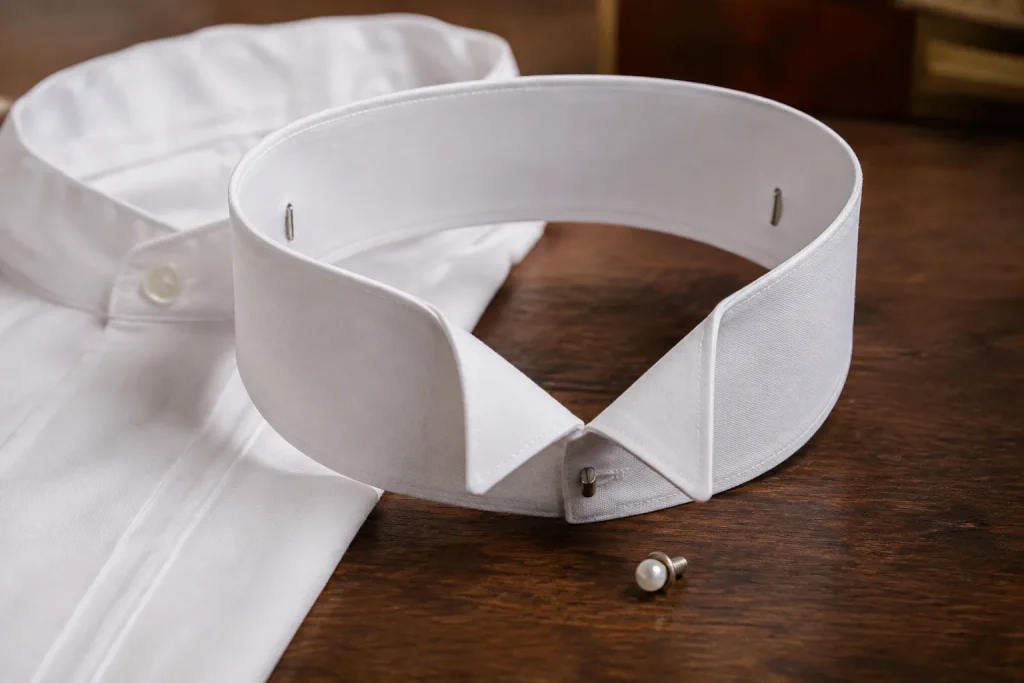
A later wing collar in the Powerhouse collection is described physically as a stiff cylindrical form with two projecting triangular points at the top. Once you know the shape, it is quite difficult not to recognise one when it appears in an old photograph.
That earns the name.
They prove that multiple removable collars were stored together. I do not have his morning routine, and I am not going to manufacture one because it would make the next paragraph tidier.
The design itself is interesting enough.
On most of my shirts, the collar and the body are one garment. If I want a different collar, I choose a different shirt.
Separate the two and that changes.
The shirt body can remain exactly where it is while the component sitting around the face is removed and replaced independently. That is a fairly powerful place to put the variable part. A collar changes the line around the neck and face before anybody has had time to inspect your cuffs, appreciate your fabric choice or discover what sort of trousers you have committed to below the table.
If you were choosing one part of a shirt to make interchangeable, the bit surrounding your face is not a stupid candidate.
The historical practical reason for making that part removable was laundering. The design consequence is that the shirt has acquired a replaceable component.
Those are not quite the same claim.
I do not need to argue that men a century ago were approaching their collar boxes as modular-fashion systems. The structure of the garment does the interesting bit on its own. Once one visible component can be changed without replacing the base garment, we are looking at an idea that feels considerably more modern than the stiff white collars make it appear.
Laundry explains why the collar came off.
Once it did, the shirt had become modular.
Which is roughly where a denim jacket covered in interchangeable artwork started to make sense.
I can see this working. I still don’t want it.
SwapWear currently sells jackets built around swappable art panels. The wearer keeps a compatible jacket base, detaches the panel using Velcro at the top and bottom and zips at the sides, then attaches another one in its place. The company describes the system itself as modular.
That tells me what SwapWear sells.
It does not tell me whether detachable collars would sell well now, how popular modular clothing is generally or whether anybody is waiting impatiently for the shirt industry to rediscover collar studs.
The rest is my judgement.
I can see somebody making swappable collars work as a modern product.
Quite easily, actually.
Keep the main shirt relatively straightforward and let the collar do something more particular. Change the colour. Change the fabric. Change the shape. One shirt could move noticeably depending on which version was attached, and unlike a removable patch hidden somewhere on a sleeve, the change would sit exactly where everybody looks first.
There is enough gimmick to make the idea fun and enough actual visual effect to stop it being pointless.
For me, though, no.
It is already difficult enough to decide what to wear without reaching the end of the shirt decision and discovering that I have unlocked a second shirt decision.
Then the separate collar needs storing. It needs looking after. Whatever fastening system the modern version uses becomes another small thing with the opportunity to disappear. I would inevitably decide that one particular collar was exactly right and discover it was the one that needed pressing.
None of those problems makes the idea bad.
I think somebody could make detachable collars work now. I would not buy them.
The box is a different question
I do not need the system to want the container.
And the surviving boxes are not all the same. Te Papa’s example is wood covered with cloth. The Powerhouse has brown leather tooled with flowers. Museums Victoria’s is leather lined with silk and secured with a buckled strap. Collar box describes the job rather more reliably than it describes one fixed design.
The leather ones are the problem for me.
A small round one in tan or oxblood, stitched around the edge, with a proper little buckle and enough wear to take the shine off it would be extremely easy to justify badly.
Not a huge one. The scale matters. I share a small bedroom and I am not giving obsolete shirt equipment enough room to start affecting furniture choices.
But something around the size of that Powerhouse box, small enough to hold in both hands and low enough to sit on a wardrobe shelf, is different.
If I found one I liked in an antiques shop for under £30, I would be tempted.
I own no detachable collars.
I have no intention of acquiring detachable collars.
I would put jewellery in it.
The rings I wear, along with a few other small pieces, currently live in a plain grey drawstring pouch on the shelf inside the wardrobe. I went over and took it down.
I loosened the cord and tipped the rings into my palm.
They fit easily.
I put them back, pulled the pouch closed and returned it to the shelf.
Twenty centimetres across would be plenty.
Leave a Reply