Last winter I emptied the bottom drawer beside my bed because it had stopped closing without pressure.
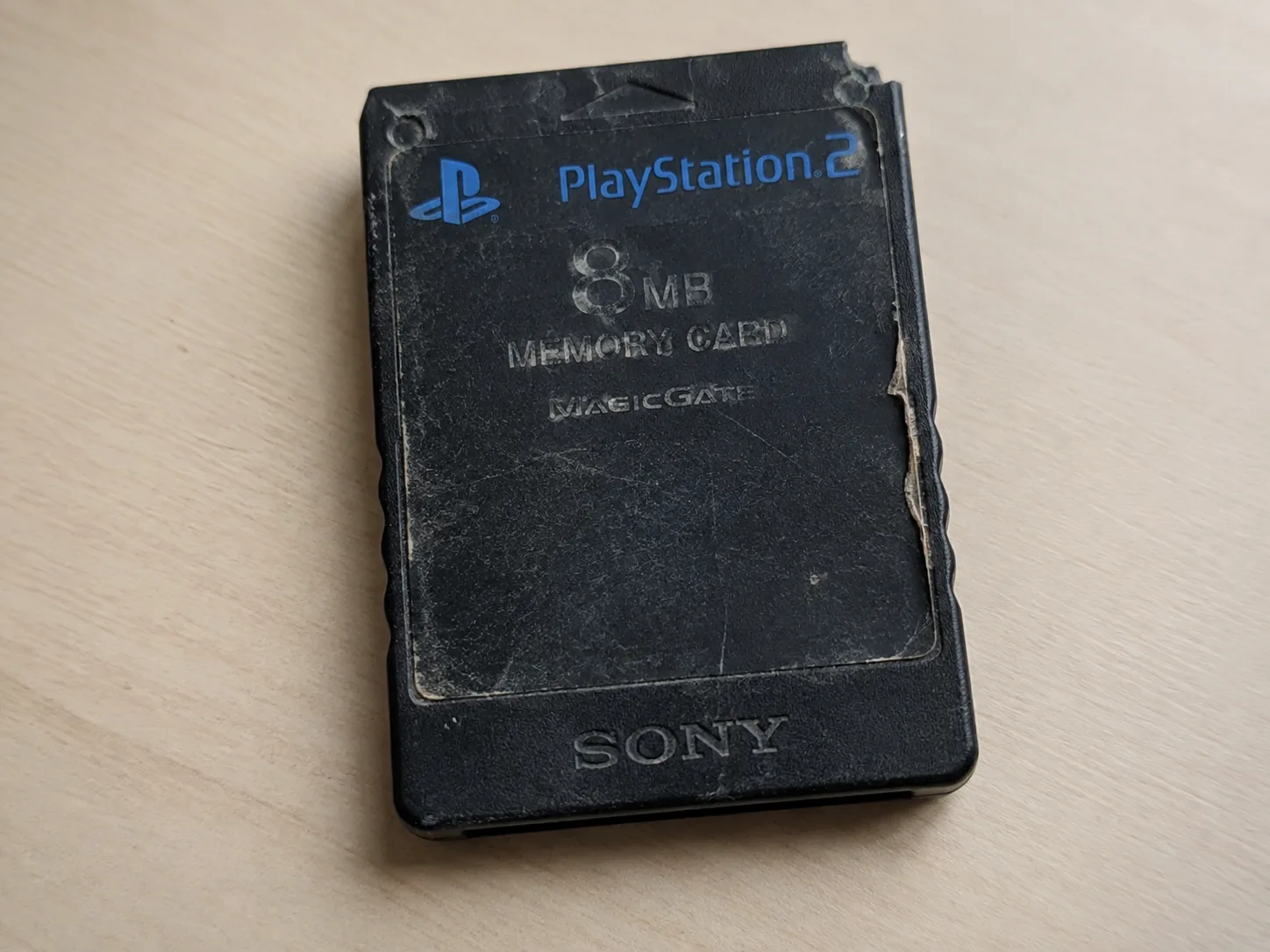
The contents were mostly the sort of small electronic debris that survives because throwing any one piece away feels premature: USB sticks, SD-card adapters, cables whose original purpose has become increasingly theoretical. In among them was a black PlayStation 2 memory card.
It made it into the pile to go.
I was holding the solution. Then I picked the card back out because I did not know what was on it.
That is why I still own it.
The card has not improved with age
It is not an attractive object. The casing is scratched, one upper corner has a small chip missing, and the printed label on the front has rubbed pale where I used to pull the card out with my thumb. One edge of that label has started lifting away from the plastic.
Nothing has been repaired. Nothing obvious is missing. It may still work perfectly, although I cannot currently tell you whether it does.
It holds 8MB.
I paid £8 for it second-hand, which was too much in the very specific sense that I only needed another memory card because I had filled the first one and refused to delete anything.
It did exactly what I bought it to do. Finished games, abandoned games and things I was unlikely ever to touch again had all accumulated on the first card. Deleting a completed save felt less like routine housekeeping than destroying evidence that I had done the work.
Buying another card meant I did not have to choose.
That worked beautifully. I am still postponing the choice.
I do not actually know what I am preserving
This is where the object becomes irritating.
I cannot give you a list of the games on it. I cannot tell you which saves are complete, which ones stopped after three hours or whether there is anything there I would recognise immediately as worth keeping.
I have guesses. Guesses are useless here.
If I opened a box of photographs, I could see what I had kept. If I found an old letter, I could read it. The contents of this card are physically still in my possession, assuming the thing works, while being almost completely unavailable to me.
I no longer own a PlayStation 2, so whenever I find the card I go through the same small sequence: pick it up, wonder what is on it, consider finding a way to read it, realise that satisfying my curiosity has become a project rather than a button press, and put it back.
It lives inside an old black zip-up pencil case in the bottom bedside drawer, alongside other small bits of technology I might conceivably need again.
Some part of my brain remains extremely vulnerable to the phrase yes, but what if?
The pencil case has become administrative limbo for objects too specific to throw away casually and not useful enough to deserve proper storage.
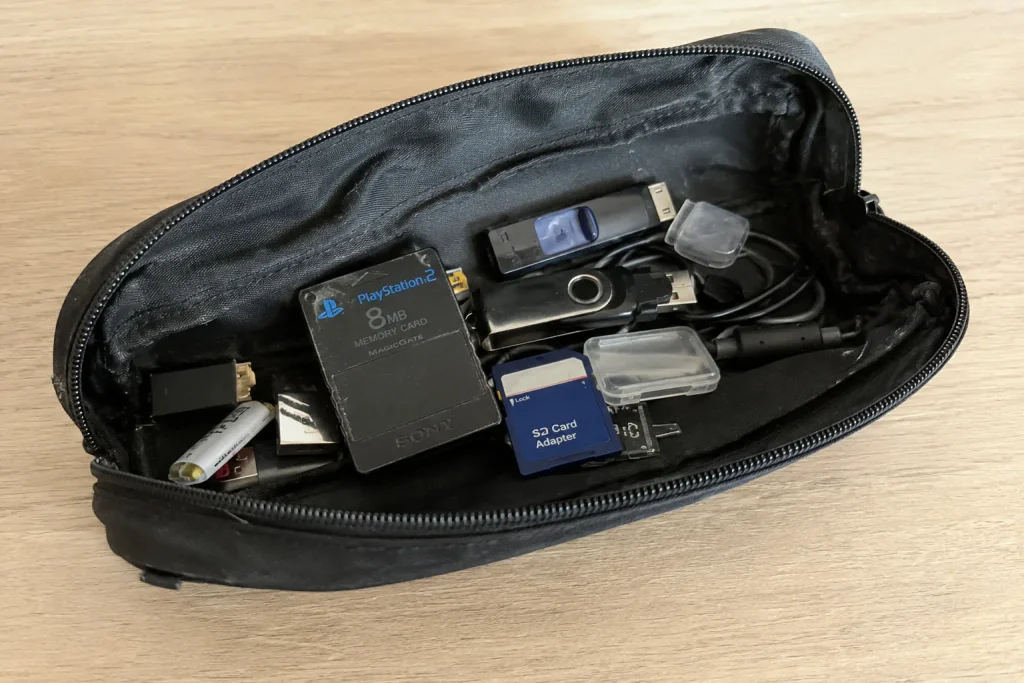
The memory card fits in rather well.
The obvious problem is that I no longer own the console it belongs to.
That would matter more if finding a PlayStation 2 were actually impossible.
Finding out is inconvenient, not impossible
For years I gave the card more mystery than the practical problem deserved.
The information is not sealed inside an archaeological object. The card was designed to be read by compatible hardware. I simply no longer own that hardware.
I could borrow a console. I could buy one, check the card and move it on again.
None of those options is beyond me. I simply have not done any of them.
That changes the question. The card is not sitting in the drawer because its contents are inaccessible. It is there because discovering them has remained just inconvenient enough for me to postpone and just achievable enough that throwing the thing away feels premature.
I have accidentally found a perfect amount of friction.
Too little to force a decision.
Enough to prevent one.
I have written an entire article about deciding which clothes should leave a crowded wardrobe, which is unfortunate because the memory card exposes how much easier I find the principle when the object in question is a jacket.
With the card, I reached the decision and then invented one extra condition: I should see what is on it first.
That condition has no deadline, which is how it has managed to last.
Uncertainty has been doing the work of sentiment
I had assumed for a long time that I kept the memory card because the saves mattered to me.
I no longer think that is quite true.
Some of them might matter. I would be pleased to find a save from a game I had put a ridiculous number of hours into. I might find a character name I had completely forgotten, a completed file I was oddly proud of or evidence that I abandoned something ten minutes before the end.
I could also find twelve saves I barely recognise and wonder why I spent years keeping them.
Until I look, both versions remain available.
That is what the card has been preserving most successfully: possibility.
Possibility is wonderfully resistant to decluttering because it cannot disappoint you. An unread card can contain exactly the thing that would justify keeping it. The moment I inspect it, the contents become ordinary enough to judge.
That is a considerably less flattering explanation for why it survived the clear-out. I was not protecting a known memory. I was giving an unknown one the benefit of the doubt indefinitely.
The scratched black plastic helps because it asks so little of me. It takes up almost no room. It does not need dusting. It has no batteries to leak into the drawer and no cable I have to accommodate. Every individual decision to keep it feels inconsequential.
Years of those inconsequential decisions are apparently how an object acquires tenure.
The £8 was worth it. Keeping it unread was not.
I do not regret buying the card. At the time, £8 solved the exact problem I had: I wanted somewhere else to put save files and did not want to delete the ones I already had.
It performed its job.
That does not give it permanent rights to the bottom drawer.
The verdict now is simple: it is not worth keeping unread.
I do not mean I am going to throw it away without looking. That would answer nothing. I mean it gets one final inconvenience.
I have to put it into something capable of reading it and find out what I have actually been protecting. Then the contents can make their own case. A save I genuinely care about can be copied or preserved. A collection of files I feel nothing about can stop occupying even this very small amount of space.
If I eventually open it and discover something wonderful, that will not prove I was right to keep postponing the job. If it contains rubbish, that will not make the card a profound lesson about letting go.
For now it is still in the black pencil case. I still do not know which games are on it, and I still have not found a PlayStation 2.
The difference is that I no longer think not knowing is a reason to keep it.
Leave a Reply