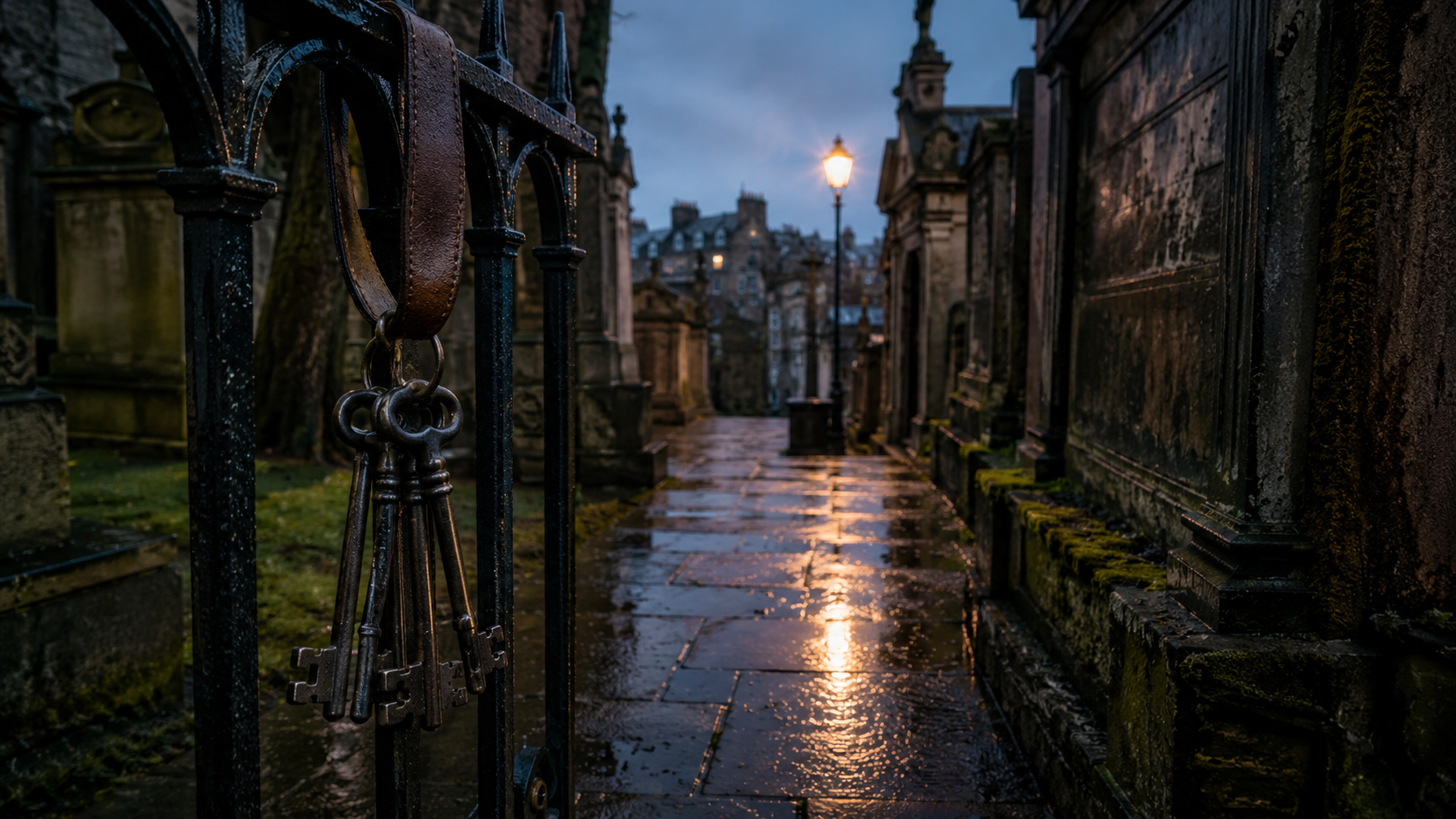
Edinburgh was hot for most of our visit, so the first supernatural benefit of the Double Dead Tour was that the underground vaults had excellent natural air-conditioning.
By the time it began to rain in Greyfriars, the city had finally arranged the weather properly.
We did not see any ghosts. Some American visitors said they had seen something curled in the foetal position in the corner of one of the vaults, alarmingly close to where I had been standing. I saw stone, shadow and absolutely nothing else. My psychic sensitivity is roughly that of a blueberry scone.
Even so, the tour stayed with me. Not because it proved anything paranormal, but because Edinburgh understands how to make a story cling to a place. Give somebody a ring of keys, lead them through a locked gate and tell them what other people claim to have seen there, and an ordinary dark corner becomes very difficult to look at casually.
The appeal began with a ring of keys
Our guide was wearing a long, worn leather duster that completed a distinctly Most Haunted look—the particular corner of British television in which every dark corridor became suspicious and somebody was always asking the spirit world to knock twice.
The coat was good, but the keys were better.
There is something irresistibly interesting about a person who appears to have keys to the underground parts of a city. Not a tidy electronic pass or one sensible Yale key, but a proper collection that suggests sealed doors, iron gates and several places the general public is not trusted to enter alone.
The Double Dead Tour, run by City of the Dead, combines the South Bridge vaults with the locked Covenanters’ Prison section of Greyfriars Kirkyard. The City of Edinburgh Council owns Greyfriars Kirkyard and handles its day-to-day maintenance, while City of the Dead advertises exclusive visitor access to the enclosed Covenanters’ Prison area used on its tours.
I had remembered this rather vaguely as the owner renting it from the council “or something”. The verified version is less mysterious, but watching the guide unlock the gate still felt far more exciting than entering another attraction through a gift shop.
Why James preferred it to the Edinburgh Dungeon
James enjoyed the ghost tour much more than the Edinburgh Dungeon, which he thought was a bit silly. I liked both.
The Dungeon is deliberately theatrical. There are actors, elaborate sets and the expectation that somebody will leap out, shout at you or implicate you in a historical crime. Its artificiality is part of the point.
The Double Dead Tour felt different because Edinburgh itself supplied the set. A fabricated cell can be entertaining, but it does not create quite the same feeling as hearing a real key turn in a gate beneath streets you walked along earlier that day. The tour still uses performance, comic timing and dramatic storytelling, but the stone chambers and burial ground do not disappear when the guide goes home.
James preferred that restraint. The guide could tell the wildest story imaginable, but she was still standing inside an actual vault rather than beside a painted backdrop.
I enjoyed the theatrical nonsense and the historical setting, so refusing to choose between them seems the sensible position. Some days you want careful distinctions between history and folklore. Some days you want an actor to accuse you of witchcraft before lunch.
Down in the South Bridge vaults
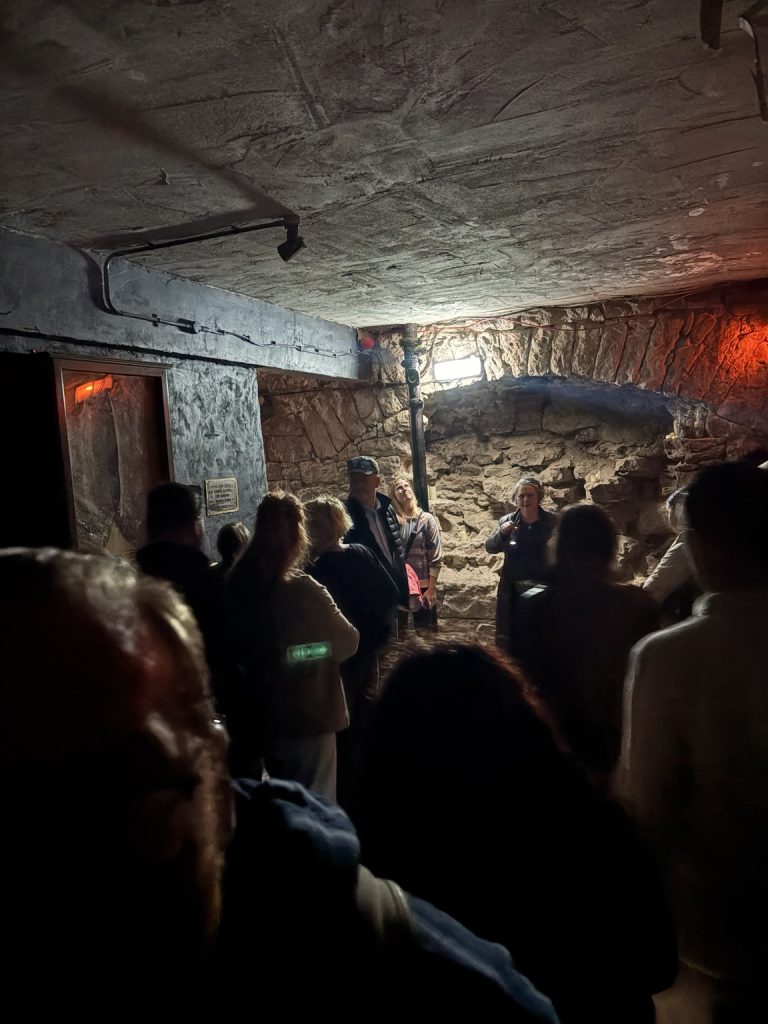
The South Bridge vaults are often presented as though Edinburgh simply discovered an underground city lurking beneath the streets. Their origin was more practical. South Bridge is a masonry-arch viaduct — a road carried across lower ground on a succession of stone arches — built in the 1780s to connect the Old Town with Edinburgh’s expanding south side. The arches were enclosed by buildings, and the higher spans were subdivided into vaults intended for storage and workshops.
I find that almost more interesting than an origin designed to be sinister. They were working spaces created as part of an expanding city. Their darkness and reputation accumulated afterwards, as uses changed and stories attached themselves to the chambers. The supernatural version did not replace an ordinary history; it grew over it.
The temperature dropped as soon as we went underground. After walking around Edinburgh in unusually warm weather, the cool stone felt less threatening than merciful.
We moved from chamber to chamber while the guide told us about reported shapes, scratches and people supposedly losing consciousness. James quietly suggested that anybody who fainted might simply have been walking around for nearly two hours.
This was a recurring feature of our experience. The guide would build a scene with complete seriousness, and James and I would whisper something unhelpful to one another at the back.
Then came the corner.
Some American members of the group said they had seen a figure crouched there in the foetal position. It was close to where I had been standing, which ought to have made the claim more disturbing.
Unfortunately, I had noticed nothing. I do not know what they saw. A person can sincerely mistake a shadow, glimpse movement that somebody else misses or interpret an indistinct shape after being told that a room is haunted. They may also have seen something I did not. Then again, my failure to see it proves no more than their claim that it was there.
All I can report confidently is that the vault contained a dark corner, they reacted to it and I remained stubbornly unvisited.
The ghost bus was definitely a bus
At one point, while we were moving through the Old Town, the guide told everyone to stop because a ghost bus was coming around the corner.
She warned us to make certain nobody was struck by it.
James watched the vehicle pass and said, “I don’t know, felt like a real bus to me.”
Still, it captured the tone of the evening. The tour never required us to surrender completely to fear. There was room for history, alleged paranormal attacks, a leather duster and an ordinary bus temporarily promoted into the spirit realm.
Greyfriars waited until it rained
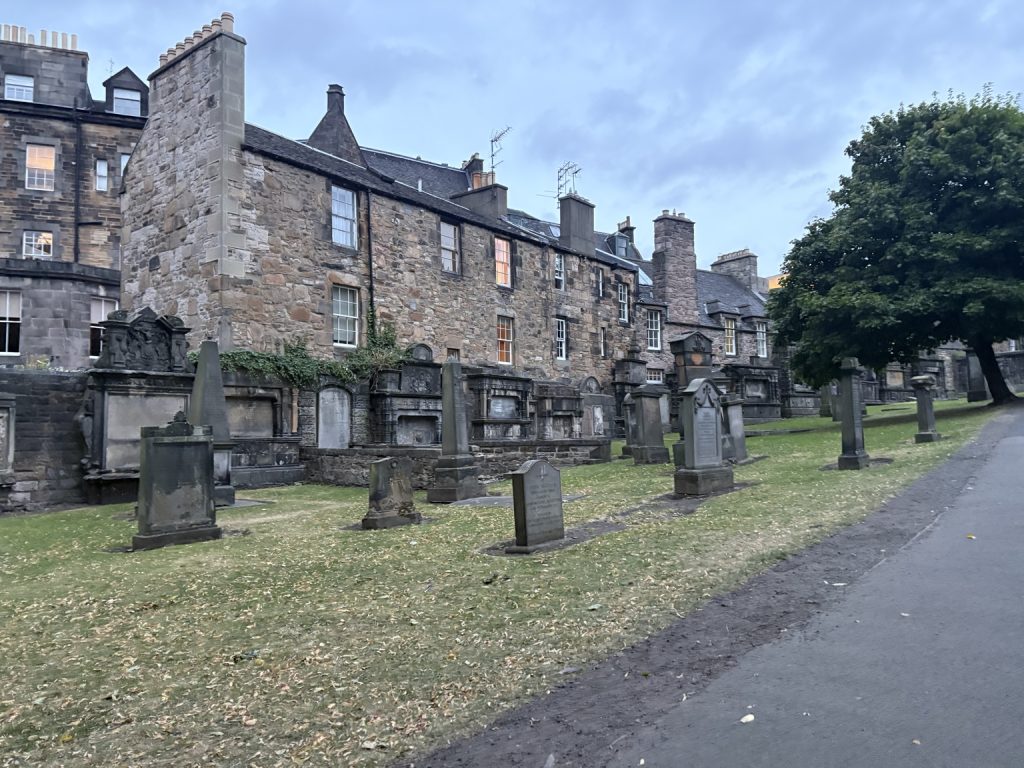
The rain began while we were in Greyfriars Kirkyard.
It had been hot throughout the trip, so the change felt welcome before it felt atmospheric. Then the stone darkened, water caught on the ironwork and the tour guide’s leather coat began looking even more professionally appropriate.
Greyfriars was established as a burial ground in the 16th century after the city sought relief from the congested churchyard at St Giles. Its monuments, walls and enclosures developed over several centuries.
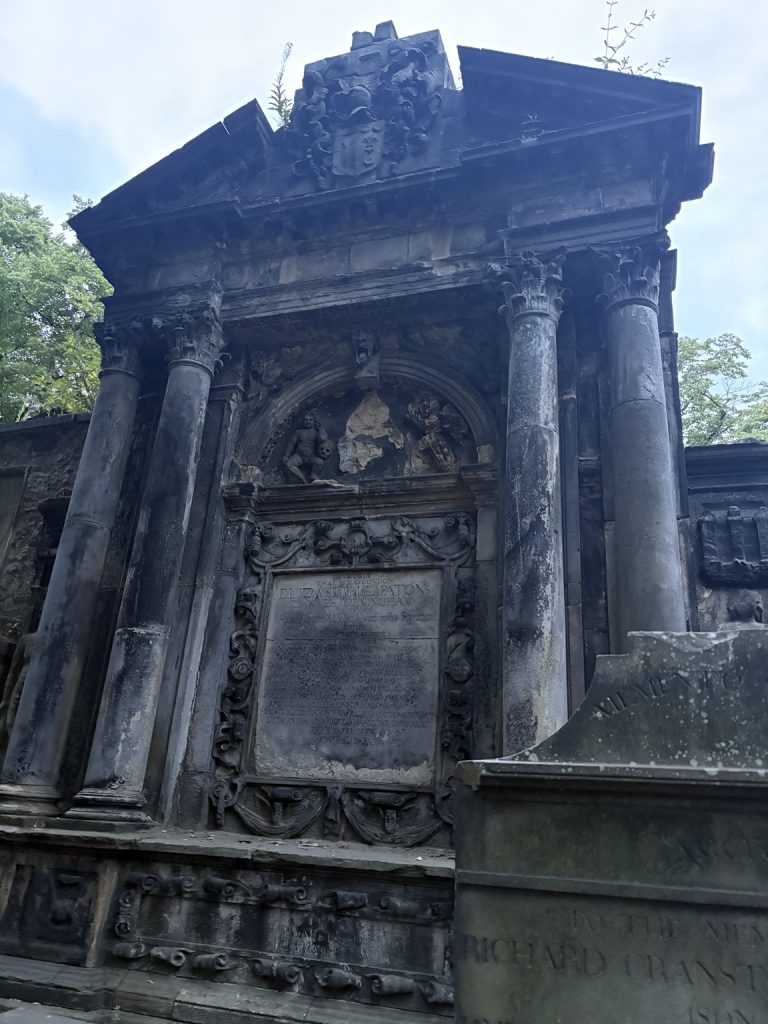
The south-western corner is associated with the Covenanters’ Prison. After the defeat at Bothwell Bridge in 1679, roughly 1,200 prisoners were marched to Edinburgh and held at Greyfriars, in a field south of the churchyard. Part of that ground was later incorporated into the kirkyard.
That history matters because it prevents the prison enclosure from becoming nothing more than a convincing backdrop for a ghost story.
Real people were held there. Whatever one thinks of the reported scratches, apparitions and fainting visitors, the place’s documented history is not imaginary and should not be reduced to gothic decoration.
The Mackenzie story was older than the tour
The modern tour associates the locked prison section and Black Mausoleum with the so-called Mackenzie Poltergeist. City of the Dead publishes accounts of visitors reporting scratches, collapses and other physical experiences there. Those are reported experiences and part of the tour’s supernatural reputation; they are not the same thing as independently established historical events.
What interested me after coming home was discovering how much older the unease surrounding Sir George Mackenzie’s tomb appears to be.
Robert Chambers recorded an earlier version of the tradition in Traditions of Edinburgh. Writing about Mackenzie’s place in local popular imagination, Chambers described his mausoleum as an object of fear and recalled children daring one another to approach its doors and call through the keyhole:
“Bluidy Mackingie, come out if ye daur,
Lift the sneck, and draw the bar!”
They would then run from the churchyard without looking back.
That passage does not prove the modern poltergeist story, nor should the two accounts be treated as though they are identical. It shows something more useful: Mackenzie’s tomb had already gathered a supernatural reputation long before contemporary ghost-tour marketing.
The details changed, but the place remained charged. Chambers repeatedly records Edinburgh in this way. Streets, closes, houses and monuments appear first as physical structures, then as locations layered with recollection, rumour, local jokes and older tales. His book is not proof that any ghost existed. It is evidence that Edinburgh residents were already telling stories about particular doors and stones.
The children shouting through Mackenzie’s keyhole were doing something recognisably similar to what a ghost tour still does: approaching a known place together, repeating a story and waiting to see whether anything answers.
What I think happened
So, no ghosts attacked our group. I did not see the crouching figure, receive mysterious scratches or feel an unseen presence. I felt cool air underground, rain in a kirkyard and the occasional need to stop laughing at James while somebody was attempting to frighten us.
That does not make the tour unsuccessful. A ghost tour is partly about the supernatural claims, but it is also about directing attention. The guide tells you where to stand, which doorway matters, what happened on the ground beneath you and what somebody else says they saw in the corner.
The city looks different afterwards.
The National Trust for Scotland describes ghost stories as part of the experience of historic places and notes that oral traditions survive through retelling, with a recognisable framework even as details change. They once helped people explain the inexplicable; today, they are often told as entertainment, but they still preserve clues about what earlier communities feared and remembered.
That is close to what I brought home from Edinburgh. Not a belief that every cold patch contains a spirit, but a sharper awareness of how stories inhabit architecture. A vault built for storage can acquire an entity. A lawyer’s mausoleum can become something children challenge and flee.
You do not have to believe every claim to notice what the telling does to a place.
Would I recommend the Double Dead Tour?
Yes, particularly for somebody who wants more than staged scares. The tour worked for us because it combined genuine historic locations, a guide who knew how to hold a group’s attention and enough humour to stop the evening becoming self-important. James enjoyed it more than the Dungeon because it felt less manufactured. I enjoyed both, but the vaults and Greyfriars were the parts I continued thinking about afterwards.
It is a long walking tour rather than a gentle indoor attraction. City of the Dead currently lists it as lasting approximately 1 hour 50 minutes and publishes age, accessibility and health restrictions, so check the current tour information before booking.
Based on our summer visit, I would also take a light waterproof layer even when the day has been warm. The vaults were pleasantly cool, Greyfriars supplied its own rain and Edinburgh’s weather showed little concern for maintaining continuity between scenes.
Most importantly, go for the access, history and storytelling rather than expecting a guaranteed supernatural event. You may see something; you may see nothing. Or you may spend most of the evening whispering jokes to your partner and narrowly escaping a completely corporeal bus. All three outcomes can produce a good night.
The tales that followed me home
Nothing followed us out of the vaults, as far as I know.
We returned with no unexplained marks, no photographs of shadowy figures and no sudden ability to communicate with the dead. James remained sceptical. I remained slightly more willing to enjoy the possibility without requiring proof.
What stayed with me was the guide’s collection of keys.
Each one opened a place that already existed, but the stories changed what waited on the other side. That is what Edinburgh’s best ghost stories seem to do. They do not need to place an apparition directly in front of you. They make an old door difficult to forget.
No ghost followed me home. The thought of all those locked doors did.