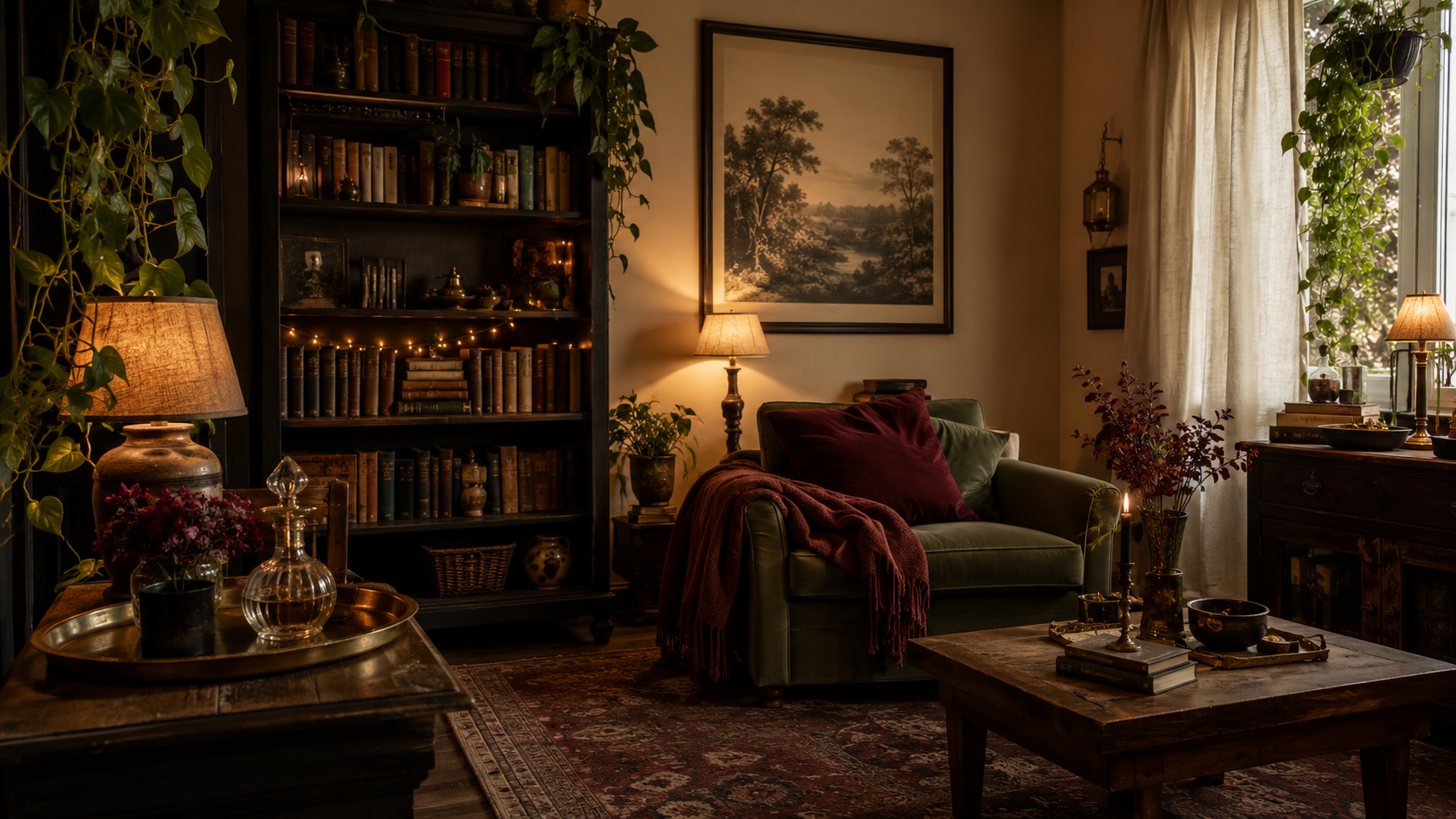
Old-world character is easy to mistake for quantity. Add another candlestick, another stack of books, another apothecary bottle and eventually the scholar’s study becomes a storage problem.
The rooms I am drawn to are rich and layered, but the effect does not come from covering every available surface. It comes from proportion, dark wood, softened colour, local pools of light, worn materials, living plants and objects that look as though somebody chose them for a reason.
The room might suggest a scholar, herbalist, traveller or woodland host. It does not need a plastic cauldron or a sign announcing that a witch lives there.
I used to describe the solution as choosing one or two memorable details and calming everything else down. I no longer think that is quite right. A room can contain a large rug, an old chest, a dramatic lamp, a wall of books and several odd objects without becoming cluttered. Trouble starts when those things have no relationship except that each was purchased to announce old-world.
Edith Wharton and Ogden Codman begin The Decoration of Houses (1897) by distinguishing superficial ornament from decoration that grows out of the architecture itself. They later argue that a room should be considered in relation to its actual purpose and the habits of the people using it. Their architectural ambitions were considerably grander than anything most of us are dealing with, but those two principles travel extremely well.
Make the room coherent before making it decorative.
That means beginning with what the room is for, then looking at scale, visual weight, materials, light and the empty space between things. Atmosphere follows from those decisions rather than from one more object added afterwards.
Decide what kind of life the room has to support
“Wizard room” is not a useful decorating brief. “A room where I read in the evening, work at a desk, keep a lot of books and occasionally expect another human being to sit down” is considerably more useful.
Start with the life that actually happens there. In a sitting room, that might mean reading, conversation, television and somewhere to put a mug. A bedroom needs a bed that can be reached without an expedition, light where it is actually needed and somewhere for clothes to live. A kitchen can contain plants, stoneware and old wooden things, but the work surfaces still have to function.
This is where an imagined story can help without becoming a shopping list. If you like the idea of a scholar’s room, ask what attracted you: books within reach, a proper desk, concentrated pools of light, substantial storage? If the appeal is an herbalist’s kitchen, perhaps it is living plants, storage jars, wood and ceramics rather than novelty bottles marked eye of newt.
The fantasy reference gives you qualities to translate rather than an inventory to reproduce. That distinction also keeps objects from having to explain themselves. If an object supports the room through its shape, material, usefulness or personal history, it can belong perfectly well. When its only connection is a word printed across it in gothic typeface, it has probably been asked to do too much exposition.
Sometimes the reason is less decorative than that. I still keep an old PS2 memory card I cannot quite bring myself to check, and its value has very little to do with how attractive it is.
Start with visual weight
A characterful room begins with its largest relationships: sofa to wall, table to floor area, bookcase to ceiling, rug to furniture.
A useful term here is visual weight: roughly, how strongly an element attracts the eye. Oklahoma State University Extension describes it as a measure of how much attention a design element draws, noting that size, darkness and contrast can make elements appear visually heavier. Shape and position can alter that balance too, so a smaller thing can still feel surprisingly heavy.
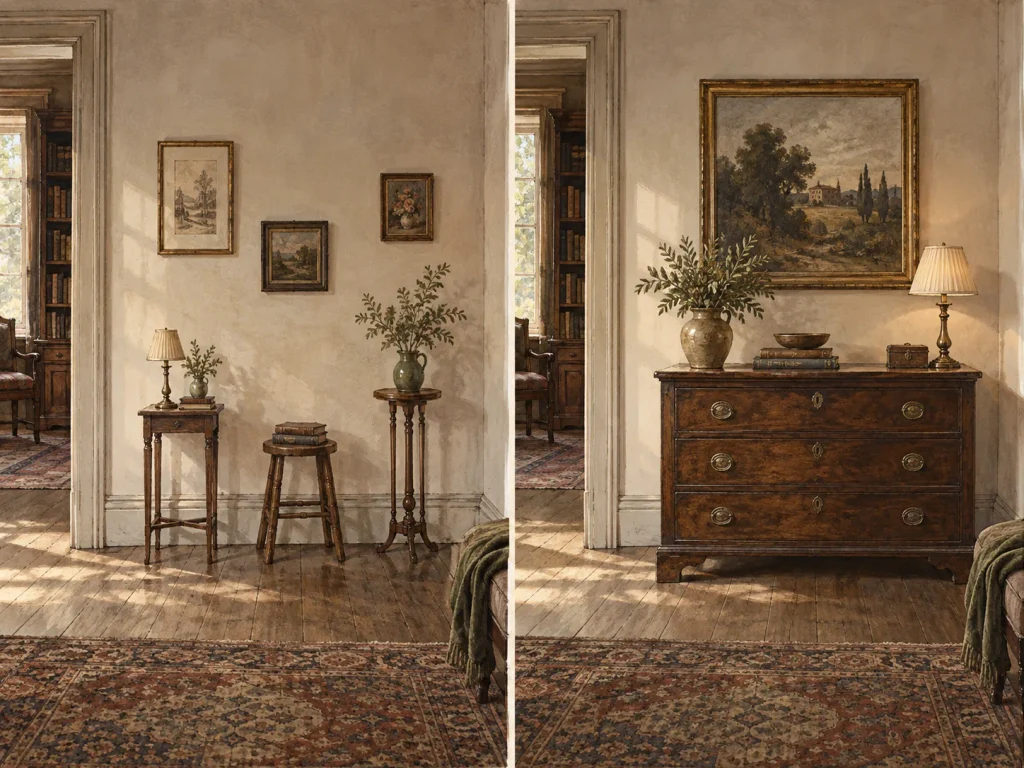
That explains why three small tables are not necessarily equivalent to one broad wooden chest. The chest may give an otherwise empty wall a single strong mass; three little tables can simply produce three separate things to notice.
The same applies across a room. A tall dark bookcase on one wall might be balanced by an armchair, standard lamp and large framed work on the other. Nothing has to match. The visual weight merely has to feel distributed rather than accidentally abandoned on one side.
This is also why small furniture can make a modest room feel more cluttered rather than less. A flock of tiny frames, occasional tables and narrow storage units creates many edges and many separate decisions. One object with enough presence can calm the arrangement.
Measure before buying. Mark a proposed footprint on the floor and walk around it. A cabinet that looked dignified in an antiques centre may reveal its true feudal ambitions when it blocks the sitting-room door.
Arrange the furniture around use, not scenery
A convincing old-world room should survive people actually entering it. Give the main seats access to light and somewhere to put a drink. Keep routes through the room clear. Put the desk where working at it makes sense rather than where it best completes the photograph.
The adventuring-party rest-stop test remains useful. Imagine several tired people arriving after rain. Can they sit down? Can somebody put a wet coat somewhere? Is there light to read by? Can they cross the room without striking a shin against an ornamental chest?
The fantasy is doing practical work here: hospitality, rest and usefulness help make the room convincing. A room that looks perfect until somebody needs a cup of tea has been designed for a surprisingly narrow range of human activity.
Give plain walls some structure before adding more objects
Many old interiors gain authority from the architecture itself: cornices, deep skirting, panelling, built-in shelves, tiled hearths and clearly framed openings.
Those elements divide large blank surfaces into purposeful shapes. When the wall already has structure, it does not need seventeen objects pinned to it for reassurance.
Wharton and Codman were particularly insistent that architectural form should do more of the decorative work rather than relying on ornament scattered over the surface.
You can translate that principle without manufacturing a Georgian drawing room:
- use one or two tall bookcases to create a strong vertical mass;
- hang curtains in relation to the window rather than swallowing it;
- place a large picture, mirror or textile in relation to the furniture beneath;
- use a rug to establish the main seating or sleeping area;
- repeat a wood tone or frame finish;
- let one wall carry more visual weight instead of decorating every wall equally.
I watch far too many videos of moulding and wainscoting for somebody who rents, but permanent alterations are where the tenancy gets a vote. Shelter England advises tenants to discuss improvements with their landlord and get any agreement in writing; it also says ordinary decorating does not usually require permission. Tenancy agreements can still impose conditions on smaller changes, so check yours before attaching anything that the next tenant will curse your name over.
Reclaimed architectural pieces can still appear without becoming building work. One old tile can become a trivet or framed object. A carved fragment can sit on a shelf. A real small piece of old material usually has more conviction than a large quantity of imitation stone.
Use materials with something happening at the surface
For old-world character, materials do more work than motifs. Wood has grain. Linen wrinkles. Glazed pottery varies slightly across its surface. Brass changes with handling and exposure. Leather creases. Woven cloth responds differently to light from polished metal or smooth plastic. Those surfaces give the eye more to read.
That does not mean natural material automatically equals quality. A badly made wooden table remains badly made, and a well-designed modern synthetic object can still belong perfectly well.
The useful distinction is whether the material has the surface, weight and behaviour you want.
Choose a small material family and let it recur: perhaps medium or dark wood, linen or substantial cotton, wool, ceramic, aged metal and glass. Paper and leather can appear where they make sense.
This is also where actual age can help. A scratched table, dulled brass lamp or worn leather chair can ground a comparatively clean room because the wear is specific rather than decorative.
Manufactured distressing becomes less convincing when the same scratches, rubbed edges and artificial patina appear across everything. Genuine wear is irregular because different materials and objects age in different ways.
Do not replace useful modern belongings merely to improve the material palette. If the plastic storage works, let it work. Put less attractive necessities inside cupboards or drawers where practical, then choose something with more character when an object genuinely needs replacing.
Let modern furniture be modern
A modern sofa does not invalidate the room, and neither does Ikea, flat-pack shelving or a bed bought last year because you wanted a mattress that did not contain the accumulated decisions of 1936.
Modern furniture can provide the quiet base layer. Character then comes from relationships with older wood, textiles, lighting, books, art and objects you have accumulated gradually.
A plain modern sofa beside an older table, on a patterned rug and near a substantial lamp can make perfect sense. It does not need to imitate the older pieces around it.
Mixing periods can actually make genuinely old pieces more convincing because they remain individual. When every single object is pretending to be antique, nothing has much authority.
Shared scale, colour and material can unite furniture from different decades without making it look like a matched suite.
Ightham Mote is a useful extreme example of the same principle. The National Trust describes interiors altered by successive owners, where Jacobean features sit alongside Palladian and Gothic elements, eighteenth-century Chinese wallpaper and even rooms decorated in a 1950s New England style. The house works because those periods accumulated rather than being forced into a single historical moment.
And second-hand furniture still has to pass an ordinary-life test. Open the drawers. Sit in the chair. Lean gently on the table. A chest with stiff drawers may be excellent for spare blankets and infuriating for socks. Age is not a substitute for function.
Use colour to connect things rather than make everything dark
An old-world room does not have to be brown. I like moss and forest green, oxblood, tobacco, faded ochre, deep blue, clay, mushroom, muted plum and the warm grey of old stone, but none of them needs to cover every surface.
A pale room can still have depth when darker wood, a substantial rug and warm lighting give it something to push against.
The useful part is repetition. Let a few colours recur through textiles, art, pottery and furniture rather than introducing a completely new palette with every purchase.
This is also how different periods can coexist. I love the 1970s, and individual pieces from the decade can sit surprisingly well among older references. A smoked-glass lamp, curved chair or amber textile works when colour, proportion or material connects it to something else in the room.
Several strong ideas can coexist when colour, proportion or material gives them some reason to know one another.
Make lighting warm, local and useful
Nothing dispels atmosphere faster than a bright white government light flooding everything evenly from above. It makes a sitting room feel less like somewhere to read and more like somewhere you are expected to explain your whereabouts.
Use several useful light sources instead of demanding that one ceiling fitting illuminate every activity equally.
A table lamp beside a chair, standard lamp near the sofa and desk lamp where somebody actually works create separate pools of light. The darker intervals between them give the room depth without making it impossible to locate your own feet.
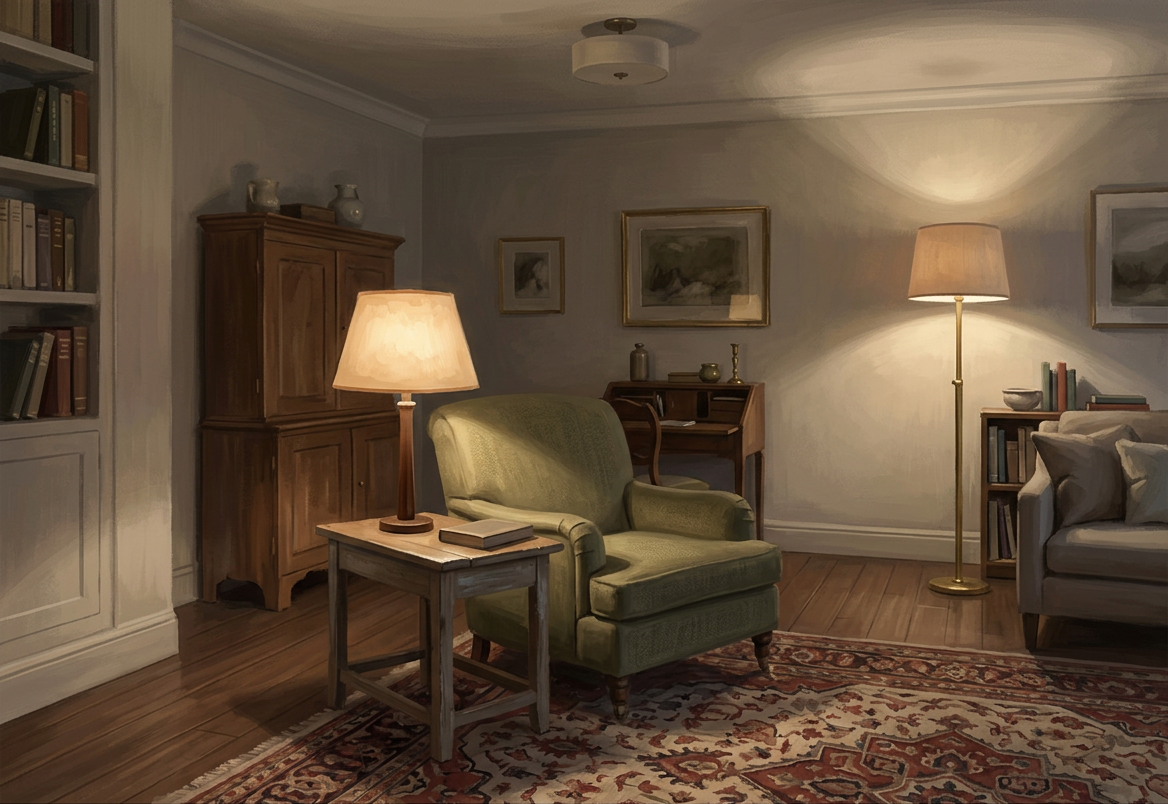
Position comes before quantity. Put the light where people read, cook, dress, work or sit.
Shades matter because they alter the distribution and character of the light. Fabric, opaque glass, paper and metal can all work depending on the fitting and the job.
Vintage-style filament bulbs still earn their place where the bulb itself is deliberately visible. Used throughout a room, however, they quickly become a decorative motif rather than a useful lighting choice.
Fairy lights can survive, with supervision
I speak from experience when I say there is a fine line between fairy lights and complete nonsense. In my twenties they were everywhere, and I crossed it more than once.
Several strands looped around unrelated objects turn the lights themselves into the main decoration.
Electrical Safety First advises against using decorative lights if the wires or plug show signs of damage and says to switch them off at the socket when they are not in use.
Vintage lamps require rather less romance about their wiring. Electrical Safety First advises against buying second-hand lamps because their electrical history is unknown, and says a lamp should not be used if its cable or plug is damaged or there are warning signs such as burn marks, buzzing, crackling or excessive heat.
I like old lamps. I simply separate liking the object from trusting whatever electrical history happens to be inside it. An old shade on a safe modern fitting is still an old shade. A vintage lamp whose electrical condition is doubtful is a repair problem before it is an atmosphere problem.
Candles can provide beautiful light too, but they need treating as an open flame rather than an atmospheric accessory. London Fire Brigade advises keeping candles in heat-resistant holders on stable surfaces, away from anything that can catch fire, and never leaving them unattended. It describes flameless LED candles as the safer alternative.
Let books and plants alter the room rather than decorate it
Books and plants are non-negotiable in my ideal room, but neither improves an interior merely by being present.
Books work best when they belong to the life of the room. Keep frequently used ones accessible. Mix upright rows with horizontal stacks where the shelf height or book size makes that sensible. Leave some breathing room rather than wedging a book into every surviving centimetre as proof of intellectual seriousness.
Plants work through shape, height, texture and growth. A large plant can change the silhouette of a corner. Trailing growth can cross the hard edge of furniture. Fine foliage behaves completely differently beside a cabinet from one enormous leaf.
That deserves more than the old advice to scatter plants around until the room looks greener. In the newer houseplant piece, I go into why some houseplants transform a room while others barely register, and why light and household safety have to constrain placement before the composition gets its vote.
The useful shared principle is that abundance needs structure. Books live on shelves, plants occupy suitable positions, collections have boundaries.
Richness has somewhere to live.
Choose objects with a reason to be there
A memorable room contains things that invite questions, but they do not all need impressive histories. I would much rather hear that an odd perfume bottle cost four pounds at a flea market than learn that six identical bottles arrived the following morning in a multipack.
What matters is selection. An older object might earn its place because you like what it was made for, because the material has aged beautifully, because you repaired it or simply because its strange little handle pleased you in a charity shop. The old collar box I became unreasonably attached to is a good example: its original job is obsolete, but the object still has material, scale and a perfectly plausible new use. That is already enough. There is no need to invent an aristocratic previous owner or a mysterious apothecary.
The same principle is useful when you want a room to suggest fantasy. The strongest objects are often not fantasy merchandise at all. An old map, wooden box, botanical print, unusual mirror or substantial candleholder can carry associations through its existing shape, material or use. A box can store letters. A map can belong to somewhere you care about. A botanical print can make sense beside living plants.
The test is whether the object still has something to offer after you remove the fantasy label. If its only job is to announce WITCH, WIZARD or MAGIC, the room is doing very little work of its own.
Collections need boundaries as well. Keep bottles on one tray, ceramics in a cabinet, small pictures on one wall or curios on a particular shelf. Containment allows you to collect generously without making the room look as though the contents of several abandoned houses have arrived for processing.
One peculiar perfume bottle is intriguing. Thirty-seven suggest that the flea market followed you home.
Let technology exist without giving it command
Televisions, speakers, chargers and cables belong in modern rooms because modern people use them. Hiding every trace of them is unnecessary; giving them the strongest visual position in the room is not.
Treat them as part of the composition. A television can sit against a darker wall or among furniture substantial enough that the screen does not become the automatic centre of attention. Keep chargers together somewhere convenient when they are not being used, and gather loose leads rather than letting each one take its own exploratory route across the floor.
The useful principle is simply to route and contain the leads so they stay accessible without becoming a separate layer of visual clutter. It does not require elaborate boxes or furniture designed to impersonate a monastery.
The same restraint applies to the technology itself. Do not make a router inconvenient, a speaker inaccessible or a television unpleasant to watch merely to preserve the atmosphere. Modern equipment becomes much less dominant when the rest of the room already has strong furniture, varied materials, useful lighting and objects with enough presence of their own.
A black rectangle is allowed to be a black rectangle. It simply does not need to become the room’s heraldic device.
Edit before buying anything else
When a room feels unfinished, buying another object is an extraordinarily tempting diagnosis. Try subtraction first.
Look at a surface and ask whether there is a clear anchor, whether the smaller things relate by use, material or colour, whether you can still see some of the surface, and whether anything is obstructing the room’s actual function.
Then remove things temporarily.
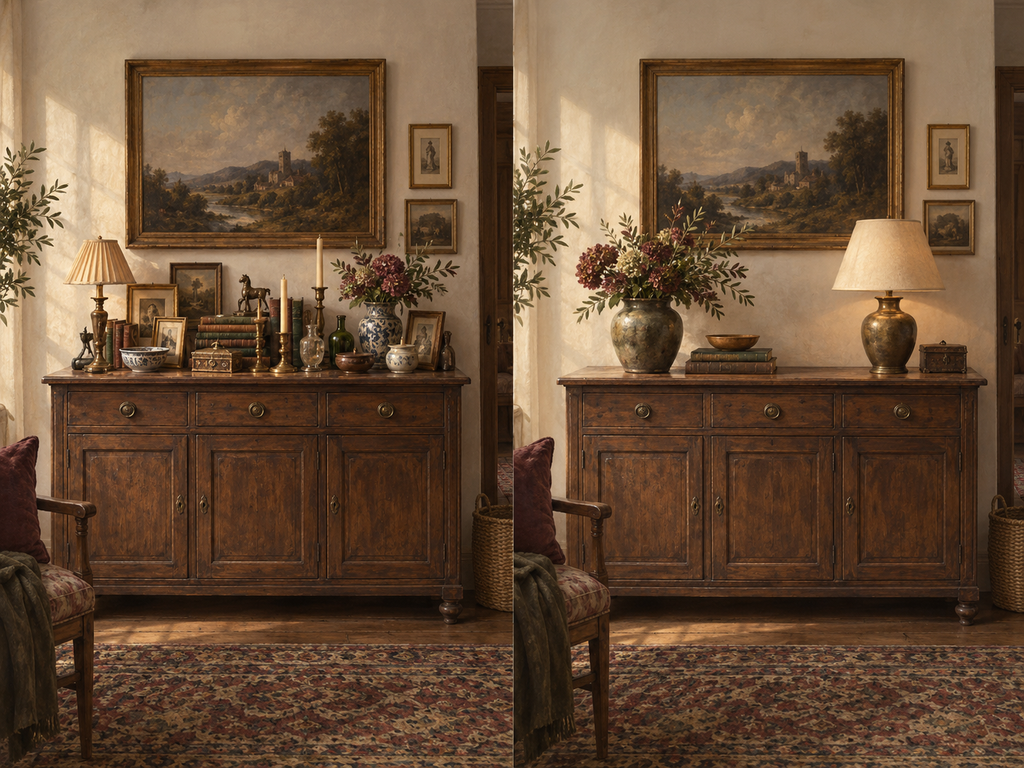
With the smaller distractions gone, you can tell whether the room actually needs another substantial piece or whether its existing anchor had simply been buried.
Empty space is not the enemy of a layered room. It allows dark wood to register, gives a lamp somewhere to cast light and lets an unusual object look significant rather than merely numerous.
A layered interior can contain plenty; the stronger test is whether its parts have relationships beyond simply sharing a theme.
Let the room acquire its character
An old-world room should not look as though it was purchased as a complete idea on Tuesday. Begin with the largest practical pieces. Sort out the lighting. Establish enough colour continuity that unrelated things can coexist. Add books, plants and older objects because they have somewhere sensible to live.
Then wait.
A home assembled gradually will contain modern basics, second-hand furniture, inherited things, holiday finds, useful objects and a few inexplicable treasures. It will change because something breaks, a plant grows, a better chair turns up or you discover that the beautiful little table is always precisely where your knee wants to be.
That mixture is what makes a room feel personal rather than staged.
The magic lies in letting this room suggest another world while continuing to serve this one. A chair can suggest a scholar because it sits beside good reading light and books somebody actually opens. A kitchen can feel faintly herbalist because plants, ceramics and useful tools belong there. A sitting room can feel ready for returning travellers because it offers warmth, comfort and somewhere to put the teapot.
The room should feel ready for a story, not buried beneath its props.