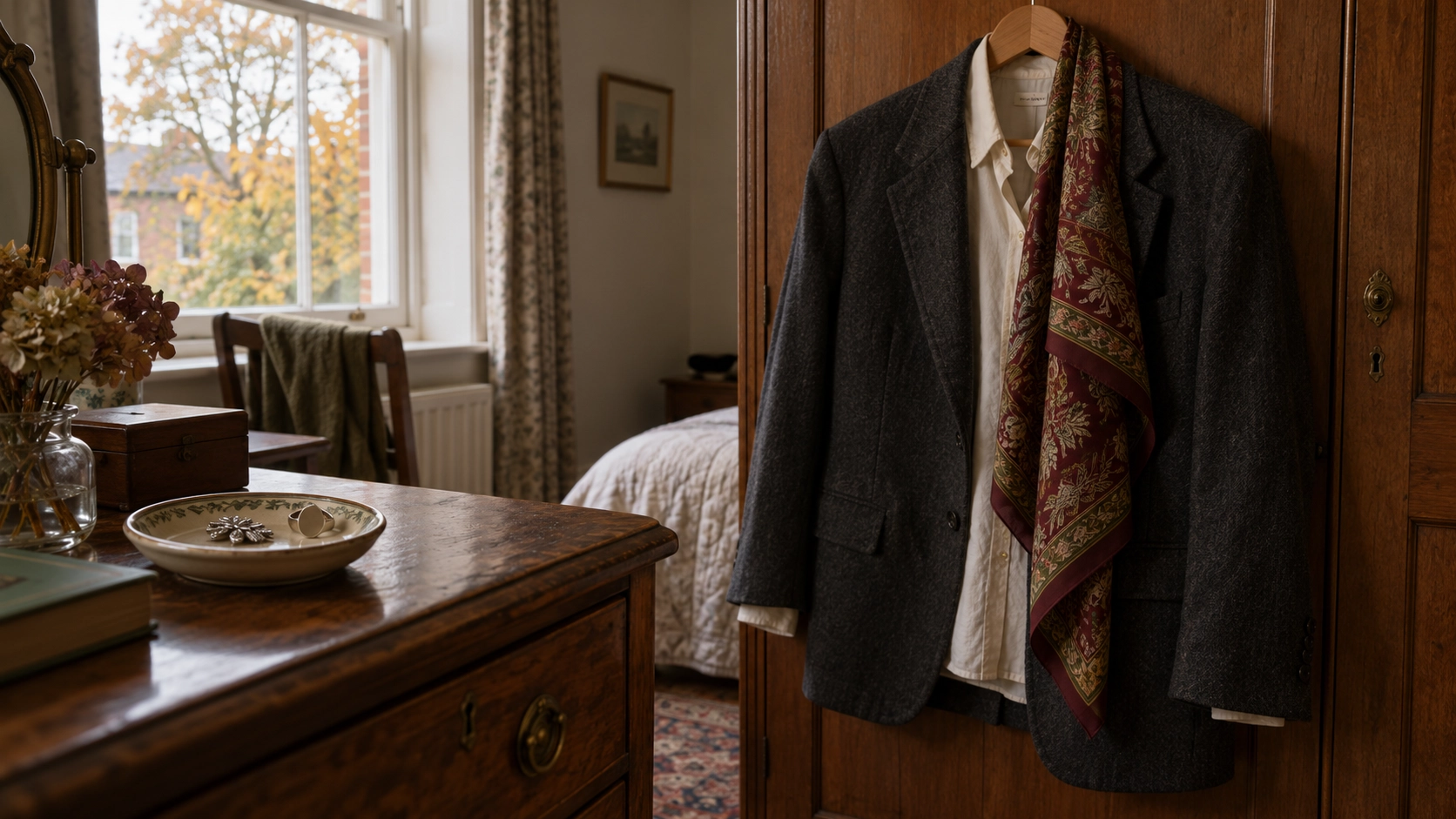
A good shirt and pair of trousers ought to be enough. Some mornings they are. On others, they produce the visual excitement of a form being completed in duplicate.
Buying another shirt would certainly be one solution, although there is a limit to how many variations of the same outfit a wardrobe can reasonably accommodate. I would rather see what a different belt, an unusual brooch or an excellent piece of silk could do with clothes that already fit.
Second-hand accessories are particularly good territory for this. Interesting colours and patterns are easier to accommodate in small quantities, and something that looks rather alarming on its own may turn out to be exactly what an otherwise restrained outfit needed.
That does not mean everything in the charity shop jewellery cabinet deserves rescuing. Some of it is hideous, and some of it is hideous in a way that might actually be useful. The distinction is worth making before paying.
Here are eight accessories I would look for, and what each can contribute to an ordinary wardrobe.
1. A patterned silk scarf
A large silk scarf can introduce colour and movement to an outfit without changing its basic silhouette.
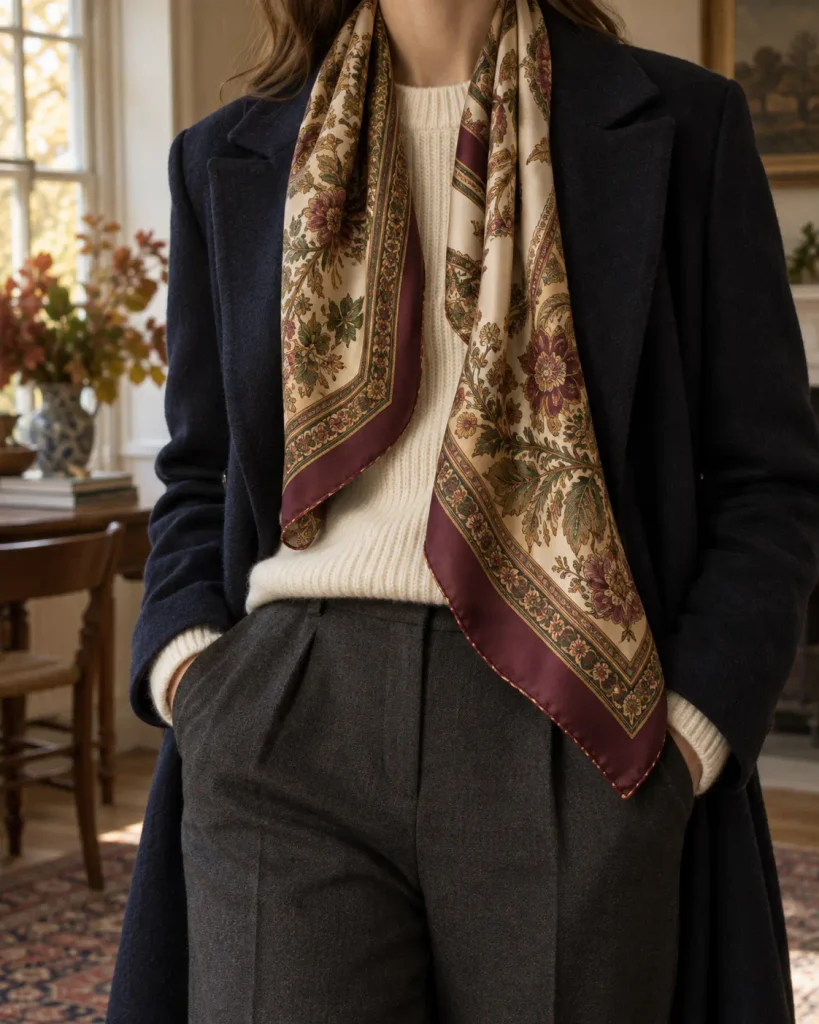
In the photograph, a navy overcoat, charcoal trousers and a cream jumper make a perfectly sound outfit, though perhaps a little sombre all together. A generous square of silk, folded diagonally and worn loosely beneath the coat’s lapels, could bring in burgundy, gold or olive. The pattern becomes a focal point against the relatively quiet wool.
I prefer this sort of loose arrangement to anything too elaborate. Let a little of the pattern show, leave the ends free if the scarf is large enough, and allow the fabric to move.
There is also something appealing about the contrast between soft, fluid silk and substantial winter cloth. A scarf that looks rather fussy spread across a table can become surprisingly convincing against a plain coat.
Look for interesting printed borders as well as the central design. A patterned border can remain visible when most of the scarf is folded away.
When buying second-hand, unfold the entire scarf and check for pulls, holes and staining. A hand-rolled hem — an edge rolled into a narrow rounded finish and stitched in place — is a lovely construction detail, though no guarantee of provenance. Hermès uses this finish on its own silk scarves.
I would be more interested in an excellent print with an unfamiliar label than a famous name attached to a scarf whose colours I disliked.
2. An old brooch
Brooches have somehow acquired a reputation for belonging either to elderly relatives or to people attending the opening of an agricultural exhibition.
Neither has exclusive rights to them.
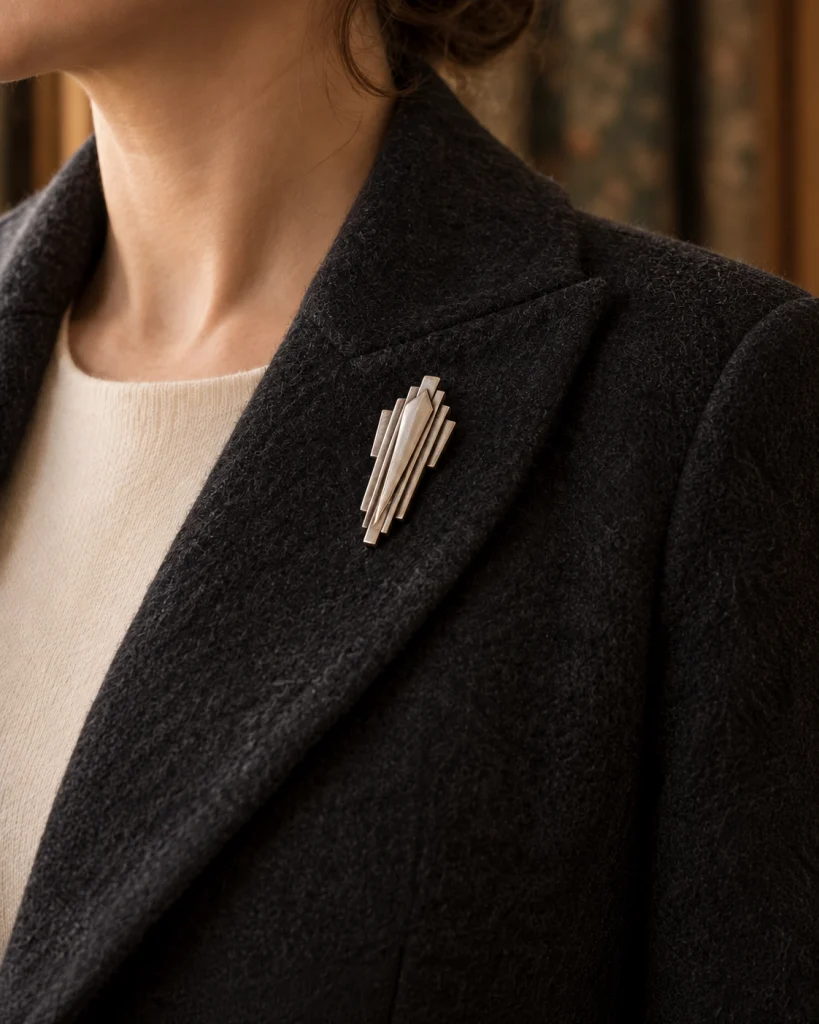
A brooch creates a focal point exactly where you choose to put it. A silver-coloured geometric piece could give a dark wool coat a slightly severe finish. A small enamel flower might look excellent against a plain cardigan. Something shaped like a beetle or an unusually elaborate leaf could be quite beautiful, provided the workmanship justified the idea.
Placement changes the result. High on a lapel, a brooch can look deliberate and slightly formal. On a substantial knitted cardigan, it feels softer and more personal. A small cluster of brooches might work too, although I would want some relationship between their shapes or colours rather than a general gathering of objects that happened to fit through fabric.
The back matters when buying. Check that the hinge and catch work properly, that the pin is sound and that any decorative stones are secure.
If a seller claims a piece is sterling silver or gold, the marks need examining rather than accepting the description. My guide to reading second-hand jewellery hallmarks explains what those tiny stamps actually establish.
Personally, I think an old brooch can be completely delightful without being worth anything as precious metal. A good design has its own value, even when it is made from thoroughly ordinary materials.
3. A pair of braces
Braces are particularly interesting with high-waisted trousers because they support the trousers from the shoulders, allowing the waistband to sit without needing to be pulled tight by a belt.
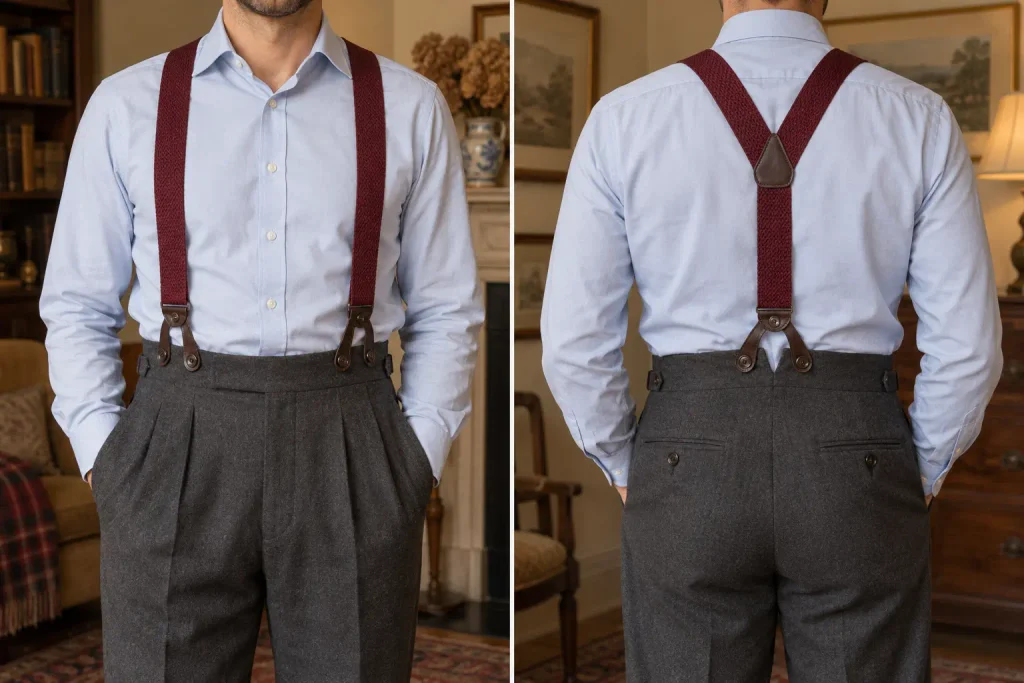
That changes the visual arrangement of the outfit. The trousers can fall cleanly from a higher waist, especially when they have pleats or a fuller leg, while the braces introduce two long vertical lines over the shirt.
A pair of dark burgundy braces with charcoal trousers and a pale blue shirt could be handsome. Patterned braces might be excellent too, though I would keep the rest of the upper half relatively quiet.
They also offer an attractive possibility beneath a waistcoat. Only small sections remain visible, but the outfit has a sense of considered construction rather than looking as though somebody simply added another layer.
One detail worth knowing is the fishtail back — a back waistband that rises into two raised points with a V-shaped notch between them, traditionally designed to accommodate braces. British clothing maker Cousin Jack uses this construction on its high-waisted trousers.
You do not need fishtail trousers to wear braces. Ordinary trousers can have suitable brace buttons, and clip-on varieties exist too, although I prefer the cleaner appearance of button fastening.
When shopping second-hand, check the elastic still recovers its shape and inspect the attachment fittings for damage.
I would also resist wearing braces and a belt together. They are both trying to hold up the same trousers, and I see no reason to appoint a committee to supervise my waistband.
4. A leather belt with an interesting buckle
A belt does rather more than stop trousers heading south. It establishes a clear division between the upper and lower halves of an outfit, which can be particularly useful with high-waisted cuts.
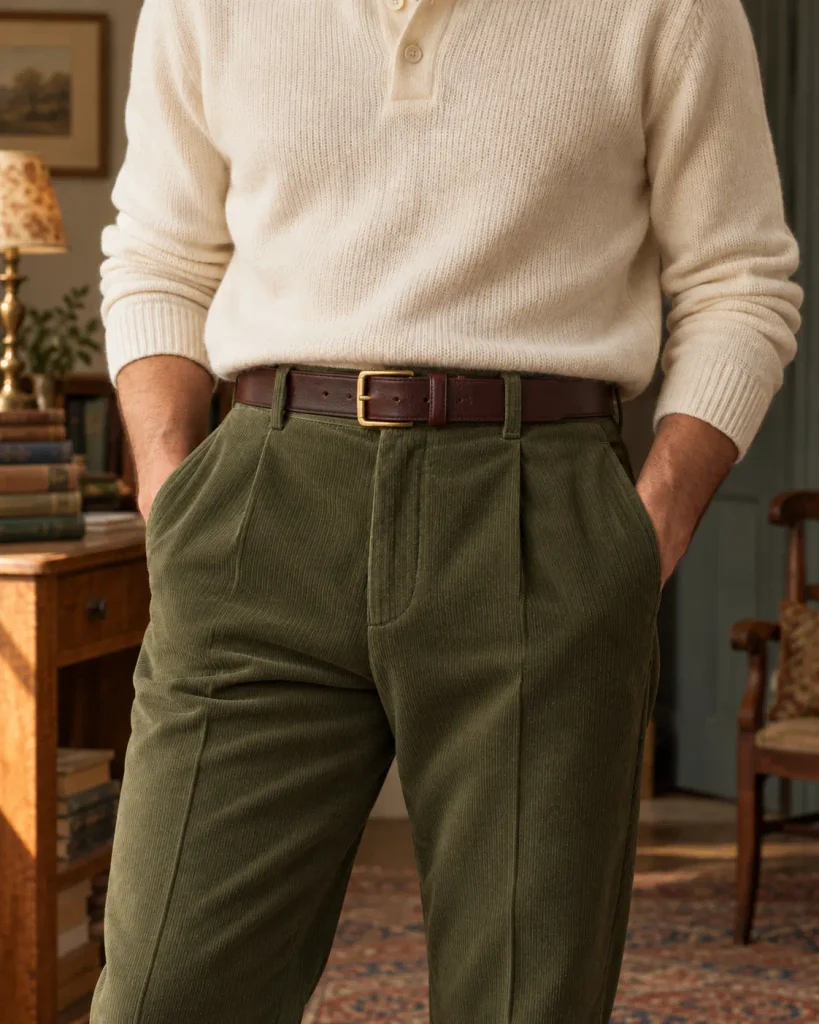
In the photograph, a cream knitted polo tucked into olive needlecord trousers shows exactly how a dark oxblood belt can make the waist more definite while introducing another rich colour.
The buckle matters as much as the leather. A small brass buckle can look quietly traditional, while a larger, more sculptural design may become the centre of the entire outfit.
I have a soft spot for unusual buckles, although there is a point at which their makers appear to have mistaken a trouser fastening for the shield of a minor European principality.
Too much detail can also become irritating if the rest of the outfit is already busy. With patterned trousers or a particularly dramatic shirt, I would probably choose something restrained.
When buying second-hand, inspect the leather around the holes for splitting and check the keeper — the small loop that holds the loose end of the belt in place. A damaged keeper is often an annoying fault on an otherwise wearable belt.
A good belt should earn repeated use. It is worth thinking about the shoes, trousers and outerwear it will actually accompany before becoming enchanted by an enormous brass horse.
5. A pocket square
The pocket square is one of those accessories that has been unfairly confined to weddings, formal dinners and photographs of men who appear to own rather a lot of cufflinks.
It can be much more relaxed than that.
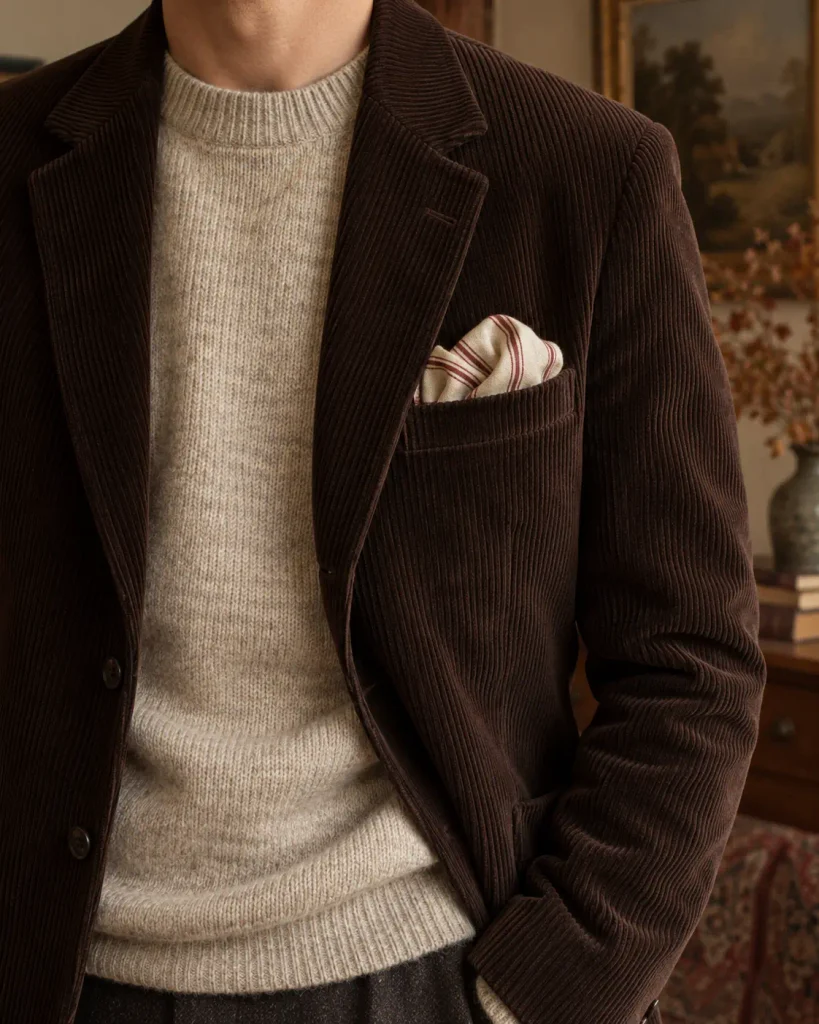
A dark corduroy blazer with a soft striped pocket square could look excellent with jeans and a knitted jumper. The little piece of cloth breaks up the jacket’s broad surface and introduces a colour that can be repeated elsewhere, or left entirely alone.
I particularly like a casual arrangement where the fabric sits loosely above the breast pocket. A cream linen square can create a clean contrast against darker tailoring, while a patterned silk one may bring a touch of eccentricity.
There is no obligation to fold it into an architectural achievement. Some of the more elaborate arrangements look as though a restaurant napkin has been promoted beyond its abilities.
A pocket square should suit the jacket’s character. Something delicate and immaculate might look peculiar in a heavily textured, rather battered old tweed coat. A slightly more relaxed fabric could be much better.
When buying second-hand, unfold it completely and inspect the corners and old fold lines for staining or damage. Avoid anything too bulky to sit comfortably in the pocket.
I would choose one for a jacket I already wore regularly rather than buying a collection in anticipation of becoming the sort of person who requires twelve pocket squares.
6. A small neckerchief
A neckerchief deserves its own place here because it performs a different job from a large silk scarf.
Where the larger scarf introduces flowing fabric and pattern across the upper body, a neckerchief sits close to the throat. It occupies the space left by an open shirt collar and provides a compact point of colour without changing the rest of the outfit.
This works particularly well with a dagger collar — a shirt collar with exaggeratedly long, sharply tapered points, as I explain in my guide to wearing shirt collars with jumpers.
A small cotton or silk neckerchief tucked beneath those long collar points could be rather lovely.
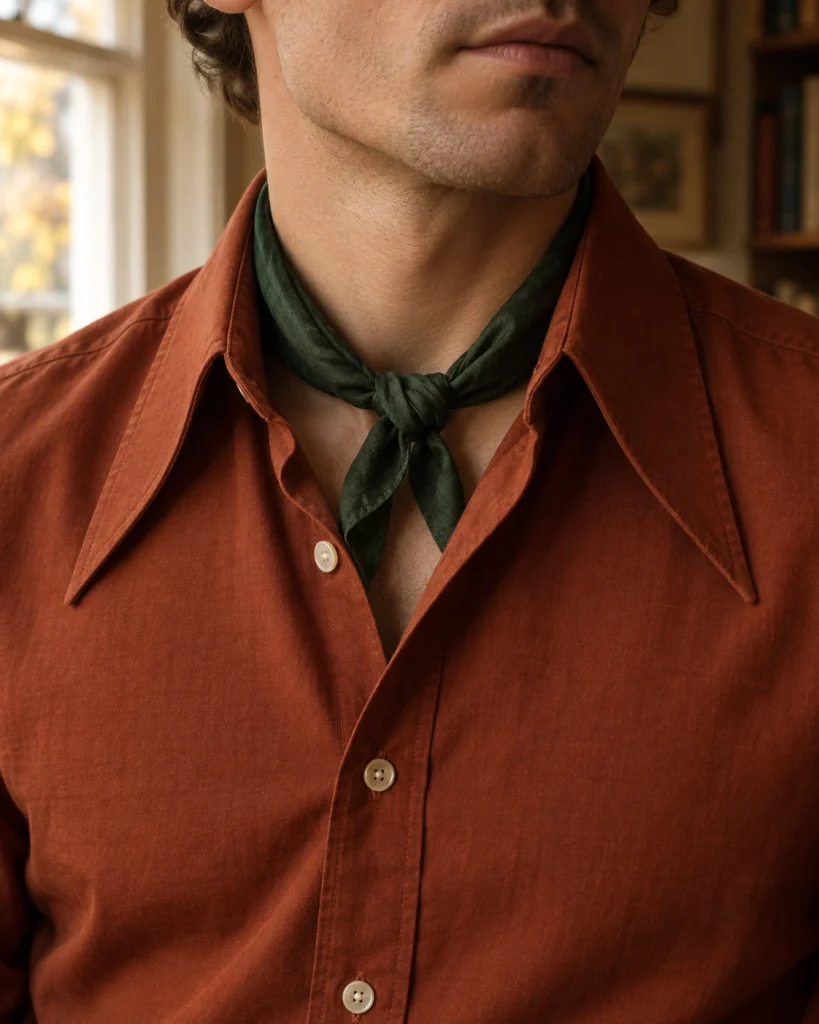
The collar still provides the dramatic shape, while the little flash of green gives the opening some colour and definition.
I would start with a simple knot, perhaps slightly to one side, rather than building an elaborate arrangement beneath the chin. The latter can begin to resemble somebody preparing to perform a trick involving a tablecloth.
A plain neckerchief is often easier to combine with a patterned shirt, while a patterned one can make a simple shirt much more interesting.
When buying second-hand, check the fabric for fading along old folds and for marks that will remain visible when tied. A little square of cloth should not require a complicated concealment strategy.
7. A signet ring
There is something particularly satisfying about a substantial ring worn with otherwise unremarkable clothes.
A plain signet ring can provide a little weight and visual interest at the hand, especially when paired with knitwear or a shirt whose cuffs sit neatly at the wrist.
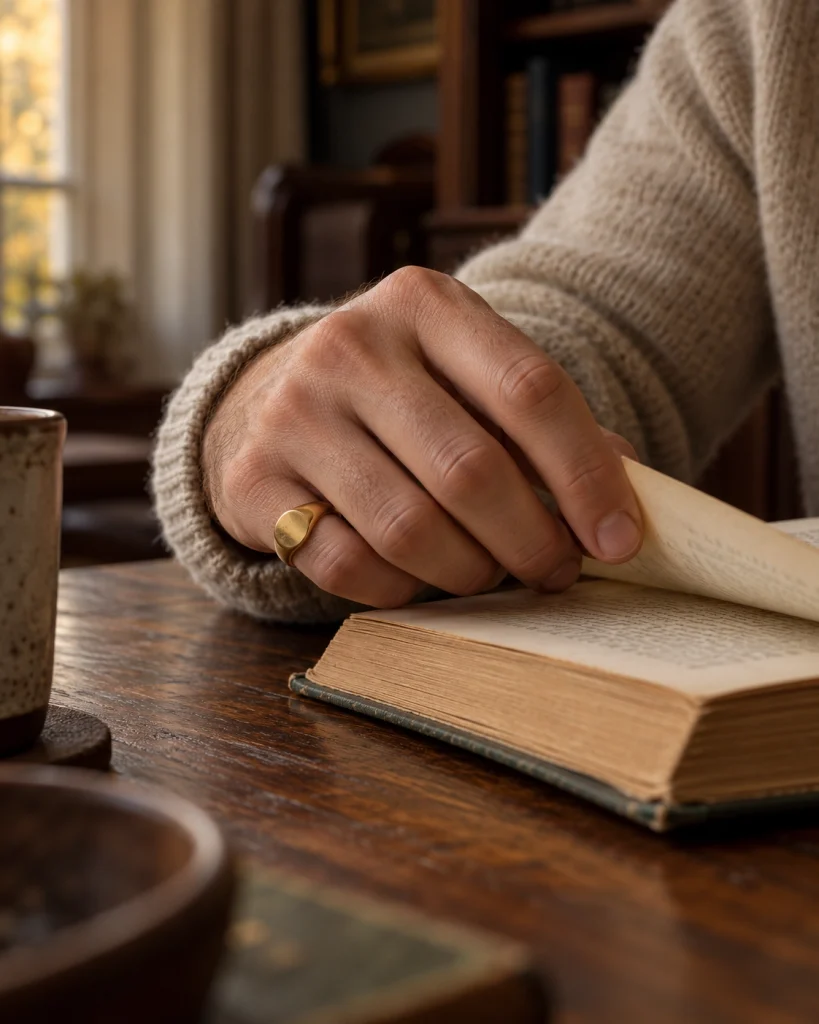
The traditional shape has a flat or slightly raised face, often oval or rectangular. Some are engraved with initials, symbols or family crests; others are left plain. I rather like the unadorned versions, where the shape of the metal does most of the work.
A warm gold-coloured ring with an oatmeal jumper might be excellent. Silver-coloured metal could look equally good with a dark green shirt or a heavier charcoal knit.
The appeal is partly that the ring belongs to ordinary movement. It becomes visible when you pick something up, reach for a cup or turn a page. It does not require an elaborate outfit to justify itself.
I would be cautious about buying a heavily engraved family crest purely because it looks grand. Unless the symbolism genuinely appeals, wearing a stranger’s heraldry seems a peculiar way of announcing oneself.
Second-hand rings need a proper fit check, and worn plating can be deceptive in photographs. Check for distorted bands, rough edges and damage around any set stones.
A signet ring can look remarkably good with nothing else in the way of jewellery. In fact, I think some of the strongest examples are worn by people who appear to have given the ring considerable thought and the rest of the outfit almost none.
8. A felt hat or a genuinely good flat cap
Hats are the most demanding accessories on this list because they alter the silhouette of the entire head and upper body.
A hat can make an otherwise simple outfit feel strikingly complete. It can also make somebody look as though they are about to provide an unsolicited guided tour of a Victorian railway station.
Much depends on proportion.
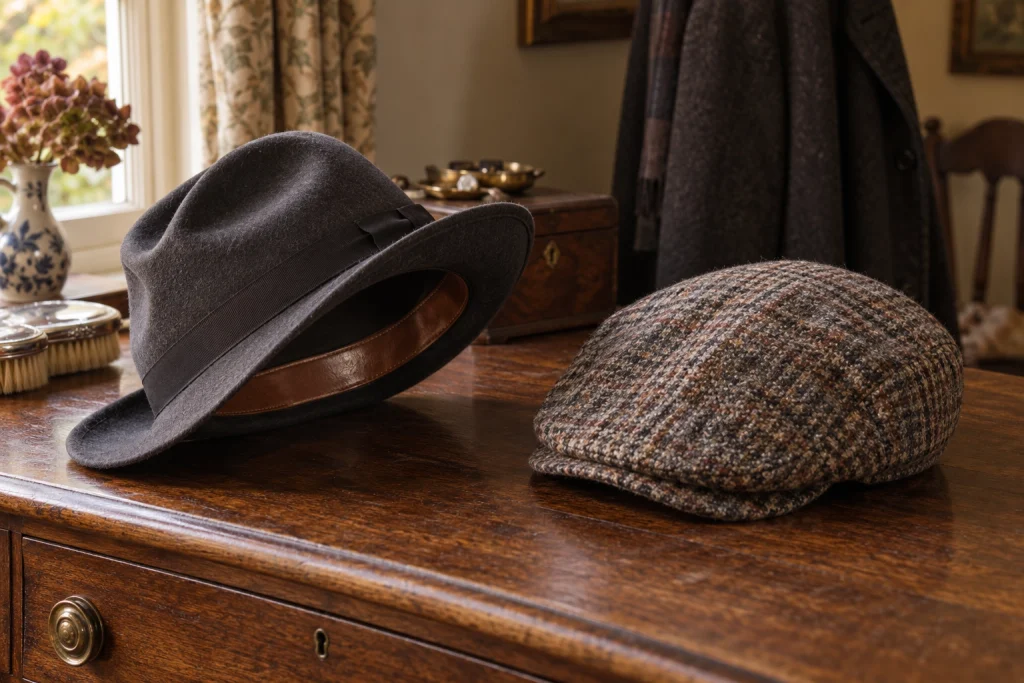
A dark felt hat with a moderate brim could work beautifully with a long wool coat and a plain rollneck. A flat cap in a subtle check might complement a short textured jacket and wider trousers.
I would be particularly careful with exaggerated brims, very tall crowns and heavily decorated hatbands. These details can be wonderful individually but become rather exhausting when worn together.
The relationship between the hat and the outerwear matters too. A broad-brimmed hat and a dramatic coat may compete for attention, while the same hat could look perfectly natural with something simpler.
For second-hand hats, inspect the sweatband — the strip inside the crown that rests against the head — along with the lining, brim and any signs of moth damage. Fit is essential; Lock & Co. Hatters provides a useful guide to measuring for hats.
I would try a hat with the clothes I expected to wear it with. Judging one in isolation can be misleading, especially under charity shop lighting that seems specifically designed to make everybody look slightly ill.
And I would need to be willing to wear it outside the house. Admiring oneself in a bedroom mirror is a comparatively undemanding test. The real question arrives when you have to walk past a bus stop.
The problem with small temptations
The dangerous thing about accessories is that they rarely seem like a serious purchase.
A scarf folds into almost nothing. A brooch fits in your palm. A ring barely occupies any space at all. It becomes very easy to justify something because it is inexpensive, unusual or too small to count as another addition to the wardrobe.
I am quite capable of admiring an object for several minutes before admitting that I have no particular use for it. Sometimes the pleasure is simply in finding something wonderfully odd, turning it over and seeing how it was made.
Fortunately, the charity shop does not charge for looking.
And the strangest thing in the cabinet can remain there, being somebody else’s problem.
Leave a Reply