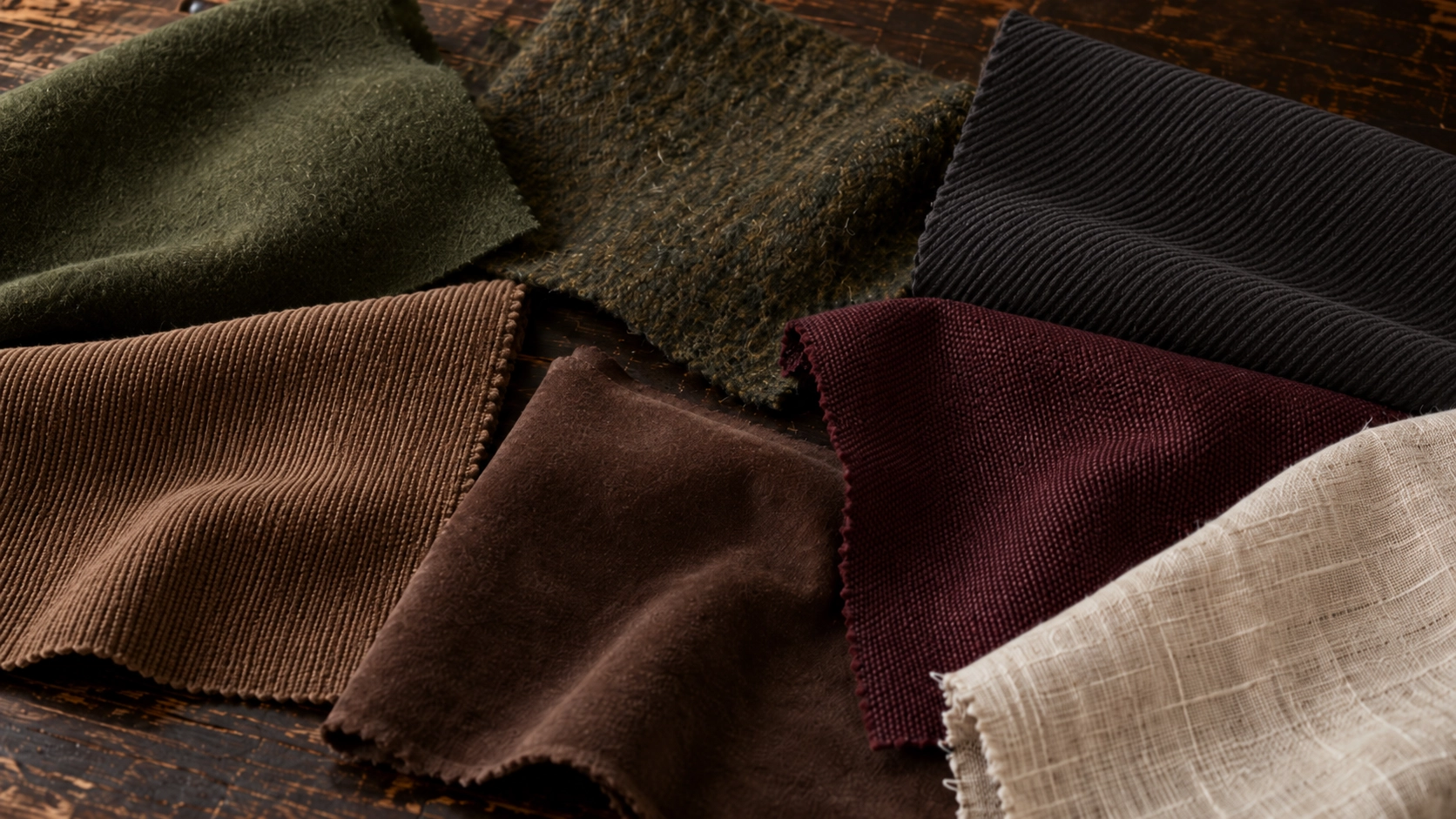
For years, practically everything I knew about moleskin came from two places: Hagrid’s overcoat and Moleskine notebooks. The official Harry Potter website confirms the former, while Moleskine says its standard notebook covers are made from polypropylene or polyurethane.
I had managed to become familiar with the word without knowing much about the cloth.
That is an awkward position to occupy when buying second-hand clothes, particularly online. A listing might describe a coat as melton, trousers as whipcord or a jacket as barathea. These sound like useful details, provided you know what they mean. Otherwise, they might as well be the names of minor characters in a Victorian inheritance dispute.
The difficulty is that textile names describe different things. Some tell you about the weight and finish of a cloth. Others describe its construction or surface. A few, such as ramie, identify the fibre itself.
A cloth name is evidence, not a guarantee. It can tell you what qualities to expect and where to direct your attention. It cannot certify the condition or quality of the garment somebody is trying to sell you.
Here are seven names worth being able to decode.
Seven fabric names at a glance
| Fabric | What the name suggests | One thing to check |
|---|---|---|
| Melton | Dense, compact cloth suited to outerwear | Thinning at the cuffs |
| Loden | Fulled wool cloth associated with outdoor clothing | The garment’s weight |
| Whipcord | Hard-wearing cloth with steep diagonal ribs | Wear across the seat |
| Bedford cord | Raised lengthwise ribs woven into the cloth | Damage to the ribs |
| Moleskin | A soft, suede-like surface, traditionally cotton | Flattened or polished nap |
| Barathea | Fine, pebbled texture often used in tailoring | Unwanted shiny patches |
| Ramie | A plant fibre that can be used alone or blended | The fibre percentage |
Warmth and weight: melton and loden
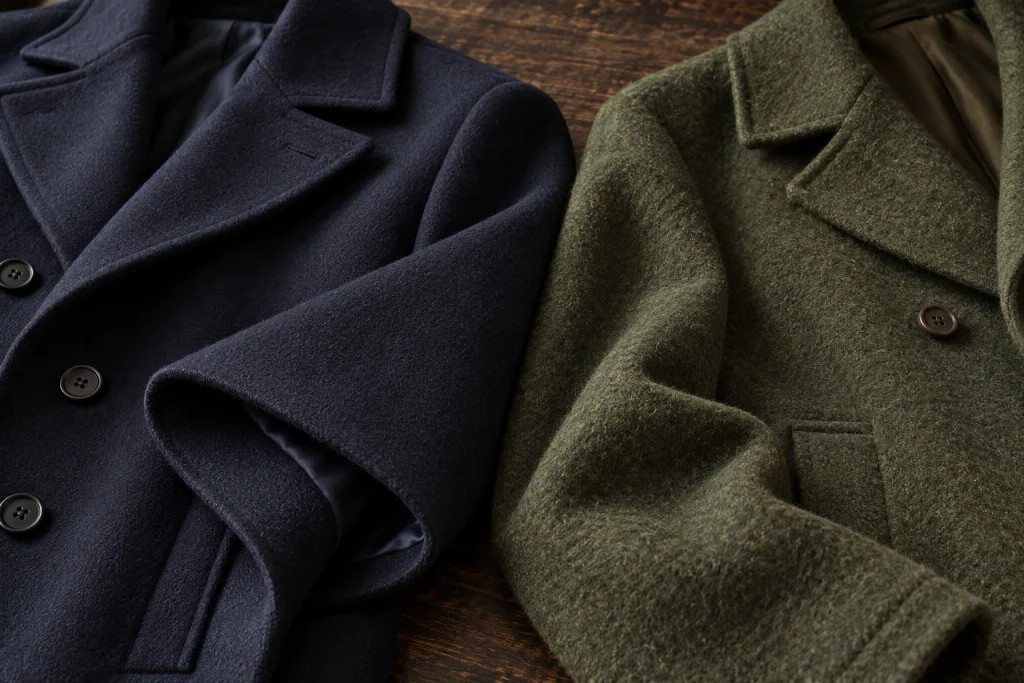
Melton: the substantial coat cloth
Melton is a densely woven cloth, traditionally woollen, whose surface has been compacted and finished to produce a relatively smooth, close appearance. The finishing can obscure the original weave, giving it something of the solidity of felt while retaining the structure of woven fabric.
British woollen mill Hainsworth describes its melton cloths as tightly woven, with a heavily brushed nap — the short layer of fibres raised on the surface. That contributes to their smooth finish and insulating properties.
This is an appealing description for a winter coat. The close surface gives melton a substantial, purposeful appearance, particularly in a long coat with a good collar. It has the sort of presence I like in outerwear: the cloth is already doing enough without requiring six decorative straps and a buckle whose sole responsibility is looking important.
The finishing also makes the condition of the surface worth considering. A little surface fluff is ordinary wear; fabric that has actually become thin is a different matter.
Check the cuff edges, where repeated rubbing may have worn away more than the finish. A beautiful, densely finished coat is considerably less persuasive if the cloth at the wrists has exhausted itself.
If you are considering a whole coat rather than cloth by the metre, I have written separately about judging a second-hand wool coat’s fit, condition and repairability. A material name gets the coat onto the shortlist. Its shoulders still have to fit.
Loden: wool that has been deliberately compacted
Loden is a traditional woven wool cloth that undergoes fulling: controlled treatment with moisture and friction that makes the wool fibres interlock and the fabric become more compact.
Austrian manufacturer Lodenwalker describes fulling as central to the cloth’s production. Its finished loden is insulating and water-repellent, qualities that explain its longstanding association with outdoor clothing.
The distinction between water-repellent and waterproof deserves attention. Loden may cope well with light rain, but the name does not mean that a second-hand loden coat can replace a waterproof jacket in sustained bad weather. That would be a rather expensive assumption to test on the way home.
Loden also comes in markedly different weights and finishes. Lodenwalker, for example, describes varieties around 300g/m² alongside others around 500g/m², with still heavier types available. Some are relatively smooth and closely cropped; others have a softer or more pronounced surface.
Check the garment’s weight. In a shop, you can judge it in your hands; online, you can ask the seller to weigh the coat. A photograph may show the classic loden silhouette beautifully while concealing how substantial the actual garment will feel.
If I am buying a coat primarily because I want to be warm, I would rather discover that difference before paying for postage.
Toughness: whipcord and Bedford cord
Whipcord: the steep diagonal
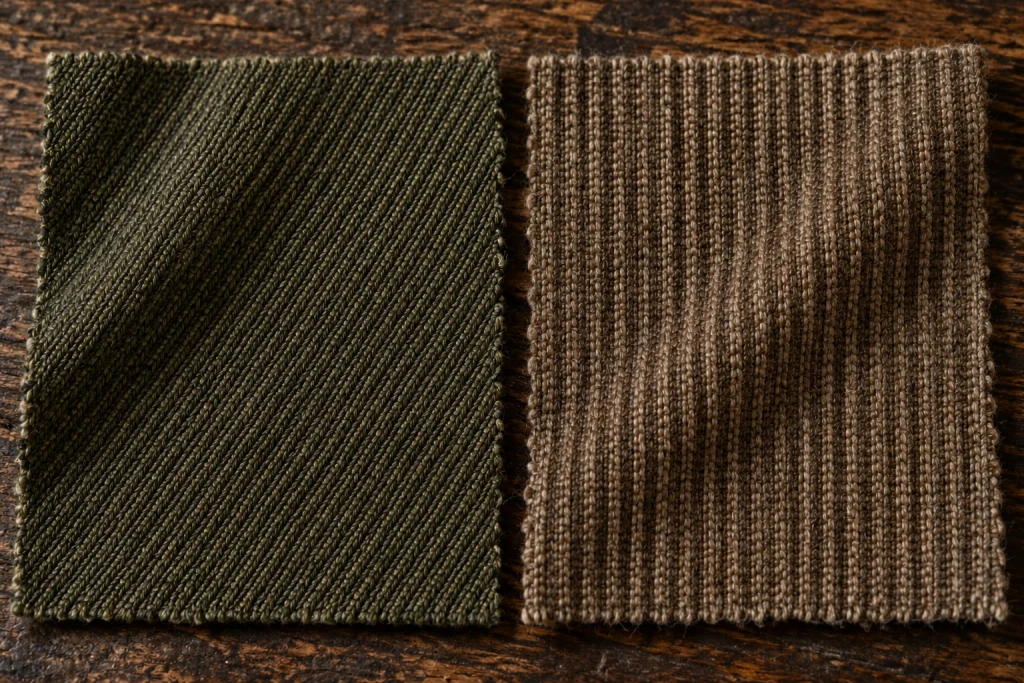
Whipcord is a firm, hard-wearing fabric with a distinctive steep diagonal rib. It belongs to the family of twill weaves, where the arrangement of the threads produces diagonal lines across the surface.
The Weavers’ Company glossary describes whipcord as a rugged cloth, usually wool, with a steeper diagonal than cavalry twill. It has historically been used for practical clothing where the fabric needs to endure repeated wear.
I rather like that it advertises its construction so plainly. A good close photograph can show the diagonals running across the fabric, although the lines may be much less obvious in a dark listing photograph taken from several feet away.
It is the sort of cloth I would be interested in for substantial trousers. The diagonal structure gives the surface a definite direction and texture without needing a conspicuous pattern.
Check the seat of second-hand whipcord trousers. Repeated sitting and rubbing may have worn down the raised diagonal surface, and the area deserves particular suspicion if the rest of the trousers looks remarkably tidy.
There is little point being impressed by a cloth’s reputation for toughness after discovering that somebody else has already used most of it.
Bedford cord: ribs running the other way
Bedford cord is another robust woven cloth, but its ribs run lengthwise rather than diagonally. The raised cords are formed by the weave itself, creating a series of parallel ridges along the fabric.
At first glance, it can resemble corduroy. The important difference is how those ribs are made. Corduroy’s characteristic raised surface comes from cut yarn floats that form a pile; Bedford cord produces its ridges through the woven structure.
The Weavers’ Company notes that Bedford cord can be made from cotton, worsted wool or manufactured fibres, so the name covers quite a range of possible garments. It has the satisfying appearance of a cloth intended to be used rather than admired from a distance.
The ribs are the feature I would want a seller’s photograph to show clearly. They should be recognisable as continuous raised lines rather than a vague impression of texture.
Check for broken or badly abraded threads across the raised cords, particularly around the knees of trousers. That is a more useful observation than deciding the fabric looks sturdy because it has prominent ribs.
Feel: moleskin and barathea
Moleskin: the soft, suede-like cotton cloth
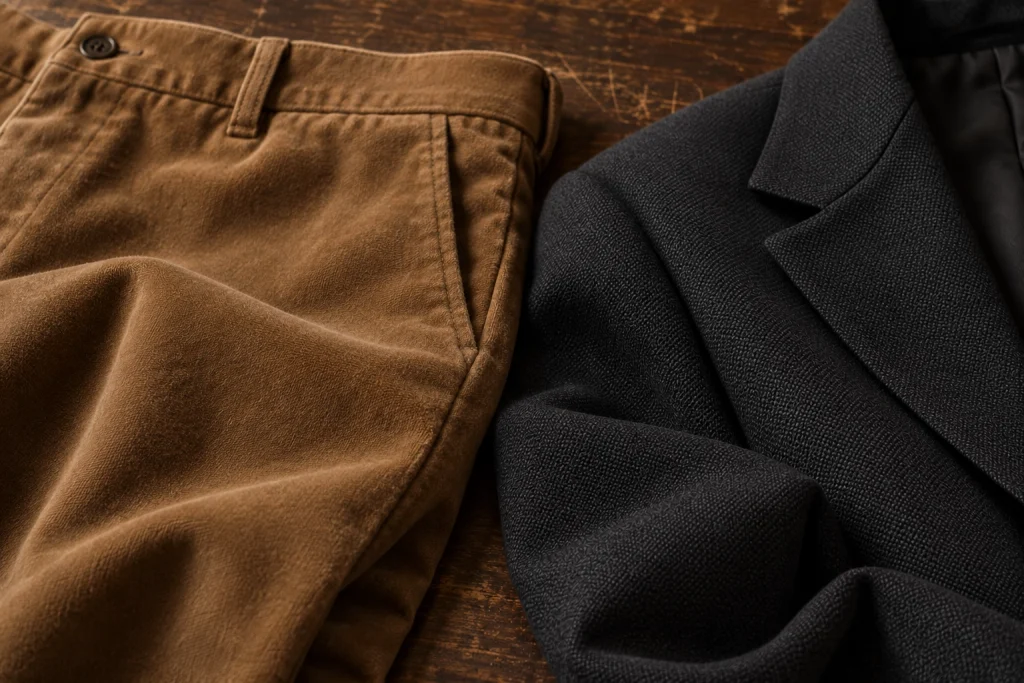
Moleskin is traditionally a densely woven cotton cloth with a short, soft surface designed to resemble an animal’s fur. No moles are required to make it, which is excellent news for the moles.
The Weavers’ Company describes the finishing process: “The floats are cut, steamed to open the fibres to produce a dense nap looking like a heavy suede.” The result is a fabric that can be both substantial and pleasantly soft.
That makes it particularly interesting for trousers and practical jackets. I can understand the appeal of a cloth that looks relatively plain from a distance but rewards being handled. It offers texture without relying on a conspicuous woven design, and its softness gives it a rather different character from hard-finished tailoring cloths.
The surface is called a nap: a covering of short fibres that gives the fabric its soft feel. It is also the part most likely to reveal how the garment has been treated.
Check for flattened, polished areas, particularly on the seat and knees of trousers. In photographs, those worn patches can catch the light differently from the surrounding cloth.
Barathea: a quiet, pebbled texture
Barathea is a cloth with a fine, pebbled surface, traditionally associated with formal tailoring. Its texture comes from a combination of woven structures that produce a close, subtly uneven appearance.
The Weavers’ Company explains that barathea was traditionally made with silk and worsted wool, but is now commonly woven entirely from worsted yarns — wool fibres that have been combed before spinning to produce a smoother yarn.
In other words, barathea does not mean silk.
That matters when a seller uses the name to make a suit or jacket sound particularly luxurious. It describes a characteristic textile structure and finish, and the texture itself may be perfectly lovely without involving silk at all.
I like the restraint of barathea. Dark formal cloth can be rather dull when its only ambition is to be uniformly smooth. Barathea introduces a little surface interest that becomes more apparent when the light catches it, while remaining quiet enough for tailoring.
Check for unwanted shiny patches, especially around the elbows of a jacket or the seat of matching trousers. Wear and repeated pressure can change the appearance of the cloth, and a photograph of the whole suit may conceal those local differences.
What’s actually in it: ramie
Ramie: a fibre rather than a cloth construction
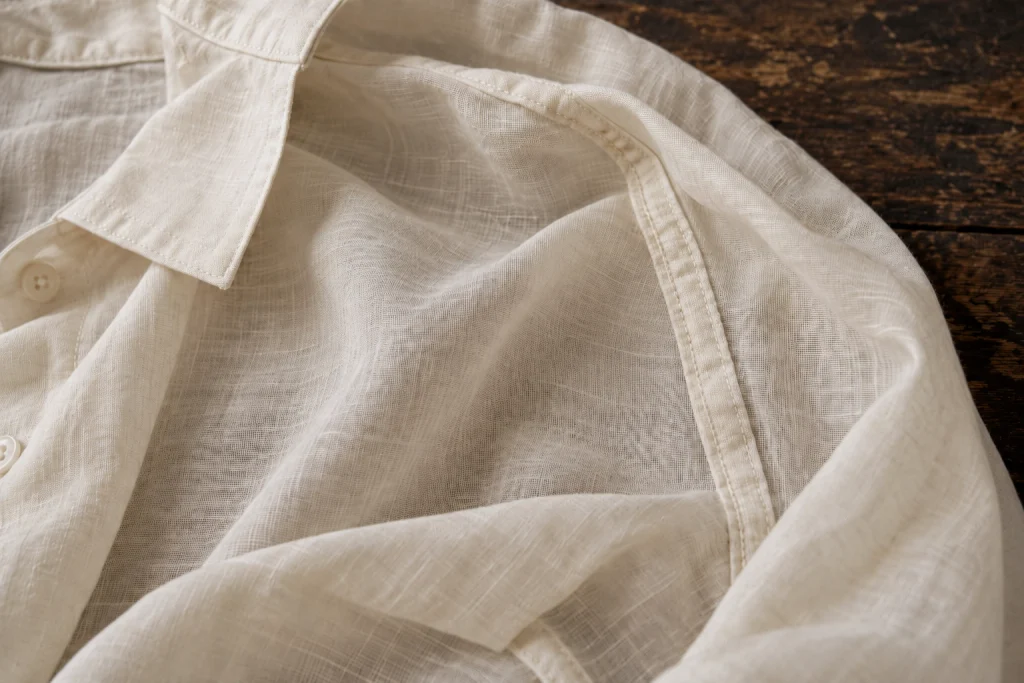
Ramie is different from the other six names. It identifies a plant fibre, obtained from the stems of plants in the Boehmeria genus, part of the nettle family.
The Weavers’ Company describes ramie as a strong bast fibre — one extracted from the inner part of a plant stem — which can be used in clothing fabrics and blended with other fibres.
Unlike melton or whipcord, the word tells you something directly about what the textile contains. It appears among the recognised fibre names in UK textile-labelling rules.
That is where the distinction between a seller’s description and a composition label becomes important.
A seller might describe a jacket as ramie because it contains some ramie, because the original label mentioned it, or because the seller believes that is what the fabric is. Those are three different levels of evidence. A ramie blend can also feel and behave quite differently depending on its other fibres and construction.
Check the actual ramie percentage on the composition label, if one survives. The UK Government’s textile-labelling guidance explains that fibre composition is what textile labels are intended to communicate.
An older second-hand garment may have lost its label, of course. In that case the listing may simply leave the fibre content uncertain. A seller can describe a fabric as linen-like or slightly crisp without those observations proving that it contains ramie.
The name is only the beginning
I rather enjoy discovering that an ordinary-looking pair of trousers has a splendidly specific textile name. I am less enthusiastic about paying for the name when the seat of the trousers has already given up.
They can keep their whipcord.
Leave a Reply