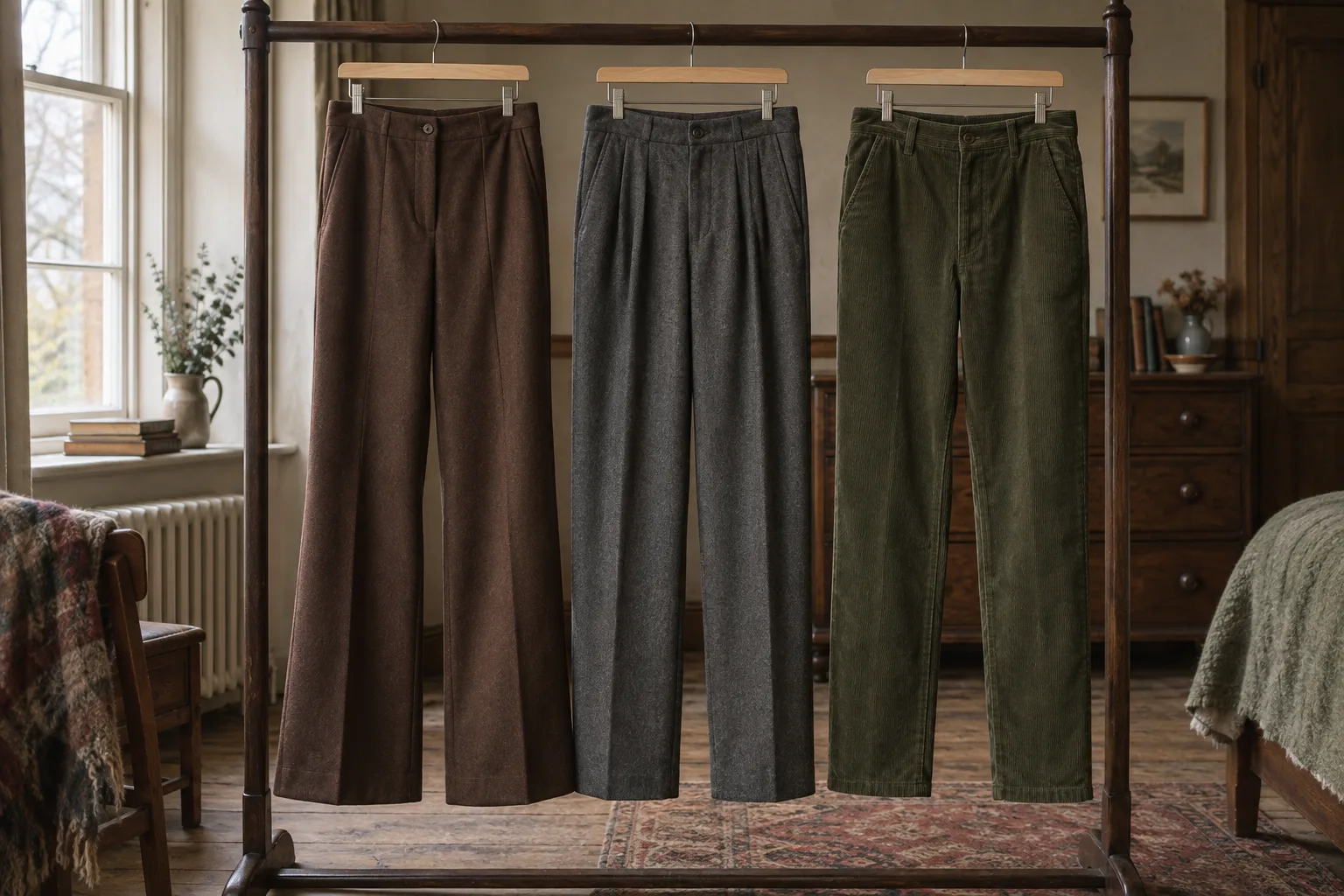
One of the pairs I brought home from Armstrongs in Edinburgh was a pair of chocolate-brown flares. They were second-hand, high-waisted, wide through the leg and exactly the sort of trousers I had been struggling to find new.
They were also too long.
I had them hemmed afterwards. Since then they have done office duty, survived my half-past-two test and become the pair I reach for when a dramatic shirt needs something substantial beneath it. The alteration mattered, but it was never being asked to change what the trousers fundamentally were.
The distinction is more useful than the usual question of whether second-hand clothes can be altered. Plenty can. The harder question is how trousers should fit before any alteration begins: whether the proportions already work, or whether tailoring is being asked to rescue a pair that was wrong from the start.
The waistband is only one part of the fit
A waistband is very persuasive because it gives an immediate answer. It fastens or it does not. Once it closes comfortably, it is easy to decide that the trousers fit and treat everything below as styling.
That is how you end up in front of a mirror wondering why a pair in your size appears to have been issued to somebody else.
The useful term here is rise. Jasper Littman’s tailoring glossary defines it as the distance between the top of the waistband and the fork of the trousers — in plainer language, the point where the inside-leg seams meet. The measurement helps determine where the trousers sit on the body, so two pairs with a similar waist measurement can put their waistbands in quite different places.
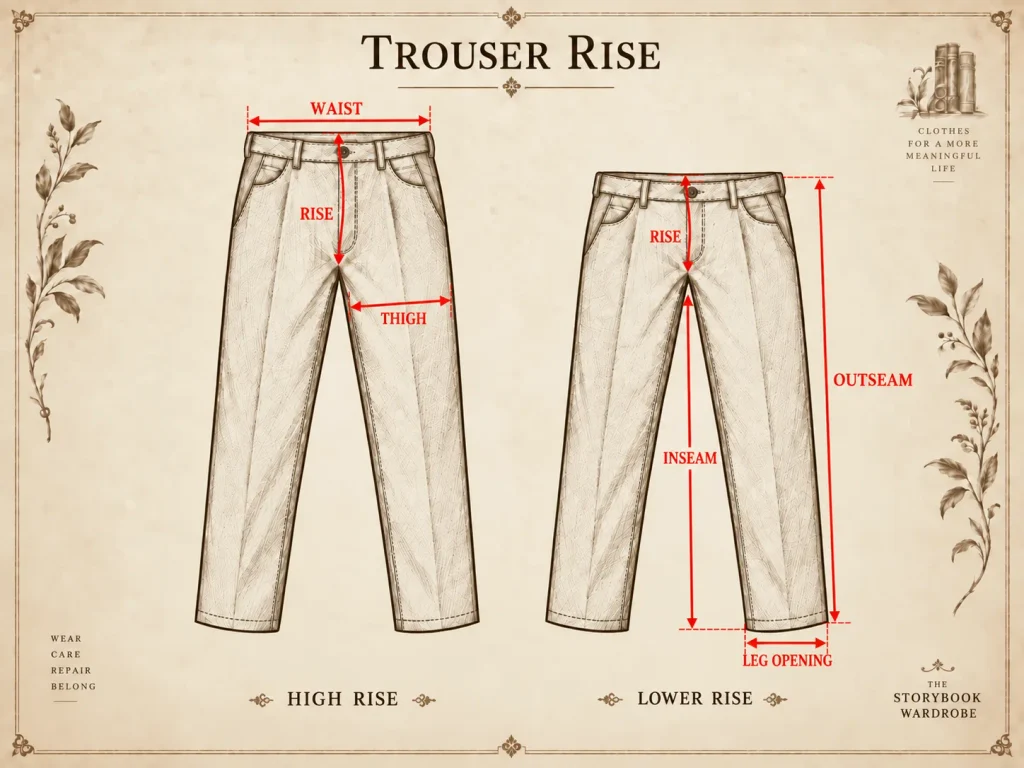
I prefer a higher rise on many of my trousers. That is my preference, not a fitting commandment. What matters is whether a pair can sit where it is intended to sit without being constantly hauled upwards, shoved downwards or endured until you are allowed to stand up again.
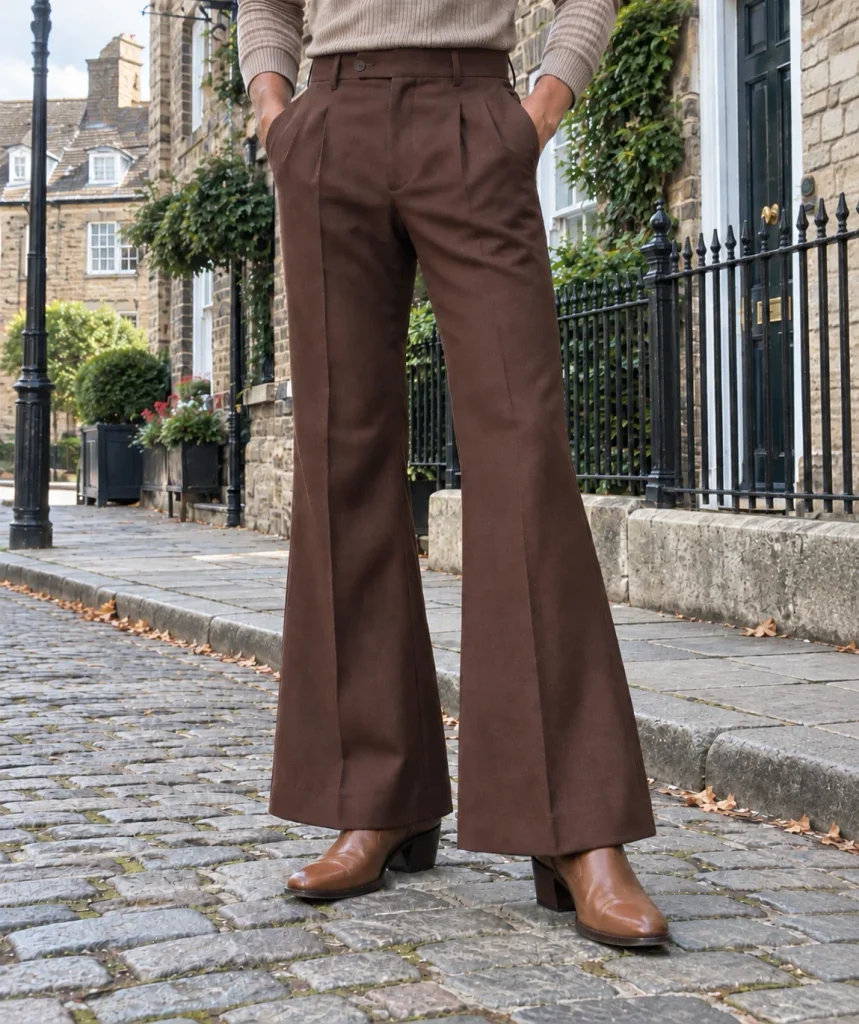
The chocolate flares make the effect fairly obvious. Their high waistband is part of why they work with the short suede jacket I have worn to the office and with the large petrol-blue shirt that otherwise occupies an impressive amount of visual territory. Those proportions are already doing useful work in both outfits.
Rise is part of the cut of the trousers. Waist circumference cannot tell you on its own where those trousers are going to live.
If you are buying trousers online, I have a separate guide to measuring clothes for buying and selling online, including how to take the waist, rise and inseam measurements from a pair laid flat.
My broader guide to making second-hand clothes look expensive already says to sit down, reach, walk and pay attention to trouser rise before buying. This is what that instruction is trying to uncover: whether the trousers still make sense once the rest of your body becomes involved.
Read what the cloth is doing without turning every wrinkle into a diagnosis
This was the part of the research where I expected to find an authoritative chart explaining that one diagonal crease means X and two horizontal ones mean Y.
Trouser fitting declined to be that convenient.
Threads has published detailed pattern-fitting guidance. In Linda Lee’s Self-Fit Your Pants, front-crotch wrinkling can appear in two opposite situations: a loose fit with too much fabric, or a tight crotch with too little length, where the fabric pulls around the body. A wrinkle is therefore much less useful in isolation than it first appears.
For a second-hand shopper, the useful response is less technical. Stand normally. Sit down. Walk. Put your hands in the pockets if the trousers have them. Notice what happens through the seat and thigh when you move: persistent pulling, obvious restriction, cloth collapsing into surplus folds, or the simple sensation that the trousers become much less comfortable as soon as you stop posing for them.
A trouser leg that looks immaculate while you stand still has not achieved very much if sitting down makes you start negotiating with it.
The charcoal pleated wool trousers in my wardrobe are a useful contrast to the chocolate flares. They are also higher-rise, but the leg is straight rather than flared, with more room through the seat and thigh. The silhouette is quite different, but they still allow me to sit, walk and move without becoming the main subject of the day.
That matters more to me than a perfectly smooth photograph. Cloth moves because people do. A temporary crease after sitting is ordinary; repeated strain or restriction deserves more attention. Where the evidence is ambiguous, I would rather leave the diagnosis to somebody who actually fits trousers for a living than invent one from a changing-room wrinkle.
Fit and silhouette are different decisions
The chocolate flares and charcoal wool trousers make this point better together than either could alone.
The brown pair is wide and visibly flared. The charcoal pair is straighter, fuller through the upper leg and quieter overall. Reducing good trouser fit to one approved outline would require one of them to be wrong simply because it looks different. That would be daft.
Fit concerns the relationship between the garment and the body wearing it: where it sits, whether there is enough room for ordinary movement and whether the cloth can hang without persistent pulling or restriction. Silhouette is the shape I want the finished outfit to have.
I happen to like trousers with a higher waist and enough room through the leg to carry some visual weight. My preference has become stronger as I have moved away from the narrower tailoring I used to own. It also suits what I wear now: larger shirts, shorter jackets, heeled boots and clothes with a fairly unapologetic 1970s influence. Somebody who wants a lower rise or a narrower leg can make an entirely different choice.
What makes me suspicious is a pair that achieves its intended shape only while I am standing very carefully. If the cloth strains when I sit, the waistband refuses to stay where it belongs or ordinary walking makes the trousers feel like a different garment, the problem has escaped the realm of taste.
Wide, straight, narrow, high or low can all be deliberate. The trousers still have to work when their owner moves.
Alter the problem you can name
The chocolate flares needed shortening. Needing a hem did not make them a mistaken purchase. I knew what was wrong with them, the problem had clear boundaries, and changing the length did not require somebody to reconstruct the upper half of the trousers.
Hemming them did not rescue bad trousers. It finished good trousers. Length has its own fitting term: break — the fold formed where the trouser leg rests on the shoe. Proper Cloth notes that both inseam length and the width of the lower leg affect how much break you get, and that the amount you want is partly a matter of style rather than one correct measurement. When I took the chocolate flares to the tailor, I asked for them to finish low: the hem now covers most of the boot, resting lightly on the top of the foot, with the toe and the heel showing beneath it. The width of the flare means the cloth falls over the boot rather than folding on it, so there’s very little break at all.
Alterations can go considerably further than hems. City Tailors in Brighton and Bath lists waist and seat changes, hemming, side-seam adjustments and tapering among its trouser services, and says tightness at the crotch or rise is one of the fit problems it works on. It also gives a useful warning about limits: lengthening depends on how much cloth is left inside the original hem, while letting out the waist depends on spare fabric inside the waistband and centre-back seams. Construction details can limit other work too.
That is enough to kill the tidy internet hierarchy in which one alteration is always easy, another always expensive and a third forbidden by ancient tailoring law. The particular trousers matter.
I have used the same independent alterations shop in Shrewsbury for years and normally go on Saturdays, so a hem or another clearly bounded job feels like part of buying second-hand rather than an emergency after it.
A hem does not worry me when the rise, seat and general shape are already doing what I want. Waist or seat work makes me stop and consider whether the trousers are worth further intervention. If the rise itself feels fundamentally wrong, an ordinary second-hand pair has to make a very strong case before I start planning substantial work around it.
The more useful question in the shop is therefore not merely, “Can this be altered?” Tailors can perform work far beyond the few jobs I routinely ask for. I want to know what I am buying before any alteration begins.
Sometimes the imperfect pair still has a job
There is one pair in my wardrobe that would make a poor exhibit in a sermon about perfect trouser fit.
They are deep-olive needlecord trousers — a fine corduroy with narrow, closely spaced ribs — with a lower rise and a closer seat than I now prefer. The waist still closes properly. They look fine. For several hours at a desk, however, they become increasingly difficult to ignore.
I have kept them.
The olive is excellent, I still like the fine ribbed texture, and they have a job that does not require eight hours in a chair. I wear them for shorter weekend outings: a few charity shops, lunch, ordinary errands, a few hours out when I am spending more time walking than sitting. For that job, the compromise is acceptable.
Fit advice can become absurdly prosecutorial. Find one imperfect proportion and apparently the offending garment must be escorted from the wardrobe before it contaminates the good trousers.
I do not need every pair I own to pass the half-past-two office test. I need to know which ones do.
The olive trousers get a few hours on Saturdays, when I am mostly on my feet. Then they go back on the rail.
Leave a Reply