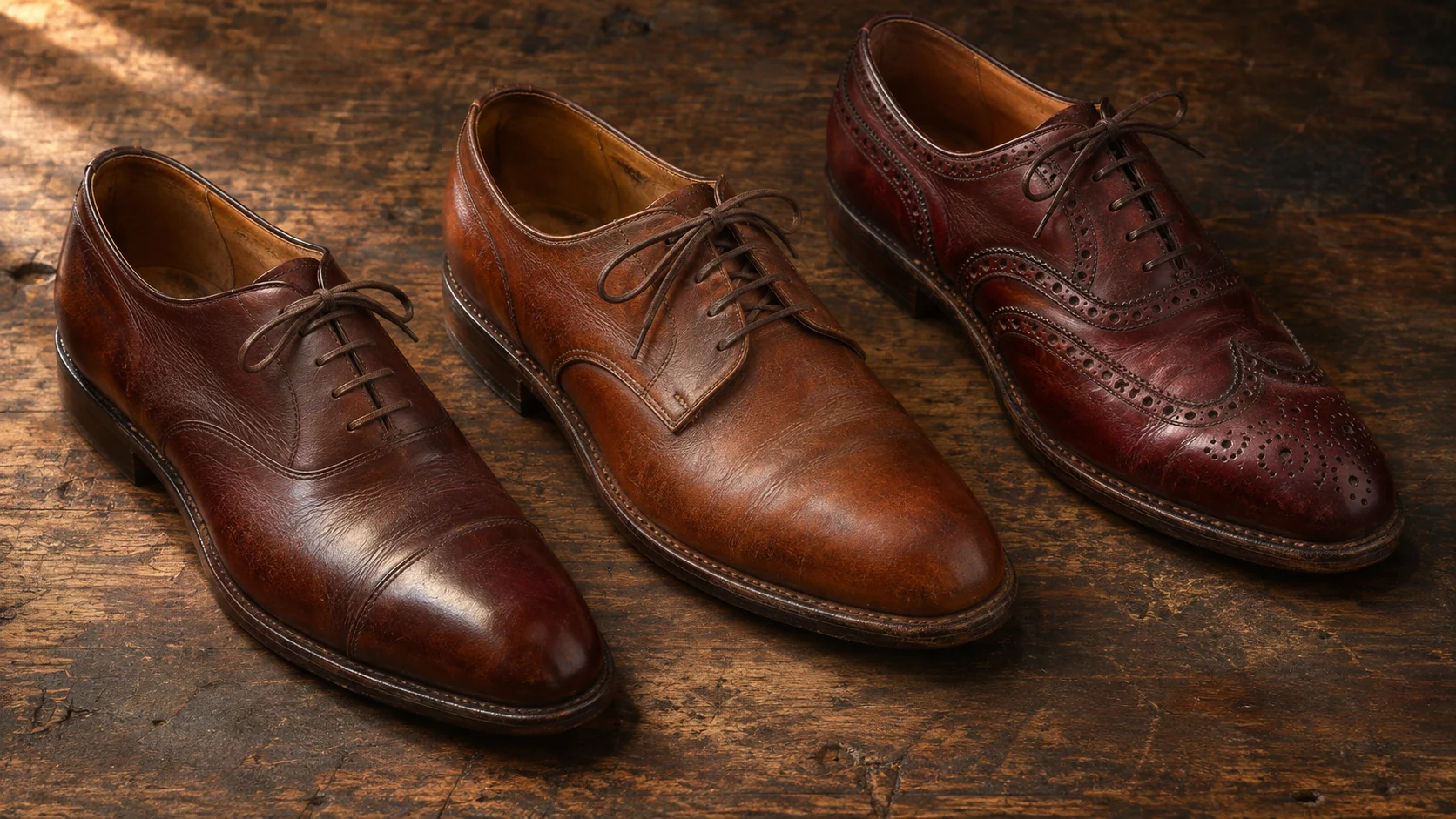
A second-hand shoe listing caught my eye for its title: “Cheaney Martin Mens Plain Derby Oxford Shoes”. That is quite a lot of shoe for one line of text. Plain sounds straightforward, but Derby Oxford seems to ask one pair of laces to perform two different jobs.
It would be unfair to call the description wrong without examining the shoes. The terminology itself is less settled than the tidy labels in a British shoemaker’s catalogue suggest. In traditional British usage, Oxford and Derby describe different ways of attaching the lace panels; in some American retail usage, Oxford is a broader name for a low-cut lace-up shoe. And brogue describes something else again.
Here’s the short version before we get into the seams:
| Name | What it describes | What to look for |
|---|---|---|
| Oxford | Closed lacing | Lace panels stitched beneath the front of the upper |
| Derby | Open lacing | Lace panels sitting over the front of the upper |
| Brogue | Decoration | Small punched holes forming a pattern in the leather |
I’ve written about whether second-hand shoes are worth buying before. This is a different problem: how to work out what you’re looking at when the label is trying to cover half the shoe department.
Oxford or Derby? Follow the leather, not the laces
The simplest place to begin is with the two pieces of leather holding the eyelets. Shoemakers call these the facings. Each has a row of holes for the laces, and the way it joins the rest of the shoe tells you which construction you’re looking at.
An Oxford has closed lacing. The side sections of the upper, called the quarters, are stitched underneath the vamp — the piece of leather across the front of the foot. At the bottom of the lacing, the facings are held close together by that construction. You get the neat, contained opening associated with a traditional dress Oxford.
On a Derby, the quarters sit on top of the vamp. The facings are free to lift and spread further apart when you loosen the laces. This is open lacing. The difference is easiest to see at the bottom of the lace opening, where the panels meet the leather below them.
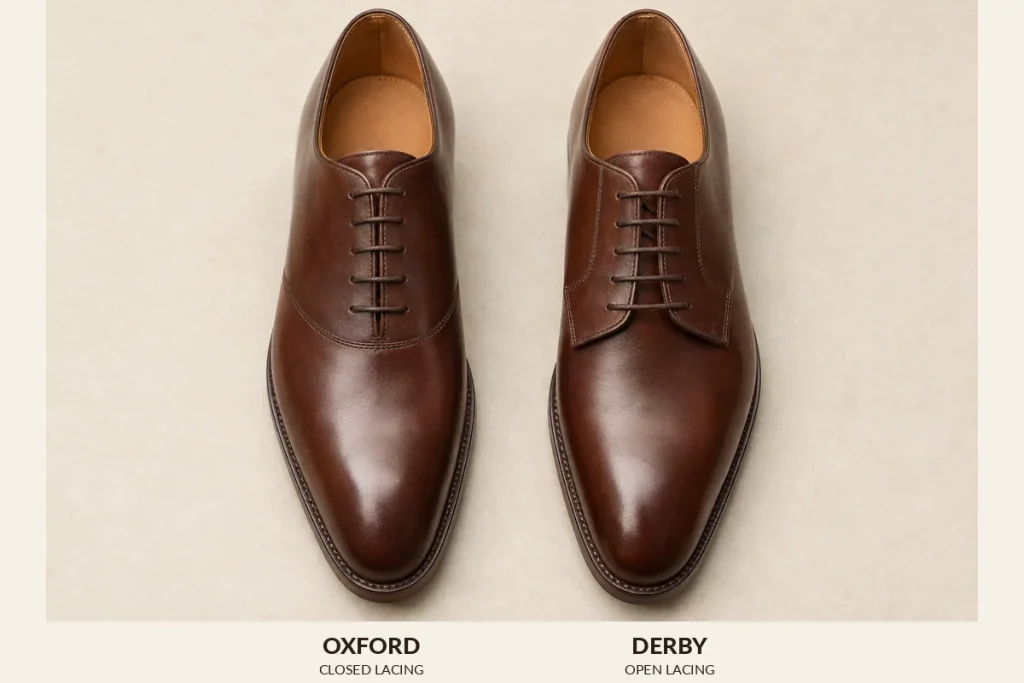
Crockett & Jones’s Oxford guide describes the same distinction in terms of where the quarters are stitched. Cheaney’s guide to Derby construction explains why the open arrangement gives more room across the instep — the raised part of the foot beneath the laces.
You need to look at the attachment, rather than just whether there’s a visible gap between the laces. A Derby can be pulled fairly close together; an Oxford can sit more open on someone’s foot. The stitching tells you more than the space left by the wearer.
In a charity shop I would lift the shoe and look from directly above. Online, a clear photograph of the lacing is enough to make a reasonable identification; an angled photograph that hides the seam may not be. A pointed toe does not make a shoe an Oxford, and a broad, round one does not automatically make it a Derby. Those are questions of shape, not lacing.
A brogue can be an Oxford or a Derby
The word brogue is frequently treated as though it names a third construction. What it describes is broguing: the small decorative holes punched into the leather, often following seams or forming a pattern across the toe. It is possible to make either lacing style with that decoration, which is why Oxford brogue and Derby brogue are both perfectly sensible descriptions.
The amount and arrangement of broguing have names of their own. Cheaney’s guide to brogues distinguishes three traditional patterns:
- Quarter brogue: the restrained one. Perforations run along the seam of a straight toe cap — the separate piece marking out the front of the shoe — with generally no punched design in the centre of the toe.
- Semi-brogue (or half-brogue): a straight toe cap again, but with additional broguing along other seams and usually a medallion, the little punched motif in the middle of the toe.
- Full brogue: the toe cap comes to a point and sweeps backwards at the sides in a W-shaped wingtip. Its edges are brogued, usually with further perforations along the shoe and a medallion on the toe.
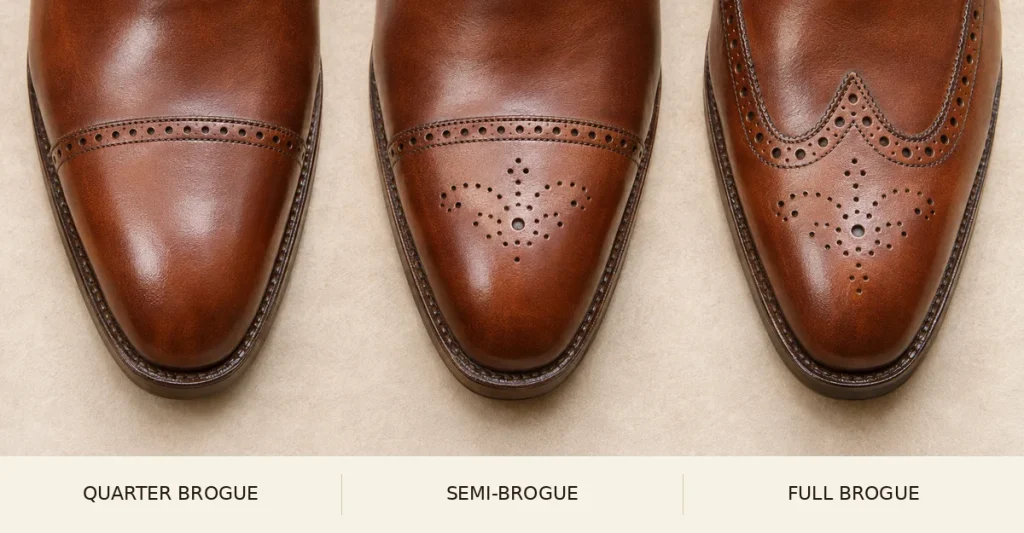
Wingtip can also appear in a listing by itself. Technically, it names the shape of the toe-cap panel: those two wings running back from the pointed centre. In a classic full brogue, that shape is accompanied by perforations. Calling something a wingtip therefore tells you where the leather pattern goes; calling it a full brogue tells you about the decoration as well.
A row of holes is not evidence that the shoe is older, better made or more formal. It is a visible design feature.
Balmoral and Blucher: the names change across the Atlantic
There are two more terms likely to turn up when browsing American shoe listings, and they come with qualifications that a neat conversion chart tends to leave out.
Balmoral, often shortened to Bal, is commonly used in American footwear terminology for an Oxford-style closed-laced shoe. Crockett & Jones records the American name, while Cheaney uses Balmoral in Britain for a more particular boot style. Its Balmoral boot guide describes the seam running along the side of the boot roughly parallel to the sole. So Balmoral in a listing is worth reading in context: it may be referring to the lacing, or to a particular design.
Blucher usually corresponds to an open-laced shoe, and Americans often use it where a British maker might write Derby. There is a technical distinction if you’re being precise. In a conventional Derby, the larger quarter panels carry the eyelets. In a strict Blucher, smaller separate leather tabs are stitched onto the upper to hold them. Both leave the lacing open. Cheaney acknowledges the distinction, although the names are frequently treated as interchangeable in ordinary selling language.
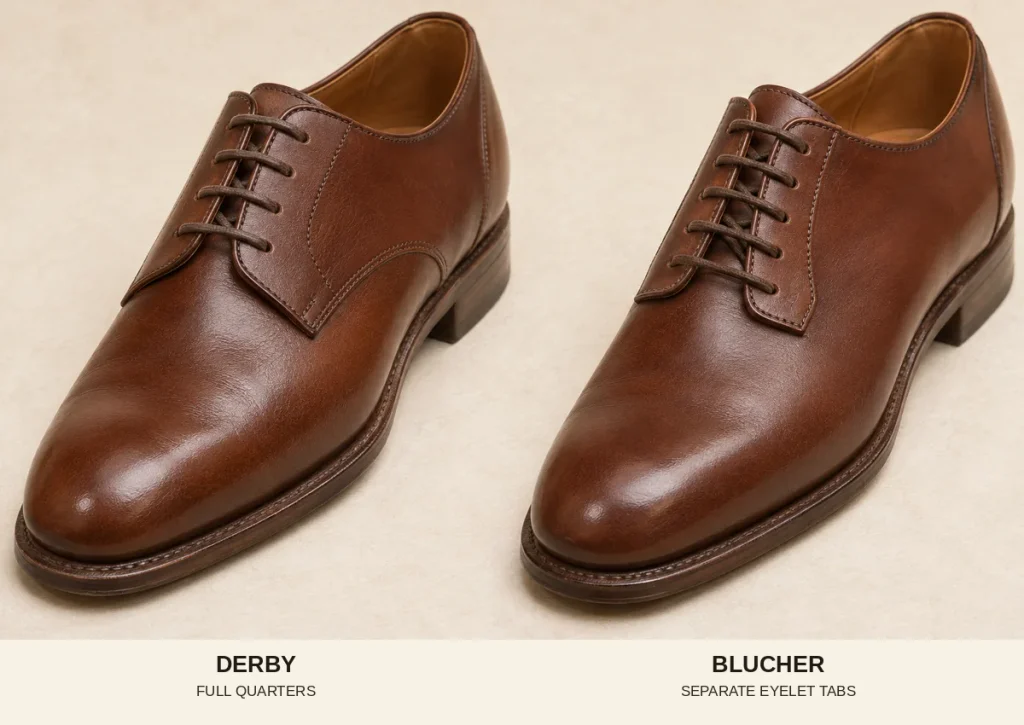
I wouldn’t attempt to identify either from a seller’s nationality alone. A British retailer can sell something described as a Balmoral Oxford, and a shoe with Blucher construction can turn up without the word Blucher anywhere in its title.
Back to the listing
“Cheaney Martin Mens Plain Derby Oxford Shoes.” With the vocabulary in place, the word that needs least argument is plain. A plain toe has no separate toe-cap seam and no decorative broguing across the front. Loake sells shoes under the description plain-toe Derby, while Cheaney distinguishes its plain-toe Derbies from capped and brogued styles. Plain says something about the toe; it doesn’t settle the lacing.
Derby is the more specific description under the usual British convention. Oxford, read alongside it, may reflect the wider marketplace vocabulary rather than a second construction. We would still need to see the facings.
There is an older, rather good precedent for the unlikely pairing. In a Stitchdown investigation into why American work-shoe makers used the word Oxford, Red Wing’s archivists produced catalogue material going back to 1907. The company had been founded only two years earlier. There, in its early advertising, was the description “Blucher Oxfords”.
Leave a Reply