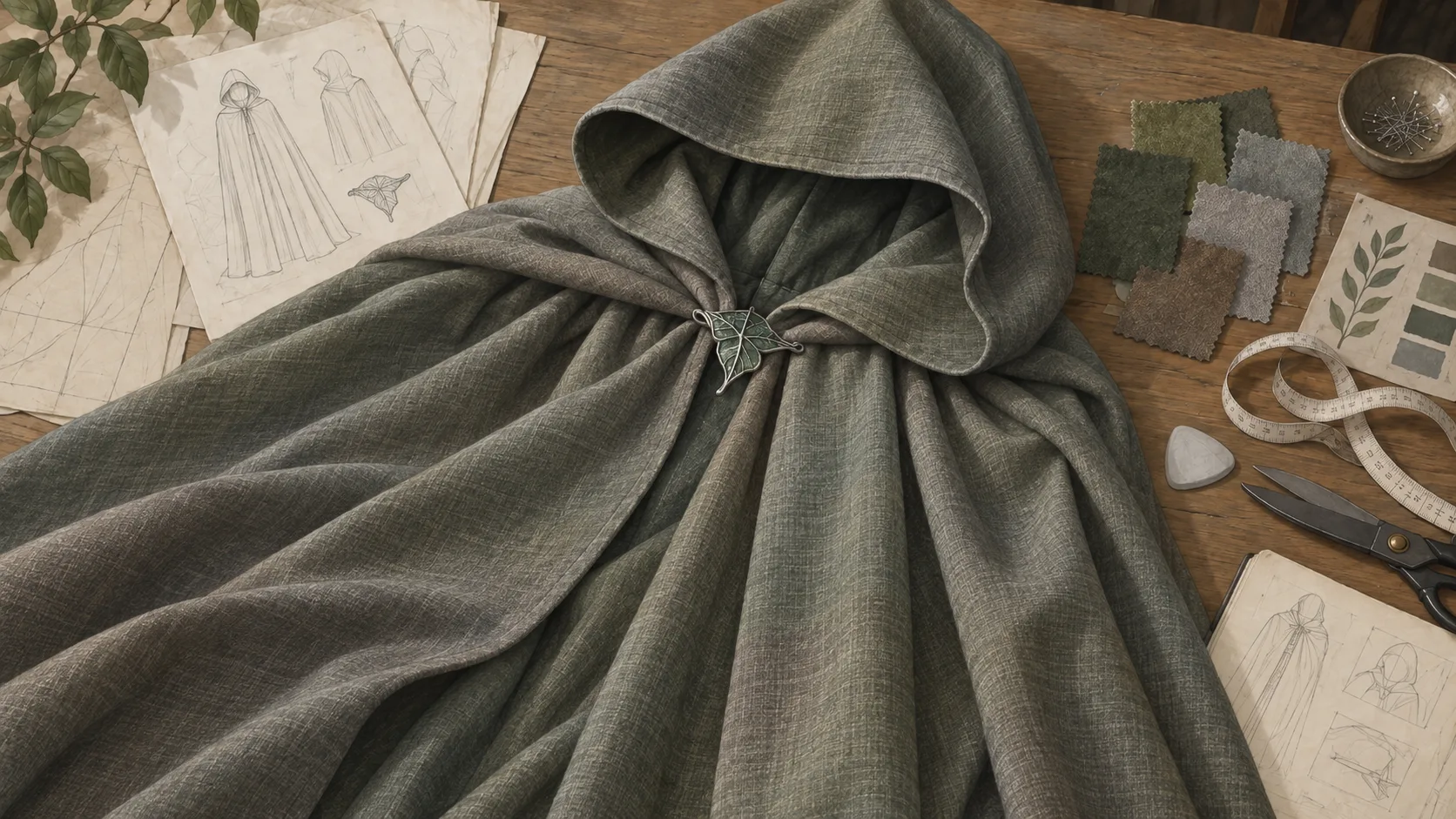
Take the film costumes away and Tolkien leaves us with something surprisingly close to a garment brief.
In The Fellowship of the Ring, the Company are given hooded cloaks made individually to size. The cloth is light and warm, difficult to pin to one colour, and changes character when it moves or catches different light. The cloaks fasten at the neck with leaf-shaped brooches. They are supposed to keep the wearer comfortable and make them harder to see among trees and stones. Tolkien is also quite clear about one thing they cannot do: stop an arrow or a blade.
That is enough information to be annoying.
It gives us construction, appearance and performance, while leaving out most of the things a textile maker would normally want to know. There is no stated fibre composition, cloth weight, weave structure, lining, cloak length or waterproofing. Even the apparently straightforward material description turns out not to be straightforward at all.
I usually prefer a storybook wardrobe translated rather than copied. This time I want to do the opposite. No general elven aesthetic, no starting with a film still and working backwards. Treat Tolkien’s words as the brief, see what real cloth can satisfy them, and only then let the adaptations into the room.
First, turn the description into a brief
The main description comes in Book II, Chapter VIII, “Farewell to Lórien”. Some of it belongs on a maker’s worktable. Some of it absolutely does not.
| Tolkien gives us | What I think it actually specifies |
|---|---|
| A hood and cloak made to each wearer’s size | Construction: these are individually fitted garments, although Tolkien gives no cut, length or hood shape |
| “light but warm silken stuff” | Weight, warmth and the character of the cloth; fibre composition is still unresolved |
| Apparent grey, green, brown and silver tones changing with movement or light | Optical behaviour |
| A green leaf-shaped brooch at the neck | Fastening |
| Light to wear and comfortable across warmer and cooler conditions | Performance |
| Help hiding among stone or trees | Performance |
| No protection from blade or arrow | An explicit limit |
| The Galadhrim’s talk of leaf, branch, water, stone and putting what they love into their making | Atmosphere, philosophy and the character of Lórien |
That last category matters. Tolkien can tell us what a thing feels like in the world without secretly dictating a mill specification. Devotion to leaf, branch, water and stone stays in the worldview column. The mill has become ambitious if it lists that under finishing options.
The dangerous word is silken.
It would be very easy to turn “light but warm silken stuff” into silk, write the rest of the article around that assumption and never notice the substitution. Tolkien has given us an adjective. He has not given us a fibre label.
The best reason for being fussy about this appears only a page or so later. The Elves also give the Company ropes. Tolkien describes those as “silken to the touch” — then, when Sam asks what they are actually made from, an Elf names the material as hithlain.
That does not mean the cloaks are hithlain. It does not prove that they are not silk either. It establishes something much smaller and much more useful: in the same chapter, Tolkien can use silken to describe how a material feels without using it to identify silk fibre.
So silk is allowed into the investigation. It does not get to arrive already wearing the crown.
What cloth changes colour when it moves?
The colour problem sounds like the obviously magical bit until you start looking at real textiles.
There is a useful textile term here: shot describes cloth whose warp, the lengthwise yarns, and weft, the crosswise yarns, are different colours, so reflected light can make different tones become more prominent as the surface changes angle. The SILKNOW Silk Heritage Thesaurus explicitly applies the term to silk or other textiles, which matters later.
The Metropolitan Museum of Art has an unusually clear surviving example. Its Changeable-color textile, designed by Associated Artists and manufactured by Cheney Brothers between 1883 and 1900, is a plain-woven silk with a black warp and red weft. The Met explains that changing light, particularly over folds, brings out the textile’s two-tone character.
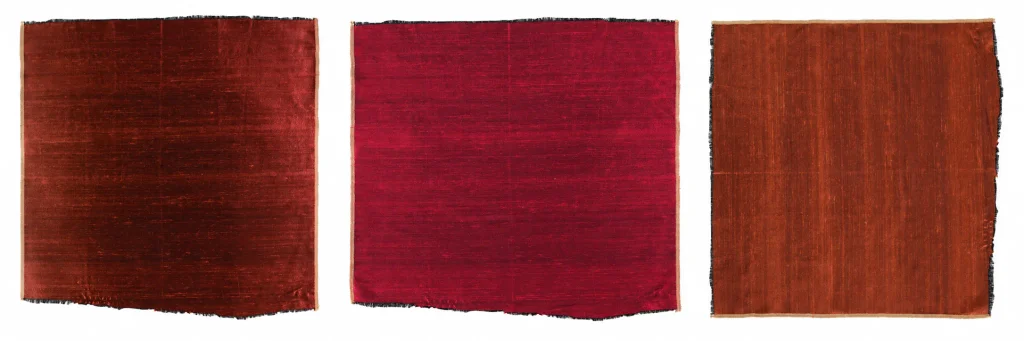
The three photographs are useful because they are photographs of one object, not three conveniently different red fabrics. They weren’t taken as a controlled experiment, so the museum’s record establishes the mechanism; the photographs just let you see it.
There is a second problem with jumping straight from that textile to Lórien. It is silk. We have just spent several paragraphs refusing to assume Tolkien meant silk, and it would be embarrassing to surrender because the museum owns something beautiful.
Solaro is the useful counterexample.
Harrisons describes Smith Woollens’ Solaro as an iridescent all-wool twill, traditionally with a khaki face and brick-red reverse. In strong light, red can come through the surface and alter the apparent colour of the cloth. Current Solaro is 100% wool.
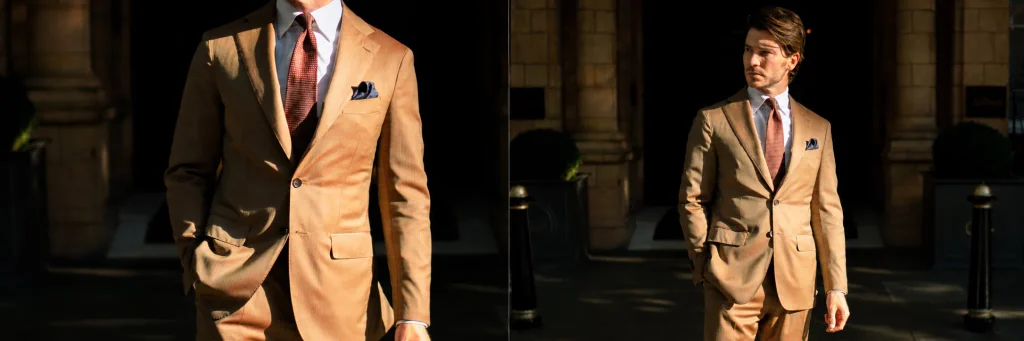
Solaro is not the Lórien cloak: the colours are wrong and the current cloth is a 355g suiting. It does not need to be. Its job here is simpler and more useful: wool can produce a real, light-dependent change in colour character.
That removes one unnecessary piece of magic. It also changes what I would give a maker. I would not ask for four literal colours that switch on command: green now, brown in five minutes, silver after dinner. Tolkien describes a cloth whose colour is hard to settle because movement and different light make it resemble different parts of the landscape. A real version should therefore be sampled for behaviour rather than matched to one heroic green swatch under shop lighting.
Light but warm is the easier problem
I have worn the stupid version of this cloak.
For a fancy-dress party on my 29th birthday I wore a heavy woollen cape with a hood and arm openings. I had dyed it olive green in the washing machine because the original green was not quite right, which remains one of the more successful things I have asked a washing machine to do.
The construction was excellent for movement: the openings let me use my hands without throwing half the cape over a shoulder. The warmth was less subtle. Outdoors it was magnificent. Indoors I was basically carrying my own central heating.
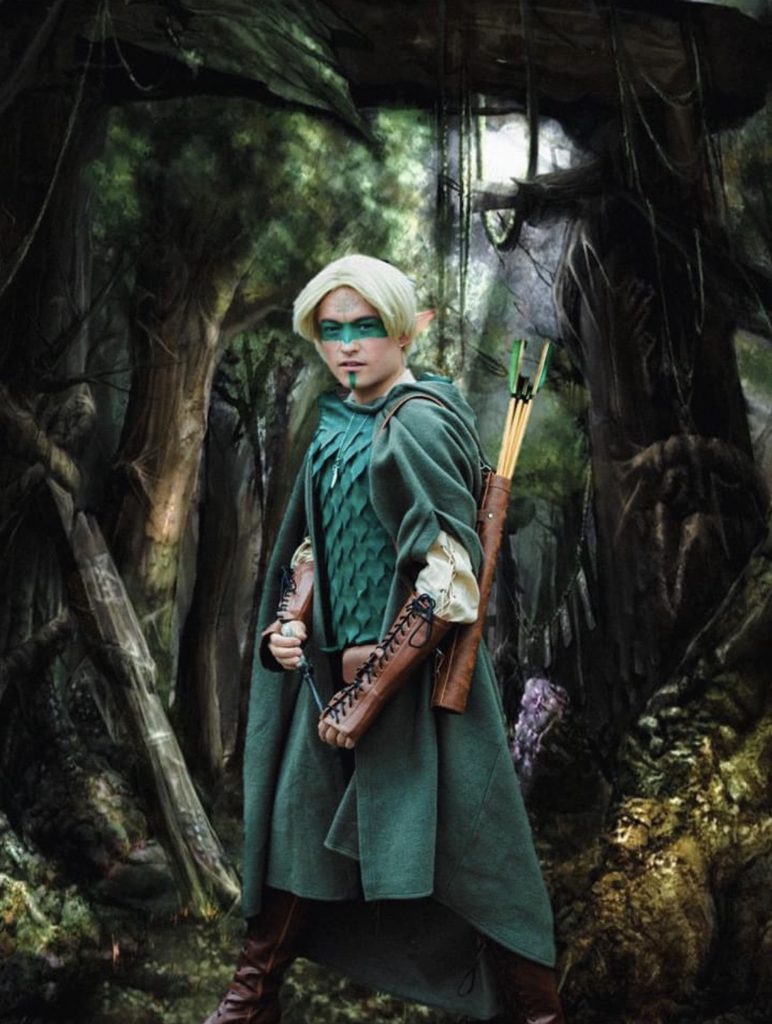
That gives me a useful bad control for Tolkien’s brief. My cape achieved warmth largely by being a lot of wool. The Galadhrim are supposed to achieve warmth and lightness, while also keeping the wearer comfortable when conditions change.
Wool makes that less unreasonable than it sounds. Woolmark explains that the natural waviness of wool fibres — their crimp — helps trap still air, providing insulation. The fibre can also absorb water vapour while allowing excess heat and moisture to escape, which is why Woolmark describes wool as useful for temperature and moisture management across changing conditions.
That is not an enchanted thermostat. A wool cloak does not inspect the weather and alter its tog rating out of courtesy.
The garment itself helps, though. A cloak can be wrapped tightly, left hanging open, thrown back from the body or pulled over the head. Fibre behaviour and ordinary adjustment can therefore do quite a lot of work before we need anything supernatural.
If I were sampling this for a real maker, I would start much lighter than my birthday cape. Fine wool, or perhaps a wool-rich cloth if sampling showed a blend improved the handle or optical effect, remains the strongest lead. Tolkien has given us no reason to insist on a heavy outerwear cloth, no reason to add a lining, and no stated requirement that the cloak survive British drizzle simply because that would be convenient.
The arm openings on mine are useful too, but they belong in the maker’s choices, not Tolkien’s specification. He tells us these are cloaks. He never tells us how the wearers get their hands out.
Could one cloak actually make you hard to notice?
The colour section proves that cloth can change apparent colour with light. The warmth section gives us a plausible fibre. Neither proves that somebody wearing the result becomes difficult to see.
Tolkien tests the cloaks several times after Lórien, and the tests are rather more demanding than somebody standing conveniently beside a mossy tree.
In The Two Towers, Aragorn, Legolas and Gimli spend a day crossing the open country of Rohan. Tolkien describes their cloaks fading against the grey-green fields strongly enough that they would have been difficult to notice until an observer came near — and the three are travelling, not posing motionless for camouflage photography.
That matters because movement is a powerful detection cue.
In 2018, Tad Brunyé and colleagues tested simulated human targets moving across complex scenes. Increasing biological motion made targets easier to detect even when the camouflage itself had low visual salience. A follow-up experiment in 2019 complicated that result in a useful way: movement remained important, but low local contrast and a pattern whose visual scale suited the background could still reduce detectability while a target was moving. Motion hurts camouflage. It does not make every other visual property irrelevant.
That makes Tolkien’s moving Three Hunters the hardest test so far. He does not say that they vanish. The claim is subtler: against the grey-green fields, few ordinary eyes would have marked them until they were near. That gives us some room — reduced salience is not invisibility — but not enough to make the problem disappear.
A subdued cloak can lower contrast with the landscape, and a broad drape can remove some of the small colour changes and familiar edges that make ordinary clothing easy to pick out. What the research does not give me is evidence that three moving people in midday light, wearing one unpatterned cloth, should reliably become as difficult to notice as Tolkien describes.
So the Rohan passage does not fail completely. I can account for the direction of the effect; I cannot yet account for its degree.
The later encounter with Éomer’s riders gives the cloaks rather more help.
Aragorn, Legolas and Gimli stop on faded grass, wrap themselves in their cloaks and sit huddled together. The Rohirrim gallop past in a long company. Some rise in their stirrups and look around, yet they do not appear to perceive the three strangers until Aragorn stands and calls out. Later he reminds Éomer that they passed the group under the “full light of day”.
That scene gives real camouflage more help than it first appears to. The three figures are stationary. They are low against faded grass. They have wrapped broad pieces of subdued cloth around much of the ordinary outline of their clothing and limbs. The observers themselves are moving quickly on horseback.
I would still call the result exceptional. I no longer think the underlying mechanisms are exceptional.
Innes Cuthill and colleagues demonstrated an important distinction in camouflage research: background matching and disruptive coloration are related but separate mechanisms. Background matching reduces the visual difference between target and surroundings. Disruptive coloration uses contrasting marks, particularly around edges, to make the target’s outline harder to recover.
Tolkien gives us no stated disruptive pattern on the cloaks. I cannot borrow one from modern camouflage because it would make the reconstruction work better. That would be fan theory with a bibliography.
Anna Hughes, Emmanuelle Briolat and colleagues tested specialist and generalist camouflage across naturalistic backgrounds in a computer search experiment using human observers. Specialist targets generally benefited from matching a particular background closely. Generalist or compromise targets could still perform well across several backgrounds, especially when those backgrounds were visually more similar; in their experiments, similarity in luminance mattered more than similarity in pattern. Generalists could also have an advantage during the first seconds of a search.
That is unexpectedly useful for Lórien.
Tolkien does not give the cloaks a series of loud terrain presets. He gives them a restrained family of apparent greys, greens, browns and silvery tones, then repeatedly places them against natural backgrounds that are themselves subdued: trees, stone, fallow ground, grey-green grass, twilight.
A compromise cloth does not need to become exactly the colour of every object nearby. It needs to avoid becoming the thing the eye picks out first.
The cloth does not make them transparent. It keeps them from becoming salient.
That gets us surprisingly far with Sam as well. At the foot of the Emyn Muil, in twilight against rock, Frodo can hear him but cannot make him out visually because the grey cloak disappears into the low-light scene. Of Tolkien’s later cloak tests, this is the one I have least trouble believing as an extreme version of ordinary concealment: muted cloth, rock, low contrast and very little light are all cooperating.
The limit appears when those favourable conditions become a guarantee.
Hughes and colleagues did not find a universal camouflage appearance that is best everywhere. Their generalists worked better when backgrounds were more alike; specialist matching still had real advantages. Brunyé’s work tells us that movement increases the chance of detection. Cuthill’s work reminds us that effective camouflage can use pattern and outline disruption that Tolkien never specifies for these cloaks. None of those studies involved people in plain-coloured fantasy outerwear wandering across Rohan, which is probably just as well for the ethics paperwork.
So I can defend strong passive camouflage. I cannot get all the way to Tolkien’s degree of reliable concealment across several terrains, lighting conditions and behaviours from the evidence I have.
That is a much smaller gap than I expected.
What I would actually ask a maker to make
I would begin with wool.
Not because Tolkien secretly wrote “wool” and everyone has somehow missed it. He did not. Wool is the fibre that currently solves the largest number of requirements with the fewest inventions: insulation without needing enormous bulk, useful moisture and heat management, and — thanks to real cloths such as Solaro — proof that wool can participate in striking light-dependent colour effects.
I would ask for a light, soft wool or wool-rich woven cloth and sample the colour construction rather than choosing one flat olive. The useful experiment would be subdued differently coloured yarns whose combined surface sits somewhere around grey-green and brown, then testing what happens when that cloth folds, moves from shade into sun and is seen against stone, winter grass and trees. Shot is one proven route to that kind of changing surface, but I would not specify a historical silk shot-cloth construction merely because the word exists. The fabric still has to survive being a travelling cloak.
I would keep the lustre controlled. Tolkien needs light to alter the apparent colour, not turn the cloak conspicuously shiny.
The cloak itself should be hooded and made to the wearer’s size because those are genuine textual specifications. I would give it enough width to wrap around the body, since that becomes useful in the Rohan scene, and fasten it at the neck with the leaf brooch. I would not automatically copy my arm openings, add a lining, make it waterproof or choose an exact length. Those are perfectly reasonable design decisions, but Tolkien has left them to us.
Then I would test the thing outdoors before declaring victory.
Same wearer, same cloth, several distances; open daylight, tree shade and twilight; stone, muted grass and woodland. I would want to know whether the colour change remains subtle rather than shiny, whether the cloth is actually comfortable after walking, and whether somebody who is not trying to prove my theory can find the wearer.
If it fails the camouflage test, I would rather record the failure than add a convenient modern disruptive print and announce that the Elves probably meant that.
The whole point of treating a book as a pattern is that the pattern gets to say no.
Then the illustrators and films get a vote
Only now do I want to look at what other people made from the same description.
John Howe’s Elven Cloak, produced for the Lord of the Rings board game by Sophisticated Games, gives the garment a broad, simple, hooded form in muted grey-brown and greenish tones. There is no jewel-bright fantasy fabric and no obvious attempt to make the cloak itself the loudest thing in the picture. That is Howe’s interpretation, not evidence of what Tolkien’s loom was doing, but it is interesting how little theatrical machinery he needed to make the description legible.
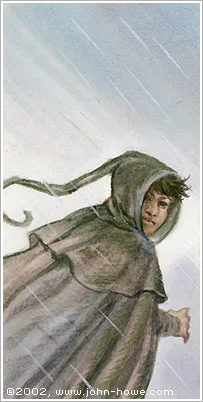
The films give us an even better check because somebody eventually had to order actual metres of fabric.
In 1998, Stansborough began working with costume designer Ngila Dickson and her team on Peter Jackson’s trilogy. A 2003 article in Handwoven records that Dickson selected the cloak fabric from Stansborough samples and quotes company co-owner Cheryl Eldridge describing the chosen design as 100% Stansborough Gotland fibre, using dark and light grey. Stansborough’s own archive also identifies its wool as the fabric used for the Fellowship cloaks.
They chose wool too.
That is satisfying rather than vindicating. The costume department was solving an adaptation problem, not revealing Tolkien’s private fibre specification. I also have no source saying the film cloth used the shot mechanism discussed earlier, so I am not going to give it one retrospectively.
What matters is the convergence. Start with Tolkien’s words instead of the screen image and wool still turns up as an unusually sensible answer.
So how much would a real maker have to invent?
Less than I expected.
The colour behaviour survives: real woven textiles can change noticeably as light works across differently coloured yarns, and an all-wool cloth can be iridescent. The thermal requirement survives in a less absolute form: wool already combines insulation with useful moisture and heat management, while a cloak can be opened, wrapped and adjusted without any assistance from Galadriel. Even the concealment survives further than it first appears. Low visual salience, good background relationship and stillness can all make something genuinely difficult to notice.
I ran into the same principle again while looking at the black-clad fantasy rogue: the darkest clothes in the scene are not automatically the least visible if the background makes them stand out.
What I cannot turn into an honest real-world specification is the reliability.
One passive cloak, with no disruptive pattern specified by Tolkien, repeatedly performs exceptionally well against trees, stone, brown ground and grey-green fields, in twilight and daylight, on still bodies and moving ones. The research gives me mechanisms that push in that direction. It does not give me a cloth I could hand to a customer with that performance guarantee attached.
I expected to find an impossible fibre.
Instead, the impossible part may simply be that Tolkien never lets an unusually good cloak have a bad day.
Pippin asks whether the garments are magic. The Elves are rather dismissive of the distinction.
On most of the brief, annoyingly, they may have a point.
Leave a Reply