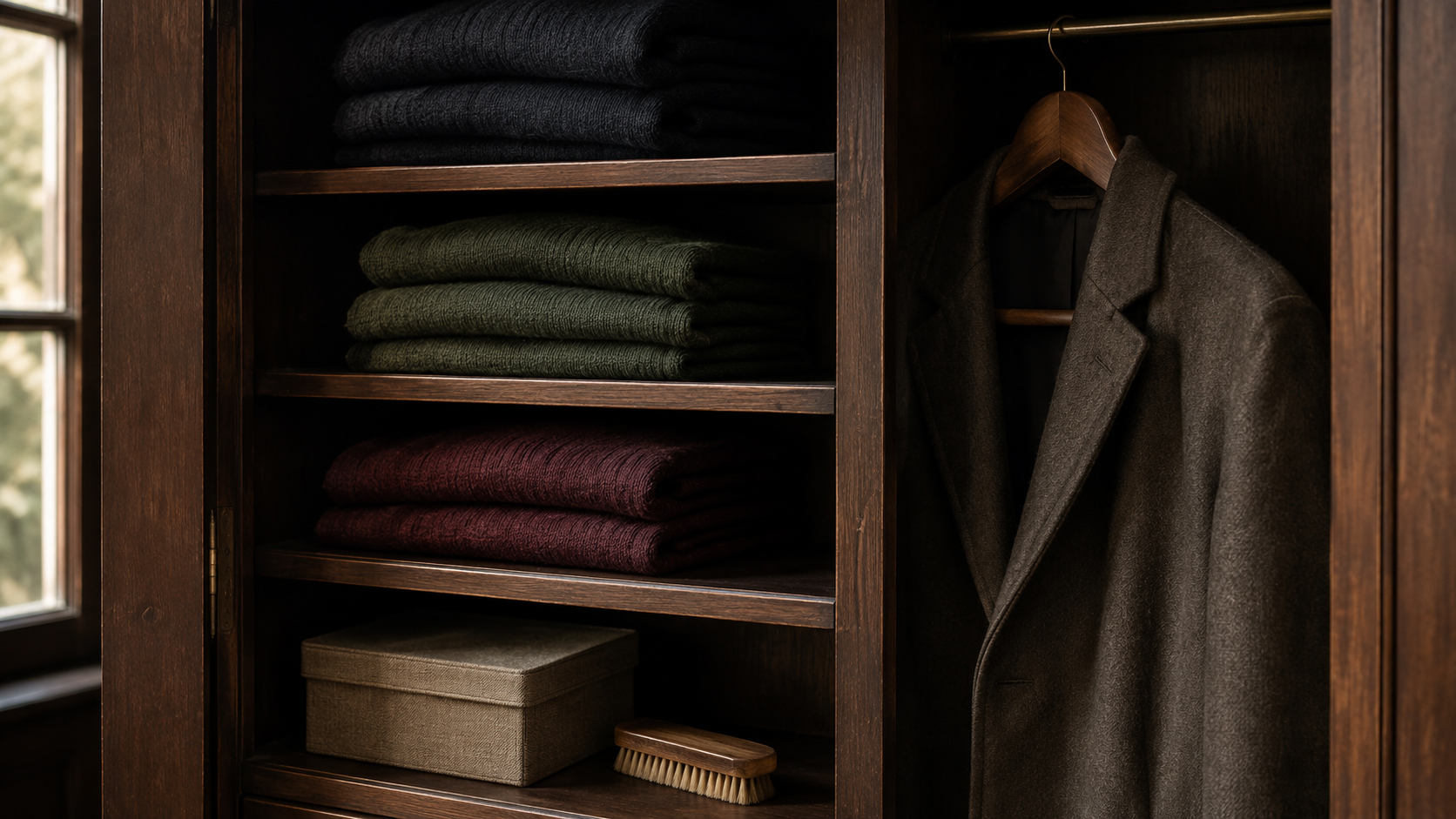
In stories, moths rarely arrive with entirely innocent intentions. They gather around forbidden libraries, pass through ruined halls and circle ancient lamps in pursuit of dangerous illumination. Before we get to how to store wool clothes safely, it helps to understand why these small creatures favour shadowed rooms, forgotten corners and garments left undisturbed.
Real clothes moths are rather less dramatic. They are not interested in cursed manuscripts or enchanted cloaks. They want dark, quiet places where vulnerable fibres have been left undisturbed.
I would love to tell you that my wool clothes spend summer folded in labelled boxes inside a dedicated storage cupboard. In reality, I have a small bedroom that I share with my partner, and I am usually pleased if everything fits into the wardrobe at all.
That is one reason I prefer moth prevention to be simple. I do not have the time or space for an elaborate seasonal ritual, and because I get cold easily and live in England, my warmer coats are never very far out of reach anyway.
Fortunately, storing wool safely does not require specialist conservation equipment or a picturesque wall of matching boxes. Clean clothes, regular movement and the occasional proper inspection matter far more than decorative sachets and complicated home remedies.
I have never had a moth problem at home. I constantly rotate what is in my wardrobe, and anything I no longer wear is usually resold—partly because bringing something new into a small room generally means something else has to leave. That may not look like a formal storage system, but it means very little remains forgotten and undisturbed for years.
The principles used to protect museum collections are surprisingly sensible when reduced to domestic scale: make the environment less attractive to pests, prevent them reaching vulnerable objects where possible, look for evidence and respond according to what you actually find. The aim is prevention and early detection, not permanent panic.
What clothes moths actually damage
The adult moth fluttering near a wardrobe is not the stage that eats clothing. Its larvae cause the damage, feeding on animal-based materials containing keratin. Wool, cashmere, fur, feathers and similar fibres are therefore particularly vulnerable.
As a child, I briefly kept a pet moth named Minty and fed him chocolate biscuits. He did not live long, although that was probably less a lesson in clothes storage than a reflection on my understanding of moth nutrition at the age of ten.
Larvae favour dark, quiet and relatively undisturbed places. Damage may be concentrated around collars, cuffs, pocket linings, trouser turn-ups, carpet edges and the folds of clothes that have not been moved for some time. Residues such as perspiration, skin oils and food can make vulnerable materials more attractive.
A single moth is a reason to inspect, not proof that every wool garment in the house has been invaded. Old holes may record an earlier problem, ordinary wear or damage that occurred before a second-hand garment reached you. Look for several signs together rather than treating one imperfect jumper as evidence of an active infestation.
Carpet beetle larvae can also damage wool and other animal fibres. Correct identification matters because traps and treatments aimed at one insect may not work against another.
Routine prevention: the habits that matter most
Routine prevention is what you do when there is no known moth activity. It should be manageable enough to become an ordinary part of looking after clothes.
A wardrobe should feel more like a well-kept library than a forgotten wizard’s archive: full of interesting things, certainly, but still clean enough that you know what is hiding at the back.
Put wool away clean
Follow the garment’s care label and the manufacturer’s instructions. Wash, dry-clean or otherwise clean it using the safest suitable method, paying particular attention to collars, cuffs, underarms and pockets.
A garment does not have to look visibly stained to carry perspiration, skin oils or traces of food. Empty the pockets too. A wool coat should not spend summer preserving crumbs, old tissues and three winters’ worth of receipts.
Allow everything to dry completely before placing it in an enclosed box or bag. Sealing a damp garment may replace an insect problem with a mould problem.
Fold knitwear rather than hanging it
Fold jumpers, cardigans, scarves and other knitted garments so that their own weight does not distort the shoulders.
Particularly delicate knitwear can be folded around clean tissue to soften a severe crease, but ordinary modern jumpers do not require an elaborate museum packing system.
Structured wool coats and tailored jackets can be kept on broad, supportive hangers. Give them enough room that they are not crushed against neighbouring clothes, and look beneath collars, inside pockets and along linings before putting them away.
Use the storage you actually have
Wool worn regularly can live perfectly well in a clean drawer or wardrobe. Regular handling reduces the chance of garments remaining forgotten for long periods and gives you more opportunities to notice fresh damage.
For seasonal clothes, rarely worn garments or homes with a previous moth problem, a clean lidded plastic box or properly closed storage bag offers a stronger physical barrier. Clothes must be clean and entirely dry before being enclosed.
Vacuum bags save space, which can be useful in a small home, but prolonged compression may flatten delicate knitwear, structured shoulders and soft finishes. They can also trap moisture if something is packed before it has dried fully.
A rigid lidded box is often kinder to good knitwear, but I am not going to pretend everyone has room for a stack of them. The practical hierarchy is simple:
- Keep the garment clean and dry.
- Store it somewhere you can inspect.
- Use a sealed container when it will be left undisturbed for a long time or when the risk is higher.
A cotton garment bag can keep dust away and reduce rubbing, but it should not automatically be treated as insect-proof.
Keep clothes moving
Regular movement helps prevent wool garments from sitting undisturbed for months and makes fresh evidence easier to notice.
You do not need to rearrange the wardrobe every Sunday. Simply wearing, handling and occasionally checking your woollens keeps them from disappearing completely from view.
The forgotten blanket behind a suitcase, the scarf at the bottom of a drawer and the winter coat that has not moved since February make better moth territory than the jumper you wear every week.
Clean the wardrobe as well as the clothes
At the change of season, or whenever the wardrobe begins to gather dust:
- vacuum the floor, corners and shelf supports;
- remove hair, lint and loose fibres;
- check carpet edges and nearby skirting boards;
- shake out garments that have been undisturbed;
- inspect the backs of drawers and the area beneath furniture.
Museums use integrated pest management, which places prevention, exclusion, monitoring and targeted response ahead of indiscriminate chemical treatment. A domestic wardrobe does not need the same documentation or equipment, but the underlying logic is useful: remove what pests feed on, reduce hiding places and make changes easier to notice.
Empty the vacuum outside if you have found suspicious insect debris. Seal the contents before placing them in an outdoor bin.
Inspect second-hand clothes before mixing them in
A second-hand wool coat or cashmere jumper deserves a proper look before it joins the rest of the wardrobe.
Examine:
- collars and cuffs;
- pocket corners;
- seams and hems;
- trouser turn-ups;
- linings;
- folds and concealed areas.
Clean the garment according to its care label and keep it separate temporarily if anything looks suspicious.
This is not because old clothing should be treated as inherently infested. Most second-hand garments are perfectly fine. It is simply easier to inspect and contain one incoming piece than to investigate the entire wardrobe later.
Old holes do not necessarily mean live moths
When I worked in a vintage clothing shop, we occasionally received garments with holes in them. That was not surprising. These were old clothes with previous lives, and the damage could have happened years earlier in somebody else’s wardrobe.
One concerned customer once spent a long time explaining that every garment should be checked for moth eggs and frozen. Her anxiety was understandable, particularly if she had dealt with moths before, but we had already inspected the stock and found no evidence of active moths in the shop.
The encounter illustrates an important distinction: a hole is evidence that a garment has been damaged. It is not, by itself, proof of a current infestation.
Before escalating matters, look for evidence such as:
- fresh or increasing holes;
- pale larvae;
- portable larval cases, small silken cases carried by some larvae;
- fine silken tubes or webbing;
- granular debris near damaged fibres;
- cast skins or empty cases;
- repeated sightings of small moths near vulnerable textiles.
Look first in the least disturbed areas: the back of a drawer, beneath a pile of jumpers, along carpet edges and underneath furniture.
What to do if you suspect moth activity
Suspected activity means that you have found a moth, an unexplained hole or something that might be insect debris, but you have not yet confirmed live larvae or continuing damage.
At this stage, contain and investigate rather than spraying the room.
Place the suspect garment inside a strong, clear plastic bag and close it securely. Mark the date and note where it was found.
Then:
- Examine the garment in bright light.
- Inspect the clothes stored directly beside it.
- Check the drawer, shelf, wardrobe floor and nearby carpet.
- Photograph any larvae, cases or debris that may help identification.
- Consider placing a suitable clothes-moth pheromone trap nearby for monitoring.
Pheromone traps attract male moths of the species for which the lure was made. They can help establish whether moths are present and whether activity is increasing or declining.
They do not remove eggs or larvae from clothing, and they are not a complete treatment. A trap that catches moths is evidence that you should investigate further, not evidence that the problem has been solved.
Do not return a suspicious garment to the wardrobe because a trap has remained empty for a few days. Equally, do not assume the whole house requires chemical treatment because you have seen one moth.
What counts as a confirmed infestation?
Treat the problem as confirmed when you find one or more of the following:
- live larvae;
- characteristic cases or webbing;
- fresh damage accompanied by insect debris;
- repeated moth catches close to wool or other vulnerable materials;
- continuing new damage after an initial inspection.
At this point, divide the work into two separate tasks:
- Treat or professionally clean the affected garments and other vulnerable items.
- Clean, inspect and, where necessary, treat the surrounding storage area.
Doing only one is unreliable. A treated jumper returned to an active wardrobe may be reinfested. Cleaning the wardrobe while leaving larvae inside folded clothes may allow the problem to continue.
Seal affected and untreated vulnerable items before moving them through the home.
Treating an individual garment
Care labels and manufacturer instructions come first. A treatment that kills insects is not helpful if it also shrinks the jumper, distorts its shape or damages leather, adhesives, dye or trim.
Washing or professional dry-cleaning
Where the label permits it, suitable washing or professional dry-cleaning may deal with insect life stages while also removing the residues that made the garment attractive.
Tell the dry cleaner that moth activity is suspected or confirmed. Keep the garment sealed while transporting it and ask how the cleaner would prefer it to be presented.
Once cleaned, keep it separately contained until the wider storage area has been dealt with.
Freezing
Current English Heritage guidance advises sealing affected clothing or small textiles in plastic and freezing them at −18°C for at least two weeks. The item should then remain sealed for at least 24 hours while it returns to room temperature, helping to prevent condensation forming directly on the textile.
For a small, robust wool garment:
- Make certain that it is completely dry.
- Place it loosely in a strong plastic bag.
- Remove excess air without crushing the garment.
- Seal the bag and mark the date.
- Use a freezer that reliably holds −18°C or below.
- Leave the garment frozen for at least two weeks.
- Allow it to warm for at least 24 hours while still sealed.
- Inspect and clean it before returning it to a cleaned wardrobe.
Freezing treats the item inside the bag. It does not treat the shelf, carpet, upholstery or neighbouring clothes.
Do not improvise this treatment for fragile historic garments, heavily embellished pieces, fur, leather, bonded fabrics or complicated mixed-material items. Seek advice from a textile conservator, specialist cleaner or experienced pest professional.
A small freezer compartment that fluctuates in temperature may not provide the same controlled conditions as a reliable freezer.
Heat treatment
Controlled heat can kill textile pests, but a domestic oven, hairdryer, radiator or improvised heated box is not a suitable substitute for specialist treatment.
Uneven heating may leave insects alive while shrinking wool, drying leather, loosening adhesives or damaging trims.
Use a tumble dryer only when the care label explicitly permits it. Do not choose an excessively hot cycle simply because heat sounds thorough.
Large rugs, upholstered furniture and bulky objects are better assessed by a professional who can offer controlled heat treatment, commercial freezing or another method suited to the materials.
Cleaning the wider wardrobe and room
Once affected clothes have been contained, empty the wardrobe or drawer methodically. Keep untreated wool and other vulnerable items sealed while you work.
Vacuum:
- shelf corners and undersides;
- drawer joints and runners;
- the wardrobe floor and back;
- cracks near skirting boards;
- carpet edges;
- beneath nearby furniture;
- upholstery seams;
- the undersides of cushions.
Pay attention to hair, lint, feathers and dead insects. Textile pests may feed on more than the obvious wool jumper.
Inspect nearby wool carpets, felt furniture pads, feather-filled cushions, blankets and animal-fibre furnishings where relevant.
Use an ordinary cleaning product suitable for the wardrobe’s hard surfaces, then allow the area to dry completely. There is no need to soak the wood in perfume, essential oil or pesticide.
Empty the vacuum outside. Place the contents in a sealed bag before putting them in the outdoor bin, and clean reusable attachments before bringing them back indoors.
Inspect adjoining cupboards or rooms when evidence is widespread rather than concentrated in one place. Old bird nests, chimney spaces and inaccessible voids can sometimes provide a source, but do not undertake unsafe roof or chimney work yourself.
Return garments only when they have been cleaned or treated and the storage area is dry.
What common moth remedies can—and cannot—do
Moths suit folklore because they are small, nocturnal and easily turned into symbols. That same atmosphere has helped create a domestic mythology around cedar chests, lavender sachets and mysterious chemical balls.
Some of these things may have a limited use. None replaces cleaning, inspection and an appropriate response to actual evidence.
Cedar
Cedar blocks, rings and balls may give off a scent that discourages some adult moth activity for a time, particularly when the cedar is fresh.
They do not reliably kill established eggs or larvae inside garments, and their effect declines as the aroma fades.
Use cedar only as a supplement to cleaning, inspection and suitable storage. Keep cedar oils and freshly treated wood away from direct contact with clothing because oils may mark fabric.
Lavender
Lavender sachets may make a wardrobe smell pleasant, but they should not be treated as a complete pest-control method.
They will not repair damaged wool, clean soiled garments or reliably eliminate larvae already feeding in folds and seams.
Use lavender because you enjoy it, not because it excuses you from inspecting the jumper beneath it.
Mothballs
Do not use loose, unidentified, unlabelled or imported mothballs.
Products sold as moth treatments may contain chemicals requiring strict conditions of use, and unauthorised products should not be supplied in Great Britain. Never place an unidentified chemical among clothes, children’s belongings or pet bedding.
Pesticides
Pesticides should not be the automatic first response to a hole in a jumper.
They do not replace:
- finding affected garments;
- removing lint and debris;
- cleaning the storage area;
- treating textiles appropriately;
- monitoring for continuing activity.
Use only a product authorised for its stated purpose where you live. Read and follow the label, leaflet and supplied safety information exactly. Instructions concerning ventilation, protective equipment, pets, children, storage, disposal and safe re-entry are part of the treatment, not optional small print.
Do not spray clothing directly unless the product label specifically permits use on textiles and the garment’s care instructions allow it. A chemical capable of killing insects may also stain fabric or affect dyes and finishes.
When to call a professional
Professional help is proportionate when:
- fresh damage continues after affected clothes and the wardrobe have been cleaned;
- larvae or moths are appearing in several rooms;
- fitted wool carpets, underlay or upholstery are involved;
- the likely source is inside a wall, chimney, floor void or inaccessible space;
- many garments are affected;
- an item is valuable, fragile or difficult to treat;
- room-scale pesticide or heat treatment may be needed.
Look for a suitably qualified and insured pest professional, such as a member of the British Pest Control Association.
Ask the contractor:
- what insect has been identified;
- what evidence supports that identification;
- which rooms and objects require treatment;
- what product or process will be used;
- how to prepare the area;
- how pets, children and vulnerable people will be protected;
- when the room can be safely re-entered;
- what follow-up monitoring is required.
A vague promise to spray everything is not a complete treatment plan.
A realistic wool-storage routine for a small home
Not everyone has a spare room, a cedar-lined wardrobe or the patience to conduct a quarterly textile audit.
For most households, a realistic routine looks like this:
- Clean wool before leaving it unworn for a long period.
- Let it dry completely.
- Fold knitwear and support coats properly.
- Keep the wardrobe clean enough that you can inspect its corners.
- Move and wear garments regularly.
- Check second-hand purchases before mixing them with everything else.
- Isolate anything suspicious.
- Escalate only when the evidence justifies it.
In a small wardrobe, limited space can even encourage useful habits. Clothes are handled more often, forgotten pieces are easier to identify and anything that no longer earns its place can be repaired, donated or resold.
That is certainly how mine works. I would enjoy a grander storage system, but at present the practical rule is that everything must fit, and anything new may require something else to leave.
Store wool calmly, not carelessly
Fantasy teaches us that old cloaks, travelling coats and well-worn woollen garments can outlive the characters who first wore them. In reality, they only manage that if somebody takes care of them.
A favourite jumper will probably never conceal a magic key. Your winter coat is unlikely to carry an ancient prophecy in its lining. They may, however, accompany you through dozens of winters, cold railway platforms, wet walks and years of ordinary life.
That feels like reason enough to look after them.
Safe wool storage rests on a handful of habits: clean garments, complete drying, suitable support, regular movement and storage you can inspect.
One moth does not justify panic. Live larvae, fresh damage or repeated evidence does justify a proper response—first to the affected garments and then to the space around them.
A domestic wardrobe does not need to operate like a museum archive. It only needs to be clean enough that pests are not comfortably fed, and orderly enough that a change does not remain hidden for an entire season.
And perhaps keep the chocolate biscuits for yourself.
If you have your own tried-and-tested wool storage routine—or perhaps your own memorable encounter with clothes moths—I’d love to hear about it in the comments.