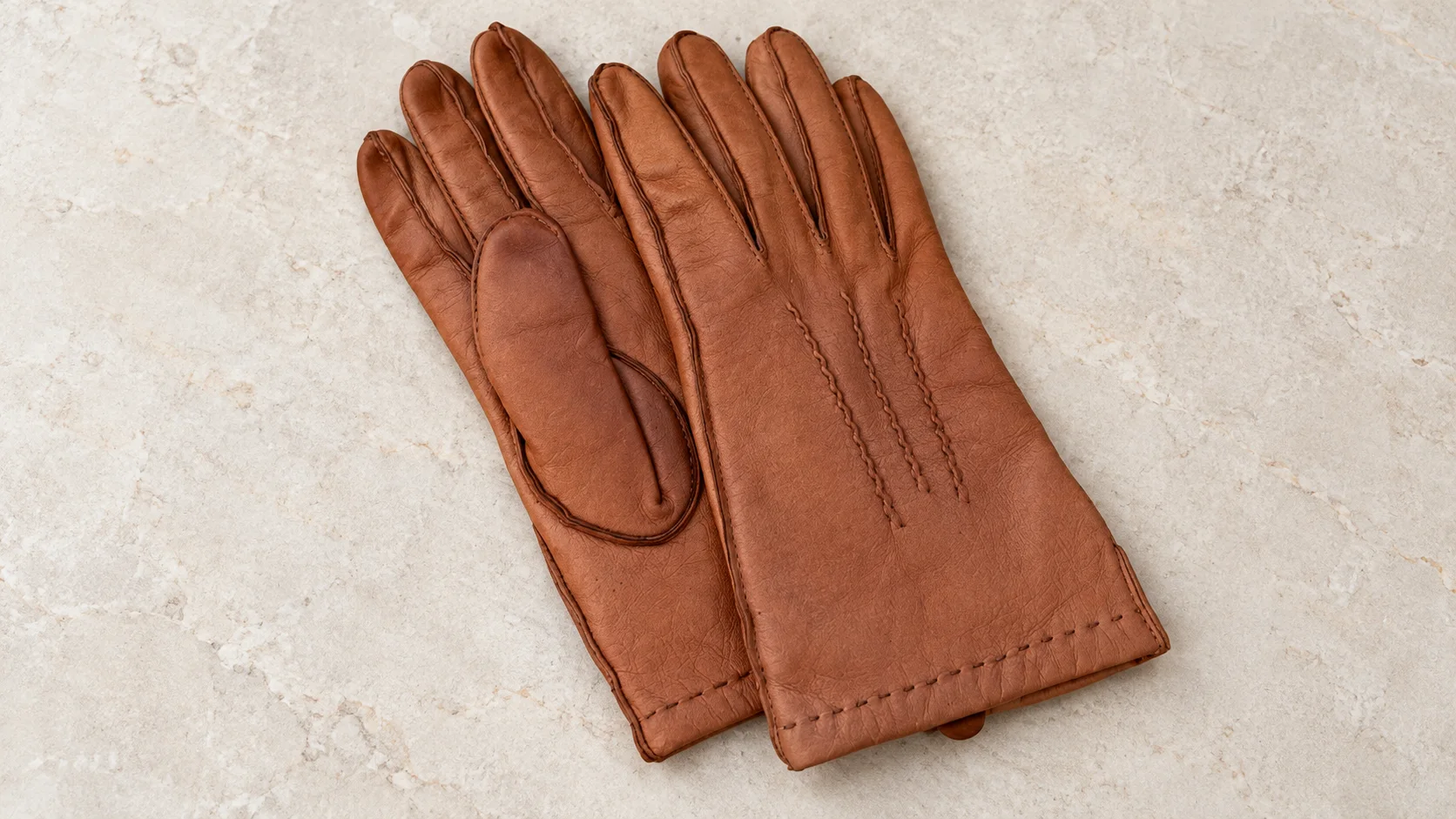
I own one pair of brown gloves. I think they are leather, although the fact that I have got as far as owning them without establishing this tells you roughly how important they have been in my life.
They are too big and bulky. Wearing them makes my hands feel as though somebody has replaced five fingers with one general-purpose padded attachment. Keys become fiddly. Getting something out of a pocket develops stages. Unless it is genuinely cold, I would rather have functioning hands.
This has been my experience of gloves generally, which would be a perfectly good reason not to care very much about them if there were not one problem: I have never knowingly owned a properly fitted pair of leather gloves.
Perhaps gloves are simply annoying and I have been right all along. Perhaps I have spent years judging them by pairs that never fitted properly in the first place.
Before deciding, I wanted to know what a leather glove is actually supposed to be doing around a hand. That turns out to involve several bits of construction I had seen without ever knowing had names.
First: is it even leather?
My brown pair presents a more immediate problem. Before inspecting the glovemaking, I need to establish what they are made from.
This is less straightforward than the old sniff-it-and-look-confident method would suggest. SATRA, the British footwear and leather technology organisation, says microscopy is the common method for distinguishing genuine leather from lookalike materials. A handheld loupe can also reveal useful information at the surface and, where a cross-section is already visible, through the material itself.
Real leather has an irregular fibrous structure through its thickness. A typical polyurethane- or PVC-coated textile is more orderly: under magnification, the coating and the textile beneath can appear as separate layers. SATRA also warns that some lookalikes contain leather fibres on their underside, which makes appearance and feel still less decisive.
So the sensible second-hand test begins with the label if there is one, then any naturally exposed edge or cross-section you can inspect without damaging the glove. A small magnifier is more useful evidence than a dramatic sniff. Sometimes that will be enough to make a reasonable judgement; sometimes the honest answer will remain probably leather.
That is fine. I would rather leave a material slightly uncertain than perform folk chemistry on it beside the accessories rail.
The pieces between your fingers
The interesting parts begin in the gaps. Dents’ glove terminology guide calls the panels running along the insides of the fingers fourchettes. The Worshipful Company of Glovers uses the term too; its collection records describe surviving gloves constructed with both fourchettes and quirks.
That suddenly makes the space between two fingers rather more interesting than it has any right to be.
Instead of each glove finger being a flat tube made by joining a front directly to a back, fourchettes give it separate sides. On one current Dents peccary glove, the company explicitly says its fourchettes allow full flexibility of movement for the fingers.
Turn a second-hand glove sideways and inspect them. Look at the stitching along those narrow panels and at the junctions where the fingers meet. A handsome back can hide quite a lot of strain in there.
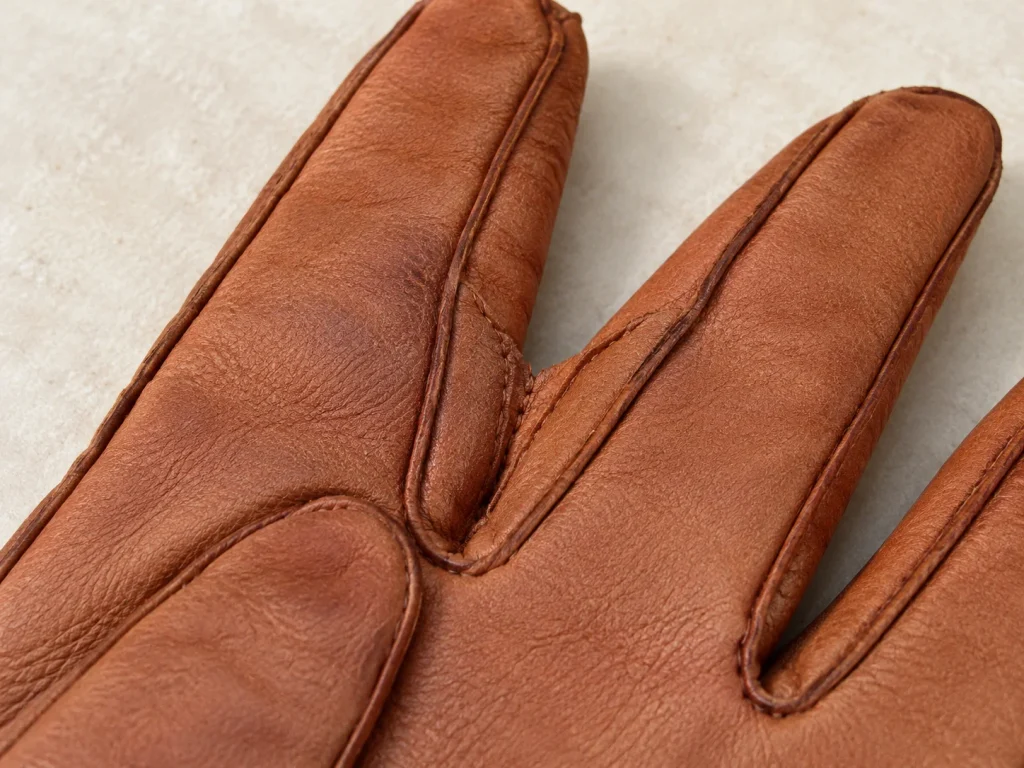
Then there are quirks: small leather gussets inserted at the base of the fingers. Dents describes its quirks as diamond-shaped pieces used to improve fit; Mike Redwood’s glove glossary describes them as small gussets sometimes fitted at the bases of the fingers or thumb to allow more flexibility of movement.
Do not turn this into a scavenger hunt. Dents itself says it uses quirks only on some of its most luxurious gloves, so their absence is not evidence of a cheap or badly made pair. Their value here is explanatory. They show how particular glovemakers have dealt with an awkward bit of anatomy: the place where several moving fingers all have to emerge from one hand.
That is much closer to the thing I had been missing. I have always thought of a glove mainly in terms of size — small, medium, large, one of them presumably mine. The construction is trying to solve a three-dimensional problem.
The leather glove in my interactive clothing glossary shows a classic pattern laid out flat, which makes that problem much easier to see.
Leather has a direction
The cut pieces are only half of it. Leather itself is not behaving identically whichever way a glovemaker turns it.
In Redwood’s specialist glovemaking material, one important property is called run — directional, non-elastic stretch created as the fibres in glove leather reorient. For chrome- or alum-tanned glove leather, he says the useful stretch should work around the width of the hand rather than up and down its length. Different glove leathers behave differently; he gives chamois or oil-tanned leather as an example normally cut for a tighter initial fit because it stretches more during wear.
This is not something I expect to diagnose confidently while standing in a charity shop. I am certainly not going to pick up a glove, squint at it and announce that the run is all wrong.
It changes how I think about fit, though. A leather glove is not simply a hand-shaped container that happens to come in several sizes. Its pieces have been cut from a material with directional give, and that behaviour forms part of how the glove is expected to accommodate the hand.
It also makes “leather stretches” rather inadequate buying advice. The direction and amount of that stretch matter, and the type of leather matters. A glove being tight somewhere does not automatically mean time will nobly sort it out.
The three lines on the back are called points
The easiest piece of glove anatomy to notice is also the one I would put fairly low down the second-hand inspection list.
Those stitched lines running along the back are called points. Dents describes three lines — or occasionally one — as decorative stitching.
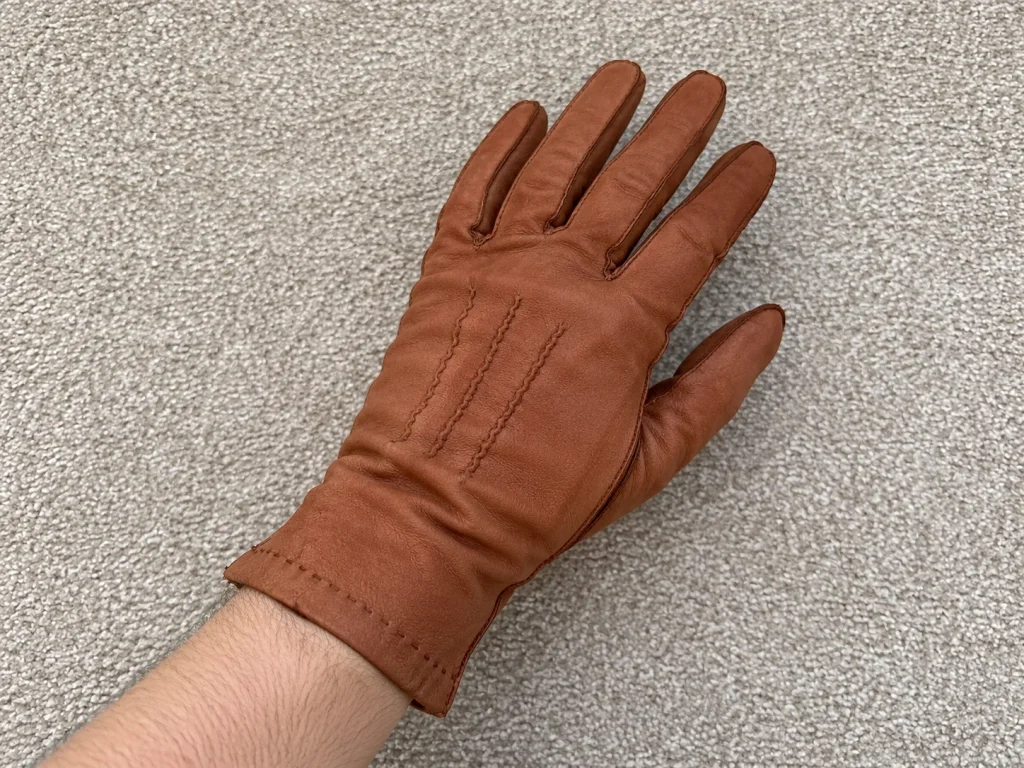
Redwood’s account is slightly different. His glossary says the familiar three-line treatment evolved from earlier embroidery into a construction and fit feature known as pointing by the late eighteenth century.
I do not think the difference needs tidying away. “Points” can describe the visible lines while their technical role has varied with period and construction. What they cannot do, from the point of view of somebody buying an unknown second-hand pair, is tell me whether the fingers are the right length or whether the leather between them is failing.
They are very good at looking important.
So how should a leather glove actually fit?
This is where my own glove history becomes slightly embarrassing, because there is more to the answer than finding a size marked M and hoping for the best.
Dents’ current size guide starts by measuring around the widest part of the dominant hand, excluding the thumb. That gives a basic glove size, but Dents also sells shorter-finger versions of some gloves, which makes an obvious point: two hands with the same circumference do not necessarily have fingers of the same length.
For its leather gloves, Dents says the initial fit may feel snug because the material gives with wear. Its guide to putting on and taking off leather gloves also says to check that the seams along the fingers, thumb and hand sit straight rather than being dragged out of position.
I would treat those as useful fitting signs rather than commandments for every leather glove ever made. Redwood’s discussion of run and different leather types is precisely why. Material, construction and intended fit vary.
What I would look for second-hand is simpler.
The fingertips should tell you immediately whether you have a serious length mismatch. If your finger has finished and the glove continues for a noticeable distance without it, the nominal size has not solved the problem. Look at where the thumb sits as well; a badly positioned thumb can make the whole hand feel as though it is being pulled sideways.
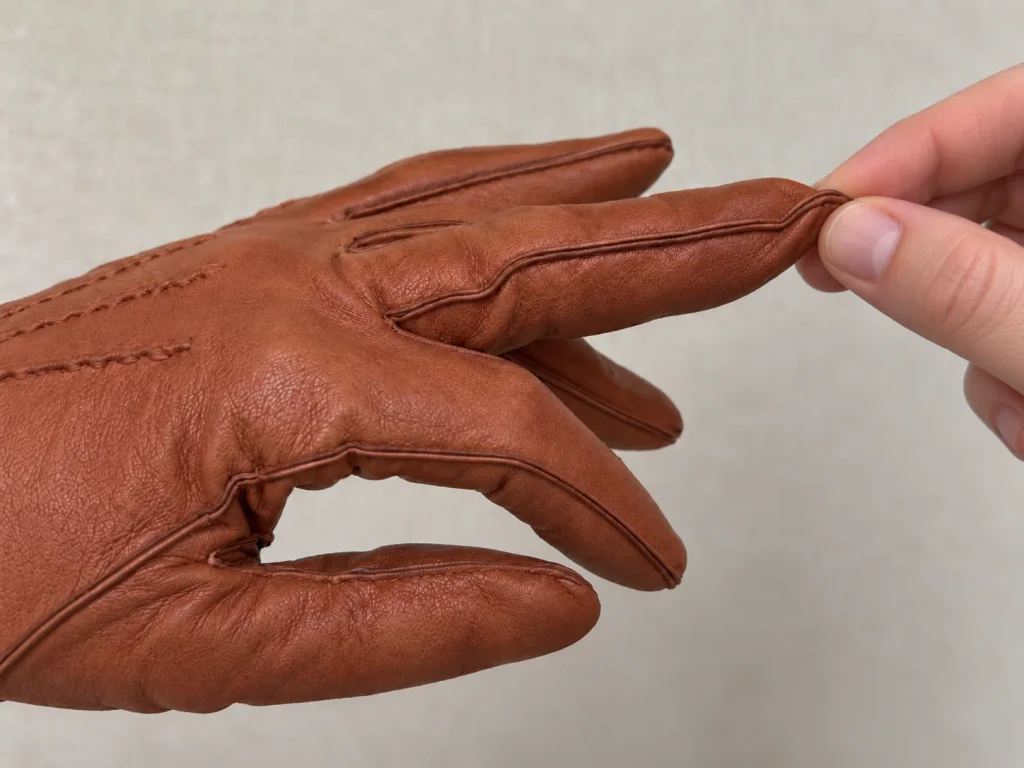
Then look at the seams. Are they lying reasonably straight, or being dragged around the fingers? Does material collapse into folds because there is more glove than hand? Does one part feel tight while another is conspicuously empty?
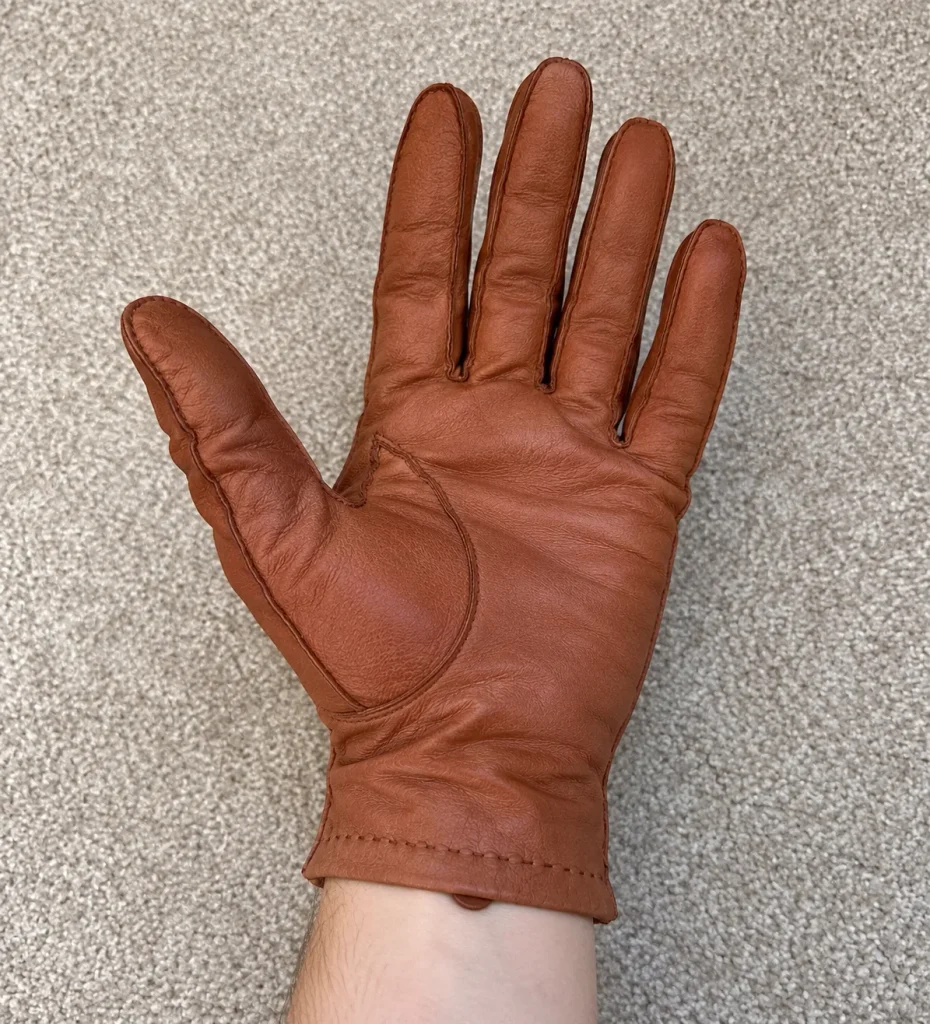
Finally, move. Open the hand, close it and try the sort of small movement that normally annoys you in gloves. This is not a laboratory test of dexterity. You are finding where this particular glove bunches, pulls or leaves surplus material.
A closer fit is not automatically a better glove. The useful distinction is between a glove shaped to the hand and one that leaves obvious surplus material or pulls in the wrong places.
“These gloves make my hands useless” is a much less useful diagnosis than “there is empty glove after my fingertip and the material is bunching around my hand”. One of those is an opinion. The other gives me something to look for on the next pair.
Second-hand gloves have already fitted somebody else
This matters more with a used glove because the leather has already been worn, flexed and pulled around another person’s hand.
That does not make ordinary creasing a defect. It does mean I want to know whether what I am seeing is wear in a sound piece of leather or actual deterioration.
The National Archives’ guidance on leather describes several warning signs that matter here: leather can harden and become permanently set over time, while unsuitable conditions can contribute to splitting and cracking. Its conservators specifically warn that trying to force hardened leather back into shape can cause it to break.
For a second-hand glove, then, I would be much happier with supple leather carrying ordinary evidence of use than with a pair that feels rigid, has cracks opening at repeatedly flexed areas or has acquired a shape that fights your hand.
The seams deserve a separate judgement from the leather itself. Dents’ repair service is a useful illustration of why: for its own gloves, the company offers repairs to seam stitching but explicitly excludes torn or ripped leather. Stitching that has opened and leather that has split are not the same fault.
If I found an otherwise excellent pair with a short section of failed stitching, I would at least ask what the repair involved and whether the glove was worth it. A split through weakened leather is a different proposition. Sewing a damaged material back together does not restore the strength it has already lost.
This is familiar territory from buying second-hand shoes: repairability should make us more informed, not more sentimental. A thing being technically capable of receiving work does not oblige me to pay for the privilege.
For gloves specifically, I would inspect the fingertips, thumb junction, the narrow panels between the fingers and the bases where those fingers meet. Those are places where shape, movement, stitching and leather all have to cooperate.
Back to the brown pair
Having spent all this time investigating my gloves, I eventually did something particularly advanced: I checked the label.
It was tucked inside the cuff. “100% Wool Lined. Genuine Leather.” Beneath that, a second label gives the size as L.
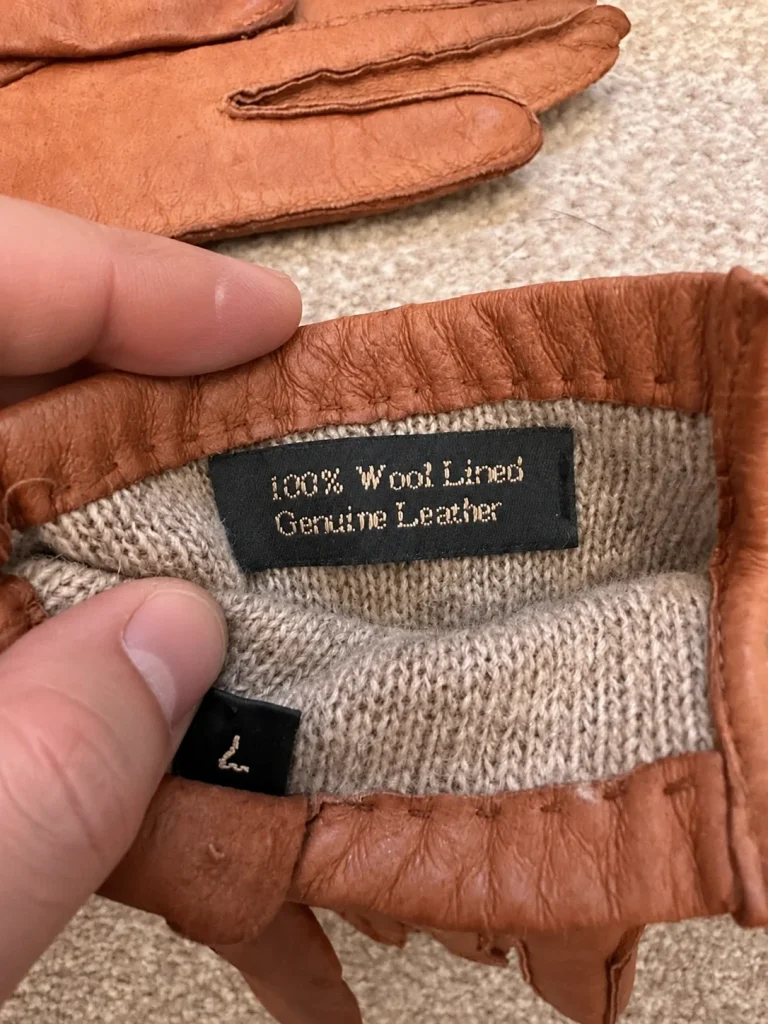
This is slightly embarrassing because checking the label is the first test I have just recommended for working out whether a second-hand glove is leather. Apparently the method is excellent provided I remember to use it.
I would take genuine leather here for exactly what it is: the manufacturer’s description of the outer material. I do not know who made the gloves, and the label tells me nothing further about the particular leather or its quality. It does at least answer the question I had unnecessarily allowed to become mysterious.
The size is more revealing. Measured around the widest part of my dominant hand, just below the knuckles and excluding the thumb, my hand is 19 centimetres — about 7½ inches. On Dents’ current men’s chart, 19–20.5 centimetres corresponds to Small, while Large covers 24–26 centimetres. That is useful context, not a conversion table: one manufacturer’s L cannot simply be translated into another’s sizing. The photographs carry the rest. Whatever its maker intended by L, this particular glove leaves obvious spare length beyond my fingers and excess material around my hand.
The 100% wool lining probably contributes to the sensation as well. Dents explicitly describes its unlined Milton leather gloves as offering a closer fit and better grip. That gives me two quite ordinary reasons for the oven-mitt effect instead of one: an oversized glove with a knitted wool lining was never an obvious recipe for delicacy.
The construction itself is rather better than I had noticed. The narrow side panels between the fingers are plainly visible, so this pair has fourchettes. Looking at them closely makes the fingers much easier to understand as constructed shapes rather than five tubes attached to a palm. I cannot identify a separate quirk confidently, so I am not going to reward myself for learning the word by inventing one.
The three wavy rows on the back give me the points as well. Before researching any of this, they were probably the only piece of the construction I would have noticed. Decorative stitching has had the good sense to live somewhere visible; the pieces doing more interesting work are hiding in the finger gaps.
Condition is not what condemns these gloves. The photographs show ordinary creasing and some darker wear, but I cannot see torn material or an obviously failed seam in the areas I photographed. What makes them poor gloves for me is much simpler: they do not fit.
That leaves my original complaint in an awkward position. I have spent years thinking gloves make my hands useless, while the only leather pair I own is labelled large, fits me badly and contains a wool lining designed for warmth rather than the closest possible fit.
None of that proves I would enjoy a properly fitted pair. I may eventually try one, reach for my keys and conclude that bare fingers remain superior technology.
I have at least lost the right to use these gloves as evidence.
Leave a Reply