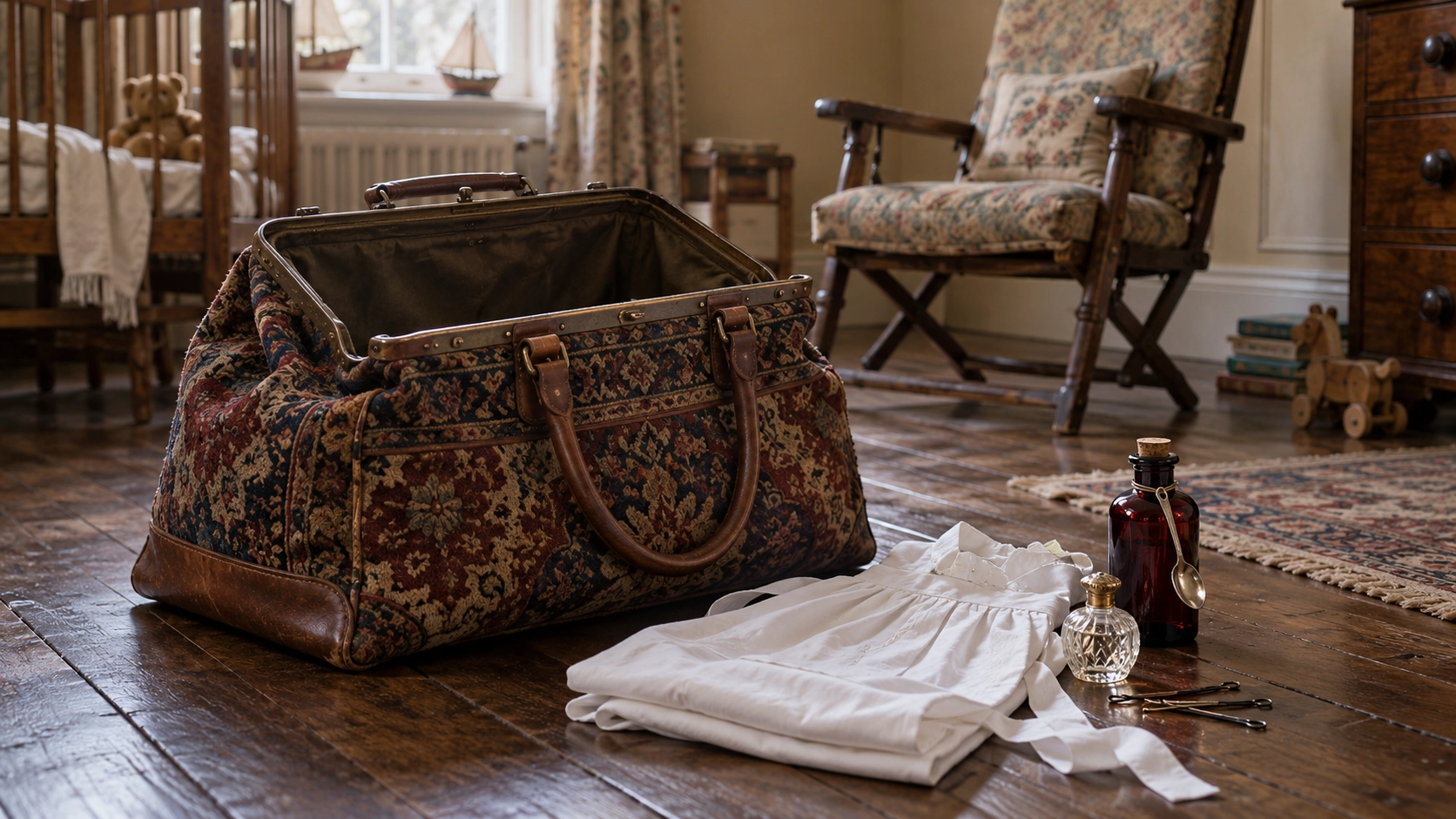
Mary Poppins has barely arrived at Number Seventeen, Cherry Tree Lane when Michael Banks makes the mistake of asking about her luggage. It’s a carpetbag, which he assumes must be intended for carrying carpets.
“No. Made of.” That’s the entire explanation he receives.
In P. L. Travers’ 1934 novel Mary Poppins, the new nurse has already arrived on the East Wind, slid upwards along the banisters and informed Mrs Banks that she doesn’t provide references. By the time she opens her bag in the nursery, the children have good reason to suspect there is something peculiar about her.
They peer inside and find it completely empty. Mary Poppins appears offended by this observation and immediately begins unpacking.
What emerges is extraordinary, although the things she chooses to bring are perhaps more revealing than the magic required to carry them.
First, the perfectly ordinary things
The first item is a starched white apron, which Mary Poppins immediately ties around her waist. She follows it with soap, a toothbrush, hairpins, a bottle of scent and throat lozenges. Later come nightgowns, boots and a few personal amusements.
There is a folding armchair among those first possessions, which rather spoils any attempt to pretend the unpacking is proceeding normally. For the moment, though, consider the smaller things.
Mary Poppins is arriving to take up employment in somebody else’s home, and she has brought the equipment for doing it. Her apron is ready, her personal grooming is accounted for, and there are enough changes of nightwear to suggest she intends to settle in properly.
The details are wonderfully conventional for someone who has just travelled upstairs by a method that ought to have alarmed the entire household.
They also suggest a woman with considerable personal standards. Hairpins and perfume may be small possessions, but they belong to her own routine. She has brought the means of looking after herself alongside the things required for her work.
Where Jane Eyre has to defend her right to choose her own clothes, Mary Poppins arrives with her own arrangements already made. She isn’t particularly interested in anybody else’s opinion of them.
The medicine bottle gives her away
Then comes the most interesting object in the bag.
Mary Poppins produces a large medicine bottle with a label prescribing one teaspoon at bedtime. A spoon is attached to its neck, and she pours out a dark crimson liquid.
Michael assumes the medicine belongs to her. Instead, Mary Poppins informs him that it is his, and his objections prove entirely unsuccessful.
When he finally swallows it, he discovers that it tastes of strawberry ice. Jane receives lime-juice cordial. The babies are given something that appears to be milk.
Then Mary Poppins pours a dose for herself. “Rum punch.” She smacks her lips and corks the bottle.
I think this is the moment when the bag gives away the most about its owner. The armchair has already established that ordinary dimensions don’t apply, but the medicine bottle reveals something more personal.
Mary Poppins is unmistakably in charge. Michael protests, Jane worries about the babies, and neither manages to alter her instructions. She knows what she is doing, expects obedience and produces an outcome that the children thoroughly enjoy.
There is an interesting mixture of severity and indulgence here. She administers the medicine with the manner of someone determined to enforce a rule, yet each child receives something pleasant.
Her own dose delights me. After all the starch, the sniffing and the refusal to answer reasonable questions, there is evidence of an appetite entirely her own. She enjoys something. She even allows herself the satisfaction of showing it, briefly, before returning to business.
The bottle also makes the magic more intimate. An impossible armchair demonstrates what Mary Poppins can do. The different flavours suggest that the contents of her possessions can accommodate individual tastes, including hers.
Then the furniture becomes impossible to ignore
The folding armchair was only the beginning.
Once the children are in bed, Mary Poppins resumes unpacking. Out come eleven nightgowns in flannel and cotton, a pair of boots, dominoes, bathing caps and a postcard album.
Finally, she produces an entire folding camp-bedstead, complete with blankets and an eiderdown, and installs it between the babies’ cots.
At this point, the carpetbag has ceased to resemble any reasonable form of luggage. The bed alone is enough to defeat the practical problem of packing. Its bedding makes the achievement more insulting to the ordinary laws of space.
What interests me is that Mary Poppins has brought her own furniture.
She is entering a household in which she will work and sleep, surrounded by people she has only just met. Yet she arrives with the means to establish a private corner of that household immediately.
An armchair suggests somewhere to sit. A bedstead provides somewhere to sleep. The smaller possessions establish everything from her working appearance to her personal comforts.
Her bag contains the arrangements of a life she has already decided how to live.
Mary Poppins doesn’t explain the furniture, either. In fact, the children’s continued curiosity appears to irritate her. Even when Michael asks whether she will ever leave them, she offers only a condition involving the changing wind.
What was a real carpetbag made from?
Michael’s confusion about the name is understandable. A carpetbag sounds like something intended for transporting a rolled-up rug, although its name traditionally refers to the material used to construct it.
Nineteenth-century examples could be made from sturdy patterned carpet cloth or other decorated textiles. Hampshire Cultural Trust’s history of bags and purses also describes carpetbags made from canvas embroidered with wool.
A particularly useful example survives in the collection of London Museum.
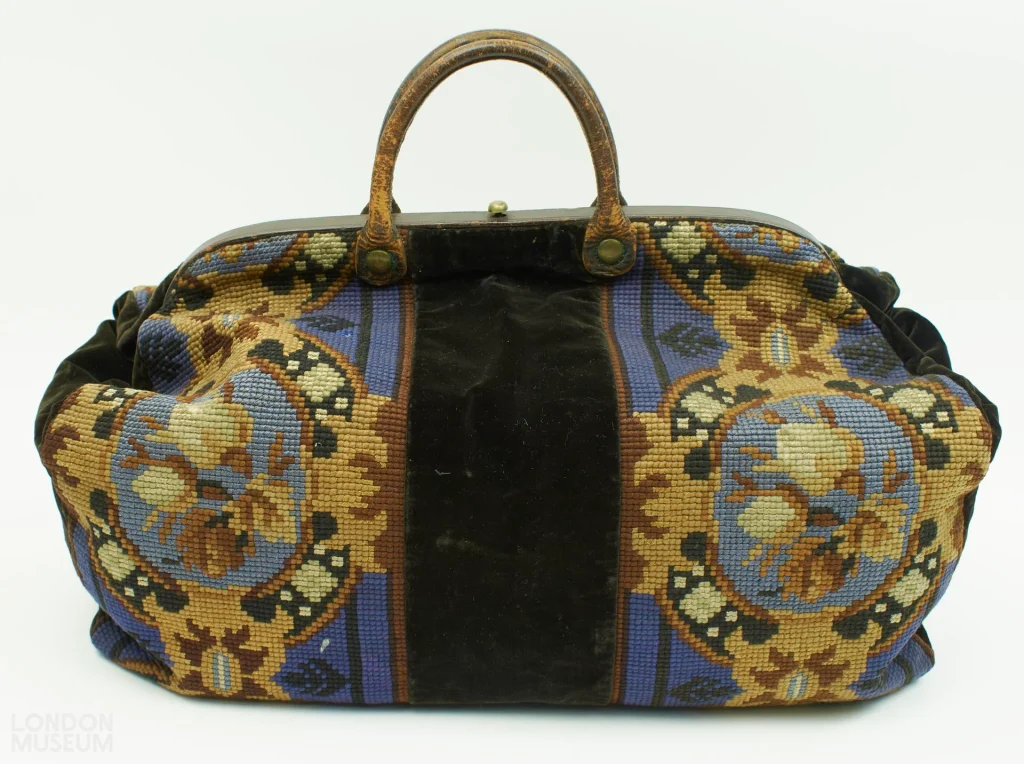
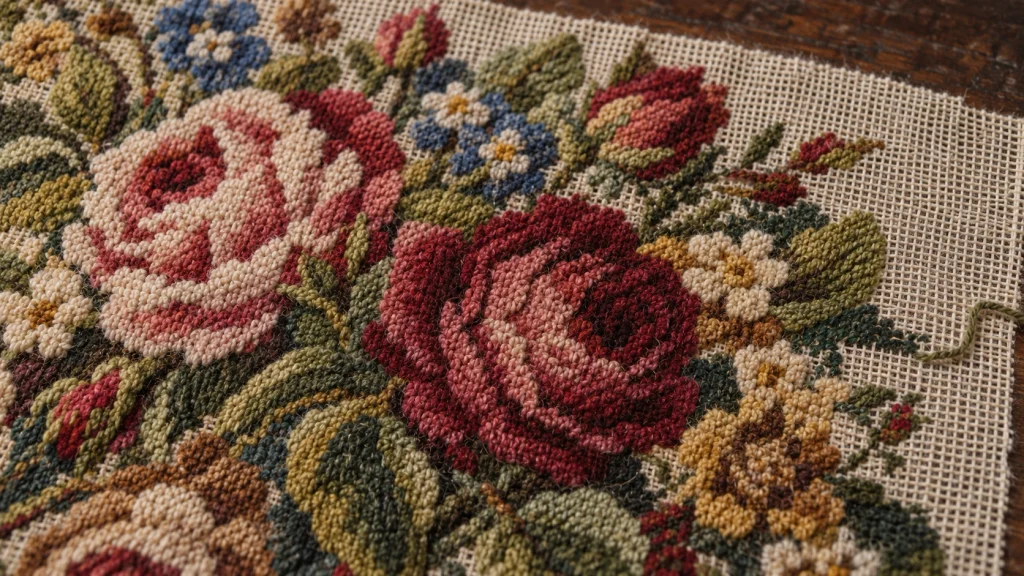
Dating from 1851–1860, this carpet or carriage bag combines Berlin woolwork in brown, blue and beige with navy cotton velvet panels. Berlin woolwork is a form of embroidery in which coloured wool is stitched onto a canvas ground to create a pattern.
The bag also has brown leather handles, a matching leather base supported by six feet, a metal press-and-lock fastening and a glazed-cotton lining.
There is quite a lot of construction involved in what initially appears to be an upholstered rectangle with handles. The leather takes the wear at the carrying points and base, while the patterned wool supplies much of its visual character. The surviving fastening has lost its key; Mary Poppins, meanwhile, puts hers in the lock while answering Michael.
It’s a handsome piece of historical evidence, whatever I think of carpetbags as accessories. It also shows why we shouldn’t assume that every surviving example was simply made by cutting up somebody’s sitting-room carpet.
London Museum records its dimensions as approximately 41 centimetres long, 19.5 centimetres wide and 23 centimetres high, excluding the handles.
Those measurements bring us back to Mary Poppins.
Could a real carpetbag manage an overnight trip?
If the London Museum bag were a perfect rectangular box, its external dimensions would enclose approximately 18.4 litres. The real internal capacity would be smaller because of the thickness, shape and construction of the bag.
That’s a plausible size for modest overnight luggage, depending on what someone needs to carry. The camp-bedstead, naturally, would be staying at home.
Anyone wanting to use a carpetbag today would generally be looking at a twentieth-century vintage example or something made more recently in the traditional style. A mid-Victorian museum piece is hardly the sensible starting point for regular travel.
A broad opening is convenient, but check the handles, fastening and lining before buying a second-hand example.
As for appearance, I think carpetbags are hideous.
I have looked at modern examples online and found a few I can admit are attractive. I’ve even encountered a good-looking one in person. It hasn’t altered my general opinion, and I have absolutely no interest in owning one.
All that busy patterned fabric and contrasting trim is usually far too much for me. I can appreciate the workmanship, understand the historical purpose and still dislike the finished object.
Fortunately, my opinion has no bearing on whether Mary Poppins should carry one. Her bag suits her perfectly. It is conspicuous, rather old-fashioned, packed with peculiarities and thoroughly unwilling to accommodate anybody else’s expectations.
The real versions might manage an overnight stay. Hers allows her to arrive for an entirely new life without leaving anything behind.
Everything except an explanation
Near the end of the first chapter, Travers tells us how the various members of the Banks household feel about Mary Poppins’ arrival.
Mr Banks is pleased that she hasn’t caused a traffic problem requiring him to tip a policeman. Mrs Banks enjoys telling people that her fashionable new nurse refuses to give references. The servants have their own reasons for being satisfied.
Everybody seems to have formed an opinion about Mary Poppins.
The book then closes the chapter with a rather wonderful observation:
“But nobody ever knew what Mary Poppins felt about it, for Mary Poppins never told anything…”
Leave a Reply