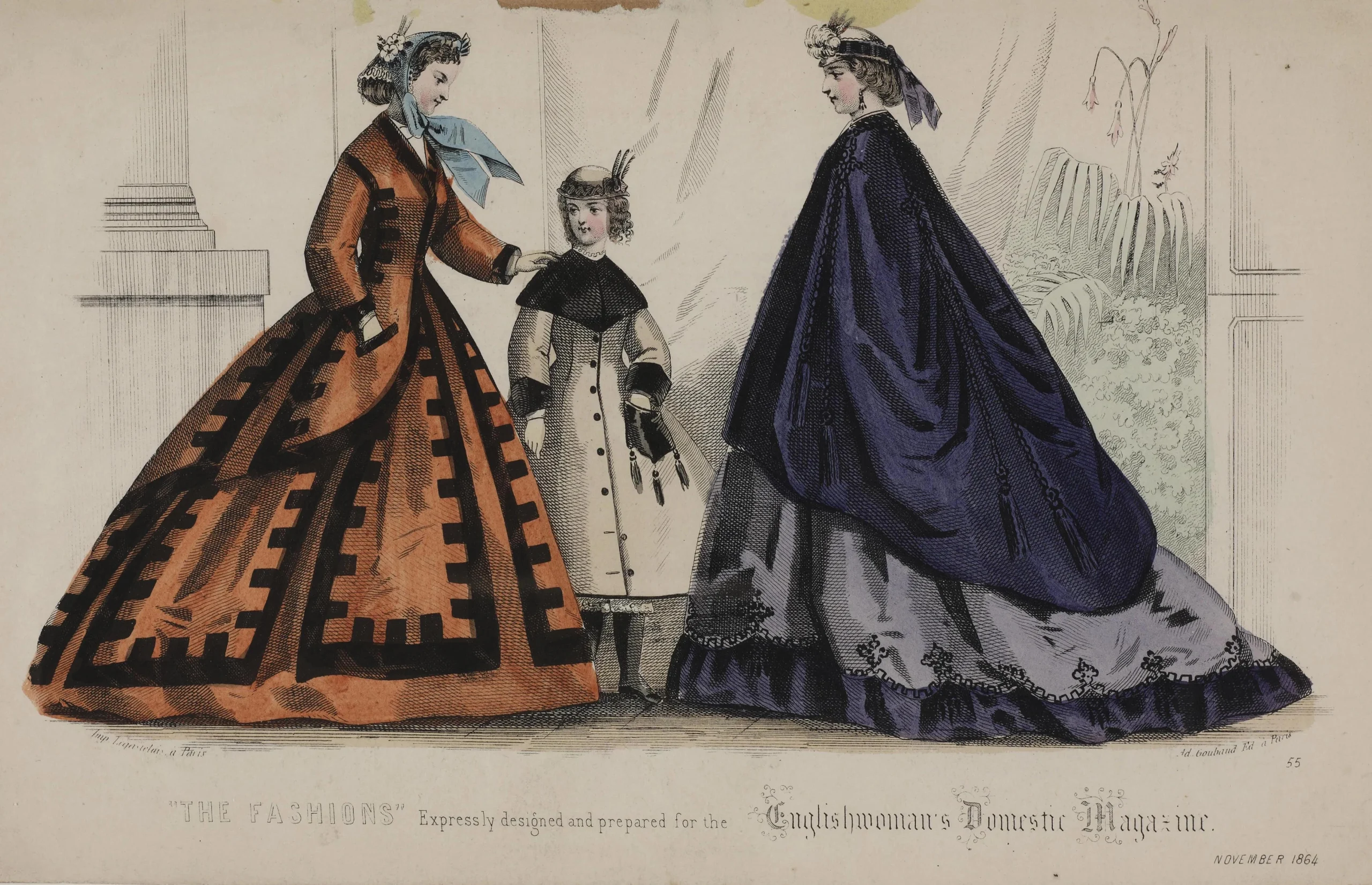
A Victorian woman could have an extraordinary amount of fabric around her legs without wearing an extraordinary number of garments. By 1864, the fashionable skirt was supported by a cage of steel hoops, and much of that magnificent circumference was occupied by air. The dress could fill a doorway rather more confidently than its wearer had intended, but the quantity of fabric tells us surprisingly little about what was underneath.
For a comfortably-off British woman dressing in the winter of 1864, eight indoor garments make a reasonable reconstruction, rising to nine or ten with an additional corset cover or warm petticoat. These figures are assembled from dated period evidence, rather than the recorded wardrobe of one woman.
We will count separate garments worn indoors, treating a pair of stockings as one item and a separately made skirt and bodice as two. Fastenings and footwear are excluded; outdoor clothing comes afterwards. And ten garments worn does not mean ten fabric layers everywhere on the body. A stocking covers the lower leg, a corset covers the torso, and a crinoline holds much of the skirt away from both.
Let’s get her dressed.
Dressing a middle-class woman in winter, 1864
Our example wears a fashionable day dress with a separate skirt and bodice, an arrangement documented by surviving mid-Victorian clothing.
1. The chemise
Running count: 1 garment
The chemise goes against the skin. It is a loose, washable undergarment, generally made of linen or cotton, covering the body beneath the corset.
Its chief advantage is that it can be laundered more readily than the structured clothing above it. Perspiration and ordinary bodily dirt reach the chemise before reaching the corset or dress.
A gown might be admired for its fabric and cut; the garment absorbing a day’s wear underneath was doing a less glamorous and rather more continuous job.
2. Drawers
Running count: 2 garments
Drawers covered the lower body and legs. In the mid-nineteenth century, they were often constructed with separate leg sections and an open crotch, which made considerably more practical sense beneath a large skirt than modern underwear might suggest.
The London Museum preserves cotton drawers dated 1851–60, with a buttoned back flap, tucks and lace frills at the leg ends.
Drawers also mattered because a hooped skirt could shift when its wearer moved or sat down. An enormous circumference was no guarantee that the fabric would remain exactly where she wanted it.
3. Stockings
Running count: 3 garments
Stockings covered the feet and lower legs. They might be cotton, silk or wool, with warmer materials particularly useful in winter.
They were commonly held in place by garters rather than attached suspenders. We count the pair as one item and treat the garters as fastenings.
A woman in an immense skirt could still have relatively little material wrapped closely around her lower legs. The volume above them was largely empty space, and empty space beneath an open framework offered nothing like the insulation of a proper warm petticoat.
4. The corset
Running count: 4 garments
Over the chemise comes the corset, a fitted supporting garment stiffened to establish the fashionable torso shape and help manage clothing fastened around the waist.
In her 1864 book Health and Beauty, the London corset maker Roxey Ann Caplin defended properly fitted corsets while criticising excessive compression. She also promoted a petticoat-suspender attached to her corset as an alternative to hoops. Her commercial interest is worth remembering.
The corset was significant to the silhouette, but it was only one part of the outfit. For the distinctions between stays, corsets and dress bodices, see Corset, Bodice or Stays?.
5. The corset cover
Running count: 4–5 garments
A corset cover is a lightweight garment worn over the corset, concealing its edges and helping prevent its structure from showing through the dress.
The Metropolitan Museum of Art preserves a cotton example dated 1864–68, although it is American.
A separate cover could be useful beneath a lightweight bodice. Our woman’s lined winter day bodice might make it unnecessary, so the running count now shows both possibilities.
6. The flannel petticoat
Running count: 4–6 garments
Flannel is a woollen fabric with a soft, slightly raised surface. A flannel petticoat could provide warmth without requiring the outer dress itself to do all the work.
Janet Arnold’s 1968 article ‘The Cut and Construction of Women’s Dresses c. 1860–1890’, in the journal Costume, reproduces an October 1868 pattern from The Englishwoman’s Domestic Magazine for a white flannel petticoat decorated with scarlet wool stitching.
Here it is an optional winter addition, worn beneath the skirt structure.
There is something almost disappointing about the practicality. A vast skirt might have been a fashionable achievement, but cold legs still required cloth that actually covered them.
7. The cage crinoline
Running count: 5–7 garments
Here comes the piece responsible for the silhouette most people recognise.
The cage crinoline is a framework of steel hoops held in position by tapes, worn beneath the skirt to support its enormous circumference.
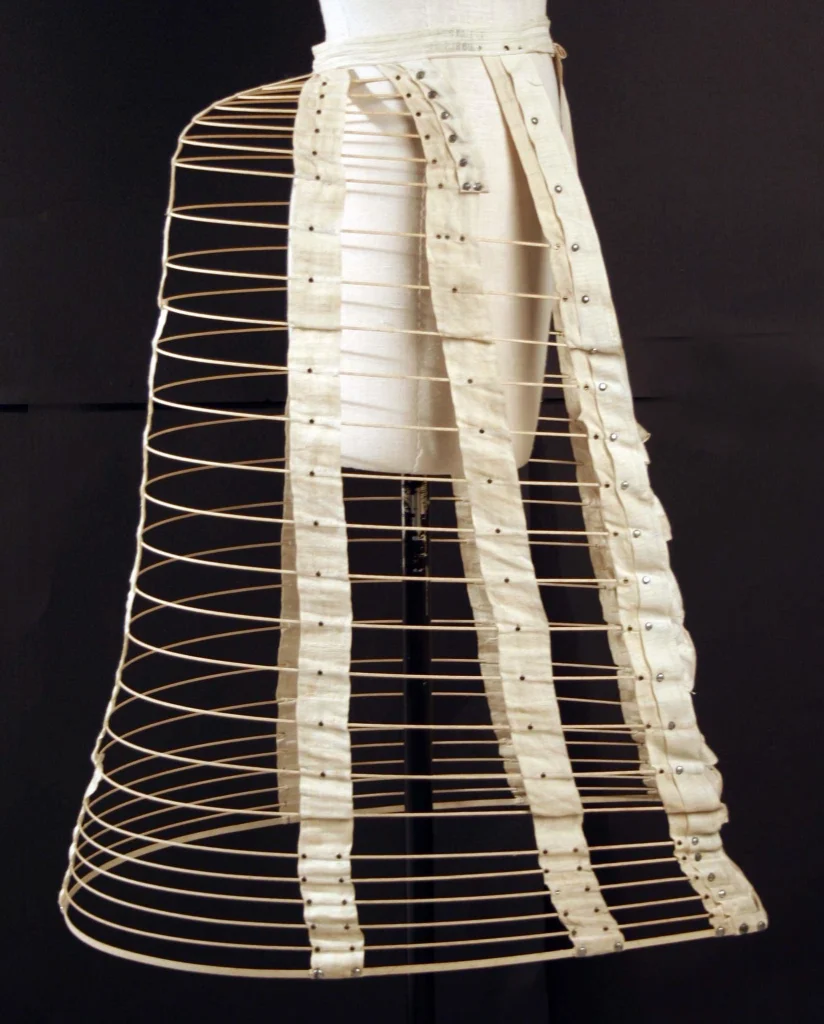
The London Museum has an example made between 1861 and 1865, patented by S. Osborne and called the Imperial Diamond Jupon. North Lincolnshire Museum’s Victorian Vogue explains how cage crinolines, introduced in 1856, displaced the numerous petticoats previously needed to hold out wide skirts.
This is the essential correction to the popular image of Victorian layering.
More volume did not necessarily mean more garments.
The cage increased the space occupied by the dress while reducing the amount of heavy material needed to support it. The fashionable outline could grow larger while the underlying arrangement became lighter.
I find the engineering more interesting than the usual story about women tolerating absurd clothes for fashion. The crinoline created inconveniences of its own, particularly in confined spaces, but it was an ingenious solution to a genuine construction problem: holding out an immense skirt without hanging all the necessary weight directly from the body.
8. The outer petticoat
Running count: 6–8 garments
The cage is in place, but the dress need not sit directly upon its exposed hoops.
A fabric petticoat worn over the framework provides a smoother surface, helping prevent the individual hoops from showing as ridges beneath the dress.
The Metropolitan Museum of Art describes precisely this arrangement in its record for a cage crinoline dating from about 1860: an additional fabric petticoat protected the dress from the metal structure beneath.
For our reconstruction, one outer petticoat does the job.
9. The dress skirt
Running count: 7–9 garments
At last, the garment everyone else will see begins to arrive.
The skirt hangs over the petticoat and crinoline, concealing the machinery beneath it. Its circumference owes more to the width of the supporting hoops than to a solid accumulation of cloth.
North Lincolnshire Museum records surviving 1860s dresses with separate skirts and bodices, including a shot-taffeta wedding dress constructed as distinct pieces.
Our woman has one dress skirt. It counts as one garment however many metres of fabric it contains.
10. The day bodice
Running count: 8–10 garments
The fitted day bodice completes the outfit. Its neckline, sleeves, fastening and shaping establish the upper half of the dress, meeting the skirt at the waist.
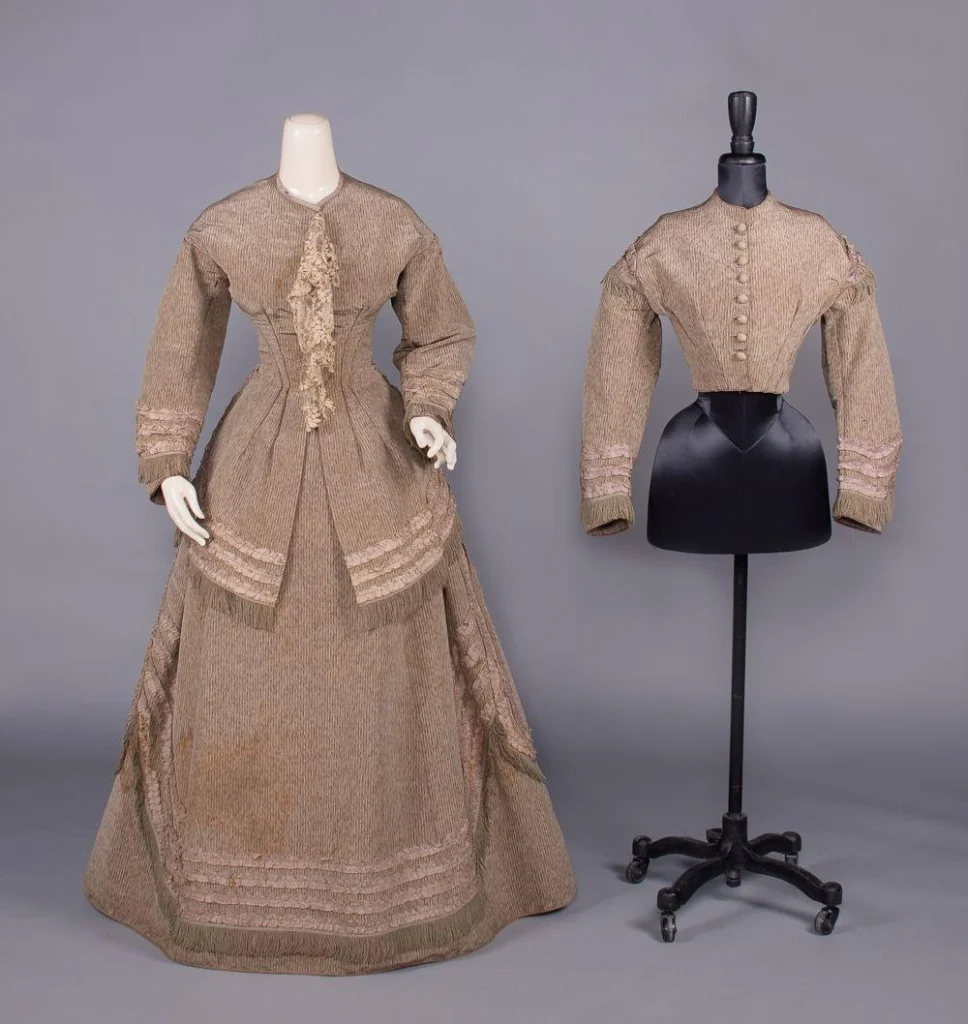
Fashion Museum Bath preserves a particularly useful ensemble from about 1868, with a long-sleeved day bodice and an alternative evening bodice worn with the same skirt.
Changing the bodice could adapt an outfit for a different occasion without requiring another complete skirt. Given the amount of fabric involved in making one, this was hardly a trivial economy.
Our woman is now dressed indoors: eight garments without the optional additions, nine with either the corset cover or extra flannel petticoat, and ten with both.
What changes when she goes outside?
Being dressed for the house in winter was not the same as being dressed for the street.
Our woman could add a mantle or cloak over her day dress. A mantle is an outer covering worn around the shoulders, generally cut to hang over the dress rather than fit closely through conventional coat sleeves.
A closely fitted overcoat would not necessarily be convenient over a crinoline. An ample mantle could accommodate the width without requiring the wearer to compress her skirt every time she put it on.
Contemporary designs for cloaks and mantles appear in Victorian fashion publications, including the 1864 autumn and winter fashion illustration preserved by the London Picture Archive.
Giving our woman one mantle brings the substantial garment count to nine to eleven, with bonnet, gloves and other accessories considered separately.
She may look thoroughly enveloped. Whether she is warm enough depends upon where the cloth actually is.
A housemaid dresses for work in the 1880s
Now change the woman.
Our second example is a housemaid in a British household employing a cook and a housemaid, an arrangement described in the approximately 1880s edition of Cassell’s Household Guide.
This comparison changes decade as well as class, so we cannot attribute every difference to social position alone.
The maid’s clothes must accommodate cleaning, carrying, stooping, using the stairs and appearing before the family. The household’s requirements are not necessarily her personal preferences.
Manchester’s Gallery of Costume collection at Platt Hall offers a useful social-history perspective. Its Cunnington Collection was assembled to examine nineteenth-century clothing in everyday life, rather than concentrating exclusively on fashionable masterpieces.
The chemise, drawers and stockings
A housemaid might wear separate chemise and drawers, together with stockings, but there was another possibility.
A combination joined chemise and drawers into a single garment, reducing bulk at the waist. Staffordshire Past Track records surviving combinations dated approximately 1870–1900.
A maid wearing separate chemise and drawers would therefore have one more garment than somebody using a combination.
The corset and petticoat
A corset remained familiar in the 1880s, although a working woman’s activities and means could affect what she chose. Beneath her dress, a petticoat provided coverage and helped the skirt hang properly.
For this reconstruction, assume one corset and one petticoat. A fashionable bustle, which projected the skirt’s fullness at the back, is not automatically included merely because it belonged to the decade.
The washable morning gown
Cassell’s Household Guide recommends washable clothing for housemaids’ morning work. The dress must survive the dirt and movement involved in cleaning rooms, making beds and carrying things around the house.
For winter afternoons, the guide recommends dark or black French twill dresses. Twill is a weave distinguished by diagonal ribs, although the term alone does not tell us the precise fibre of the dress.
A housemaid might therefore change her outer dress during the day. That replaces a garment rather than necessarily increasing the number she wears at once.
Our morning reconstruction uses one washable working gown.
The clean white apron
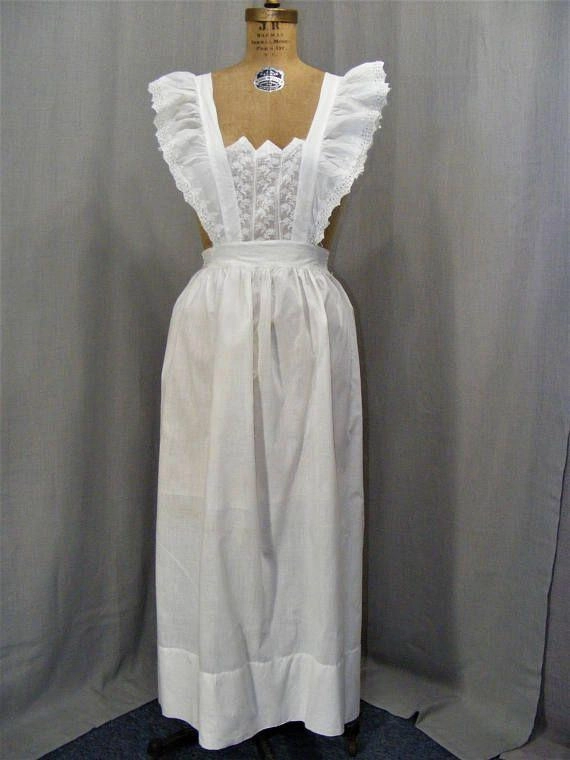
Over the working dress comes a white apron.
Cassell recommends white aprons for servants answering the door and waiting at table. They protect the dress, but also establish the appearance expected of a woman serving in the household.
A clean apron allows an otherwise serviceable dress to remain in use without being changed whenever its wearer needs to look tidy.
The interesting part is that the guide goes further. The clean apron does not have to remain the outermost garment during work.
The wide holland apron
Holland was originally a closely woven, plain-weave linen cloth; by the later nineteenth century the name also covered certain glazed cotton fabrics. The Getty Research Institute’s textile terminology records that change.
Cassell recommends a wide holland apron over the white apron during house-cleaning.
That word over is doing an enormous amount of work.
The maid wears two aprons at once. The outer one takes the dust and dirt of bed-making and cleaning. The white apron stays underneath, available when she must appear before the family.
Rather than changing her entire dress, she can remove the dirty covering and become presentable.
It is an unusually precise piece of clothing advice, and an admission that the work itself is dirty enough to require a removable defence.
The spotless maid’s apron beloved of costume departments and sentimental household imagery gives us only half the arrangement.
Taking one apron off
Imagine the housemaid cleaning a bedroom when she is called to the front door.
The household manual has already accounted for the problem. She removes the holland apron, leaving the white one showing.
She has not changed her chemise, corset, petticoat or working gown. She has removed one garment.
The clean apron is part of an efficient method for moving between dirty work and the presentation required by the household.
The social expectation is hardly difficult to read. The work must be done, but its dirt must disappear when she appears upstairs or at the front door.
The cap and the winter street
Cassell also recommends a neat white crochet cap throughout the year. Crochet makes fabric from interlocking loops of yarn formed with a hooked needle.
The cap adds another visible garment to the indoor outfit. Its role concerns neatness and household position more than winter warmth.
When the maid leaves the house, she may need additional clothing suited to the weather. The manual does not supply a complete street outfit, however, and I would rather leave that total open than equip her with an invented coat, shawl, bonnet and gloves merely to produce a pleasingly symmetrical comparison.
Cassell specifies four visible garments in its recommended morning cleaning arrangement: gown, white apron, holland apron and cap. The number falls to three when the outer apron comes off.
Add stockings, a corset, one petticoat and either a chemise with drawers or a combination, and our fuller reconstruction reaches eight or nine garments during cleaning, falling to seven or eight after the holland apron is removed. This assumes a one-piece working gown and no additional winter underwear or bustle.
So how many layers did Victorian women wear?
For our chosen middle-class woman in 1864, the reconstructed indoor count is eight to ten garments. A mantle adds one substantial outdoor item, with headwear and other accessories considered separately.
For the 1880s housemaid, Cassell securely identifies four visible working garments in its recommended cleaning arrangement, while a fuller outfit of eight or nine depends on stated underclothing assumptions. Removing the outer apron reduces either tally by one.
Neither figure measures how many thicknesses of fabric cover any single part of the body.
The 1864 crinoline explains why a spectacular skirt could contain so much empty space. The housemaid’s apron arrangement explains something equally revealing: how a small change in clothing could mark a change in duties.
One woman puts on a structure to hold her dress away from her legs. The other has a protective layer designed to come off the moment the household wants her looking clean.
Leave a Reply