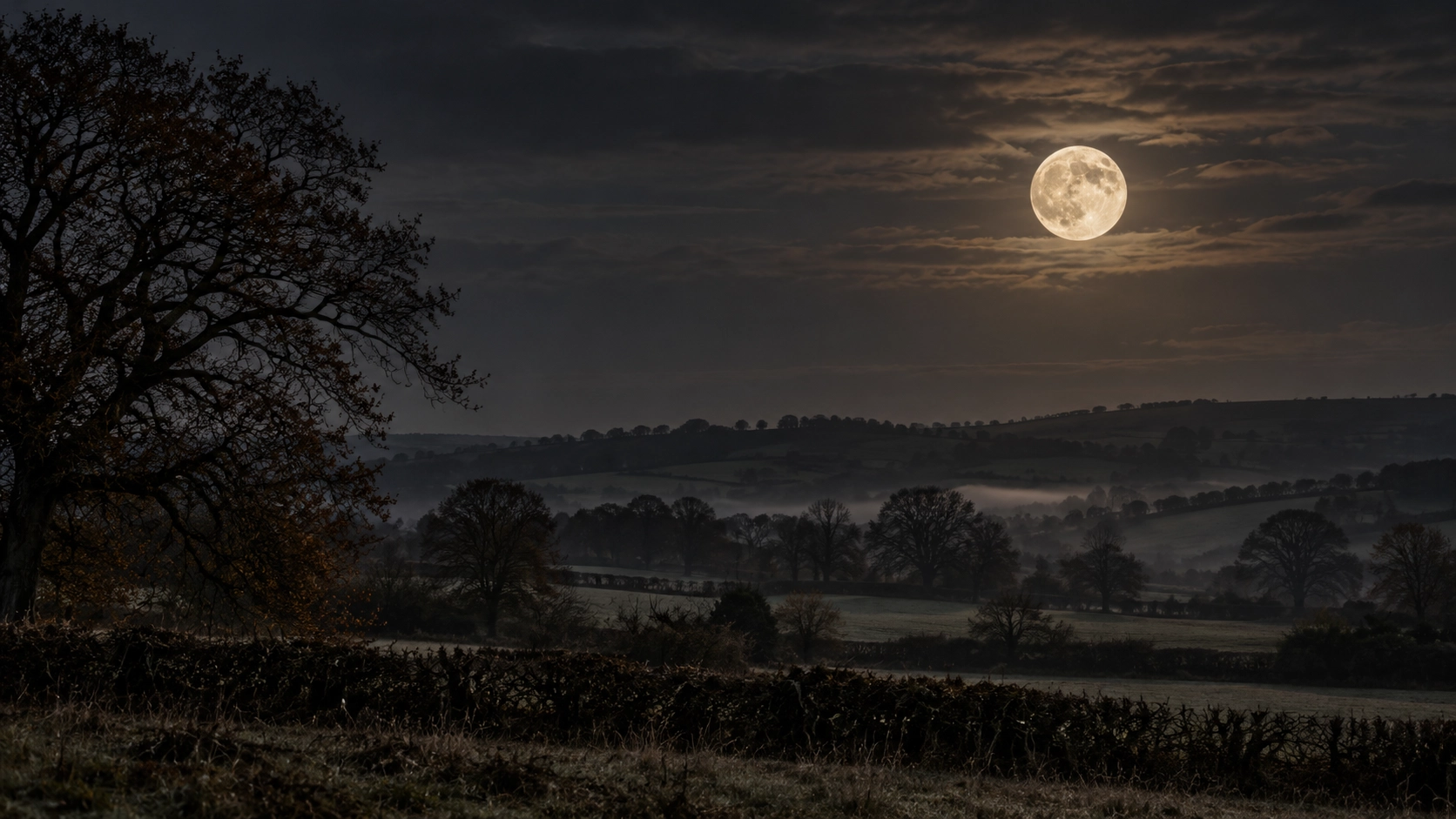
At 4.12am on Monday 26 October, the Moon will be full over Britain. The Royal Observatory Greenwich calls it the Hunter’s Moon, a name that sounds as though it ought to come with a woodland ceremony, several generations of inherited wisdom and someone wearing antlers.
It has a rather more interesting paper trail.
In 1710, the London periodical The British Apollo printed a remark about the autumn Moon which the Oxford English Dictionary preserves in its historical citations:
“The Country People call this the Hunters-Moon.”
There is no named inventor. The publication was reporting an expression already attributed to rural speakers. Whoever answered the question evidently expected readers to recognise that country people had names for things which did not necessarily appear in learned astronomy.
The Hunter’s Moon was in English print more than three centuries ago, and somebody thought the name belonged to the countryside.
Its companion, the Harvest Moon, was also in English print by the early eighteenth century. These names belong to a recognisable British tradition, though their appearance in English print does not prove that equivalent names were absent elsewhere.
Their dates follow the season. The Harvest Moon is the full Moon nearest the autumn equinox. The Hunter’s Moon comes next. In 2026 those dates are 26 September and 26 October respectively. In another year, the Hunter’s Moon may arrive in November.
So Monday’s name has a British history of its own. How it came to share a calendar with the Worm Moon, Strawberry Moon and Beaver Moon requires a journey through several books, and some remarkably confident editorial decisions.
Jonathan Carver reports a different calendar in 1778
In 1778, Jonathan Carver published Travels Through the Interior Parts of North-America, describing his journeys through the Great Lakes region and northern Mississippi valley during the 1760s.
Carver had encountered several Indigenous peoples, but his chapter on reckoning time does not identify which particular community supplied each moon name. His book is evidence of what Carver reported, rather than a definitive record of any one nation’s calendar.
His list nevertheless contains familiar names. March is the Worm Moon, August the Sturgeon Moon and November the Beaver Moon.
The Worm Moon is particularly revealing. In Carver’s account, its name concerns creatures emerging from winter shelter in the bark of trees and wood. That is more specific than the familiar modern explanation about earthworms returning to thawing soil.
Then the dates begin to misbehave.
Carver gives October as:
“the Travelling Moon”
He associates the name with people leaving their villages for the places where they intended to hunt during winter.
December, meanwhile, is:
“the Hunting Moon”
His Hunting Moon therefore sits two months later than Monday’s Hunter’s Moon.
Those names describe identifiable activities within Carver’s account. Travelling refers to seasonal movement between settlements; hunting describes an occupation associated with another part of the year. The months themselves are reckoned through lunar cycles, although Carver presents the names alongside familiar English month labels.
The material had travelled from communities living by their own reckonings of the seasons into an English book, where its original geography was already difficult to recover.
Daniel Carter Beard strikes an average
By 1918, Daniel Carter Beard had a different purpose in mind.
Beard was an American outdoorsman, illustrator and influential figure in the early scouting movement. His American Boys’ Book of Signs, Signals and Symbols brought together signs, codes, ways of marking time and other material intended to be useful to young people learning outdoors.
On page 79, under the heading Signs for the Indian Seasons, Beard acknowledges that moon names vary between regions. His solution is wonderfully revealing:
“by comparing them all and striking an average as near as may be”
He then presents a consolidated list.
An average is a useful thing when measuring temperatures or calculating how much something costs. As a method of recording cultural names, it is rather more adventurous.
For October, Beard gives:
“Moon of Leaf Falling, Nuts Moon.”
He places a Moon of Harvest in August, a Moon of Wild Rice in September and a Moon of Deer Mating in November.
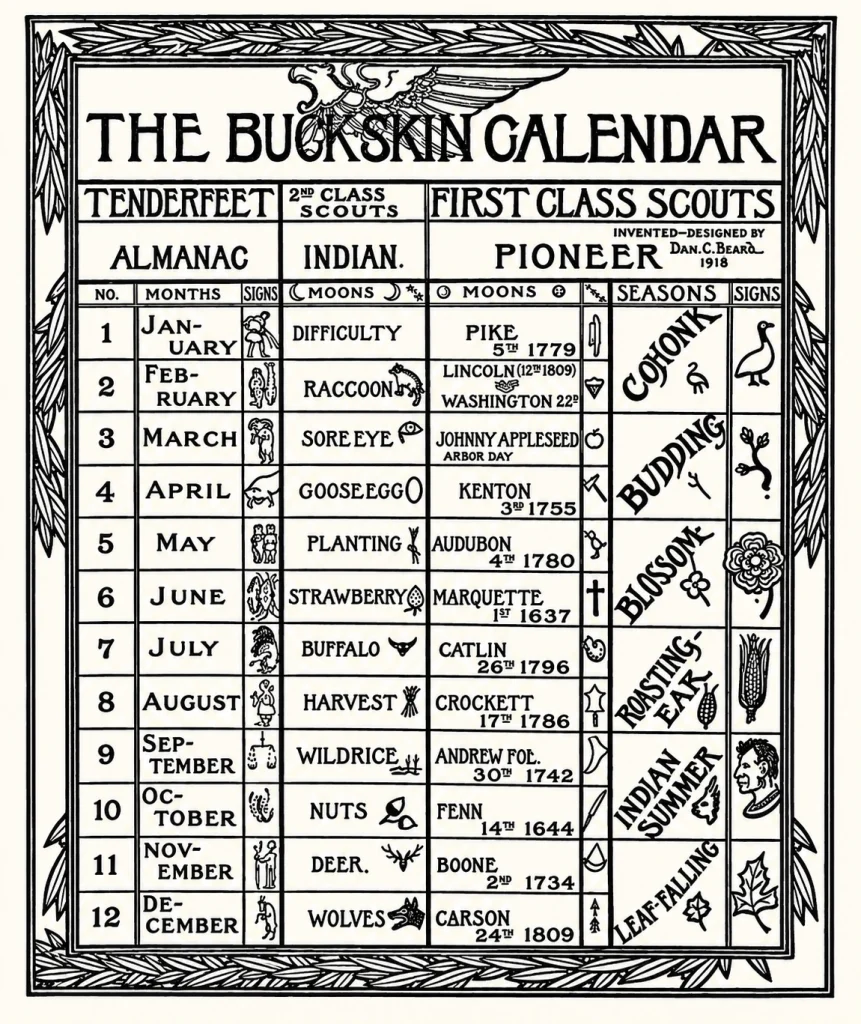
The result is not Carver’s list. Beard was choosing and combining reported names to construct something his readers could use.
It matters that this appeared in a scouting handbook. A child could learn the names as practical outdoor knowledge without remembering the sentence about averaging them. The selection might eventually be repeated without the explanation of how it was assembled.
I encountered another version of that process while investigating the Wulver in my bestiary. The Shetland wolf-man acquired the appearance of inherited folklore through repetition, although the creature’s documented origin lay with a twentieth-century writer. Beard’s moon names are a different case, rooted in reported traditions, but printing and repetition can make an editorial decision look older and more settled than it is.
At least Beard showed his working.
A name can survive without keeping the same month
There are better ways to see what happens to these traditions than trying to recover every name through eighteenth- and nineteenth-century English-language collectors.
Ojibwe.net’s Moons & Days gives names used across different Anishinaabe communities, distinguishing western and eastern dialects and recording regional variations.
Among its October entries is Binaakwe-giizis, translated as Falling Leaves Moon. An eastern-dialect entry also gives Bnaakwii-giizis as Harvest Moon.
The resource explicitly acknowledges that the names differ according to community, environment and activity. Its thirteenth moon can fall at different points in different years.
A lunar month is the period between successive occurrences of the same Moon phase, roughly 29½ days. It does not fit neatly into the Gregorian calendar’s twelve months.
The distinction helps explain why similar English translations need not refer to the same tradition. Carver’s Hunting Moon, Beard’s Moon of Deer Mating and Monday’s Hunter’s Moon can all concern the seasonal relationship between people, animals and hunting. Similar subjects do not establish identical origins.
The names are more interesting when their particular histories remain attached.
The almanacs put names on the calendar
The next important handlers of these names were almanac publishers.
An almanac is an annual reference book combining calendars, astronomical information and other practical material. Moon phases have an obvious place in one: they can be predicted and printed long before the year begins.
Moon names fit naturally beside them.
The Maine Farmers’ Almanac of 1937 printed a seasonal sequence that included the Harvest Moon and Hunter’s Moon. It attributed those names to “our early English ancestors”.
That is worth noticing. This particular almanac presented its names as English tradition, while other publications and compilers were circulating names attributed, with varying degrees of precision, to Indigenous peoples in North America.
The modern Old Farmer’s Almanac, a separate publication from the Maine Farmers’ Almanac, publishes a familiar month-by-month list alongside numerous alternatives attributed to particular peoples. Several of its names match Carver’s, including the Worm Moon, Sturgeon Moon and Beaver Moon.
The publications had performed different jobs. Carver reported names. Beard selected and combined them. Almanac editors printed names beside astronomical dates, giving them the convenient shape of an annual reference.
And then one writer managed to change the meaning of a name by misunderstanding a previous almanac.
James Hugh Pruett and the Blue Moon mistake
A Blue Moon now commonly means the second full Moon in a calendar month. There is another definition: the third full Moon in an astronomical season containing four.
Both are in use, and their coexistence has a very particular history.
The Maine Farmers’ Almanac used the seasonal definition. Most astronomical seasons contain three full Moons, but occasionally one contains four. Under the almanac’s system, the third received the designation Blue Moon, preserving the positions of the other seasonal names.
The 1937 edition identified 21 August as a Blue Moon.
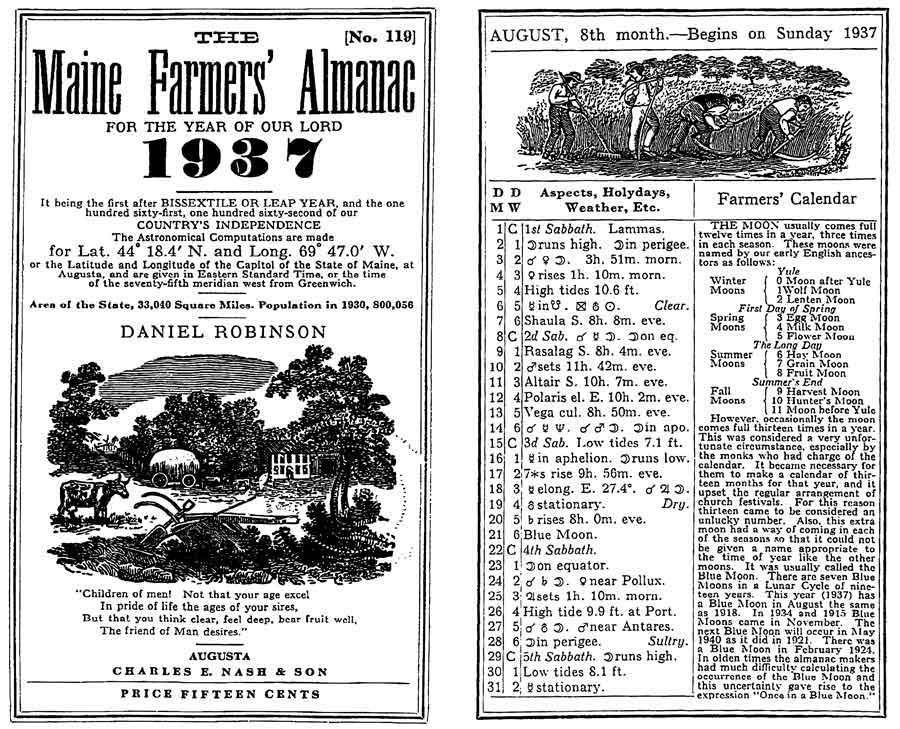
In July 1943, Laurence J. Lafleur discussed Blue Moons in Sky & Telescope, referring to that almanac. His explanation mentioned years containing thirteen full Moons but did not clearly establish how the Blue Moon was selected.
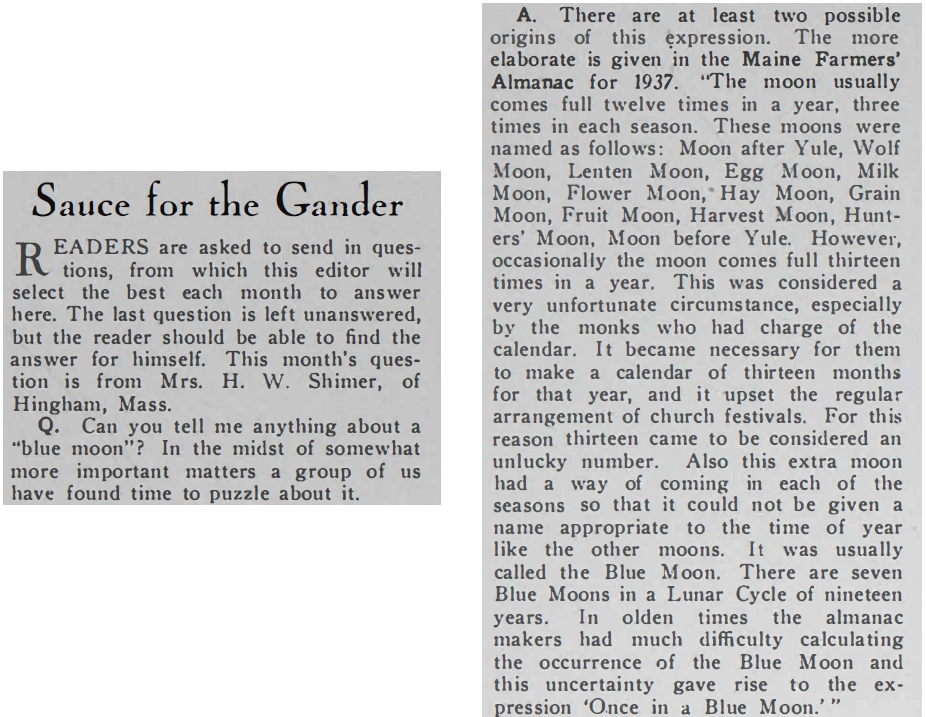
Three years later, James Hugh Pruett took up the subject in the March 1946 issue of the same magazine. His article, Once in a Blue Moon, considered what happened when thirteen full Moons occurred in a year.
He reasoned that one calendar month would have to contain two full Moons. Then came the crucial phrase:
“This second in a month, so I interpret it, was called Blue Moon”
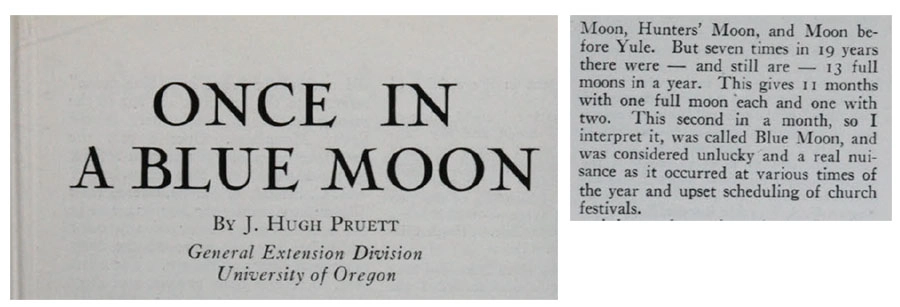
That interpretation was wrong as an account of the Maine almanac’s method.
There is something magnificent about the small qualification so I interpret it. Pruett was making an inference, and he said so. The phrase did not prevent the inference from travelling considerably further than the original explanation.
On 31 January 1980, Deborah Byrd repeated the second-in-a-month meaning on the radio programme StarDate. The definition circulated widely, and by 1999 Sky & Telescope was publicly explaining how its own pages had helped create the confusion.
The magazine’s later investigation, assisted by folklorist Philip Hiscock and astronomer Donald W. Olson, traced the misunderstanding through the earlier publications. Sky & Telescope now explains both definitions, acknowledging the part its 1946 article played.
A misunderstanding that enters ordinary usage does not vanish when its source is corrected. Both Blue Moon definitions remain established conventions.
But the detail I keep coming back to is the date in the 1937 almanac.
Its Blue Moon occurred on 21 August. It could not possibly have been the second full Moon of that calendar month. The evidence against Pruett’s interpretation was sitting in the publication he was trying to explain.
He had given the Moon a new appointment without checking its diary.
Leave a Reply