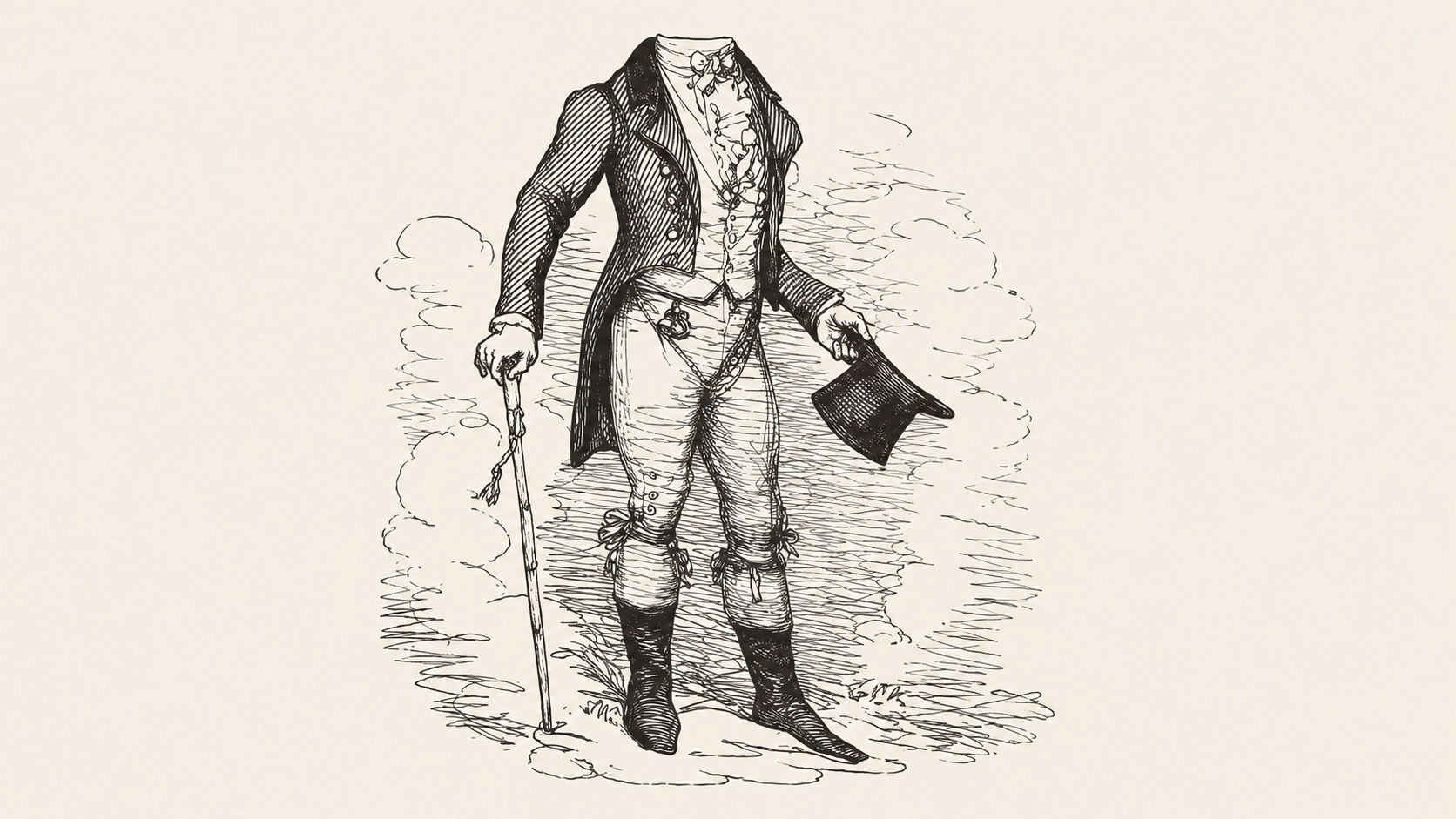
George Cruikshank had a question he wanted somebody to put to the next ghost they encountered: “Who’s your tailor?”
I like to think that if I ever encounter an apparition, I shall have rather more immediate concerns. But Cruikshank was an illustrator, and he had noticed something about the supernatural that apparently troubled him more than the prospect of a dead person entering his bedroom.
The dead kept their clothes.
In his 1863 pamphlet, A Discovery Concerning Ghosts, Cruikshank argued that ghost stories contained an absurdity so fundamental that exposing it would dispose of the entire business. A human spirit might be difficult to explain, but that was nothing compared with the difficulty of explaining its waistcoat.
He pursued this argument through reported apparitions, familiar ghost stories and his own illustrations. By the time he had finished, the afterlife required an extensive manufacturing industry, several specialist trades and a stock of supernatural stockings.
I have considerable sympathy for his irritation. If an apparition insists on being recognised by its clothes, I think we are entitled to inspect them.
Exhibits for the defence
Before Cruikshank begins pulling the garments apart, we ought to establish what the supposed ghosts were wearing. The reports are rather more precise than the familiar figure in a bedsheet suggests.
Exhibit A: The winding-sheet
Cruikshank begins by summoning an imaginary army of ghosts, complete with pale faces and white shrouds.
A winding-sheet is cloth used to wrap a body for burial. As historian Shane McCorristine explains, its association with ghosts connects the apparition to the corpse. The spirit appears carrying a visible reminder of death.
There is a sort of logic to that, especially in older stories where the dead return to deliver a warning or demand something from the living. The shroud establishes who has crossed the boundary. It is practically an introduction.
Exhibit B: Monsieur Caron’s formidable wardrobe
Cruikshank reproduces an account from Robert Dale Owen concerning Baron de Guldenstubbé, who reportedly encountered an apparition in Paris.
The figure appeared out of a greyish vapour, gradually becoming a substantial-looking older gentleman with white hair and whiskers. He wore a white cravat, a long white waistcoat, a high stiff shirt collar and a black frock coat. The cravat was a cloth neckband tied at the throat; the frock coat was a long-skirted, fitted coat worn as respectable daytime dress.
The apparition also leaned on a heavy white cane.
The account identified the figure afterwards as Monsieur Caron, a previous occupant of the property. Owen considered the precise details of appearance and dress significant evidence for the identification.
Cruikshank was especially interested in the cane. If the apparition eventually disappeared, what happened to the walking stick? Had it gone wherever the spirit went? Did it require separate arrangements?
The waistcoat had already caused enough trouble. The cane made things considerably worse.
Exhibit C: The housemaid in the sprigged cotton dress
Our final witness comes from a later report, first published in the Proceedings of the Society for Psychical Research in 1885, pages 106–109.
Kathleen Leigh Hunt described seeing a figure she initially took for a housemaid. She saw it from behind, so the face offered no help. What caught her attention was an ordinary servant’s appearance: a white cap and a light cotton dress, with what she described as “a white ground, with a spriggy pattern all over it”.
A sprigged pattern consists of small, scattered motifs, often floral. It is exactly the sort of detail I would look for when examining an old printed cotton dress, although in this case there was no garment available for inspection.
Leigh Hunt specifically distinguished the figure from the cook, who wore much darker cottons and was smaller. She subsequently described a second sighting and reported that the housemaid had denied being where the figure appeared.
The account concerns experiences long after Cruikshank’s pamphlet was published. He never had the opportunity to cross-examine this witness himself.
I suspect he would have enjoyed it enormously.
Objection one: Does a coat have a soul?
Cruikshank’s complaint begins with the distinction between a person and everything that person happens to be wearing.
A face, he reasons, might reasonably be associated with an individual spirit. The same argument becomes much harder when extended to a frock coat, waistcoat, shirt collar and cane.
Clothing is manufactured. The wool came from somewhere. Somebody spun, wove, cut, pressed and stitched it. Buttons were fitted. The finished garment might subsequently have been repaired, altered or given away.
At which stage did any of this become immortal?
Cruikshank asks whether clothes become part of our souls. The implication is wonderfully inconvenient. If a person can return after death with their complete outfit, either garments possess some spiritual existence of their own or the spirit has acquired an entirely new set.
Neither explanation appealed to him.
He illustrates the problem with a reported apparition of a headless gentleman in a blue coat with bright gilt buttons. Cruikshank draws him complete with boots, stockings, a hat and a walking stick. There is no face to recognise, yet practically the entire figure remains visible. Cruikshank’s verdict is that the supposed apparition amounts to a suit of clothes. The drawing at the top of this page makes his case rather efficiently: remove the person, and an astonishing amount of gentleman remains.
The shroud raises the same difficulty in a slightly different form. It is associated with the dead body rather than the person’s everyday identity, but it remains cloth. Wrapping a corpse in linen does not explain how linen could subsequently walk about without it.
Cruikshank was quite determined that the dead should not be allowed to smuggle ordinary textile production into the spiritual realm.
Objection two: Somebody else might have the trousers
Cruikshank makes an even more awkward observation when he considers what happens to clothing after its owner dies.
He refers to Daniel Defoe’s writings on apparitions and objects to accounts in which ghosts appear wearing garments that have since been cut up, passed to other people, destroyed or left hanging in wardrobes.
Imagine a deceased gentleman returning in his familiar coat. Meanwhile, his surviving relatives have sensibly distributed his possessions, and somebody else is wearing that very coat to dinner.
We now have two coats. One is a perfectly ordinary garment with a new owner. The other apparently belongs to somebody who has been dead for several years.
This is quite a demanding arrangement for the tailoring profession.
Cruikshank’s objection reaches beyond the existence of spectral fabric. It concerns the identity of the object. Does the dead man retain the coat itself, somehow duplicated? Does he wear an imitation formed from spiritual material? Or does the apparition reproduce the garment through some process that produces a convincing copy?
None of these arrangements is especially economical. The first requires a coat to exist in two places at once. The second requires materials that nobody has satisfactorily accounted for. The third merely leaves us asking how the copy was made.
Objection three: The supernatural tailoring trade
Here the pamphlet becomes magnificent.
Having established that a ghost cannot simply take its earthly garments along, Cruikshank considers the possibility that spirits have clothing made for them elsewhere.
That requires materials. Spiritual wool, spiritual leather, spectral buckles and buttons. Somebody must prepare the fibres, spin the yarn and weave the cloth. Somebody must cut the patterns and assemble the garments.
A gentleman expecting to appear in a properly fitted coat will require considerably more than an agreeable mist.
Cruikshank imagines supernatural shops supplying the dead with their outfits. He develops the idea into a complete series of trades, including tailors, hatters, bootmakers and button makers.
His concern extends to the tools.
There must be needles, thread, pressing equipment and the iron traditionally called a tailor’s goose — a heavy iron used to press cloth and seams. Cruikshank is particularly delighted by the prospect of a ghostly version of one.
He has found a fault in the metaphysics of apparitions and responded by conducting a workplace inspection.
Then come the stockings.
Cruikshank objects to the idea of a respectable lady appearing before company without the appropriate footwear. Social decency apparently survives death, and with it the obligation to maintain one’s hosiery.
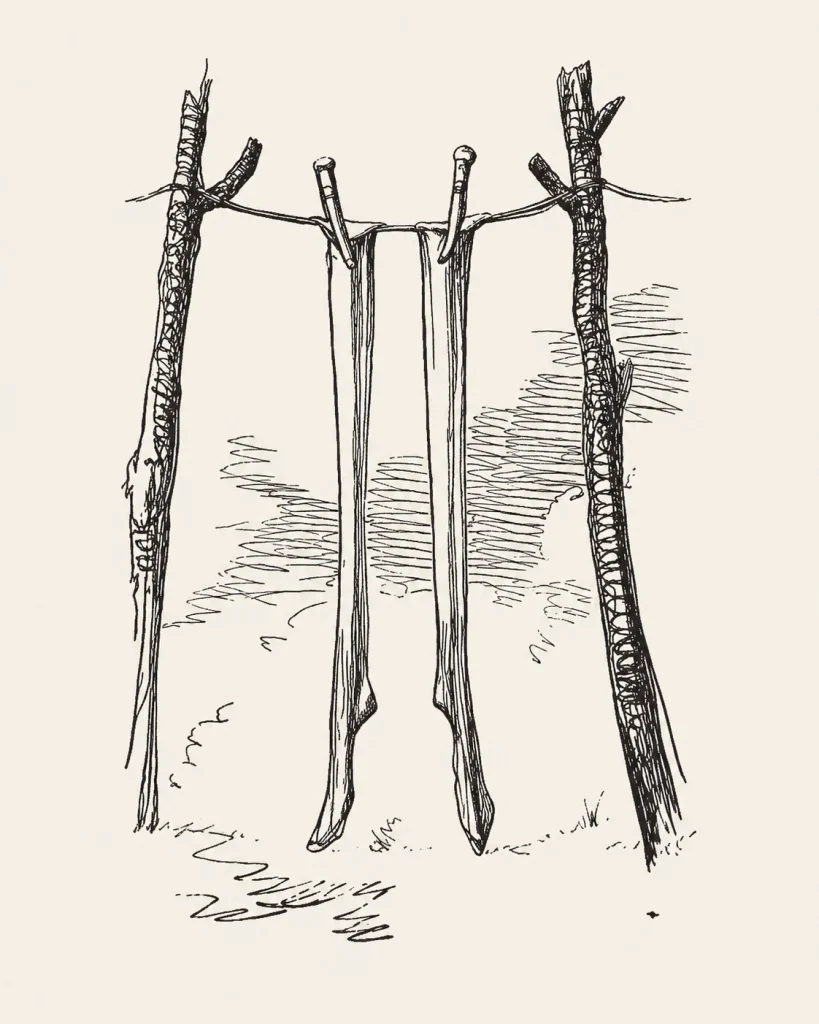
His emphatic conclusion is that there must be “GHOSTS OF STOCKINGS”.
He supplies an illustration of two stockings hanging on a line, which is probably the least frightening supernatural manifestation ever committed to print.
I admire the commitment to the argument. Plenty of sceptics would have considered the spiritual nature of clothing, found it implausible and moved on. Cruikshank requires the entire supply chain to report for questioning.
Yet buried in the comedy is a genuine philosophical difficulty. If a ghost has a physical appearance, but cannot be made of ordinary physical matter, what exactly are we claiming exists?
The witness has a clothing problem too
There is another possibility, and it does not require a single supernatural stocking.
Perhaps the clothes belong to the experience of seeing the ghost, rather than to an independently existing figure.
McCorristine discusses this through the history of ghost-seeing, including nineteenth-century explanations that compared apparitions with dreams or other mental images. In 1897 the writer and folklorist Andrew Lang argued that people generally appear clothed in dreams, and suggested that waking apparitions might follow a similar pattern.
I am not convinced that nineteenth-century assumptions about what people dream of should settle the matter. But the broader possibility is important: a person might experience a recognisably dressed figure without its clothes having any separate material existence.
Kathleen Leigh Hunt’s report shows why that distinction matters.
Her initial identification depended heavily on dress. She could not see the figure’s face, but its white cap, light patterned cotton and general appearance suggested the housemaid. The cook’s darker clothes and different stature helped her reject that alternative.
During our Edinburgh ghost tour, other visitors reported a crouching figure in a vault corner where I saw nothing at all. Leigh Hunt’s account offers the opposite sort of description: a figure with enough clothing detail to suggest an identity before its face was even visible.
McCorristine draws attention to the way clothing identified occupation and social position in Victorian reports. It supplied information before anybody spoke or turned around.
A dress can make a person recognisable from behind. A uniform can identify a job. A familiar coat can suggest somebody we know before we have properly seen their face. Our minds already use clothes to make remarkably quick identifications in ordinary life.
An apparition described in the same way may tell us something about those habits of recognition.
The verdict on the ghost’s wardrobe
Cruikshank believed his clothing argument had demolished ghosts altogether. I think he was entitled to be pleased with the amount of trouble he had caused, although his conclusion goes further than his evidence permits.
If a ghost is supposed to be a physical visitor wearing actual garments, his objections are substantial. A coat needs an explanation. So do the buttons, stockings and walking stick.
If the ghost is instead a vision, dreamlike experience or appearance created in the witness’s mind, the argument changes. We can investigate why the figure was dressed as it was without requiring its clothes to possess souls.
But before anybody declares the case closed, I would still like to know what became of Monsieur Caron’s cane.
Leave a Reply