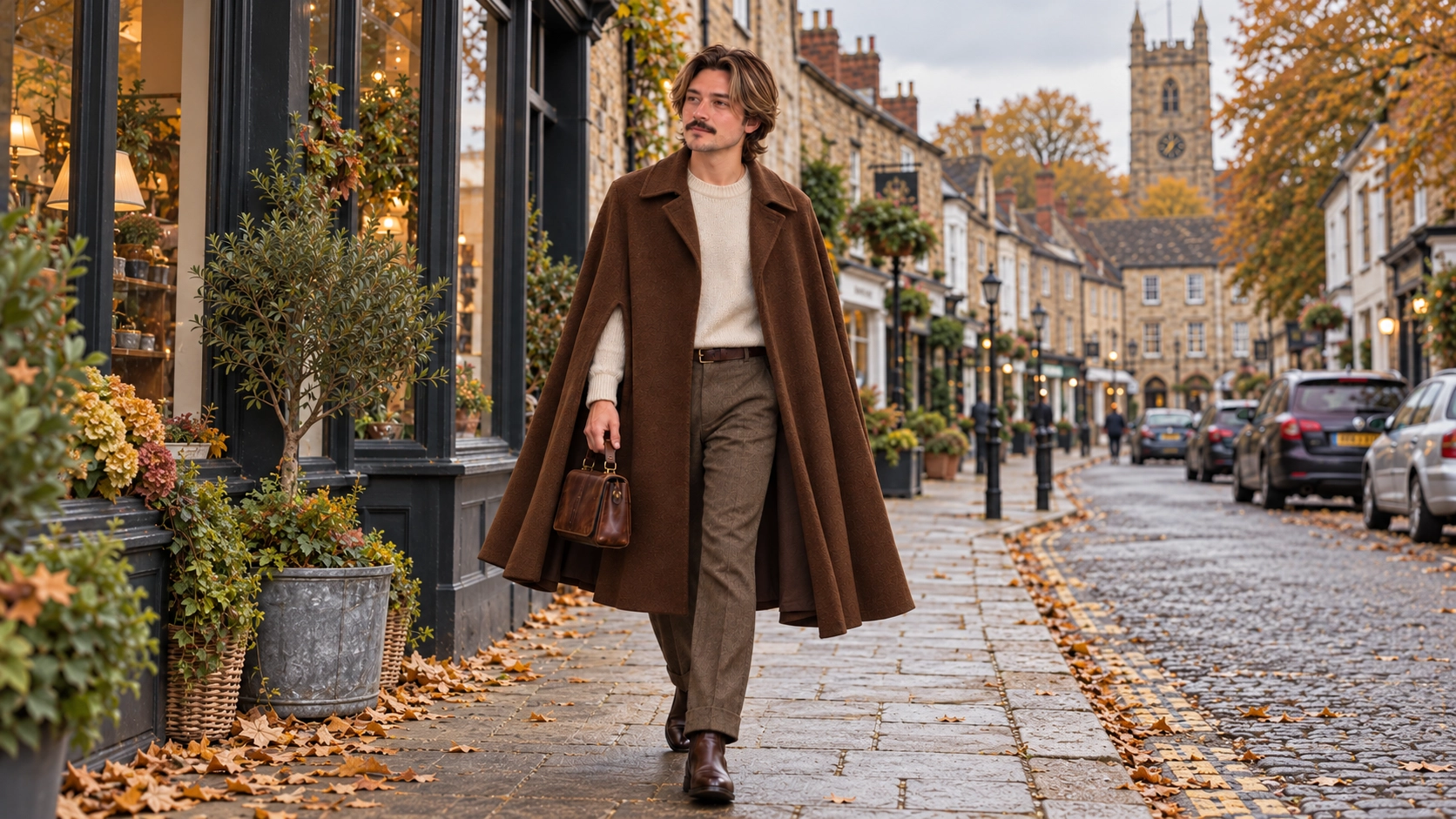
I would absolutely wear a cape to the shops. I like the sweep of the cloth, the shape it makes around the shoulders and the rather extravagant amount of fabric involved. I have no intention of apologising for any of that. I would, however, like to be able to get my purse out without conducting a minor rescue operation inside my own clothing.
My piece on Dracula’s wardrobe ended with the stage cape, where a great flourish of fabric is rather the point. An everyday cape has a less glamorous set of responsibilities. It must let its wearer reach for things, carry a bag, walk into the wind and get through an ordinary autumn afternoon without needing a stagehand.
I want one that moves freely when I walk and falls properly when I stand still. I would carry a small handled bag in my hand, leaving the cloth to hang from my shoulders without a strap dragging it across my chest. The design of the cape itself decides whether that arrangement is elegant or intensely annoying.
Cape, cloak or caped coat?
The terminology is less tidy than modern shopping descriptions suggest.
A cloak generally covers much of the body, hanging from the shoulders without fitted sleeves. It can be wrapped around the wearer, drawn across the front or thrown back to free an arm. A cape is usually shorter or less enveloping, although historical examples do not obey one universal length rule.
The International Council of Museums’ costume cataloguing vocabulary makes a useful distinction between garments with no shaping for the arms and those with partial shaping. It places the Inverness cape among the latter.
Then there are caped coats: garments with a more tailored body beneath an additional layer of cloth over the shoulders. Some have conventional sleeves; others provide openings through which the arms emerge.
These differences matter more than the name on a listing. A seller may call something a cloak because it is long and dramatic, or a cape because that sounds more fashionable. The photograph might reveal an entirely different construction.
I would look first at what happens beneath the shoulders. That is where a cape either becomes useful outerwear or reveals that it was designed chiefly for standing about looking impressive.
The arm problem — and the Inverness solution
The simplest cape gives you a continuous sweep of cloth with little interruption beyond the front opening and neckline. It can hang beautifully. It can also make an ordinary movement surprisingly complicated.
To reach for something, you may need to lift the edge, open the front or draw the cloth backwards. There is nothing inherently wrong with that. A generous cloak is meant to be adjusted and wrapped, and some people will happily accommodate it. But reaching for a door handle is a rather frequent activity to require a complete rearrangement of one’s silhouette.
Arm slits offer one solution: openings cut into the garment through which the arms can emerge without lifting its entire edge. Their position matters enormously. An opening too far back may make the wearer pull against the shoulder; one too high or too narrow may leave the elbow struggling to move naturally.
My olive-green wool cape had arm openings, and I already know how much difference they make.
For an everyday cape, I would test the opening with a specific movement. Put one arm through, bend the elbow, reach forward and then lower the hand beside the body while holding a small bag. Watch what happens to the shoulder and the front hem. If the entire cape shifts each time the hand moves, the opening is doing rather less work than its existence suggests.
The wrong placement is a genuine fit problem. Altering an arm opening may mean changing its position, the surrounding seams and the way the cloth hangs. It is considerably more involved than replacing a loose button.
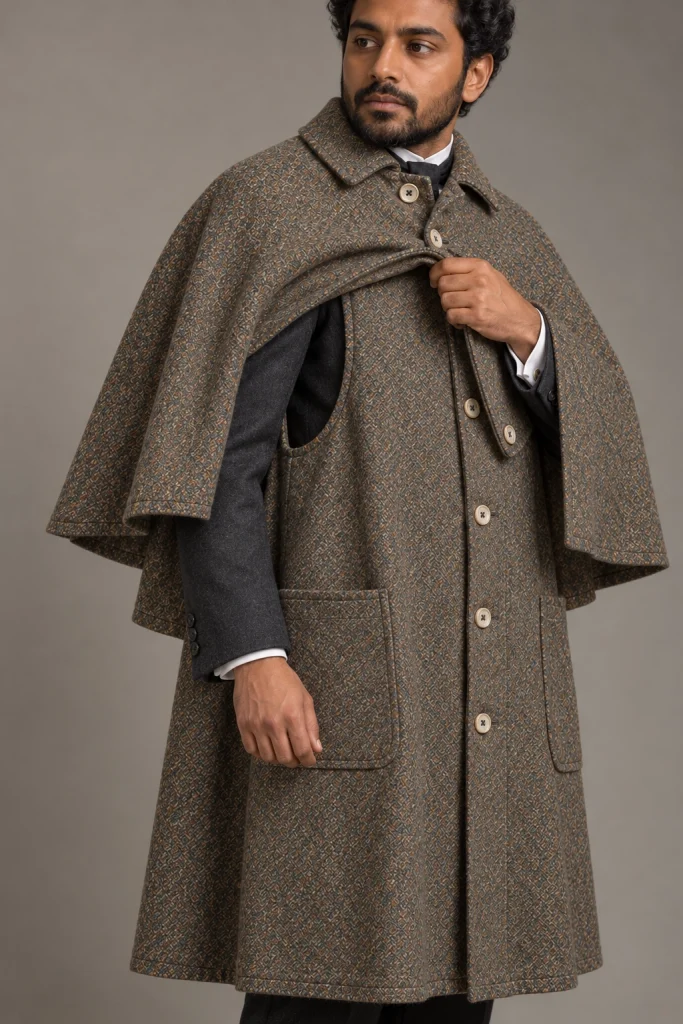
The historical answer I find most interesting is the Inverness cape: in its sleeveless form, an overcoat with generous armholes beneath a separate shoulder cape. The wearer can bring an arm out through the underlying coat while the upper layer remains draped over the shoulders.
Glasgow Museums has an example dating to around 1865, recorded as having been worn by John Brown, Queen Victoria’s servant. Its collection description specifies flecked tweed, a high neckline with a turn-down collar, and a hip-length shoulder cape fastened with bone buttons. Beneath it is a longer, sleeveless garment with deep scooped armholes, further buttons down the front and two patch pockets.
This is proper outerwear construction. The separate layers have different jobs, and the arm openings are incorporated into the shape rather than being an afterthought.
Oscar Wilde was already making the practical argument in 1884. In More Radical Ideas upon Dress Reform, published in the Pall Mall Gazette on 11 November, he wrote:
If an opening or slit for the arm is required it should be made quite wide, and may be protected by a flap
He offered the contemporary Inverness cape as his example. Wilde was arguing about freedom of movement in clothing, and the width of an arm opening was apparently a matter worth taking seriously. I agree with him, rather more enthusiastically than I expected to agree with a Victorian essay on overcoats.
Not every historical Inverness had precisely the same arrangement; sleeved versions also existed. I would therefore want to see beneath the shoulder cape before trusting the name. The construction that interests me is the sleeveless body with a generous opening and a separate covering above it.
That arrangement allows the hand to come out without requiring the entire garment to be thrown backwards. It is an answer to a practical problem that a simpler cape leaves to the wearer’s patience.
Fastenings, bags and the freedom of the drape
A cape hangs from the shoulders, but the fastening determines how much of that movement remains available.
A single clasp or brooch at the neck leaves the fronts free to separate and overlap. That is useful for wrapping the cloth around the body, although a gust of wind may be given rather too much creative freedom. A row of buttons can hold the front more securely and keep the two sides in a more predictable position. The price is that the garment may become less adjustable while fastened.
The Inverness offers another possibility because its overcape and underlying garment can have separate closures. The Glasgow example has buttons on both layers. That gives the construction more control than a single clasp at the throat, although the actual ease of movement still depends on the cut.
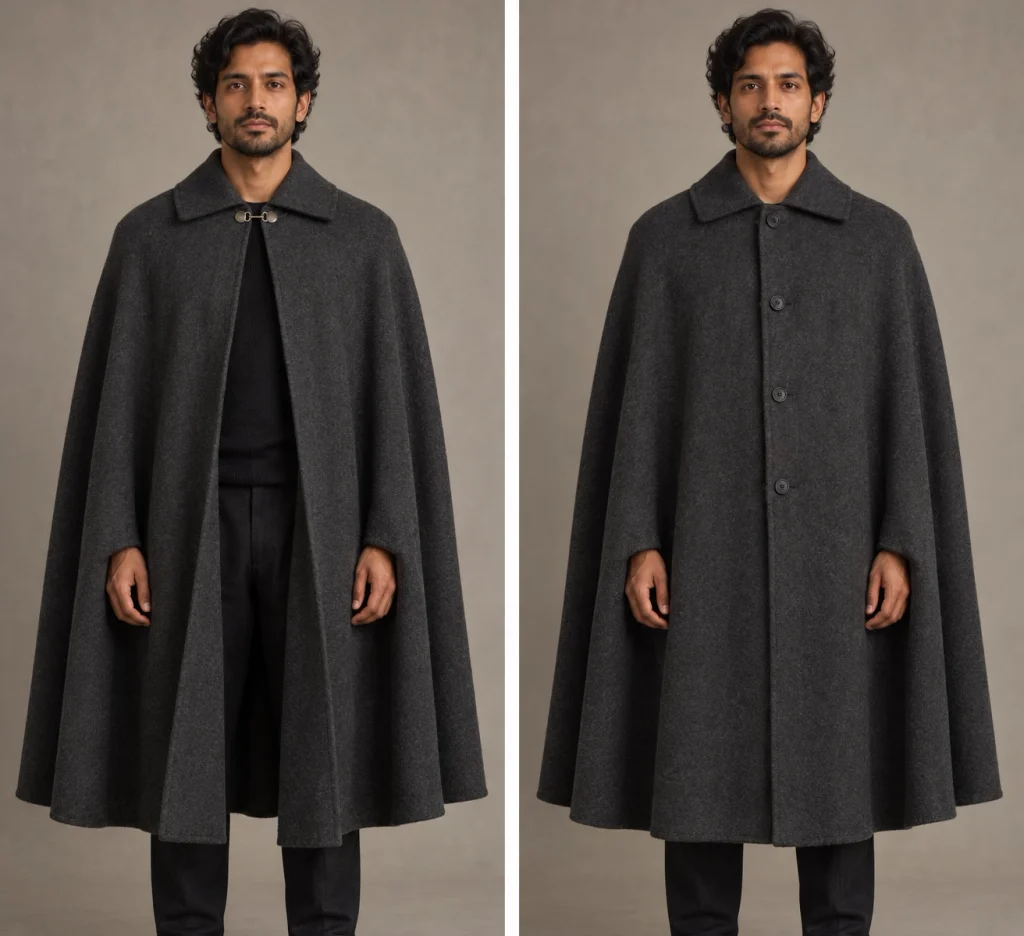
I would pay particular attention to the neckline. A cape carries a substantial amount of cloth from a relatively small area, and a strained fastening is not something to ignore. Look for stretched buttonholes, thinning fabric, pulled stitching and abrasion where the collar or closure takes the load. Replacing a soundly attached button that has worked loose is a straightforward repair; dealing with weakened cloth around the fastening may be much less obliging.
Then there is the bag.
I would carry a small handled bag by its handle, in one hand. A compact bag can hang beneath the arm without imposing a second system of straps across the cape. The arm opening still needs to let that hand emerge and lower comfortably, which brings us straight back to the cut.
A crossbody or messenger strap would run diagonally across the garment, pinning part of it against the torso and interrupting the way it falls. A backpack would introduce straps over the shoulders and bulk beneath the cloth. Even a shoulder-carried tote would compromise the arrangement I actually want, and carrying a large tote in my hand would introduce an entirely different amount of bag.
I want the cape to swing.
That movement has a practical side. Cloth which can fall and shift freely around the wearer allows an arm to move without necessarily dragging the entire garment along with it. Restrict the drape with a tight strap and the cloth has fewer places to go. Depending on the cut, the result may be pulling, bunching or a cape that spends the afternoon caught beneath a bag.
If the fabric still hangs well with a bag in hand, excellent. If the entire arrangement starts to pull towards the occupied hand, I have found something handsome that will annoy me every time I leave the house.
What happens when autumn stops being picturesque?
An autumn cape needs a more serious argument than its resemblance to something worn beside a ruined castle.
Warmth comes first for me. I get cold easily, and a garment’s generous appearance does not guarantee that it protects the places I particularly need covered.
Length, cloth, collar and closure all contribute. A cape that overlaps generously across the chest may provide good coverage while standing and walking, but the front can open when the arms move. Dedicated arm openings introduce their own exposure, particularly if a forearm remains outside the covering for any length of time.
A sleeveless Inverness can put a layer of cloth over the upper arm and shoulder while allowing the hands out underneath. That is a useful compromise, although the moment the arm reaches beyond the covering, some of its protection is surrendered.
Wind is the next difficulty. The same free drape I enjoy in calm weather gives moving air something to catch. A wide, loose front may lift or separate; a light cape may need holding down. Weight can influence how a garment behaves, but a heavy fabric is no substitute for examining the shape and closures.
I would look for generous front overlap, a secure neckline and enough room to move without pulling the fronts apart myself. If the cape only stays in place while I stand perfectly upright with both arms tucked inside, it has been designed for a considerably less active person.
Then rain arrives.
Wool can be an excellent outerwear material, but a wool label is not proof that a garment is waterproof. The structure and finishing of the fabric matter. Woolmark’s work on wind- and water-resistant wool demonstrates this rather neatly: its specially developed cloth uses a dense structure and finishing process to achieve increased resistance to wind and water. Those properties cannot simply be assumed for an unidentified vintage wool cape.
The construction creates further questions. Can water enter through the arm openings? Does the shoulder covering direct rain away from them? Will the front separate in wind-driven rain? Is the hem likely to become wet and troublesome during an ordinary walk?
For cool, dry weather, I can see a well-cut cape being an excellent outer layer. I would also consider one for changeable conditions where I can judge the forecast and the particular fabric’s protection. For persistent rain and strong wind, I would usually choose a proper weatherproof coat. There is nothing romantic about arriving somewhere soaked and pretending it was an artistic decision.
The final indignity is going indoors. A substantial cape must either remain on, be opened or be taken off and carried. I would want to know whether it can be folded over an arm without becoming an enormous heap of cloth, and whether its length makes it awkward to put down somewhere sensible.
That inconvenience may be perfectly acceptable. I have willingly worn clothes that require more thought than an ordinary jacket. I merely prefer to know what I am agreeing to before buying several metres of the problem.
Would I wear a cape instead of a coat?
Absolutely, although I would be particular about which cape. I will not buy one whose arm openings fight me, however magnificent it looks on the hanger.
I want to walk down the street with the cloth moving around me, one hand carrying my bag and the other available to do whatever needs doing. That seems a perfectly reasonable amount of drama for an afternoon in Shrewsbury.
Leave a Reply