Yesterday I ended an article about my new £40 herringbone coat by saying that something in the wardrobe might eventually have to leave.
I also said I had decided not to think about that today.
Today arrived.
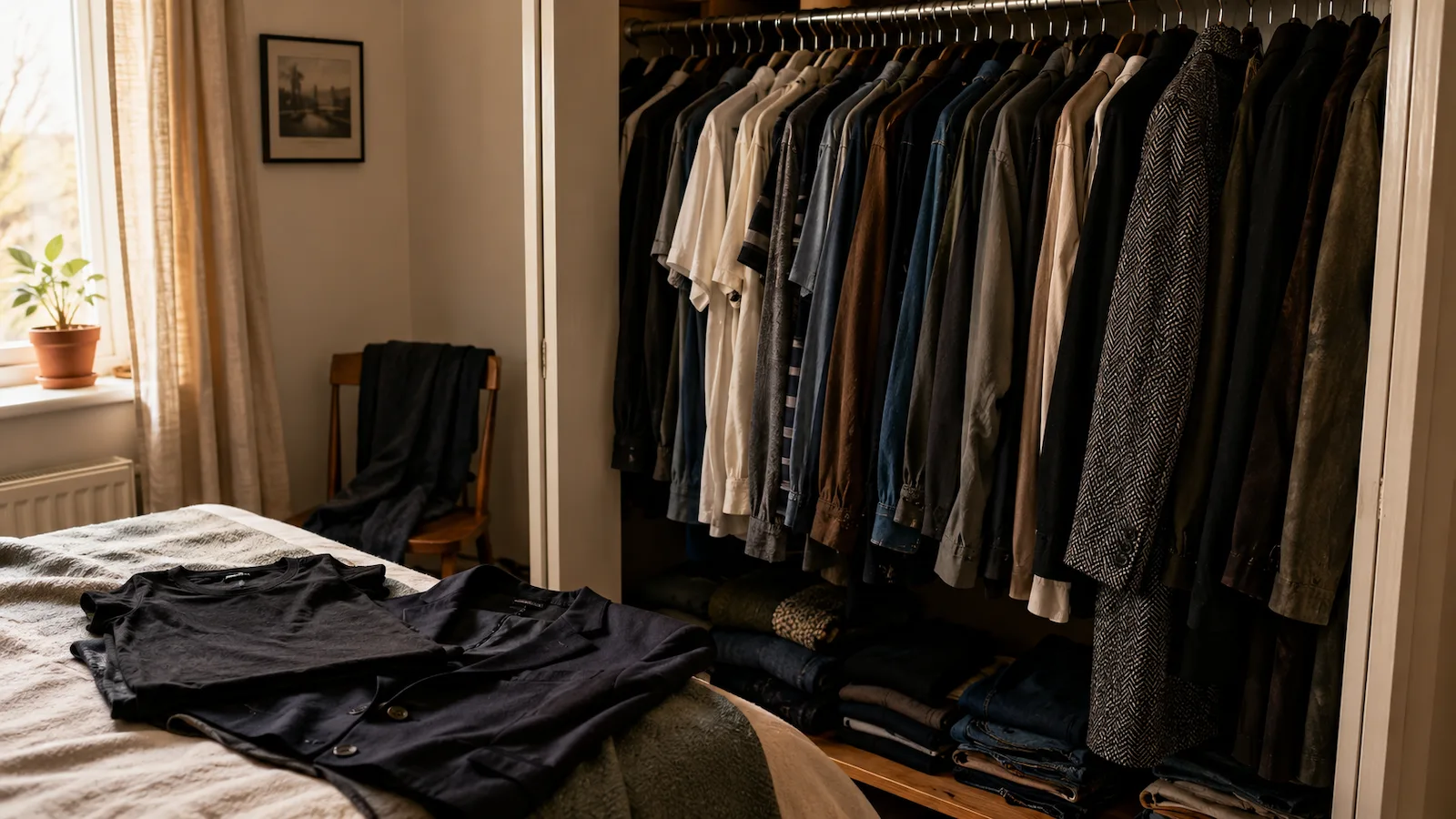
The coat fits beautifully. The wardrobe does not. I share a small bedroom, there is no neglected dressing room waiting to absorb another rail, and pushing the hangers together more firmly has reached the point where it is no longer storage so much as compression.
Fortunately, having very little room has accidentally given me a reasonably good system for working out what I actually wear.
My shirts and T-shirts sit in rows. Once I have worn and washed something, it goes back towards the front. Over time, the things I keep choosing remain easy to reach and everything else drifts backwards.
Coats and jackets work in the opposite direction. I return them to the right-hand side of the rail, so anything that has not been worn for a long time gradually works its way towards the left.
The wardrobe is essentially keeping attendance.
That does not mean the garment at the back automatically goes. Not wearing something is evidence, not a verdict. The useful question is why it has ended up there: because I no longer like it, because something else does its job better, or because I still have a specific reason to keep it.
That is where I start.
Start where the unworn clothes have collected
You can reproduce my system with backwards hangers, notes or wardrobe apps if you have the inclination. I have achieved roughly the same thing through lack of space and habit.
When I want to clear things out, I do not empty the entire wardrobe onto the bed. I know what that looks like: it begins as a purposeful wardrobe edit and ends six hours later with a duvet covered in trousers and nowhere to sleep.
I start at the back of the rows and the left-hand end of the rail.
The useful thing about doing this passively is that I cannot rewrite history while I am standing there. A jacket pushed to the far left has not been worn much simply because I suddenly remember liking it in 2017.
The wardrobe has receipts.
What I need to establish is why.
There are sensible reasons for something to be unworn. A heavy coat may simply have been waiting for winter. Formalwear does not need to justify itself every Tuesday. A particular shirt might belong to an outfit I have not completed yet.
Then there are the garments where you pull them out, look at them and immediately understand what happened.
Make duplicates compete with each other
Basic clothes have a peculiar ability to multiply without any individual item seeming excessive.
One black T-shirt is useful. A second black T-shirt is also useful. By the third, I need to start asking why all three are entitled to exactly the same bit of wardrobe.
I do not have a minimalist objection to duplicates. If somebody wears black T-shirts constantly and needs several between washes, obviously they should own several. I do not. There is enough variety in my wardrobe that I am rarely desperate for the fifth consecutive day of plain black cotton.
My storage system has usually settled the argument before I begin.
If three black T-shirts started together and one is now permanently near the front while the other two have worked their way backwards, there is my answer. The favourite is not the one I say has the nicest neckline while conducting the clear-out. It is the one I have actually been wearing.
Then I compare the details: fit, neckline, cloth, shape after washing. If the back-row versions do nothing the front-row one does not already do better, they go.
This works beyond T-shirts. Two navy jumpers may both be perfectly good, but if one repeatedly returns to the front and the other keeps disappearing backwards, the second has quietly become a backup for a problem that may not exist.
A wardrobe full of second choices is still full.
Sometimes the clothes are fine and you have moved on
The more difficult category is clothing that still fits, is still in good condition and has nevertheless become wrong.
I recently sold a few blazers on Vinted that had been sitting towards the neglected end of the rail for years. They were very early-2010s in a way that is difficult to miss once you see it: narrow, skinny fit, polite office proportions, not technically offensive and utterly uninteresting to me now.
Nothing had happened to them.
I had.
The position on the rail was useful because it stopped me pretending this was merely theoretical. I had not been choosing them. Other jackets went out and returned to the right. These stayed left.
There is a temptation with staples to treat usefulness as permanent. It is a black blazer. Everybody needs a black blazer.
Perhaps the category is useful. That does not mean this particular version still is.
Once those blazers had gone, I realised I actually did want another black suit jacket. I just wanted a better version of the idea: stronger shape, more interesting proportion, something that could still behave like a staple without looking as though I had bought it because a list on the internet said a man ought to own one.
That is one of the most useful things a wardrobe clear-out can tell you.
Sometimes removing an old staple does not mean you have stopped wanting the category. It means the old version has finally stopped obscuring what the replacement needs to become.
The gap can be information.
An unfinished outfit is not automatically a failed purchase
There is one piece of standard decluttering advice I am quite happy to ignore: if you cannot currently wear an item with several things you already own, get rid of it.
Sometimes you bought the beginning of an outfit.
You found the jacket first. Or the trousers. Or the strange shirt that makes perfect sense in your head but requires a particular pair of shoes before anybody else will be expected to understand.
That is allowed.
The position of these clothes in my own wardrobe tells me they have been neglected, but not why. Something may be languishing at the back because I have failed to finish what I started rather than because I no longer want it.
The distinction I make is between a plan and a fantasy.
“I am keeping this because I want high-waisted charcoal trousers to go with it, I know roughly what I want, and I am saving for them” is a plan.
“I might need this if my life changes completely and I begin attending events I have never previously attended” is something else.
You do not have to demand immediate versatility from every garment. Some of the most interesting wardrobes are built because somebody was willing to keep an awkward piece long enough to find its companions.
But eventually the rest of the outfit has to arrive.
A vision is not indefinite storage permission.
Sometimes the back of the wardrobe is exactly where something belongs
I am also suspicious of strict time limits.
“If you have not worn it for a year, get rid of it” sounds wonderfully decisive until the thing in question is an excellent coat, unusual pair of trousers or beautifully made jacket whose shape has simply fallen out of fashion for a while.
This is where my attendance system needs interpreting rather than obeying.
A garment that has drifted backwards because I dislike it is one thing. A garment I still love, but which is currently waiting for its moment again, is another.
Fashion circles back on itself often enough that occasionally the reward for refusing to get rid of something for fifteen years is discovering that everybody else wants one again.
Alyson Walsh has written about keeping 1990s bootcut needlecords through the skinny-jean years because she knew she would wear them again, describing that period as a “fashion sabbatical”. That feels much closer to how I think about good older clothes than the idea that every unworn item has missed a deadline.
I would keep something through a long quiet period when three things are true: I still genuinely like it, the garment itself is good enough to deserve the space, and I can imagine wearing it again without having to become a substantially different person first.
Long-unworn wool also needs storing properly rather than disappearing into a forgotten corner; I have a separate guide to storing wool clothes and preventing moth damage for exactly that reason.
Sometimes waiting is clutter. Sometimes it is patience.
I discovered a much less tidy version of that problem with an old PS2 memory card I kept because I did not know what was on it.
Knowing the difference is unfortunately still your job.
There are wardrobe decisions I cannot advise you on
One area where I am no use whatsoever is keeping clothes through significant changes in body size.
I have been roughly the same size for sixteen years.
That means I can tell you how I decide whether something still suits me, whether I actually wear it and whether I think it deserves the space. I cannot meaningfully tell somebody whose weight fluctuates how many sizes to retain, how long to keep them or what will feel sensible six months from now.
I could invent a compassionate-sounding rule. It would still be invented.
So if that is the problem you are dealing with, you need advice from somebody with relevant experience rather than a man whose trousers have had an unusually uneventful decade and a half.
Eventually the space is worth more than the sale
Once I have decided something can leave, there is another decision: how much effort am I willing to spend extracting value from it?
If a wearable garment is worth listing, I put it on Vinted. The old blazers eventually sold there, which was satisfying partly because I got some money back and partly because somebody else evidently wanted exactly the narrow black jacket I no longer did.
But listings can sit for months, and eventually I have to remember what problem I was originally trying to solve: space.
If a £10 or £15 sale might happen eventually but the garment has spent another three months occupying the room I was supposedly trying to recover, I have not really decluttered it. I have changed its administrative status.
There is a point where getting the space back is worth more to me than waiting for the possible sale.
When I reach that point, clean and genuinely wearable clothes can go to an appropriate charity shop or clothing bank. Clothes that are no longer suitable for reuse need a proper textile-recycling route rather than being donated as somebody else’s disposal problem. Recycle Now has current UK guidance and local recycling information for clothing and textiles.
I am strongly against throwing wearable clothes into the rubbish simply because I no longer want them.
The purpose is to move the garment on, not merely move the pile.
The wardrobe should tell you something when you finish
The test of a clear-out is not how impressive the outgoing pile looks.
Put the clothes back and look at what has changed.
Can you move the hangers? Can you see what is there? Are the shirts you actually wear nearer the front? Has the left-hand end of the rail stopped functioning as long-term parking for jackets you keep avoiding?
More importantly, do the remaining gaps tell you anything?
Getting rid of those old skinny blazers clarified something for me immediately. I had not grown tired of black tailoring. I had grown tired of that black tailoring.
So there is now a space in the wardrobe where a black jacket used to be.
I want another one.
This time I know the job description. It needs enough shape and character to feel deliberate, it needs to work with the clothes I actually own now, and it needs to be interesting enough that three years from now it is still returning to the right-hand side of the rail.
The new herringbone coat has its space. Several other things no longer do.
And somewhere out there is a black jacket that is about to make this entire exercise slightly self-defeating.
Leave a Reply