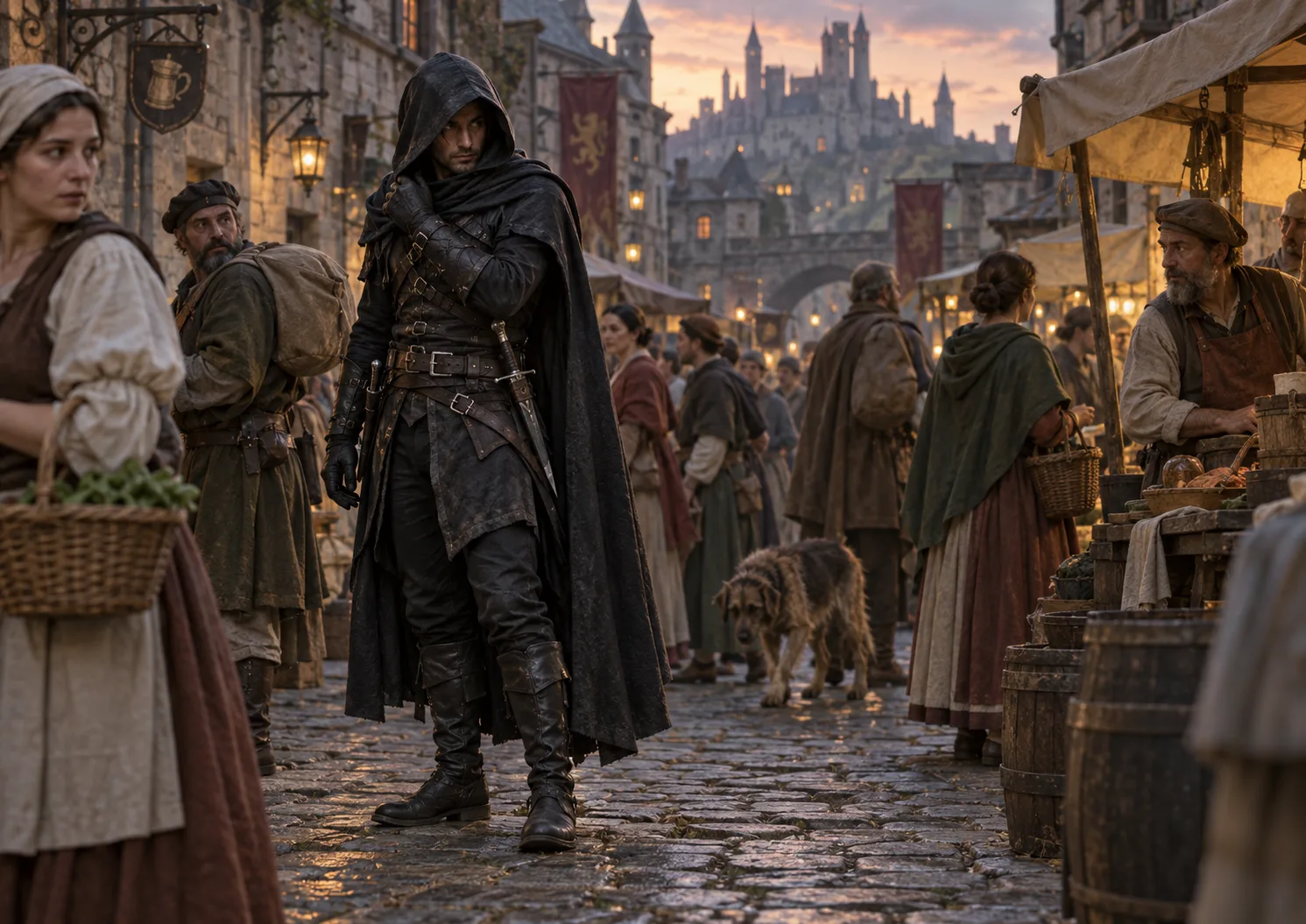
Vax’ildan does not dress to reassure anybody.
He is an assassin who becomes the divine warrior of the Matron of Ravens, and by then he dresses like it: black studded leather covered in intricate scrollwork, under a mantle of the Matron’s black feathers.
It is also extremely legible.
Nobody watches Vax enter a room and thinks he might be there to discuss the accounts. The clothes tell you what sort of character has arrived before he has had the courtesy to throw a dagger at anything.
That is perfectly reasonable for Vax. He is a fantasy assassin becoming the divine champion of a death goddess; subtle hints would be rather wasted on him. The trouble begins when his particular visual solution hardens into an occupational uniform, and every rogue starts receiving the same parcel of black leather, hood, knives and unresolved family history.
The problem with dressing like a rogue is that anybody looking at you can tell you are a rogue.
And historically, that is a rather strange place for the archetype to have ended up.
The rogue did not begin in black
Bilbo Baggins is employed as a burglar and looks nothing like somebody who has selected “Rogue” from a character-creation menu.
Tolkien himself pictured Bilbo in green velvet breeches, a red or yellow waistcoat, a brown or green jacket and gold or brass buttons; the dark-green hood and cloak in the same description are explicitly borrowed from a dwarf. Even modern gaming taxonomy has caught up with the joke: Wizards of the Coast’s 2026 Magic: The Gathering | The Hobbit set prints several versions of Bilbo as a “Halfling Rogue”. Apparently the waistcoat has passed inspection.
That does not mean Bilbo secretly established the canonical rogue palette as moss green and brass buttons. It means the underlying role came first. He is small, underestimated, employed to enter somewhere he should not be and expected to rely on discretion and nerve rather than standing in front of a dragon exchanging formal blows with it.
The game mechanics arrive later and begin giving that role harder edges.
Gary Gygax and Robert Kuntz’s Supplement I: Greyhawk, first printed in 1975, added the thief as one of the main Dungeons & Dragons character classes. Its rules are remarkably recognisable. A thief can wear only leather armour and no shield; among the basic abilities are moving with great stealth, picking pockets, hiding in shadows and striking silently from behind.
There is the ancestry of a great deal of fantasy rogue clothing already: light armour because the class is mechanically restricted to leather, shadow because hiding is something the class actually does, and a fighting style that rewards getting somewhere inconvenient before anybody notices.
Black is conspicuously absent.
The rulebook gave us leather. It did not give us black.
Even the word rogue took time to settle over the broader game archetype. In the 1989 second-edition Advanced Dungeons & Dragons Player’s Handbook, “rogue” became a category containing two rather different creatures: thieves and bards. The book describes cunning, nimbleness and stealth as the thief’s hallmarks, while the bard gets through the world by charm, talent and wit.
That broader meaning is worth remembering. A rogue was already capable of being somebody who slipped behind you unnoticed or somebody who talked his way through the front door.
George Barrington preferred the second option.
George Barrington dressed for the room
Barrington was one of late eighteenth-century London’s most notorious pickpockets, although you would have been forgiven for overlooking the occupational dress code.
The National Portrait Gallery of Australia describes how, after arriving in England, he adopted the identity of a gentleman and stole while mingling at fashionable gatherings. His clothes were doing something more useful than signalling criminality: they were explaining why he belonged in the room.
One of the best surviving images of Barrington is the frontispiece to The Memoirs of George Barrington from 1790. It depicts him being caught picking an aristocrat’s pocket, traditionally identified as Count Orlov, at Covent Garden Theatre. Barrington and his victim inhabit essentially the same fashionable visual world: coats, waistcoats, stockings, dressed hair. You have to look at what the hands are doing before the thief becomes obvious.
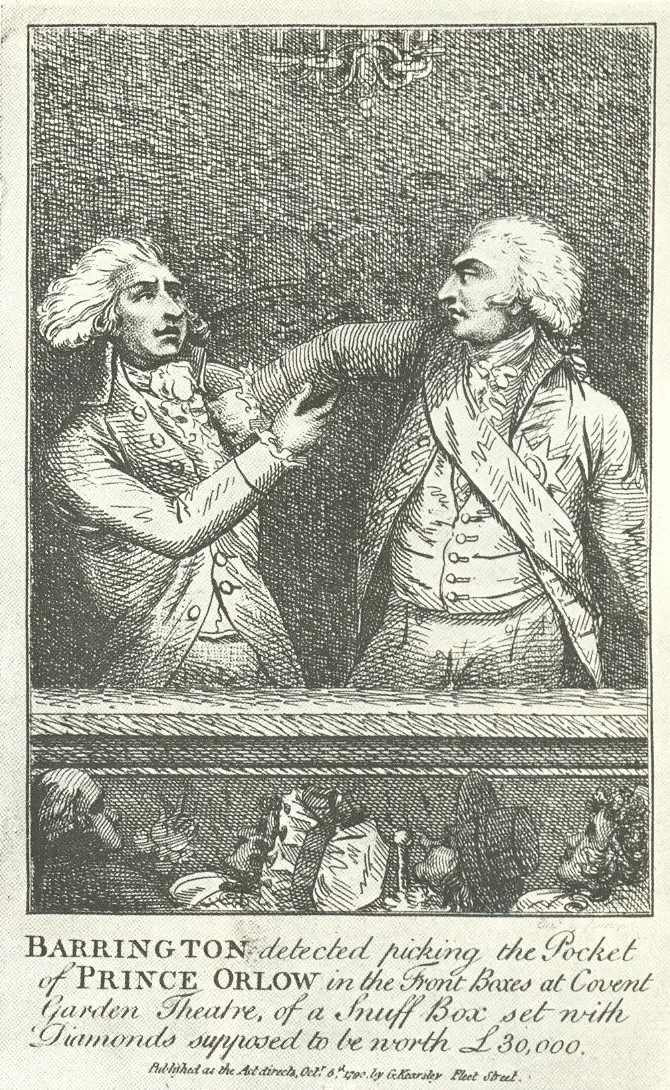

That qualification matters. The Gallery warns that the various memoirs published under Barrington’s name were loose with facts and almost certainly not written by him. The engraving is not eighteenth-century CCTV.
What is documented is the method beneath the mythology: Barrington adopted the identity of a gentleman and worked among fashionable society. The picture then shows us how contemporaries wanted that identity understood. His sophistication was interesting precisely because the thief and the gentleman were difficult to separate by sight.
Call it social camouflage: clothes making your presence ordinary enough that nobody has to invent an explanation for you.
A burglar dressed like a burglar has created a problem before reaching the pockets.
When mechanics acquire a wardrobe
I cannot find one clean historical moment when the D&D thief’s leather armour turned black, acquired a hood and began dressing as though every tavern had an unusually strict goth policy.
I do not think there was one.
What can be traced is the gradual convergence between the things rogues do and the visual language used to make those abilities instantly readable. Games need classes to feel different. Illustrators need characters to read at a glance. Leather marks lighter armour; daggers suggest close, quick violence; darkness and shadow make stealth visible to an audience who cannot actually watch somebody becoming less noticeable.
That last move is inherently odd. The artist has to depict invisibility.
By the time we reach the current World of Warcraft Rogue, the package is almost complete in Blizzard’s own description. Rogues wear leather, use daggers among their available weapons, attack from the shadows, use stealth and poisons, and have a Subtlety specialisation described as a dark stalker ambushing unsuspecting prey.
I would not blame World of Warcraft for inventing this. It is more useful as evidence that the vocabulary had become thoroughly legible: tell a modern fantasy audience “leather, daggers, poison, shadows” and very little further paperwork is required.
Colour then gets asked to perform a job that clothing in games often needs to perform and practical camouflage does not: announce the concept clearly.
Which is where the black begins to misbehave.
Black is not an invisibility cloak
Black can conceal you; it can also turn you into the cleanest silhouette in the landscape. The difference is the background.
A 1944 US War Department field manual on individual camouflage is admirably uninterested in anybody’s aesthetic commitment to darkness. It treats concealment as a relationship between the person and whatever is behind them. At night, it warns that silhouette and background remain vital and gives the wonderfully destructive sentence: “A silhouette is always black against a night sky.”
That is the bit the fantasy rogue wardrobe tends to forget.
The figure does not disappear merely because the cloth is the darkest object available. Put a dark body against a lighter road, horizon or sky and the body becomes a dark shape with exceptionally cooperative edges. Water, moonlight, artificial light, buildings, vegetation and the observer’s position all change the problem.
I ran into the same dependence on background from the other direction with Tolkien’s Lothlórien cloaks, whose usefulness comes from their relationship with stone, tree and changing light rather than one supposedly invisible colour.
Black is therefore neither clever nor stupid on its own. It has to belong to its surroundings.
The US military managed to produce an excellent counterexample to its own infantry lesson during the Second World War. The Air Force Materiel Command History Office records extensive testing of night-fighter paint and says glossy black — or standard Olive Drab — proved more effective for that particular problem than flat black. By 1944, American night fighters were directed to use glossy black and, where possible, polish it.
Good. Keep that inconvenience.
Otherwise we would merely swap one costume rule for another and spend the next decade informing innocent fantasy artists that a true rogue wears navy.
The useful principle is harder to embroider on a hood: camouflage depends on the object, the background, the light and the observer.
And once you accept that, the black rogue uniform stops looking inevitable.
The shinobi had already solved the same problem
The National Diet Library of Japan makes an almost embarrassingly direct comparison available to us.
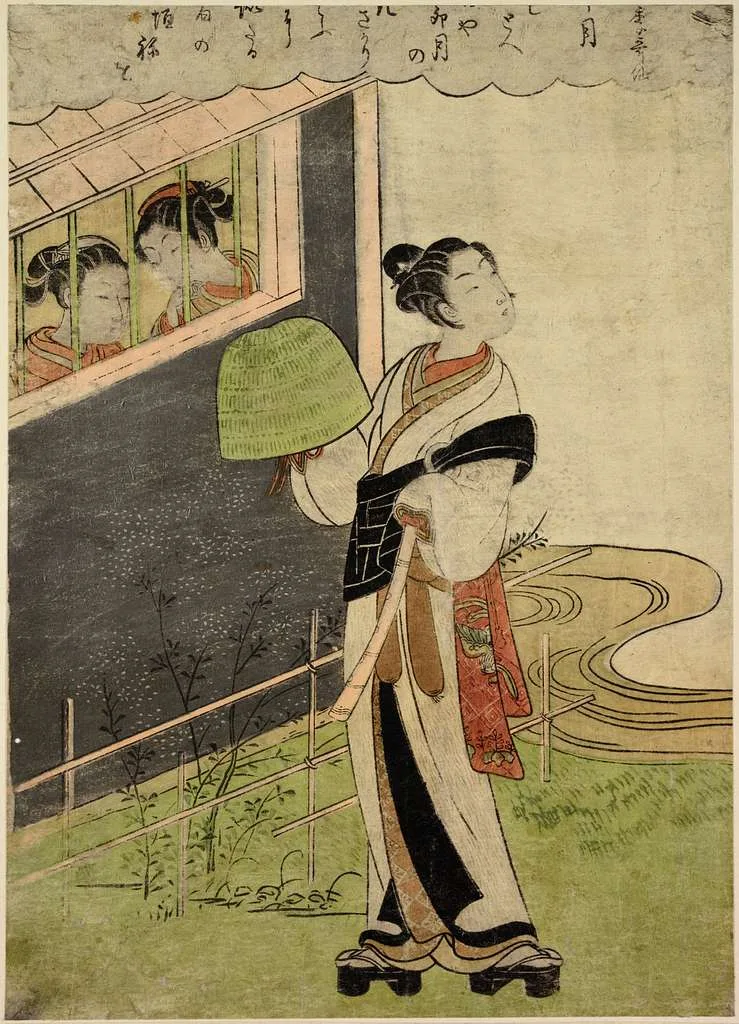
Its exhibition on the difference between historical ninja and entertainment ninja says that real shinobi did not generally wear the distinctive all-black costume now associated with them. According to the seventeenth-century Shōninki, suitable clothing could be brown, persimmon, black or dark blue — ordinary, unobtrusive colours for the period. Black is still on the list; it has simply lost its supernatural ability to make a person cease existing.
More revealing than the colours are the disguises.
The Shōninki describes shichihōde, literally the “seven disguises”: roles including a mendicant monk, wandering Buddhist priest, mountain ascetic, merchant, street entertainer, performer and ordinary everyday dress. The National Diet Library points out the shared advantage. Someone dressed this way could approach other people without immediately looking suspicious.
That is Barrington’s fashionable coat again, arrived at from a completely different tradition.
The important garment is the one that explains why you are standing there.
There is something almost comic about what popular culture eventually did with this.
Take people whose working advantage depended on looking ordinary, give them a single instantly recognisable costume, then spend several centuries insisting the recognisable costume is what made them stealthy.
Fantasy rogues should probably be taking notes.
Then theatre needed the invisible person to be visible
The black-clad ninja has a strong theatrical connection, although the neat version of the story is neater than the evidence deserves.
The National Diet Library says the familiar black ninja costume is believed to have spread through theatrical forms such as kabuki and jōruri. A novel can simply tell you that the unobtrusive merchant is secretly a ninja; a stage production needs an audience at the back of the room to understand rather more quickly who has just appeared. Black clothing became a visual device for making the character immediately identifiable.
At the same time, Japanese theatre already had another black-clad figure whose job depended upon the audience agreeing not to see him.
A kurogo is a kabuki stage assistant dressed completely in black, including the face. Japan’s National Theatre explains that black functions as a theatrical convention for invisibility: the kurogo can move props, help with costume changes and work around the performers while the audience accepts that he is not part of the visible dramatic world. Bunraku puppetry uses the same convention, with black-clad puppeteers receding from the action they animate.
Then reality gets one little vote.
In a snowy kabuki scene, black would stand out. The kurogo therefore changes to white. Around water or the sea, light blue may be used instead. Even theatrical invisibility eventually has to acknowledge the background.
It is very tempting to join these facts into one perfect origin story: stagehands wore black because black meant invisible; ninja borrowed the stagehand costume; modern culture inherited the ninja.
I cannot support that clean chain.
The untidier version is more useful anyway. A practical disguise tries to stop the stranger being recognised as significant. A theatrical costume has almost the opposite task: it must tell the audience what the stranger signifies.
Somewhere in that change of job, the invisible man becomes one of the easiest people in fiction to spot.
Arsène Lupin changes the man, not the uniform
Maurice Leblanc’s Arsène Lupin offers a third solution and has the decency to be French about it.
In the early Lupin stories he is described as the “man of a thousand disguises”. The list sprawls through occupations and identities: chauffeur, detective, bookmaker, Russian physician, bullfighter, commercial traveller, young man, old man. At one point the problem is precisely that Lupin might be this gentleman or that one, the neighbour at dinner or the person sharing the room.
There is no Lupin uniform because an instantly recognisable Lupin uniform would render Lupin substantially less employable.
His clothing is doing narrative work in a different direction from Vax’s. Vax becomes more himself as the black leather and raven feathers accumulate. Lupin becomes whoever the room will accept.
Barrington did something similar in life, the Shōninki describes it as a practical method, and Lupin turns it into entertainment. The pattern is starting to look less accidental.
So what would a rogue actually wear?
If I wanted rogue influence in an ordinary wardrobe, I would start one question earlier than “what does a rogue wear?”
What is this particular rogue trying to pass as?
A person who belongs in a university archive has a different wardrobe from someone expected at a country pub, a smart hotel, a railway platform, a warehouse or a wedding. None needs an occupational badge reading THIEF. The useful clothes are the ones that make the character plausible in the room before they make the character interesting to us.
That is the same translation problem I use when building a storybook wardrobe without looking like costume: take the quality you want, rather than buying the fictional uniform.
That changes the modern translation considerably.
Black can stay. So can charcoal, navy, brown, olive, burgundy, cream or whatever else belongs naturally to the setting and the person wearing it. The important distinction is no longer “rogue colour” versus “non-rogue colour”; it is whether the colour makes sense beside the clothes and surroundings it has to live among.
Leather can stay too, although head-to-toe leather is a very efficient way of informing the bus queue that you have selected a subclass. A worn leather jacket, belt, bag or shoe can supply toughness and texture without making the outfit look issued.
Then I would steal from the original game mechanics rather than their later costume shorthand.
The clothes should let the wearer move. A jacket that binds across the back every time you reach forward has failed before we get to the daggers. Trousers should tolerate sitting, walking and taking stairs without requiring a private negotiation. Pockets should hold actual objects. Shoes should survive the amount of city, station, weather or countryside the character is supposedly crossing. A coat should work with whatever is underneath it rather than merely billow beautifully from the doorway until somebody asks it to fit on public transport.
Those are ordinary wardrobe concerns, which is precisely why they work.
The rogue flavour can arrive through smaller decisions: a soft dark jacket rather than a rigid one, a collar that can sit open, boots with some wear rather than ceremonial polish, a useful cross-body bag, a knit with enough texture to avoid looking corporate, a coat with deep pockets and a silhouette that moves cleanly. Pick two or three cues and let the rest of the outfit belong to normal life.
Most importantly, resist solving “rogue” before solving the person.
A polished confidence trickster and a travelling scout can occupy the same archetype without sharing a shopping basket. So can Bilbo and Vax. Once the category starts demanding identical clothes from both of them, the category has stopped explaining anything.
Vax can keep the feathers
Which brings me back to the man in black leather.
Vax works because he is doing almost everything this article has advised an unobtrusive rogue not to do.
He is an assassin who becomes the divine warrior of the Matron of Ravens. The Deathwalker’s Ward is black leather with a mantle of black feathers because by that point his clothes have acquired religious, magical and narrative meaning. They are supposed to announce him.
If Barrington dressed like the gentleman beside him so that he could enter the room unnoticed, Vax dresses like the omen arriving to collect somebody from it.
Both choices make sense.
The mistake was never Vax dressing like Vax. It was assuming everyone else in the class had signed the same uniform order.
Leave a Reply