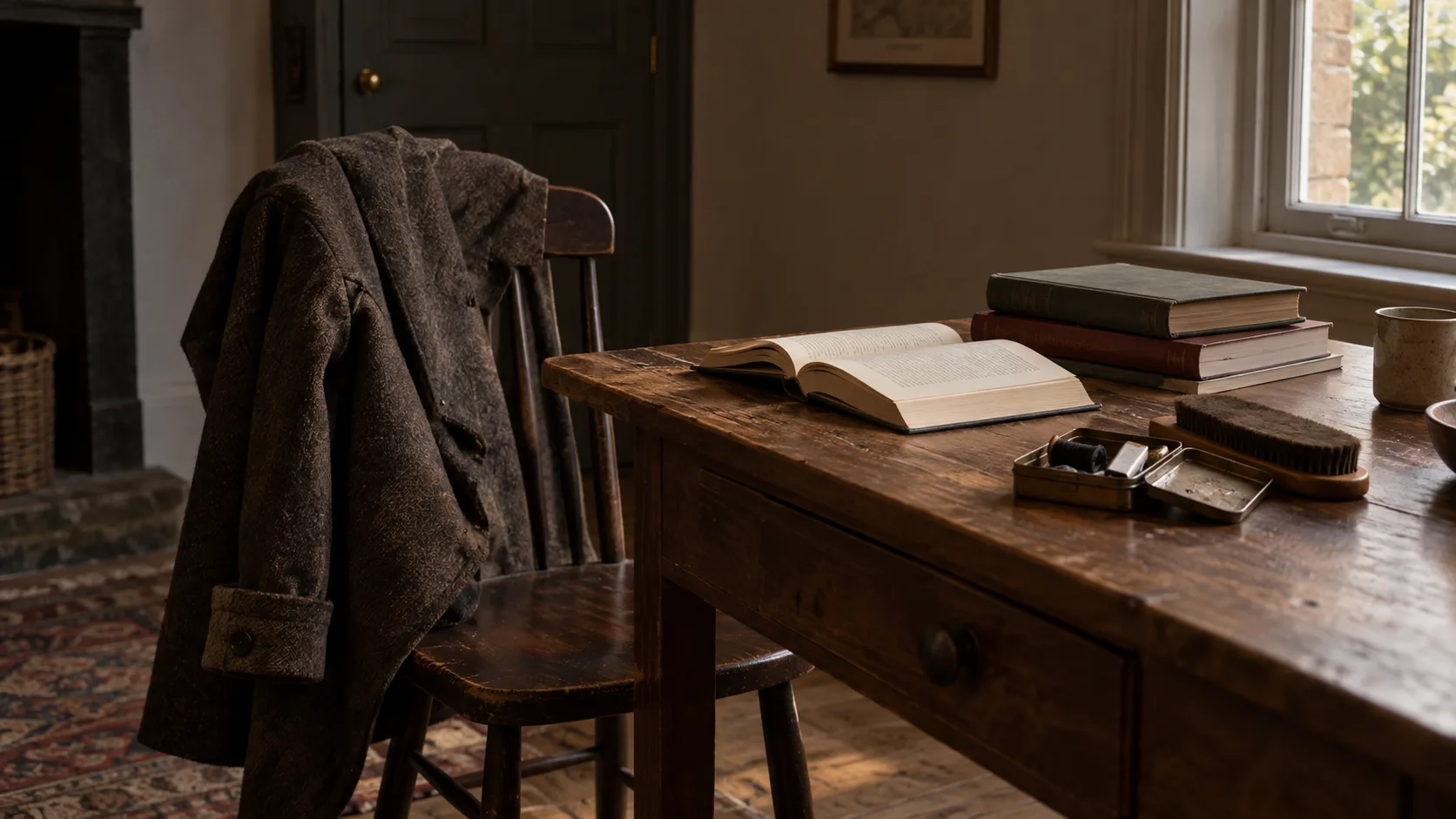
If you tell me what you would do with a damaged coat, whether you would learn a dress code or quietly bend it, and which outfit you would rather leave the house in, I can probably recommend you a book.
Clothes do much more interesting work in fiction than merely telling us what somebody looks like. They can mark rank, hide a person, make belonging visible, turn sewing into a livelihood, preserve something that cannot easily be replaced or make a uniform feel like relief rather than restriction. Two characters can wear almost the same thing for completely opposite reasons.
That is what this quiz is interested in.
There are ten questions: five outfit choices and five wardrobe situations. For the outfit questions, pick the option you are genuinely drawn to. For the situations, choose what you would actually do. None of the answers is meant to be the clever, stylish or morally correct one.
At the end, you will get a book recommendation, a close second, and the clothing instinct that separated them.
No percentage match. No personality type. Your wardrobe has enough paperwork already.
Rowenna Miller’s Torn is fantasy for anyone who has ever looked at an enchanted dress and wondered who cut the pattern, who paid for the cloth and whether the customer has settled the invoice. Sophie Balstrade runs a dressmaking shop where the magic is worked into the same stitching that makes the clothes function. Her assistants drape, cut, fit and mark hems. The order book contains riding habits, pelisses, court gowns, jackets and smaller charmed pieces; one cancelled dinner gown matters because its price would have covered a week’s wages for both assistants. The fantasy does not excuse Sophie from cash flow. Quite right too. A spell is impressive, but the landlord remains notoriously resistant to them. That practical groundwork is why the clothes matter when the novel becomes political. Sophie’s fashionable silk dress can advertise her professional competence when she applies for her business licence; red wool caps turn a political movement into something visible. Dressmaking keeps crossing the boundaries between private skill, public reputation, class and power because Sophie’s work puts her in rooms she could not otherwise enter. Most importantly, sewing is not a charming occupation the plot eventually asks her to grow beyond. Sophie built the business, employs people, depends on its income and is good at the work. When marriage is presented as a possible route away from needing the shop, she does not find the prospect particularly liberating. She wants the work. Read Torn if the part of clothing that interests you is what hands can do with it: cut it, alter it, sell it, charm it, build a livelihood from it and occasionally discover that a seam has become political. Katherine Addison’s The Goblin Emperor is for anyone who finds a dress code more interesting once it starts behaving like grammar. Maia becomes emperor with almost no preparation and arrives at court in mourning clothes that have already been dyed black repeatedly, no longer fit properly and advertise his previous circumstances rather efficiently. His memory of his father supplies the opposite image: imperial white stiff with embroidery, moonstones everywhere, authority rendered in cloth before anybody opens their mouth. Clothes are among the first things to tell Maia that his new position has rules he does not yet know. That becomes wonderfully literal when Maia asks his Master of Wardrobe what an uncrowned emperor is supposed to wear to a public funeral. Full imperial white is wrong; ordinary court mourning is wrong; his existing clothes are certainly wrong. The solution is black and plum cloth embroidered in white: mourning colours without the full formality of prescribed court mourning. Court mourning here means the formally regulated dress appropriate to bereavement at court; knowing when not to wear it is as important as owning it. This is what Addison does particularly well with clothes. They are neither costume porn nor a code the reader is expected to memorise. Maia has to learn what a garment says because governing requires him to become legible inside an institution that existed long before he arrived. His wardrobe is part etiquette lesson, part constitutional document and occasionally part warning that everybody else already knows the rules. If you enjoy clothing as social knowledge — rank, occasion, mourning, office, propriety — The Goblin Emperor makes that knowledge matter without turning good taste into moral virtue. Maia’s problem is not that he needs nicer clothes. He needs to understand what the clothes are saying before he can decide what sort of emperor will be inside them. Convenience Store Woman is the result for anyone who understands that being told exactly what to wear can sometimes feel less like erasure than relief. When Keiko Furukura begins working at Smile Mart, the new staff are a conspicuously mixed group. Then the uniforms arrive. Long hair is tied back, watches and accessories come off, everyone tidies themselves according to the same checklist and the assorted individuals become recognisable convenience-store workers. The transformation pleases Keiko. The clothes come with instructions, and so does everything else: how to stand, greet a customer, bow, handle food and move through the shop. For once, normality has a manual. That distinction matters. The uniform does not express Keiko’s unique inner self, and the novel has no interest in pretending that it does. Its usefulness lies almost in the opposite direction. Inside the store, age, gender and background recede behind a role Keiko knows how to perform well. Outside it, the expectations become far murkier: career, marriage, femininity and adulthood all seem to require knowledge everyone else received without her. At work she can put on the clothes and know what happens next. There is something rather refreshing about a novel willing to take that attraction seriously. Style writing tends to treat individuality as the obvious prize and uniformity as the dreary thing we escaped from. Murata is interested in the person for whom endless self-definition is itself exhausting. So this is not really a recommendation about liking plain clothes. You could own six velvet coats and still recognise the appeal. It is about clothing that makes a social role clear, repeatable and usable — and about what happens when the small fluorescent world with the store uniform makes more sense than the supposedly freer one outside it. In The Tale of Genji, colour has consequences. A robe can be expensive, technically fine and still reveal that its wearer has misunderstood the season, the company or the century. Clothing in Murasaki Shikibu’s courtly world is part of aesthetic literacy. Kasane, layered combinations of colours chosen in relation to the natural world and the changing seasons, is central to the dress culture represented in the novel. Taste therefore lies in relationships: one colour against another, cloth against season, formality against occasion. Ornament by itself is rather beside the point. The novel repeatedly shows clothes being read in exactly this way. A woman appears in faded imperial purple and an old sable mantle that now looks painfully behind the times; elsewhere mourning has prescribed shades, and Genji arrives at a gathering in white lined with yellow over a deep wine-red robe while the people around him wear plain official dress. The clothes tell you who has judged the moment well before the narration has finished being polite about it. That makes Genji a particularly good recommendation if you enjoy clothes whose interest lies in appropriateness rather than novelty. The pleasure is not simply that everything is sumptuous. It is that refinement depends on noticing: season, ageing dye, layers, combinations, context, the slight embarrassment of a choice whose moment has gone. Read it for the much stranger proposition that getting dressed can be a form of attention. The grey robes in She Who Became the Sun are useful because they make Zhu less interesting to look at. After taking her dead brother’s identity, Zhu enters a monastery as a male novice. The other boys dress in trousers and undershirts, short inner robes, then wide-sleeved grey monastic robes; straw sandals finish the uniform. A monastic robe here is the enveloping grey outer layer shared by the novices. Zhu is smaller than the boys around her, but once everybody is dressed alike that difference becomes much less legible. The robe even tangles around her legs when she runs. It is not magical camouflage, beautifully engineered disguise or a particularly flattering coat. It works because everybody else is wearing one too. That makes clothing part of Zhu’s larger talent for controlling what other people are able to read. She needs to look sufficiently like the category she has entered that nobody begins asking the dangerous second question. The uniform supplies an existing explanation: novice monk. She does not have to invent an entire visual identity when an institution is willing to provide one. There is a useful severity to that idea. Clothes often distinguish the protagonist in fantasy — the unusual cloak, the significant colour, the armour nobody else could possibly own. Parker-Chan gives Zhu a garment whose advantage is precisely that it does not distinguish her. Read She Who Became the Sun if you are drawn to clothing as practical control over visibility: knowing when individuality is useful, when it is dangerous, and when the smartest thing a garment can do is make somebody look exactly like everyone standing beside them. Fatma el-Sha’arawi does not dress to disappear. While working undercover, she turns up in an all-white suit with a matching waistcoat, dark blue shirt, gold tie, glittering cufflinks, a black bowler and a gold pocket watch made to resemble an antique astrolabe. The clothes are conspicuous enough for another character to comment on them, which is rather the point: Fatma is trying to project a young socialite with enough money and confidence to belong in the business at hand. Her bowler, the hard rounded felt hat that completes the look, is not a final touch of modest anonymity. It is punctuation. That is what makes her such a useful result in this quiz. Clothes can conceal by reducing information, but they can also conceal by supplying a very convincing explanation. Fatma gives people something obvious to notice and lets that apparent identity do the work. Even under cover, she does not become visually blank; she constructs another readable version of herself. The trick only works because the presentation is coherent. Suit, tie, watch, cufflinks and hat all belong to the same story. Nothing looks accidentally expensive or inexplicably theatrical. She is not piling on eccentricity until nobody can see the detective beneath it. She is controlling the conclusion people reach when they look. That makes A Master of Djinn a particularly good recommendation if clothing interests you as authorship. A strong personal style need not reveal some pure inner truth. Sometimes its value lies in deciding which version of yourself reaches the room first — and making that version convincing enough that everyone else accepts the introduction. A beautifully embroidered surcoat costs more than cloth in The Mask of Mirrors. It costs heat, comfort, transport and occasionally the feeling in your feet. Ren is constructing Renata Viraudax, the noblewoman she needs other people to believe exists. The clothes therefore have to withstand inspection. A surcoat, the decorative outer layer worn over an underdress or other clothing, can be beautifully embroidered while the rough wool cloak that replaces it in private is lined with raw fleece. Ren’s fashionable shoes hurt all day. The household keeps most rooms cold, eats simply and sleeps together on a pallet in the kitchen because maintaining the performance of wealth is expensive. That last part is what stops the wardrobe from becoming a parade of lovely fantasy clothes. Ren is not merely choosing things that look aristocratic. She and Tess are budgeting a false social position. Lace, transport, heating and garments all belong to the same calculation. The outfit has to look effortless precisely because the effort must remain invisible. Carrick also makes clothing readable in both directions. Ren uses dress to tell other people what she wants them to believe, but she can also read status, money and intention through what other people wear. Clothes are part of the city’s social language, and her success depends on speaking it fluently enough to lie in complete sentences. Read The Mask of Mirrors if the interesting part of style is not standing out but passing inspection: understanding the codes of a room, reproducing them convincingly and knowing that a single wrong detail can expose much more than bad taste. It is fantasy for the reader who notices the coat, then immediately wonders what the coat is trying to prove. Before Deka can wear the mask expected of an adult woman, she has to be judged worthy of it. That turns an accessory into law. Ordinary women’s purity masks may be made from thin wood or parchment and painted with prayer symbols; feast-day versions become elaborate sun, moon and star forms picked out in gold or silver and arranged with religiously significant geometry. Deka expects to receive a sturdy white half-mask of heavy parchment reinforced with thin wood. It is not the finest available. It is simply the best her father can afford. A purity mask in the novel is therefore much more than face covering. Wearing one follows the Ritual of Purity and publicly places a girl inside the social order: respectable, marriageable, properly recognised. Material quality adds another layer because wealth determines how impressive that legitimacy can look. The uncomfortable part is that Deka initially wants the thing. Of course she does. The system has taught her what the mask promises: acceptance, safety, adulthood and perhaps courtship. That makes the clothes more interesting than an obviously wicked uniform forced onto somebody who objects from page one. Dress can regulate people very effectively when the reward for compliance is belonging. The Gilded Ones belongs here for readers interested in clothes as permission — who is allowed to wear what, what has to happen before they may wear it, and what judgement the garment announces once it appears. Its masks are beautiful objects embedded in an ugly question: whether being correctly dressed feels reassuring because the rules are good, or because the cost of failing them has been made frighteningly clear. Tenar enters the ceremony in white and leaves it in black. At six years old she is brought before the empty throne barefoot, bare-headed and wearing a straight white shift. Around her, the priestesses move in long black robes and hoods. After the ritual at the throne, two of them dress the child in a black robe, hood and mantle — an outer covering worn over the shoulders. Soon afterwards she insists that she is no longer Tenar. She has become Arha, the Eaten One. The clothes are severe because the institution is severe. Their sameness matters because the clothing joins ritual, title and place in replacing the child’s previous identity with an office that claims to have existed before her and will continue after her. That is why plainness matters here. Nothing would be gained by embroidering the robes into loveliness. Their force lies in repetition, darkness and collective form: one more priestess in the ranks, one more body made legible through the institution rather than through personal choice. Read The Tombs of Atuan if austere clothing interests you precisely because it can carry enormous meaning without ornament. Le Guin understands that a uniform may do more than tell the world where somebody belongs. It can also tell the wearer that belonging is supposed to be all they are. Jo March goes to a party with a burned dress and one good glove. That is a considerably better starting point for thinking about clothes than another ballroom full of inexhaustible silk. Jo’s poplin has been scorched and mended, but the damage still shows, so the plan is simply to keep her back turned where possible. Her gloves are stained and cannot be replaced; Meg considers gloves essential enough that the sisters negotiate their way through the shortage. Elsewhere Meg’s white tarlatan ball dress has been pressed and mended repeatedly rather than replaced. Tarlatan is a thin, stiffened open-weave cotton used for nineteenth-century gowns. None of this means the March sisters have transcended wanting nice things. That would make the book much duller. Meg wants silk. Gloves matter because appearing properly dressed matters. Ribbons, slippers, pins and dresses still produce pleasure and embarrassment. Limited money does not magically convert everyone into a saint of anti-consumption. The clothing argument is instead about what happens when social presentation continues to matter but replacement cannot be assumed. You mend the burn. You clean the old gloves. You borrow the pin. You press the dress again. Then you go to the party. That makes Little Women the recommendation for somebody who sees care as part of wearing clothes rather than as the tedious interval before buying new ones. Its wardrobes are full of constraint, but they are also full of participation. The Marches do not repair things so they can retreat from being seen. They repair them because life is still happening, invitations still arrive, and the dress has to make it through another evening. Virginia Woolf lets clothes change the terms of the argument while Orlando remains stubbornly Orlando. After Orlando’s sex changes, Turkish coats and trousers can still be worn without forcing a sharp distinction between male and female dress. Later, an Englishwoman’s skirts produce a very different experience: fabric gathers around the legs, swimming becomes impractical and other people begin responding to Orlando according to what those clothes announce. Woolf then complicates her own proposition. Perhaps clothes alter the wearer; perhaps they reveal something already there. The novel enjoys the instability too much to settle it neatly. The fabric can be very specific. Orlando’s flowered paduasoy — a strong, rich silk cloth — is lovely enough to admire while the skirt made from it still restricts movement. Much later, Orlando can open a cupboard, choose an old black velvet suit trimmed with Venetian lace and recover the physical freedom of trousers along with the social reading of a nobleman. That makes dress neither disguise nor confession. It is something more mobile: a way of trying on different relationships with the world and discovering that the world changes its behaviour in reply. Orlando is therefore the book for readers whose style refuses to become a permanent declaration. Masculine and feminine, old-fashioned and current, practical and splendid can all remain available without requiring one of them to expose the final, authentic person underneath. The clothes matter enormously, but they do not get the last word. If the pleasure of getting dressed lies partly in discovering how many plausible versions of yourself one wardrobe can contain, Woolf got there rather earlier than the personal-brand industry. On Tuesday, Simone wears white. On Wednesday, everyone else is in purple. This is a disaster until it becomes a triumph, which tells you almost everything useful about Glitterati. Simone belongs to a wealthy elite whose fashions change with terrifying speed and whose social lives revolve around noticing whether everybody else has kept up. His white wardrobe includes several suits, one of them made from a newly invented light-emitting material. Turning up in white on the wrong day initially looks like social annihilation; moments later the mistake can be reinterpreted as audacious innovation. Elsewhere even blushing may or may not be fashionable, and a nosebleed can become a trend worth claiming as intellectual property. The useful term here is fashionista: somebody for whom following, making and judging fashion is not a minor interest but a social occupation. In this world the judgement has expanded until almost nothing remains outside it. Clothing, interiors, bodies and behaviour are all vulnerable to the next change in taste. That sounds exhausting because it is. It is also fun. The novel would be much less effective if fashion were merely a punishment inflicted on shallow people who ought to know better. Simone genuinely understands the game, enjoys its pleasures and cares desperately about playing it well. The cruelty works because the delight does too. Read Glitterati if changing fashion interests you as a system rather than a nuisance: the thrill of novelty, the pleasure of getting something exactly right and the absurd speed with which yesterday’s triumph can become today’s evidence against you. It is the result for somebody willing to admit that rules can be ridiculous and still be tremendous fun to play with.See every book in this quiz
Torn
The Goblin Emperor
Convenience Store Woman
The Tale of Genji
She Who Became the Sun
A Master of Djinn
The Mask of Mirrors
The Gilded Ones
The Tombs of Atuan
Little Women
Orlando
Glitterati
Keep reading
How to Build a Storybook Wardrobe Without Looking Like You’re in Costume
Start with the fictional quality you want, then translate it into clothes that still make sense in ordinary life.
The Problem With Dressing Like a Rogue Is That Everyone Can Tell You’re a Rogue
What happens when clothes meant to signal stealth become the easiest costume in the room to recognise.
I Remembered the Ice Dragon, but Not the Book
I rebuilt my childhood fantasy bookshelf from scraps of memory — and found that some details survived perfectly while others had quietly rewritten the books.
Leave a Reply