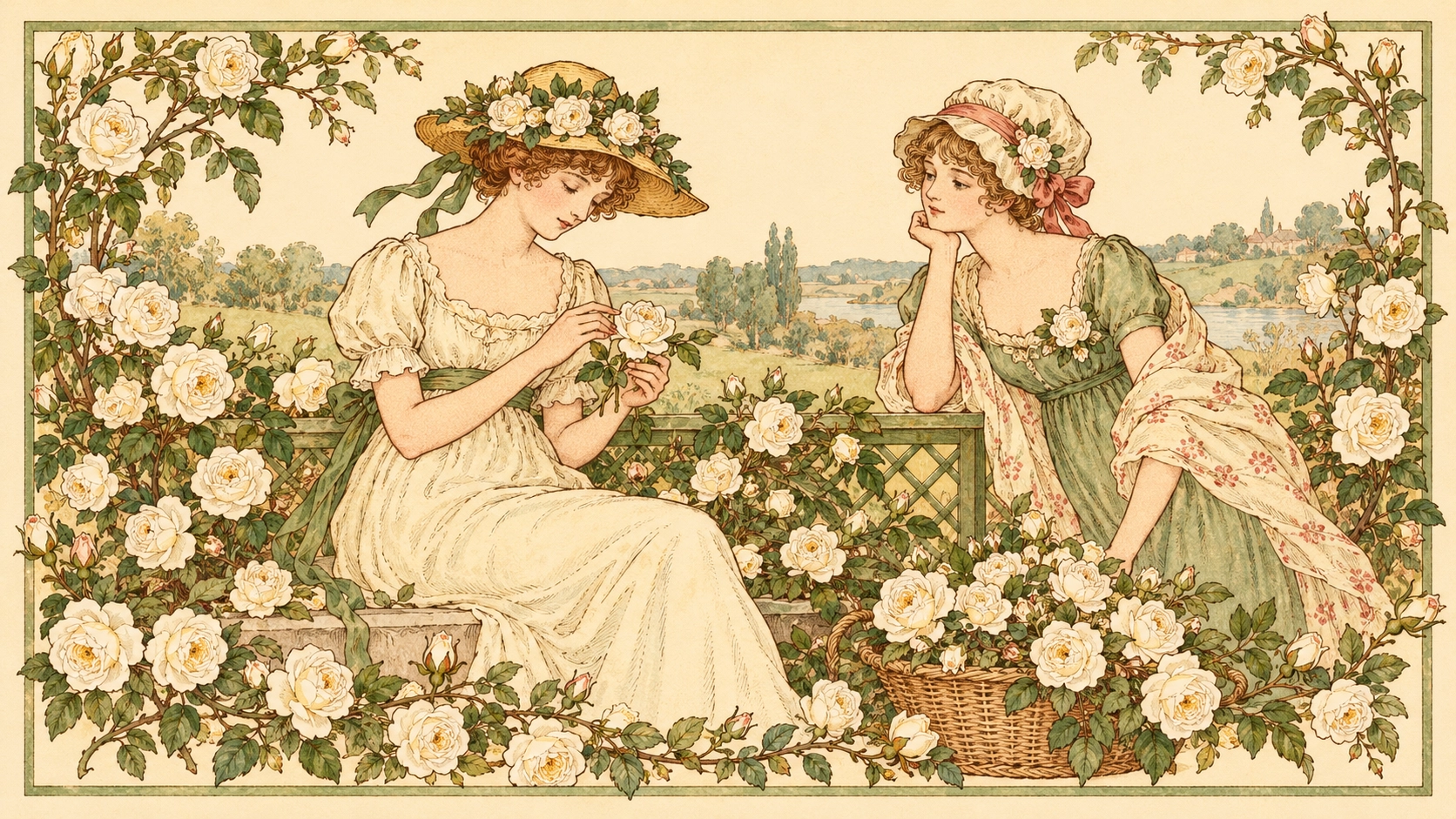
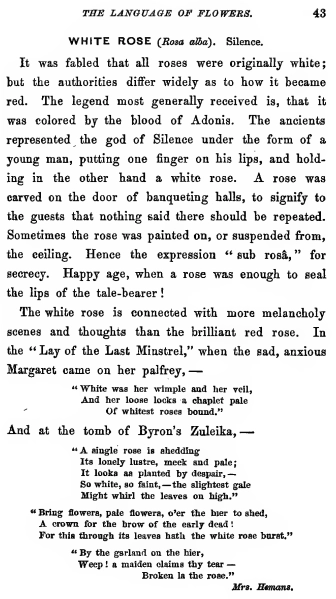
In an 1839 edition of The Language of Flowers; With Illustrative Poetry, revised by Frederic Shoberl, a white rose means silence. By the time Kate Greenaway published her Language of Flowers in 1884, a white rose meant “I am worthy of you.”
This is a fairly serious problem if you have been told there was one Victorian language of flowers.
Both books belong to the nineteenth-century fashion for floriography — the practice of assigning sentiments and messages to flowers — and offer long lists that look reassuringly like dictionaries. Open them at the same flower, though, and the dictionary starts arguing with itself.

The familiar version of this history is much neater. A Victorian admirer selected the right flowers, arranged them into a bouquet and sent a message that could not safely be spoken aloud. The recipient, apparently equipped with the correct botanical intelligence service, understood.
The books are real. The meanings are real in the sense that authors really printed them. The single shared code is where things become much less obliging.
The white rose changed with the dictionary
Greenaway’s white rose does not even have one meaning once the flower changes condition. Her plain white rose says “I am worthy of you.” A withered white rose means “Transient impressions”. A white rosebud means “Girlhood”.
Shoberl’s book is more ambitious still. Its preface lays out a small grammar for altering a floral message. Present a flower in its natural position and its sentiment is affirmative; turn it upside down and it becomes negative. A rosebud with its leaves and thorns carries one meaning, removing the thorns changes it, and stripping away the petals while keeping the thorns changes it again.
Position matters too. The book’s marigold means pain, but placing it on the head, heart or bosom produces different kinds of it. Even the pronouns receive instructions: incline the flower to the right for I, and to the left for thou.
These are wonderfully literal rules, and they belong to one particular book.
That is the problem with the tidy modern list — white rose: innocence; red rose: love; lavender: distrust. A period dictionary might distinguish colour, bud from blossom, fresh from withered, upright from reversed or one physical presentation from another. Another dictionary might begin with a different meaning altogether.
So the useful historical questions multiply very quickly. Which flower? Which form of it? Which dictionary? Which year?
A search result that gives only “Victorian meaning: X” has removed precisely the information needed to know how Victorian the answer really is.
1819 was the turning point for flower-language publishing
The roots of the Victorian craze are earlier than Victoria’s reign. In Beverly Seaton’s The Language of Flowers: A History, 1819 emerges as an especially important year.
Alexis Lucot’s Emblèmes de Flore appeared in January. In December came Le langage des fleurs, published in Paris under the name Madame Charlotte de Latour. Seaton describes the latter as the beginning of the great proliferation of flower-language books, while also finding considerable similarities between Latour and Lucot that extend beyond individual flower-and-meaning pairs.
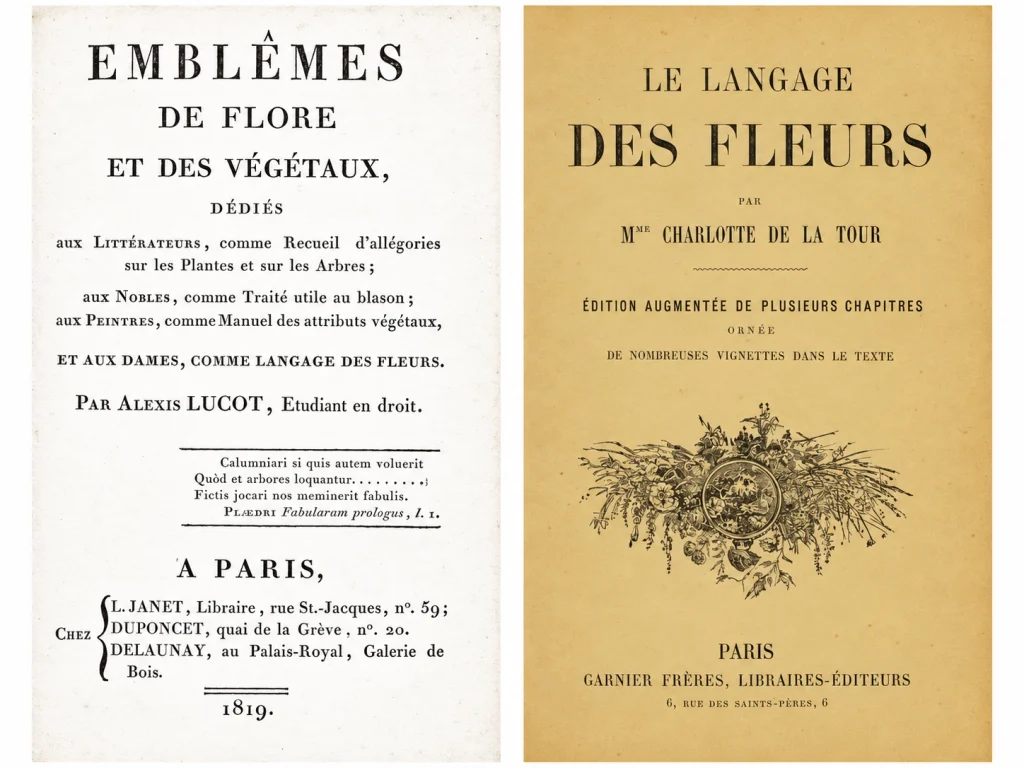
Lucot scan via HathiTrust Digital Library; Latour scan from Cornell University Library via the Biodiversity Heritage Library. Both public domain.
Lucot, rather wonderfully, put a warning opposite his title page threatening to prosecute “counterfeiters”. Seaton doubts that he ever pursued Latour. If he had, the history of romantic floral symbolism might have contained substantially more paperwork.
The borrowing matters because these books were already being assembled from other books. Seaton finds early compilers freely copying one another while also having to invent new material. The nineteenth-century flower language therefore expanded through repetition, alteration and invention at the same time.
Even the authorship of Le langage des fleurs is less settled than the familiar citation suggests. Seaton considers Louise Cortambert a possible identity behind “Charlotte de Latour” but says she cannot prove it, and also raises Aimé-Martin. The modern Bibliothèque nationale de France authority record identifies Charlotte de Latour with Louise Delaistre, épouse Cortambert; a separate BnF catalogue record for an 1845 edition still notes that the work was also attributed to Aimé Martin.
The bibliographical uncertainty sits beside a much clearer legacy: what spread was a successful publishing form, with flowers arranged into a vocabulary, surrounded by stories, poems and associations, ready for the next compiler to borrow, tidy, expand or disagree with.
The dictionary makers were editing the language while they printed it
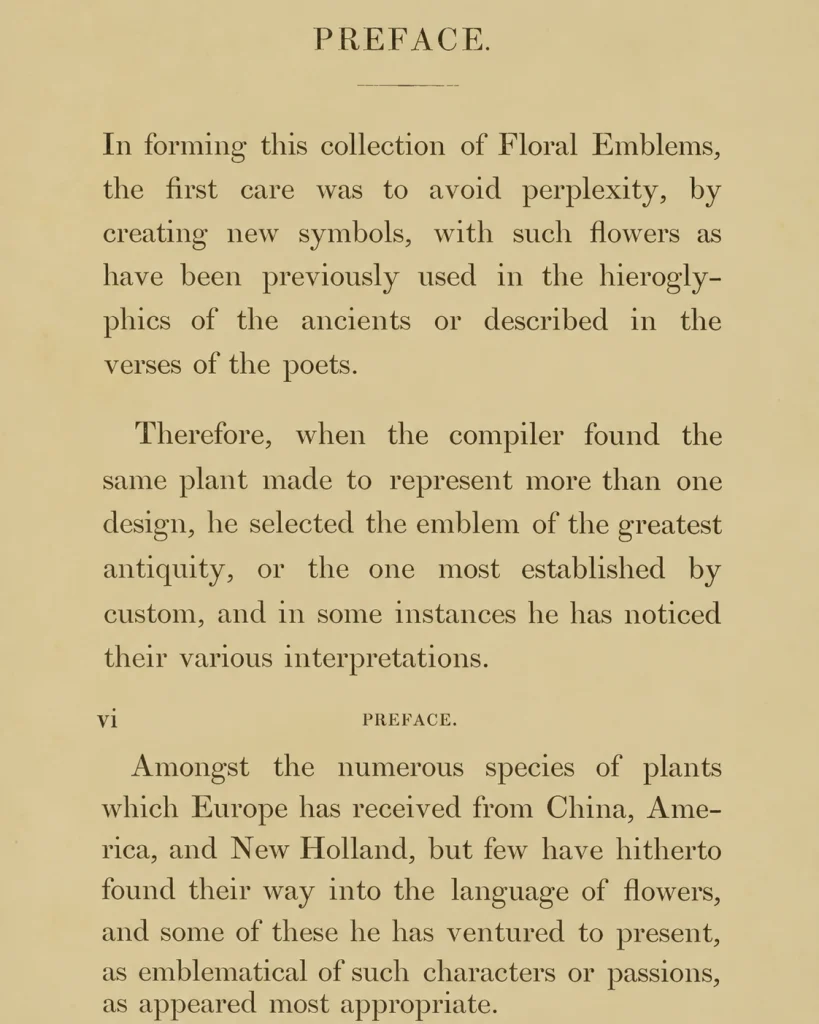
Henry Phillips was unusually frank about this. His Floral Emblems, published in London in 1825, drew on earlier French flower books alongside poetry, classical material and other symbolic traditions. In the preface Phillips explains that when the same plant carried several interpretations, he selected between them. For plants that had not yet acquired an emblem in the material he was using, he ventured to supply one. He also devised additional symbols for numbers, days and months.
His ambition was to establish a “settled collection of floral emblems”.
The word settled is doing heroic work.
Phillips was trying to make the system coherent precisely because the material available to him was not automatically coherent. In Brent Elliott’s The Victorian Language of Flowers for the RHS Lindley Library, the competing dictionaries become the point rather than an inconvenience: Elliott opens by remembering enquiries from people wanting the “real” meaning of a flower when his period sources kept supplying several different answers.
Phillips also shows why apparently contradictory rose meanings need careful handling. His book contains a separate emblem for a dried white rose, associated with preferring death to the loss of innocence. That should not be put beside Greenaway’s ordinary white rose as though the two authors were answering precisely the same question. To Phillips, the state of the flower was part of the entry.
Shoberl presents a different sort of editorial candour. His preface says the book is founded on a small French volume, but enough alterations have been introduced that it “cannot, strictly speaking, be called a translation.”
Authors inherited meanings, rejected meanings, translated them, altered them, added new plants and devised rules for using them.
A dictionary gives the impression that it is recording a language that already exists outside its pages. These books were often helping to manufacture the language on the page.
The books are easier to document than the bouquets
There is no difficulty proving that flower-language books circulated widely in the nineteenth century. They were published, translated, adapted, played with and reissued in considerable numbers.
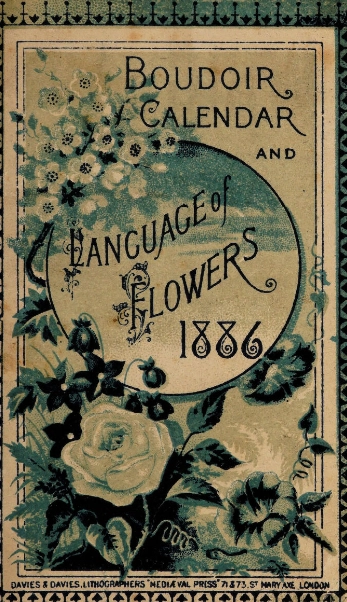
Finding the books is easy. Finding good evidence that people routinely used them to send elaborate coded bouquets is another matter.
English Heritage’s account of the language of flowers makes the distinction plainly: the books were popular, but it says there is “no real evidence” that people actually designed bouquets to deliver specific messages, suggesting instead that the system functioned more as a parlour game for genteel women.
Seaton reaches a similarly deflating conclusion. Her flower emblems, in her words, “only form a language in a book”. She finds flower meanings used in parlour games, but a bouquet presents a more basic difficulty. Put several emblems together and you have a collection of sentiments without reliable syntax.
There is no reliable way to tell which flower modifies which, or whether their order matters. Is the rose answering the carnation, or has the carnation just accused somebody of something dreadful on its own initiative?
Seaton gives a much more convincing social example: whose bouquet a young woman chose to carry could signal a suitor’s chances. Flowers could carry courtship, affection, remembrance, status and ritual significance without every gathering of stems functioning like a telegram.
The distinction is worth keeping because the exaggerated version is so seductive. A prohibited declaration of love smuggled through a bouquet is much more fun than a gift book used for a drawing-room game.
The less spectacular history is still peculiar enough. I have used flower meanings myself. At college, as part of my photography course, I made a tarot-based fashion project and drew floral borders around the cards. I would take the meaning I was working with — the card represents this, this flower is listed as representing something similar — and put the two together.
I was choosing from a reference system because it gave the image another layer. I was not under the impression that a passing nineteenth-century gentleman could inspect the border and recover my complete intentions before luncheon.
Oddly, I find the historical version more charming once the universal dictionary disappears. If two people wanted to use flowers privately, sharing the same book would make the whole thing rather sweet: a code because they understood its rules, rather than because an entire century had supposedly agreed that the hydrangea had one official opinion.
The useful question is not what a white rose meant to the Victorians. It is which book the other person had.
Leave a Reply