An umbrella allows you to carry your own little patch of shelter through a town centre. Unfortunately, everyone else is expected to accommodate it. Suddenly the ordinary business of walking along a pavement involves negotiations about height, distance, doorways and where somebody else’s umbrella is pointing.
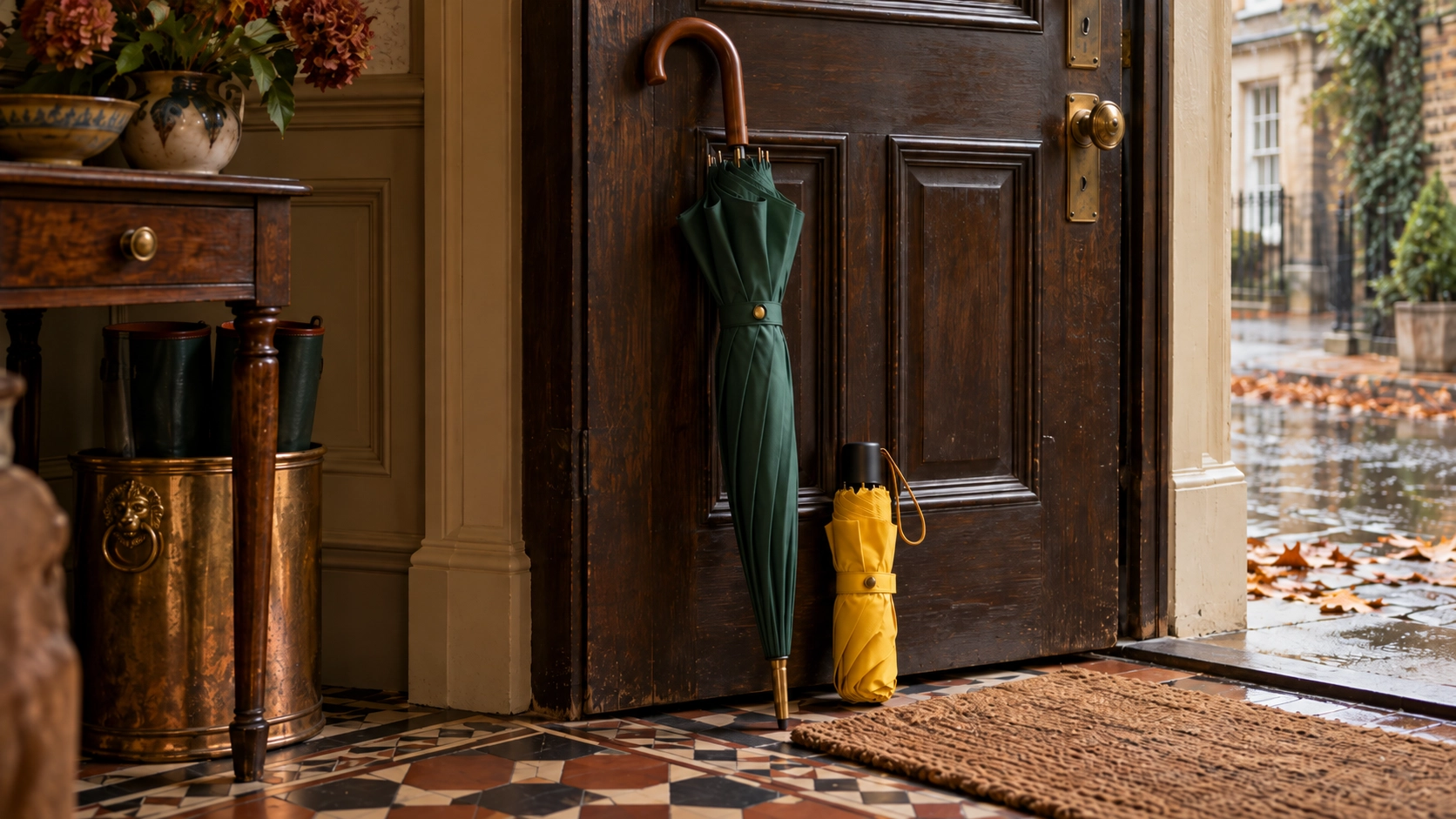
I rather like umbrellas. I have a smart green one for when I’m properly dressed and a little folding yellow one for brighter outfits.
For such an ordinary accessory, the umbrella has acquired a remarkable amount of social baggage. It has been mocked as unmanly, subjected to elaborate rules of conduct and treated as a potential omen of death. All because somebody wanted to avoid getting wet.
The man who didn’t invent the umbrella
Jonas Hanway is regularly credited with introducing the umbrella to England around 1750. It’s a satisfying story, particularly when accompanied by tales of London coachmen abusing him for carrying one.
The difficulty is that umbrellas were already here.
Heritage Crafts points to a mention in The Female Tatler from 1709 and John Gay’s Trivia: or, The Art of Walking the Streets of London, published in 1716. In Book I, Gay describes English women using umbrellas against winter rain, contrasting them with the ornamental sunshades of Persian women and rulers.
Hanway’s importance lies in his association with making regular umbrella-carrying acceptable for English men, rather than introducing an object nobody had previously encountered.
The Dictionary of National Biography records that he persevered despite jeering from pedestrians and opposition from chairmen and hackney coachmen. Heritage Crafts attributes the hostility of the professional drivers to fears that portable shelter might threaten their livelihoods.
There is something marvellously petty about it. A man could apparently become a public nuisance simply by declining to get wet. The umbrella was already useful, already known and already being carried by women, but a man holding one was another matter.
By the end of the eighteenth century, umbrellas were familiar enough to appear in satirical prints of ordinary London life. Isaac Cruikshank and George Moutard Woodward’s Returning from a rout on a rainy night, published in 1797, shows a group negotiating a wet street beneath enormous umbrellas.
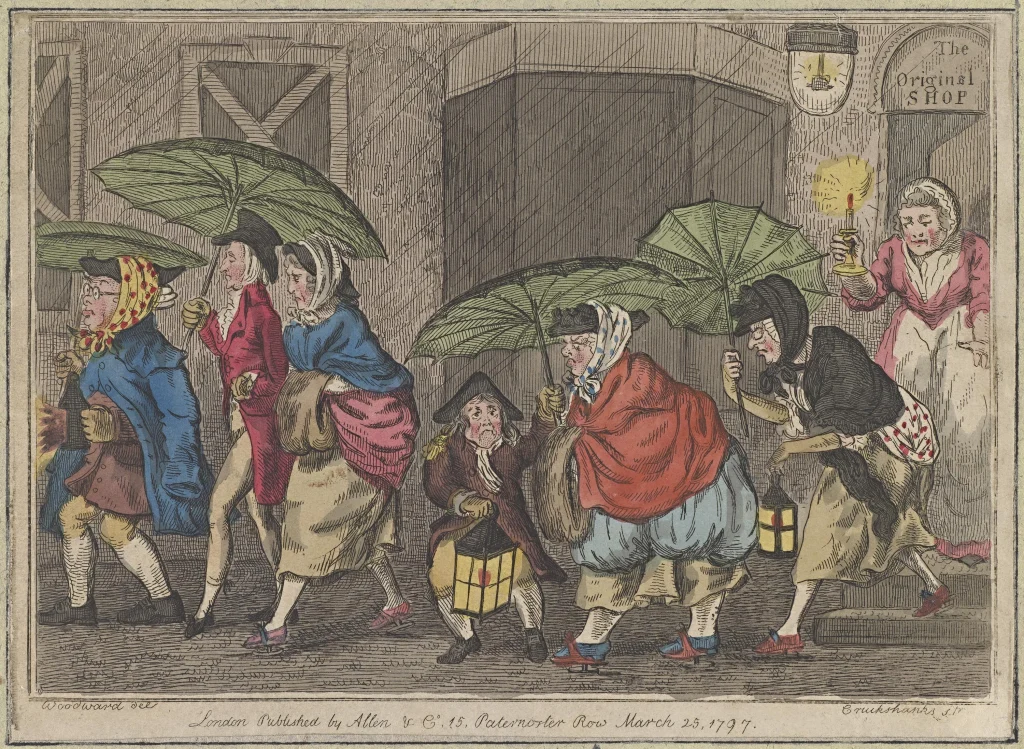
They look thoroughly accustomed to the arrangement. The umbrellas themselves look capable of occupying the entire pavement.
Your umbrella does not own the pavement
John Gay had already devoted considerable attention to the difficulties of walking through London. Book II of Trivia contains rules for passing fellow pedestrians and deciding who should have the safer position beside the buildings:
Let due civilities be strictly paid.
The wall surrender to the hooded maid;
The advice continues with instructions to make way for older people, porters carrying heavy loads and pedestrians who need assistance. Gay also distinguishes between people who deserve courtesy and swaggering bullies who apparently deserve a trip towards the gutter.
It is pedestrian etiquette with rather more aggression than Debrett’s would probably recommend.
More than a century later, an 1818 engraving in the London Museum collection shares the title The Art of Walking the Streets of London. One of its satirical panels, How to carry an umbrella, shows a pedestrian thrusting his umbrella into another person’s face. Other little disasters unfold around him.
The basic problem has barely changed. An open umbrella extends well beyond the person carrying it. The person beneath it may be perfectly comfortable while somebody alongside is being prodded by its edge or receiving a steady drip down their shoulder.
Even Debrett’s pedestrian etiquette guidance still devotes attention to umbrellas. It recommends that when two umbrella-carriers approach one another, the person nearer the buildings should raise theirs while the person nearer the road lowers theirs, allowing both to pass.
I love that this requires written instruction. Two people, two umbrellas, a perfectly ordinary pavement, and we have reached the stage of formal traffic management.
There is a practical point beneath the absurdity. Pay attention to where the fabric ends rather than merely where your own head is. Give people room where possible, and don’t open the thing suddenly in somebody’s face. At a doorway, close it without depositing the collected rain onto whoever happens to be standing beside you.
Even my little yellow umbrella, which is much less imposing than a traditional walking umbrella, can become an inconvenience if I’m paying more attention to my destination than the people around me.
The fact that an umbrella protects me from the weather doesn’t entitle me to make the weather somebody else’s problem.
Apparently, opening it indoors is even worse
Then there is the superstition.
Most people will have encountered the warning that opening an umbrella indoors brings bad luck. Depending on where you heard it, the explanation may have involved offending ancient gods, damaging the furniture or accidentally injuring somebody.
There is, however, a particularly interesting Shropshire record. I live in Shrewsbury, so this one lands rather closer to home than the usual collection of vaguely ancient warnings.
In Shropshire Folk-Lore, Charlotte Sophia Burne records that opening an umbrella inside a house was considered unlucky, especially when held over the head, when it became an omen of death.
Placing an umbrella on a table was another prohibited act. Bellows and boots appear in the same collection of offending household objects.
I find the escalation wonderful. Outside, the umbrella is performing an entirely sensible service. Bring it through the front door, and suddenly somebody may have to worry about their imminent demise.
Burne offers a rather good observation about how certain objects acquire these reputations. Many things, she writes, were thought unlucky “simply because they are unaccountable, unusual, or even only unsuitable.”
There’s something particularly recognisable about that last word. An object can be perfectly acceptable in one setting and deeply objectionable in another. We do it constantly with shoes, hats, coats, bags and things we consider rude to place on a dining table.
Some rules are practical, some are etiquette, and some have survived long after anyone can confidently explain why.
The umbrella has managed to collect all three.
Two umbrellas, three different moods
My own umbrellas have rather less historical significance, but they do have distinct responsibilities.
The green one is my smart umbrella. It belongs with brown coats, dark orange, plum and the warmer, deeper colours I enjoy wearing — much the same palette I use for dark academia outfits in ordinary life. It looks considered without demanding that the entire outfit accommodate it.
The little yellow one does something different. It is bright, cheerful and a little childish in a way I genuinely like. With strong pink, vivid blue or other bold colours, it feels entirely deliberate.
An umbrella is a surprisingly visible accessory. You might spend time choosing a coat, a pair of shoes or a particular shirt, only to spend the entire walk through town under a large patch of fabric that is effectively the most conspicuous part of your outfit.
Of course I care what colour it is.
I would quite like a black umbrella as well. With an all-black outfit, black is better than green. There is something pleasing about taking a colour scheme all the way through to the object you’re carrying in your hand.
But on an ordinary weekday, when I’m walking to work or getting groceries, I may prefer the hood of my raincoat. It is attached to something I’m already wearing, leaves my hands free and requires considerably less negotiation with approaching pedestrians.
I don’t feel obliged to look particularly elegant while buying washing-up liquid.
The umbrella comes out when it suits the clothes, the occasion and my mood. It is a small form of dressing for the day I’m actually having.
Would I buy a vintage umbrella?
Old umbrellas are seductive in the way old luggage is seductive: they appear to have come back from somewhere interesting. That may be true. It does not mean they should go out again.
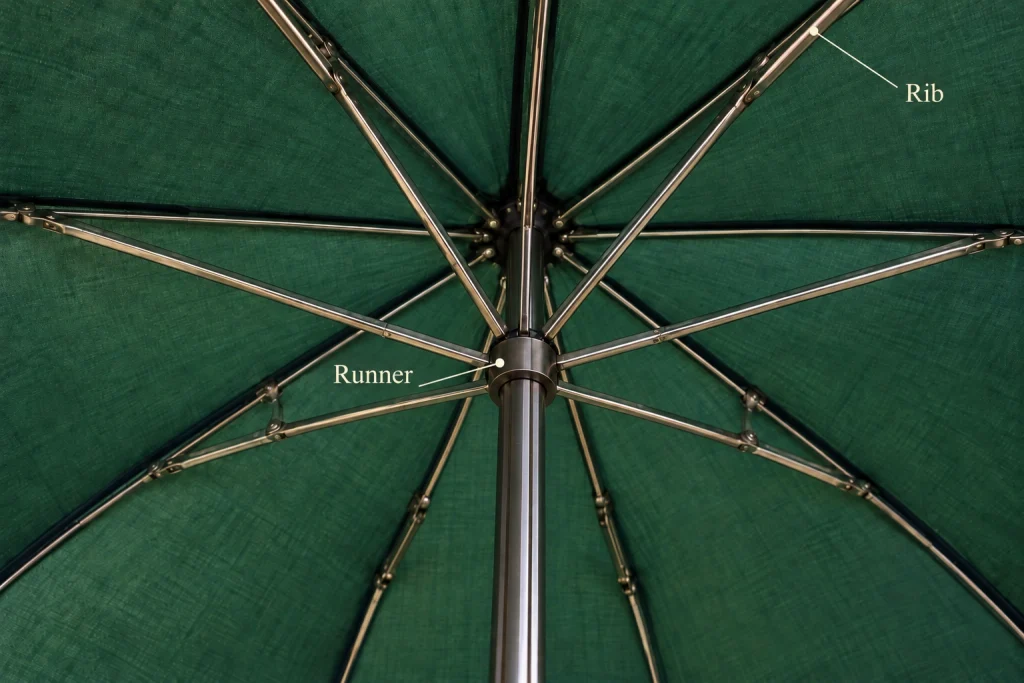
If I were considering one second-hand, I’d ask to open and close it somewhere there is room, and watch the movement rather than the finish. The runner, the sliding collar that opens the frame, should travel without sticking or having to be bullied. Look along the ribs, the narrow supports beneath the fabric, for bent sections, loose joints or awkward repairs. Hold the open umbrella towards the light to spot pinholes, thinned patches and splits near the seams. Check that the handle feels secure and that the umbrella folds and fastens properly. A stale, damp smell is not improved by a handsome wooden handle.
I’d also ask one unromantic question: can I carry this through a wet Saturday without spending the whole time worrying about it? If its charm depends on never exposing it to rain, it belongs in a collection, not in my hand on the way into town.
Whichever I choose, I still have to get through the doorway without soaking whoever is coming out.
Leave a Reply