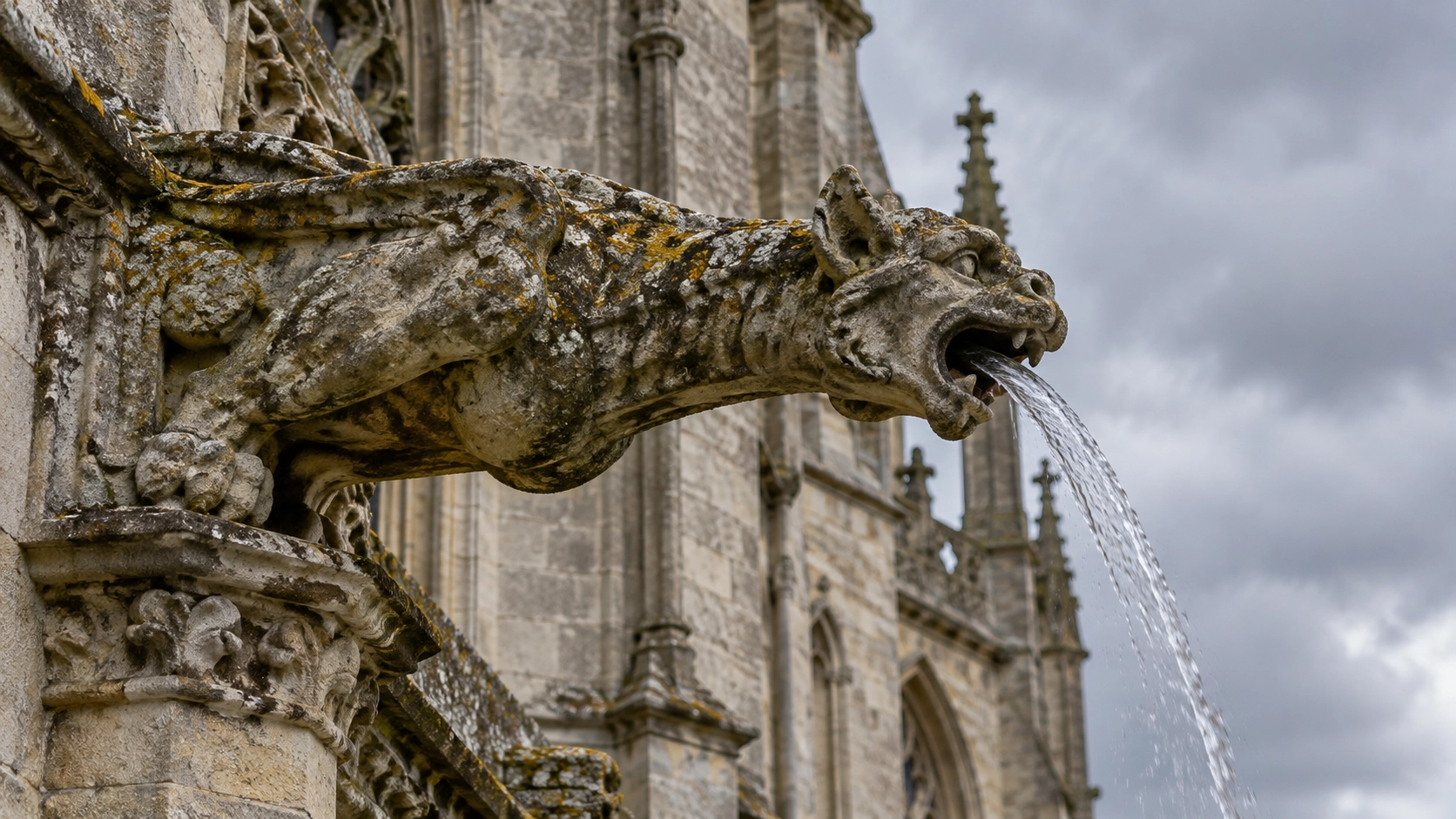
A gargoyle is a carved waterspout that directs rainwater away from a building. A grotesque is an ornamental carving with no drainage channel. Both may have fangs, wings and a face suggesting considerable personal difficulties, but only the gargoyle has to work in the rain.
The distinction is easy enough to remember. The more interesting question is why a church needed stone monsters to dispose of its water in the first place, and what happens when those monsters finally wear out.
First, get the rain off the roof
Picture a large church in heavy rain. Water runs down the roof, and it has to end up somewhere that will not steadily soak the walls. A straightforward pitched roof can use broad overhanging eaves — the lower edges of the roof projecting beyond the wall — to throw water clear.
A parapet — a low wall rising above the roof edge — gives a cathedral its impressive, uninterrupted outline. Behind it, rainwater cannot simply slide off the edge. It needs an outlet.
A parapet gutter is the channel concealed behind that wall, often lined with lead in historic buildings. Water travels along it towards an outlet through the masonry. Building conservation specialist Jonathan Taylor explains the arrangement in his account of rainwater disposal in historic churches. The elaborate roofline also comes with a gutter that must be cleaned. Leaves remain unimpressed by Gothic architecture.
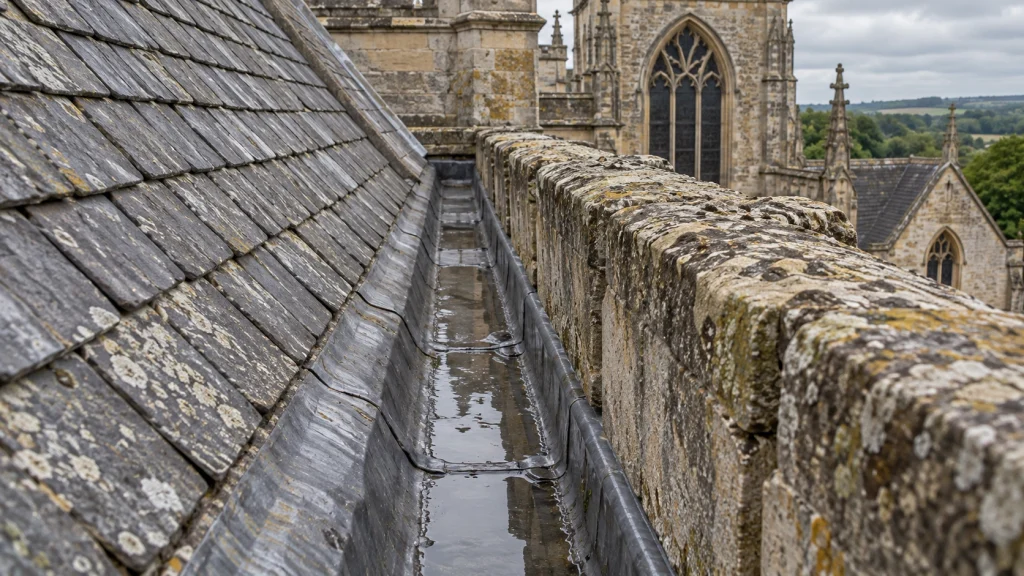
The outlet is where the stone carver enters the story.
The gargoyle sends it flying
A stone spout projects beyond the wall so that the rain leaves the building in a stream and falls some distance from the masonry. The gargoyle is that spout made into a creature: water travels through the channel and usually emerges from an open mouth.
The distance matters. Water repeatedly running against a wall can damage mortar and stone. The spout keeps the flow away from the building’s face, although poor drainage where it lands can still leave the base of the church wet.
A projecting spout gives the carver peculiar freedom. The water channel must work, the stone must support its own projection, and the whole thing must withstand weather. Beyond that, the mouth can belong to practically anything.
Look at a gargoyle from the side. Find the outlet; see how far the mouth projects. The creature becomes a shaped piece of drainage equipment, a better achievement than simply giving a building teeth.
A grotesque has no such contractual obligations. It can leer from a corner without carrying a drop of water. Its meaning depends on the particular building; an alarming face is not automatically evidence of a universal medieval belief about frightening away evil.
Then somebody offered the rain a downpipe
Gargoyles were never the only solution. Taylor records lead hoppers and downpipes at the Tower of London as early as the thirteenth century. A hopper is a collecting head that receives rainwater and feeds it into a vertical pipe. Instead of shooting out through a stone mouth, water can run down the building in a controlled channel and into drainage below.
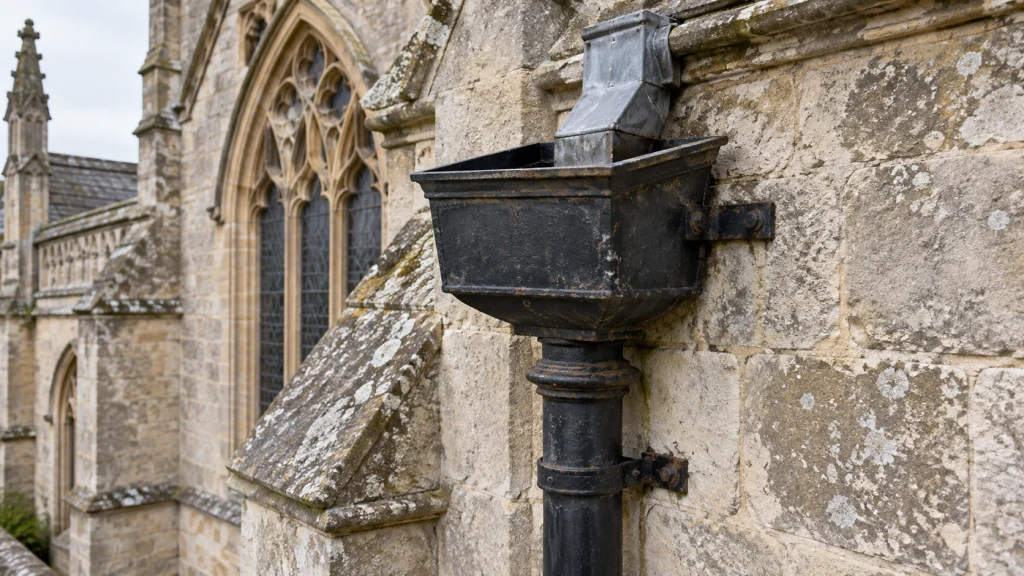
The change was gradual. Cast-iron rainwater fittings began to provide a simpler, more widely used system from the late eighteenth century; by the middle of the nineteenth, gutters and downpipes had become predominant. That did not mean every gargoyle immediately retired. Some historic carvings remain part of working drainage systems, and old stone spouts can coexist with later pipework.
A roof may retain splendid projecting faces even when pipes handle much of the rainwater. Once you know the route — roof, parapet gutter, outlet, then either a projecting spout or a collecting hopper and downpipe — the carvings become easier to read. But it also exposes a less picturesque problem: stone left outside for centuries does eventually fail.
What do you replace when the original has almost disappeared?
Wind, rain, frost and pollution erode exposed stone. A face becomes a lump with a suggestion of teeth. An important old carving may become too unsound to keep in place.
Conservation then becomes a problem of evidence as well as workmanship. If enough survives, a mason can follow the old design. If the details have vanished, a supposed faithful copy is really somebody’s guess dressed as history.
I am inclined to distrust replacement stonework that arrives pretending to have been weathered for several centuries. I’ve made much the same complaint about faux-aged furniture: a new object does not improve simply because somebody has supplied it with counterfeit wear. Cathedral stonework raises the stakes because a repair can also overwrite what little evidence remains of the original.
Ripon Cathedral dealt with that problem unusually well.
Ripon: when copying is right, and when invention is better
In 2015, Ripon Cathedral replaced three failing gargoyles. The important detail is that they were not all in the same condition.
Two had eroded so badly that their original appearance could no longer be read. The third still retained recognisable features, including claws and belly feathers, but was structurally unsound. The cathedral’s conservation policy therefore required two different responses: create new work where the details were lost, and reconstruct the surviving design as faithfully as the evidence allowed where they remained.
Cathedral architect Oliver Caroe and archaeologist Liz Humble explain in Commission by Competition that the new designs had to respect the surviving base of each carving and Gothic architectural principles. They must not imitate an ancient patina.
The cathedral ran a competition judged by the dean, architect, conservation representatives and two experienced stone carvers. Designs were assessed for technical construction as well as artistic merit. The decision belonged to craftspeople and custodians, informed by what survived of the stone.
The case study includes before-and-after photographs. Alan Micklethwaite carved a retching woman, her mouth providing a particularly revolting exit for rainwater. Tom Nicholls carved a bat based on the local Daubenton’s bat. Martin Coward took the third commission, following the recognisable original form while reconstructing missing details.
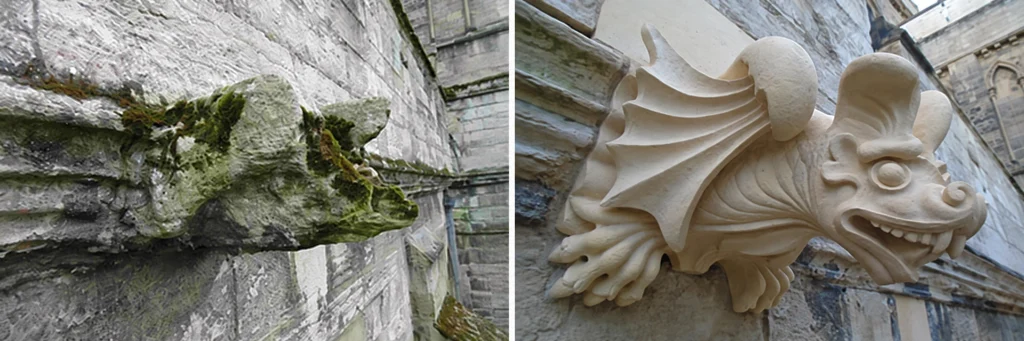
Nicholls’ bat is my favourite. Its ears and claws reach beyond the architectural lines, while its features become a forceful Gothic silhouette. It belongs to the stonework rather than resembling a natural-history model balanced on top. London Stone Carving’s photographs show its projection and rainwater function.
The retching woman is deliberately unpleasant, but the unpleasantness has a job: she seems to be expelling exactly what the building needs to get rid of. I like it more as a gargoyle than I would as an ornament. Coward’s more conservative reconstruction deserves equal credit for a less flamboyant reason. In his case, the surviving carving had something definite to say, and the new one listened.
Three replacements, two different principles, no need to pretend that all three are medieval. That seems a much better policy than either copying everything or treating every loss as a blank cheque.
When the joke becomes the whole design
There are other, more conspicuous attempts to put a modern face on old stone. At Paisley Abbey, a replacement gargoyle from the 1990s looks uncannily like the creature from Alien. The Scottish Civic Trust records the resemblance; whether the carver meant a direct film reference is less firmly established. I find it wonderfully ridiculous and rather naff. The first thing the carving asks you to recognise is somebody else’s monster.
Washington National Cathedral has a literal Darth Vader grotesque, selected through a children’s design competition in the 1980s. The cathedral’s own photograph and account show a splendid competition idea and, to my eye, an unpersuasive permanent carving. The helmet is still a helmet. There is little transformation in moving a familiar film design from screen to stone.
I do not object to a joke on a cathedral. I object when recognition does nearly all the artistic work.
Canterbury: the animals have a reason to be there
At Canterbury Cathedral, four new grotesques were revealed after scaffolding came down in April 2026. The old carvings on the west towers had deteriorated so thoroughly that their subjects could no longer be identified. The cathedral’s stonemasons, led by Benn Swinfield, made four new creatures with a deliberate connection to Kent’s wildlife.
The cathedral’s September 2026 account, with real photographs of the carvings explains the choices. A beaver represents an animal returned to local waterways. A peregrine falcon reflects birds living at the cathedral itself. The red-billed chough has returned to Kent after more than 200 years’ absence, while the pine marten remains absent, with conservation organisations investigating its possible return.
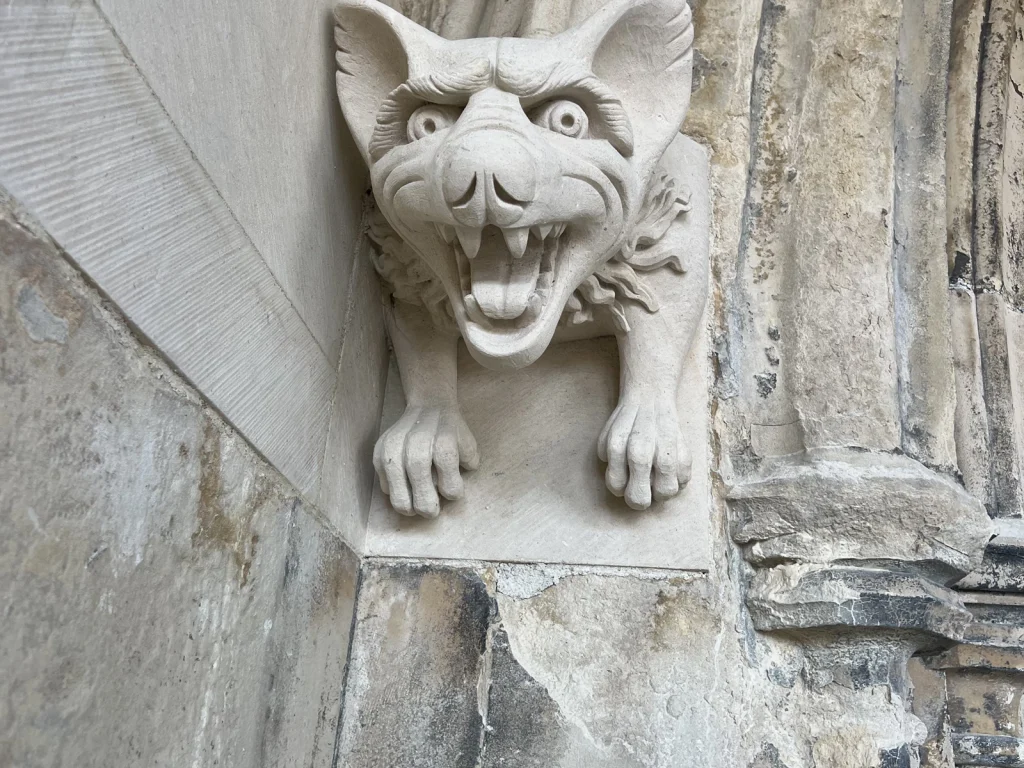
The pine marten is already there in stone, above the Great West Door. In the Kent countryside, it is still missing.
Leave a Reply