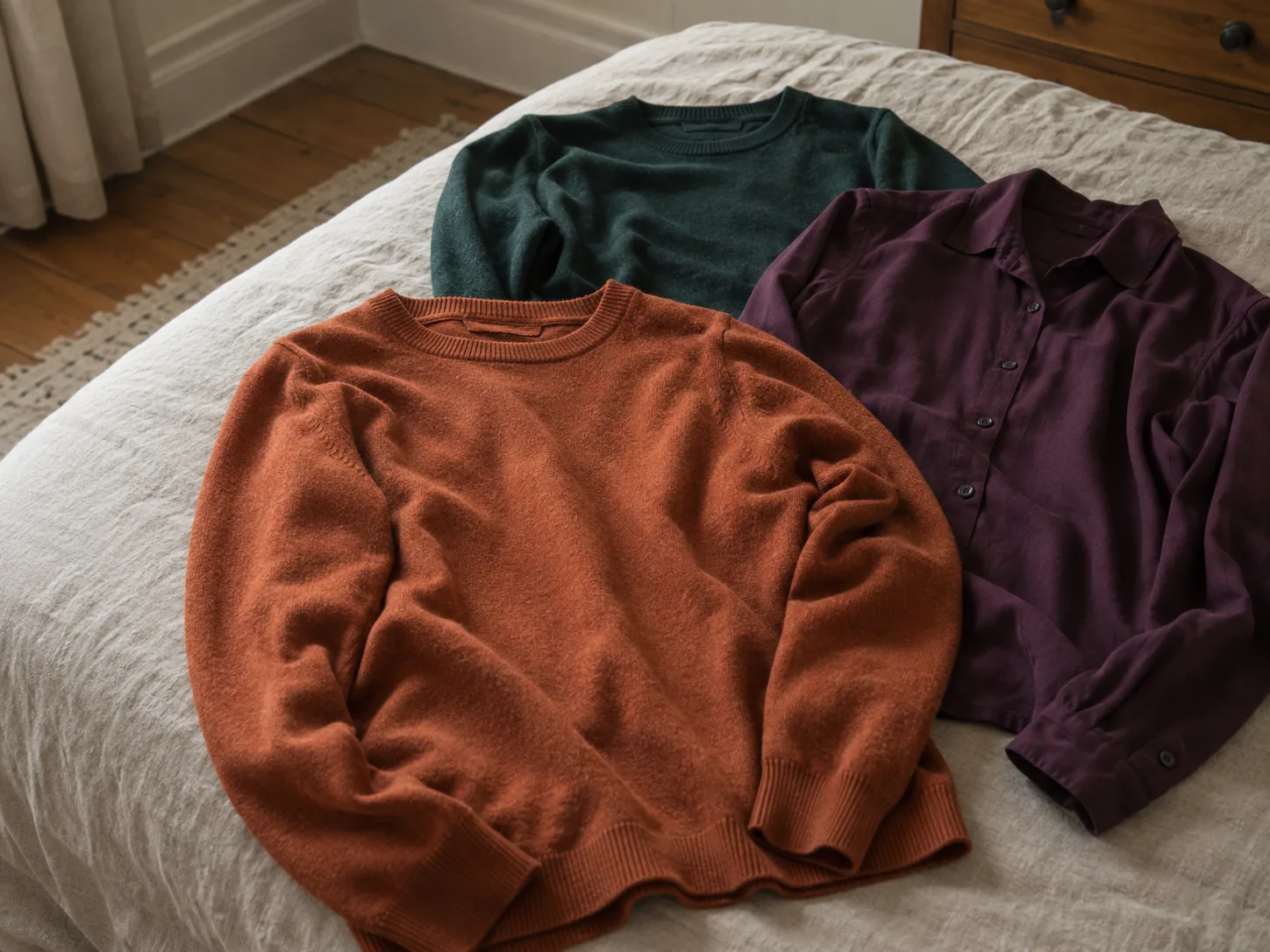
The least bobbly of the three garments I pulled out for this article cost me £8.
It is a muted rust cotton crew-neck jumper from a charity shop, about two years old, with a surface that still looks remarkably clean from ordinary standing distance. Its left side seam has also wandered several centimetres towards the front and the hem no longer hangs quite level. If pilling were a complete quality test, this thing would be winning.
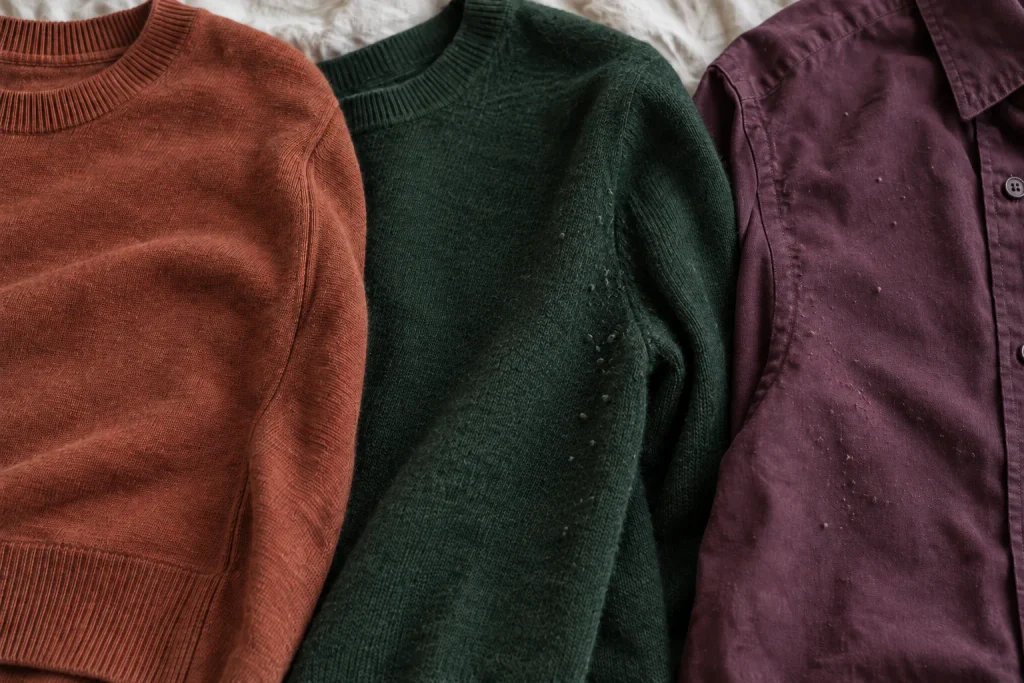
The most expensive is a dark bottle-green cashmere jumper I bought new in an end-of-season sale for £110. It has done five winters. The ribbing is still good, the shape still works and I still want to wear it. It also has fine pills beneath the arms and along the sides. I noticed more of them during its first couple of winters than I do now, and I have combed the surface lightly on a few occasions.
The third garment is not a jumper at all. It is the deep plum polyester-viscose shirt I bought on Vinted for £11 plus postage, and it is here because it has the most useful history. I have already taken a debobbler to it once. The surface improved. After more wear, some of the bobbling came back.
Trying to rank those three garments by the neatness of their surfaces gives me an answer I do not trust. The £8 cotton looks best and hangs worst. The cashmere pills and remains a good jumper. The plum shirt has been groomed and has started bobbling again.
Pilling is evidence. It is simply much noisier evidence than the little balls on the surface make it look.
What the surface is doing
A pill does not appear fully formed and then sit on a garment for ever.
A 2020 open-access paper from researchers at Lodz University of Technology describes several stages in the process. Mechanical action brings fibres out towards the surface, creating fuzz. Those protruding fibres can become entangled into pills. With continued rubbing, laundering and wear, some of the fibres still holding a pill to the cloth can pull out or break, and pills may eventually be shed. The surface we see at any one moment reflects several things happening alongside one another: more fibre appearing, pills forming and fibres or pills wearing off.
That makes the obvious reading of a smooth jumper rather unreliable.
Fewer visible pills can mean that the fabric is resisting their formation well. Pills can also wear away at different rates. The Lodz paper discusses how differences in fibre, yarn and fabric alter the balance between formation and wear-off; in some constructions, surface fibres can even wear away before much pill formation becomes visible.
So counting bobbles as though they were permanent damage points gets us only so far. The surface is showing one stage in its wear, rather than a complete account of everything that has happened to it.
Abrasion still matters. Woolmark says rubbing during wear contributes to wool pilling and points particularly to the underarms, sleeves and sides, as well as contact with other surfaces. That was the useful limit of the point when I wrote about dressing for a desk job: repeated contact can contribute to pilling. My shirt cannot identify the office chair as the culprit merely because the two have spent a lot of time together.
Once you know that, fewer pills can still be good news. They just cannot issue a certificate of character on behalf of the entire jumper.
What changes how a fabric pills
The opposite overcorrection is to decide that because good knitwear can pill, bobbling tells us nothing about how cloth was made.
The evidence is less convenient than that.
Textile researchers Gonca Özçelik Kayseri and Erhan Kirtay studied cotton interlock knits made using different cotton blends, yarn counts, twist levels and fabric tightnesses. Within the fabrics they tested, higher yarn twist and greater fabric cover were associated with lower pilling propensity, while a greater proportion of short fibres was associated with more pilling. Their model for total pill count also found fewer pills as average fibre length, yarn twist and fabric cover increased.
Those were cotton interlock knits. I cannot take the findings, point them at a cashmere crew neck and announce that textile science has finished for the day.
They do independently establish the useful part: fibre, yarn and fabric construction can affect what happens at the surface.
For wool, Woolmark gives designers broadly similar advice, recommending longer fibres, higher practicable yarn twist and greater fabric cover where reducing pilling is the aim. Woolmark is an industry organisation, which is why I would rather have the independent cotton work beside it than make one wool body responsible for most of the article.
Then cashmere arrives to make the quality argument properly awkward.
Johnstons of Elgin, a cashmere manufacturer, tells its customers that small pills may appear after the first few wears of knitted cashmere, describing loose fibres becoming tangled where areas rub during wear. The Cashmere and Camel Hair Manufacturers Institute, an industry body, makes a different but compatible point in its buying guide: it identifies fibre length and fineness as important quality characteristics and says longer, finer cashmere fibres tend to pill less.
Price itself does not appear in that physical sequence. Fibre properties, yarn and construction do.
My bottle-green jumper cost £110 and has pilled. I remember more of it in the first couple of winters and less now. That observation cannot tell me why. Johnstons can describe one reason pills may appear early in cashmere wear; I cannot borrow that explanation and quietly turn it into the history of my particular jumper.
Its own evidence is more modest. After five winters, it still holds its shape, the ribbing is still sound and I still like wearing it.
The pills get a vote. They do not get the casting vote.
When the bobbles come back
The plum shirt is more awkward because I have already done something about it.
When I wrote about dressing for a desk job, I mentioned that the shirt had stubborn bobbling even after a pass with a debobbler. I also refused to blame the office chair. The shirt spends hours against a chair and desk, and abrasion is relevant to pilling, but that leaves several other parts of the mechanism unresolved.
What I know now is smaller and more useful: I removed visible bobbles, the shirt looked better, and after further wear visible bobbling developed again.
The Lodz research explains why removing the existing pills need not end the surface process. As a textile continues to be used, more fibres can emerge and become entangled while other fibres and pills wear away. Grooming changes what is on the surface at that moment; it does not alter that whole cycle into a one-off event.
Recurrence therefore gives me a maintenance fact before it gives me anything resembling a diagnosis.
It cannot tell me that the polyester-viscose cloth is poor. It does not establish that the shirt is deteriorating unusually quickly, identify my desk as the cause or prove that the debobbler somehow failed. The same returning bobbles also give me no reliable answer to another question I would quite like answered: how many more times can I safely remove them?
That gap remains.
My beginner clothing-care guide already recommends using bobble removers and fabric shavers lightly because they cut material from the surface, testing first and stopping once the appearance has improved. What I still cannot support is a universal number of passes, a lifetime allowance of de-pilling sessions or a visible point at which repeated cosmetic grooming becomes meaningful structural thinning.
I would rather leave the number blank than invent one because three passes sounds reassuringly scientific.
Recurrence can still change what I do. If a garment needs repeated grooming to stay at the level of smoothness I like, that becomes part of owning it. The useful measure for me is ordinary wear: how often am I reaching for the comb or shaver compared with how often I actually reach for the garment?
That tells me about the maintenance burden. Fibre quality remains a separate question.
With the plum shirt, the useful fact is that the effect of grooming did not last indefinitely. The cause remains open.
Smooth enough
The plum shirt already has another problem.
As I wrote in the desk-job piece, the fit is closer through the body than I now prefer, particularly after several hours sitting down. I still like the colour and the way I can wear the collar open, but it has ceased to be my idea of an easy eight-hour work shirt.
A debobbler can make that shirt neater. It cannot give me the extra room I want through the body.
That changes how much enthusiasm I have for keeping its surface immaculate. I am not binning the shirt because some bobbles returned, and their return has not suddenly proved that I bought rubbish for £11. But I have no great desire to make de-pilling it a recurring appointment when another part of the garment already limits how often I choose it for work.
If the surface becomes scruffy enough to bother me, I may tidy it. Perfectly smooth is not a standard I am particularly interested in enforcing there.
The cashmere gets more of my attention.
There is no competing argument about the fit. The crew neck still sits properly, the body has kept its shape and the ribbed hem has not developed any ambitions of its own. Five winters in, it remains a jumper I want in the wardrobe.
I have combed the obvious pills lightly a few times. Johnstons recommends careful combing for knitted cashmere, while my broader care guide supplies the caution I would apply to any surface-removal tool: gentle treatment, and no pursuit of perfect smoothness at the expense of the cloth.
I do not timetable this. When the surface gets distracting, I deal with some of it. When it does not, the jumper gets worn.
There are still a few fine pills beneath the arms when I pull it on.
I button my coat over it.
Leave a Reply