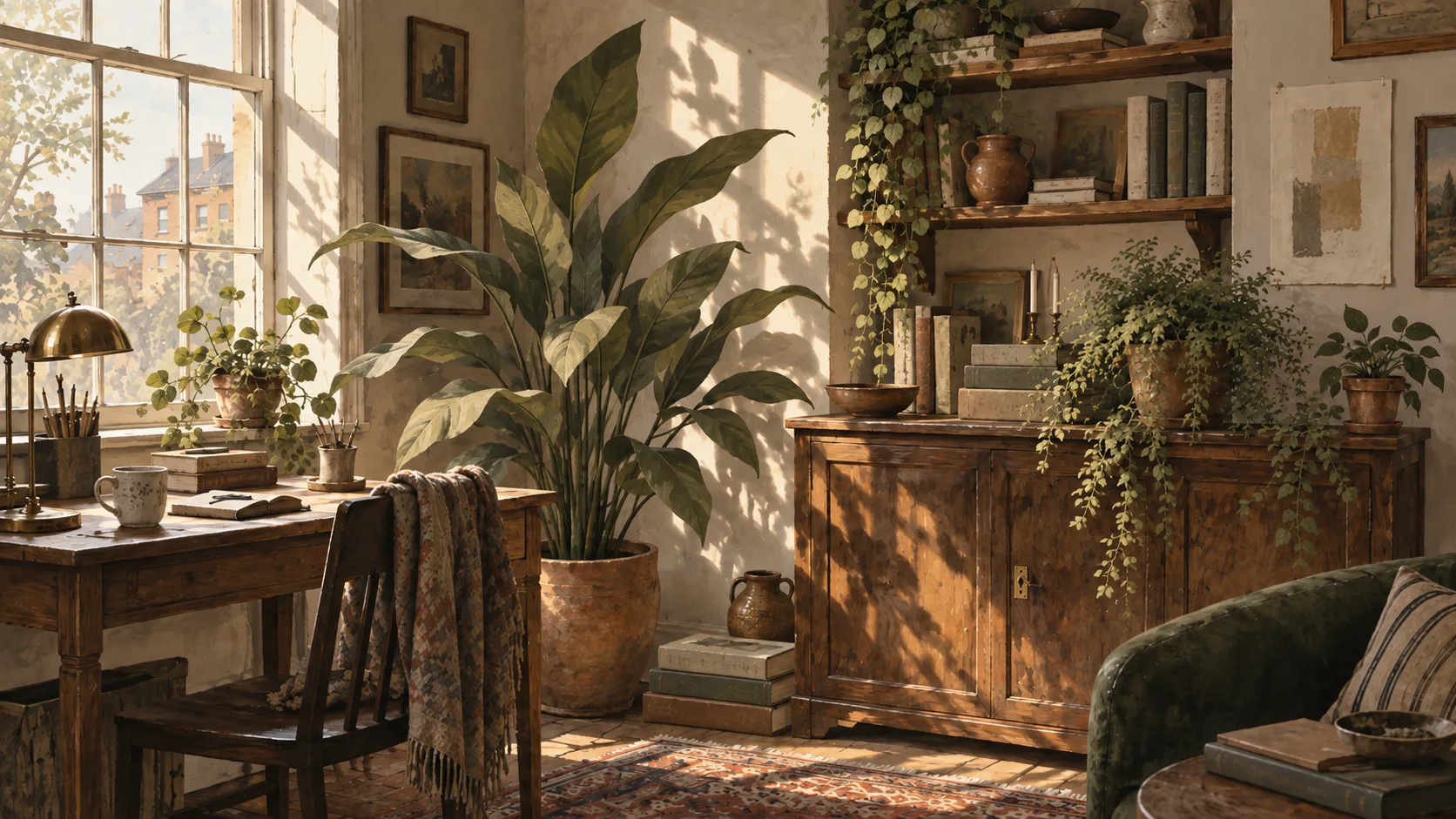
Some rooms with houseplants feel older, stranger and more inhabited; others simply contain a plant.
A single large plant can make an empty corner feel as though the room has grown around it. Trailing stems can cross the neat edge of a shelf. Fine foliage can soften furniture that looked rather pleased with its straight lines five minutes earlier. Then there are the twenty identical little pots lined across a windowsill like an herbaceous firing squad, technically alive and doing almost nothing to the room at all.
When I call a room magical, I do not mean you should be taking cuttings, chucking them into a cauldron and waiting for the wallpaper to levitate.
I mean that houseplants can bring a genuine bit of magic to an interior by making it feel less static and less completely designed. Something in the room grows towards the light, becomes asymmetrical, throws irregular shadows, drops old leaves, gets too large for the place you originally chose and generally refuses to remain exactly where it was composed.
That is what makes a room feel inhabited rather than staged.
I realised that decorating with houseplants makes more sense when I judge them using much of the same vocabulary I use for clothes: silhouette, texture, proportion and wear. A large plant can alter the silhouette of a corner. Fine foliage changes texture. A tiny pot can be badly proportioned for the space around it. Plants acquire their own version of wear — except that much of it is growth: stems lengthen, leaves turn towards light and the neat specimen you bought gradually develops opinions about where it would prefer to be. It is the same critical apparatus, pointed at a corner instead of a body.
I have used the same principle before when looking at how to make a modern room feel old-world: start with proportion, material and the room’s larger lines before adding atmosphere.
I have only been keeping houseplants seriously for about a year. I do not grow difficult species, and my repotting career could still be itemised without much difficulty. What I do have is a small collection living in real rooms, enough time with it to notice which plants materially change those rooms, and a household constraint that stops placement becoming an exercise in arranging pretty things wherever they photograph best.
That is more useful than choosing a plant because somebody has labelled it cottagecore.
Light and safety come before placement
Interior-design advice about plants has a bad habit of beginning with the empty corner, although the plant has requirements of its own.
Before asking where a shape would improve the composition, you have to ask where the plant can actually live. Light constrains placement before placement can become a design decision.
The monstera gives the clearest example because light affects the very silhouette you wanted it for. The RHS recommends bright but indirect light and notes that plants growing in poor light often develop fewer of the characteristic holes in their leaves. Put one in a gloomy corner because the corner needs a dramatic monstera and you may gradually get less of the visual feature that made it useful there in the first place.
The same constraint applies differently across species. The parlour palm prefers bright indirect light but can tolerate lower levels, while string of bananas wants a bright position and can tolerate some sun. Those requirements have already narrowed the available places before composition enters the discussion.
Prayer plants have their own version of the same constraint. The RHS recommends bright filtered or indirect light for Maranta leuconeura.
The perfect compositional position means nothing if it steadily produces a worse plant.
My aloe made the problem unexpectedly literal while I was researching this article. I had been treating it mainly as a small plant that was awkward to place; then I discovered that the ASPCA lists Aloe vera as toxic to cats. I moved it before I finished writing. It still needs a bright position, so the new problem was finding somewhere that worked for the plant without leaving it where the cats could easily get at it.
That is the whole problem in miniature. Horticulture says where the plant can thrive; safety removes some of those positions; only then does the room get to express an opinion.
There are five cats in this house. One is mine, but it is a shared home, so I cannot base every decision on one animal’s habits or assume that I personally control every door.
Several plants I own are listed as toxic to cats. The ASPCA’s cat plant list identifies Monstera deliciosa, English ivy and Aloe vera among plants toxic to cats.
String of bananas needs a separate source. North Carolina State Extension identifies Curio radicans as having low-severity poison characteristics, flags it as a problem for cats and says it is toxic if ingested by pets.
Those sources establish the toxicity. What I do with that information in my own house is a household compromise, not a general recommendation to keep toxic plants around pets.
My rule has been that toxicity changes the floor plan.
The monstera lives in the bedroom, where the door stays shut and the cats are not allowed. The ivy and string of bananas hang from the conservatory roof in positions these particular cats have never shown the slightest interest in reaching.
That is an observation about this household, not a recommended safe height. Five feet is not a magical force field, and another cat might regard it as a warm-up.
The plant that changes the shape of a room most dramatically is also the one I can only keep in a room nobody else uses.
Placement has to do several jobs simultaneously: support the plant, keep the household safe and improve the room. Sometimes there will be no position that satisfies all three, and then an attractive empty corner has to remain empty.
Large plants can redraw a room
The quickest way for a plant to change an interior is through silhouette.
Corners are normally made from very decisive geometry: floor meets wall, wall meets wall, furniture introduces another rectangle. Put enough irregular plant mass into that structure and the eye begins reading a different shape.
This is why scale matters before species. A plant with enough height or spread can occupy what was previously negative space, interrupt a long bare wall and make the hard edge of a room less obvious. It becomes part of the architecture rather than an ornament standing beside it.
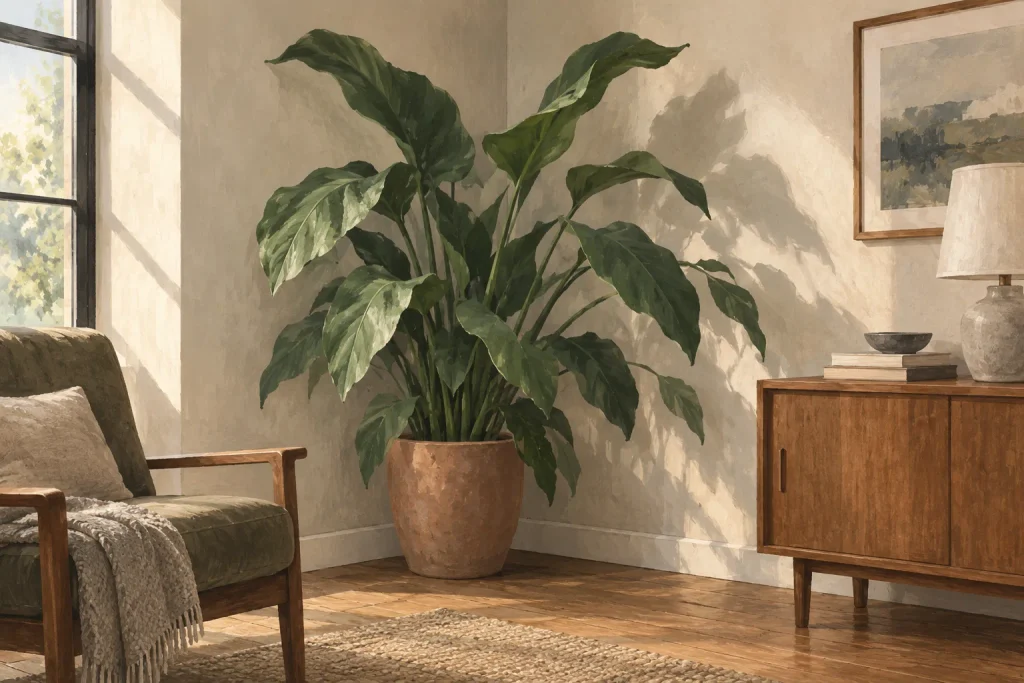
My monstera does this in the bedroom. It has become large enough that I notice the corner differently with it there: the broad leaves push out into space that previously belonged to wall and air, and the shape is irregular enough that the room no longer appears quite so neatly bounded.
A smaller upright plant can do a quieter version of the same job. My ZZ plant at work does not annex the office, but its strong vertical growth gives the desk a taller silhouette without requiring much horizontal space.
The point is not that every room needs something enormous in the corner. It is that silhouette has consequences. If the room needs height, a flat rosette is not going to provide it through force of personality.
Trailing growth makes a room less finished
Furniture is obsessed with edges: shelves stop, desks stop, cabinets stop. Trailing plants are less cooperative.
Once stems begin to cross the edge of a surface or descend from a hanging pot, the plant stops behaving like an object placed neatly in the room and starts occupying the room itself. It uses air that furniture leaves empty. A clean horizontal line acquires something irregular, growing and slightly beyond control.
That is one reason plants can make an interior feel more inhabited rather than merely decorated. A vase stays where it was composed. A trailing plant does not: it lengthens, leans towards light, crosses the boundary of its pot and eventually forces you to decide whether to prune it, move it or let it carry on behaving disgracefully.
The effect can happen at very different scales. A ceiling-hung plant can turn the empty distance beneath it into part of the composition. A smaller trailing plant on a desk or shelf can interrupt the hard line of the furniture and make that edge feel less final.
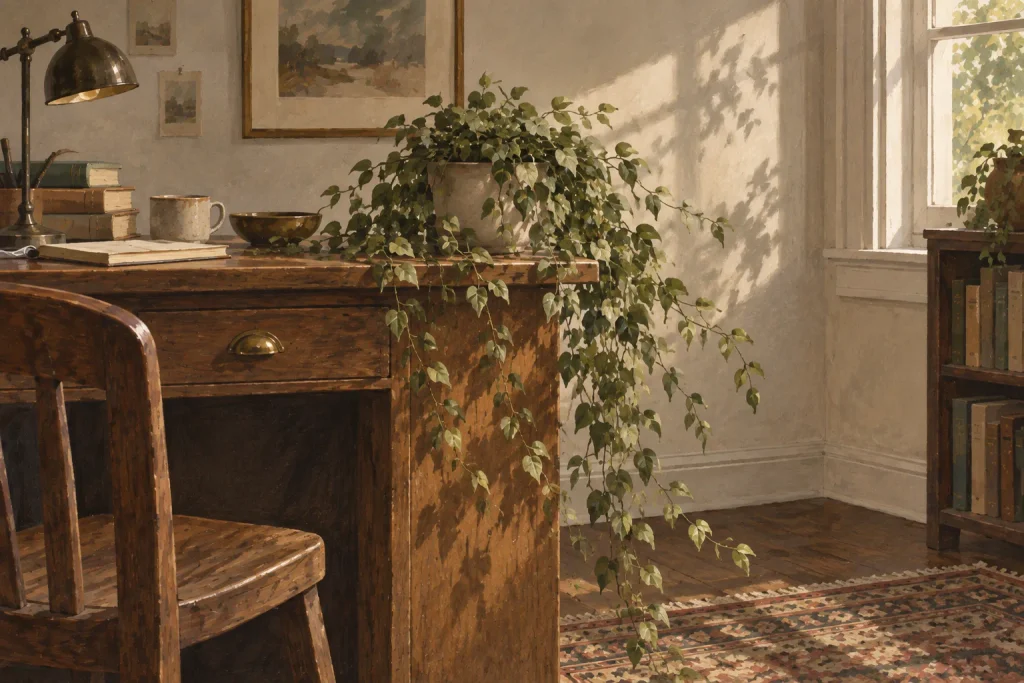
My ivy and string of bananas do the large version in the conservatory, descending from pots hung from the roof into otherwise unused vertical space. The satin pothos on my desk at work does the smaller version: the plant begins as something sitting on the furniture, then the stems carry it beyond the furniture’s boundary.
String of bananas is particularly well suited to that job because Curio radicans has long trailing stems, reaching around 90cm. The RHS groups it with the other indoor “string of” plants and recommends bright indirect light, although some sun is tolerated; in summer it advises keeping them out of strong direct midday sun, which can scorch the leaves.
One trailing line in the right place can do more than a windowsill filled with identical little pots standing to attention. In my conservatory, that height has another job too: it also keeps those trailing plants away from the cats.
Fine foliage changes the texture of empty space
Scale is not only about how much area a plant occupies. It is also about how solid that area feels.
A plant with several enormous leaves creates broad blocks of colour and strong edges. Fine foliage breaks roughly the same amount of space into dozens of smaller lines, gaps and shadows. The effect is lighter, even when the plant itself is not particularly small.
My parlour palm is useful here. Its fronds are divided into many narrow leaflets, so the wall remains visible through and around them rather than disappearing behind one dense green surface. The RHS describes parlour palms as producing arching fronds made from multiple pairs of narrow leaflets, which is exactly the structure responsible for that fine-grained effect.
This works particularly well around objects with a lot of hard geometry. A palm beside a cabinet does not merely add green. The fine foliage introduces a completely different scale of line from the straight edges, handles and flat planes of the furniture.
It changes shadows too. Broad leaves tend to make broad shapes; dozens of narrow leaflets break light into something much more complicated.
That is why “I need a plant there” is not quite enough information. A room already full of little objects may benefit from one large, calm shape, while a severe room of straight lines may want something finer and more unruly. The colour may be much the same while the spatial job is entirely different.
A room should reward more than one viewing distance
Not every plant has to reorganise a corner to justify the space it takes up.
Some work through surface texture: veining, markings, repeated leaf shapes or subtle differences in colour that become more interesting the nearer you get. Their contribution is not architectural. It is the sense that the room contains things which do not reveal everything from the doorway.
A good interior can have several scales of attention. Something large establishes the room from across it. Smaller details appear only when you sit beside them, walk past them or lean closer.
Plants are particularly good at this because the detail belongs to something growing. Leaves overlap imperfectly, face slightly different directions and refuse to arrange themselves into the tasteful repeating motif a wallpaper designer would probably have preferred.
My prayer plant gives me exactly that effect. From across the conservatory it reads as a modest hanging mass of foliage. Closer up, the lime-green veins against the darker green leaves become the reason to look at it.
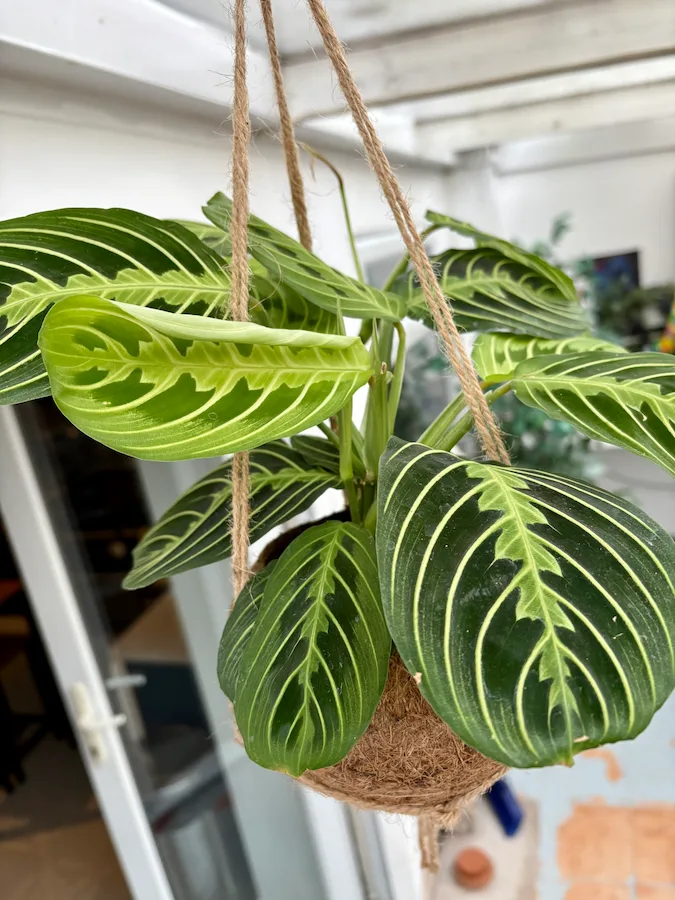
The container is doing useful work too. Coir — fibre from the inner husk of the coconut — has a coarse, fibrous appearance that sits comfortably beside the foliage without trying to imitate it. The jute suspension continues that roughness upwards.
A glossy patterned pot could easily turn the whole thing into an argument between two objects that both believe they are the interesting one. That does not make natural materials inherently superior; it means this container has the right degree of visual importance for the plant it is holding.
There is a practical lesson in viewing distance as well. Fine markings cannot rescue a plant that has been put somewhere nobody ever gets near enough to see them. If the reason you love a plant is the detail on individual leaves, it needs a position where the room allows that detail to register.
A beautiful plant can still be the wrong size
A plant can be handsome and still be almost useless in the place you have chosen for it.
Put one compact pot in the middle of a large empty corner and the problem is not that the plant lacks character. The proportions are simply wrong. The eye reads the wall and floor first; the plant becomes punctuation at the bottom of a page with no sentence above it.
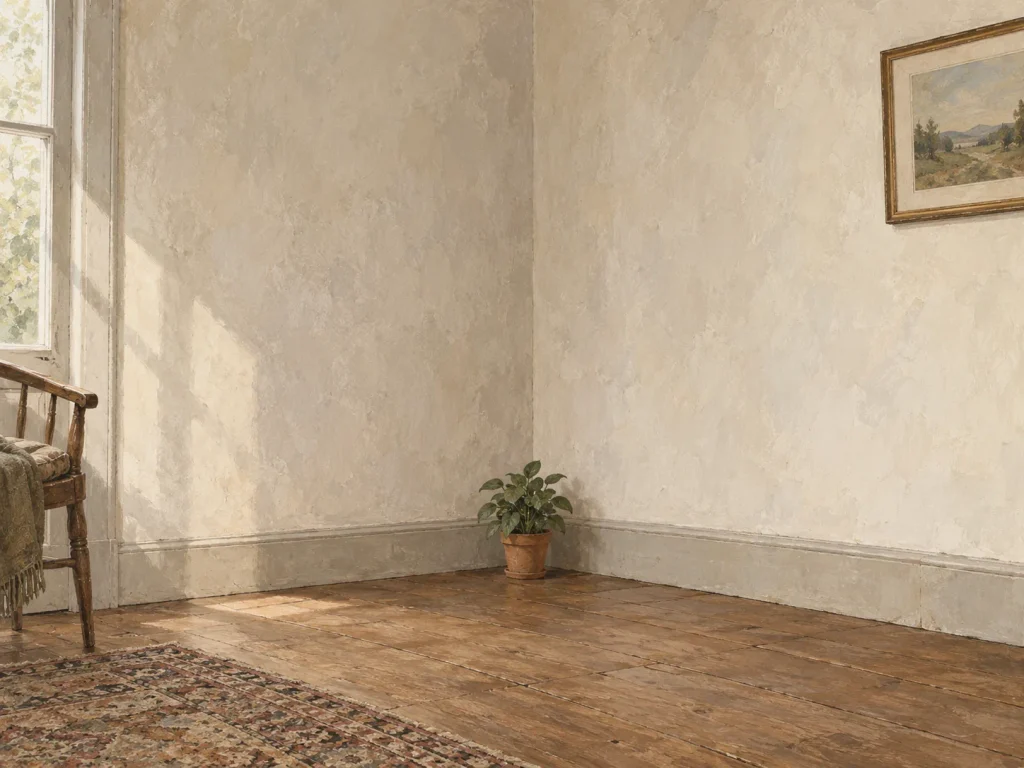
Small plants tend to make more sense where the viewer can meet them at their own scale: on a desk, shelf or sill, or among a small group of objects rather than being sent alone to solve several square metres of architecture.
My haworthia and aloe have both taught me this. They are interesting at close range and remarkably good at vanishing when I put them somewhere that asks them to carry an entire corner. A haworthia can be excellent on a shelf; give the same little plant responsibility for a vast empty corner and the result is rather different.
It looks as though somebody has lost a plant.
This is where proportion becomes more useful than “aesthetic”. A small succulent and a large leafy plant may both suit the same room stylistically. They are still not interchangeable because they occupy space differently.
The pot is part of the composition
Once a plant has somewhere it can genuinely live, the container starts mattering.
A pot changes height, visual weight, colour and texture. A heavy dark container can make a small plant feel more grounded. A pale one may recede. A pedestal raises foliage into a completely different relationship with nearby furniture.
A container can ruin the arrangement by demanding far more attention than the plant. Glossy glaze, busy decoration and motivational script have a particular talent for making an innocent aloe look as though it has been appointed workplace wellbeing officer. If the foliage is already supplying shape, colour and texture, the pot does not need a competing career.
The useful question is whether the container supports the visual character of the plant or starts a second, unrelated performance beside it.
The coir pot around my prayer plant works because the coarse fibre is quieter than the leaf pattern. A simple ceramic pot can do the same for a strongly architectural plant. A more decorative container may be useful where the foliage itself is plain enough to tolerate it.
There is a practical limit underneath all of this. The RHS says drainage holes in the base of a container are essential so excess water can escape.
A magnificent cachepot does not acquire horticultural competence because its glaze matches the wallpaper. If the decorative outer pot cannot provide the conditions the plant needs, it is decoration around the actual functional container. Treat it accordingly.
The room changes because the plant does
There is one difference between plants and almost every other object in a room that matters more the longer you keep them.
They do not stay finished.
A chair can fade and a leather bag can acquire scuffs, but those are consequences of use. A plant is actively making more of itself. Stems extend. New leaves appear. Old ones go. The balance of the plant changes and, eventually, the arrangement around it has to respond.
This is the plant version of wear, although growth is really the better word for it.
It is also where the sense of an older, more inhabited interior finally earns itself. A room with a mature plant contains visible time. The plant has been there long enough to become different from the neat little specimen that first arrived. It may have leaned towards a window, outgrown a shelf or forced a change of pot.
That does not mean neglect becomes picturesque. A failing plant does not acquire atmosphere merely because the leaves are brown. There is a difference between something showing the history of being alive and something requesting assistance.
Maintenance is therefore part of the interior whether the mood board acknowledges it or not. Watering, pruning, repotting and occasionally admitting that the beautiful position is the wrong one all alter the composition over time; the room and the plant keep renegotiating.
The best houseplants do not merely fill the gaps in a room. They give the room something alive to negotiate with.
Leave a Reply