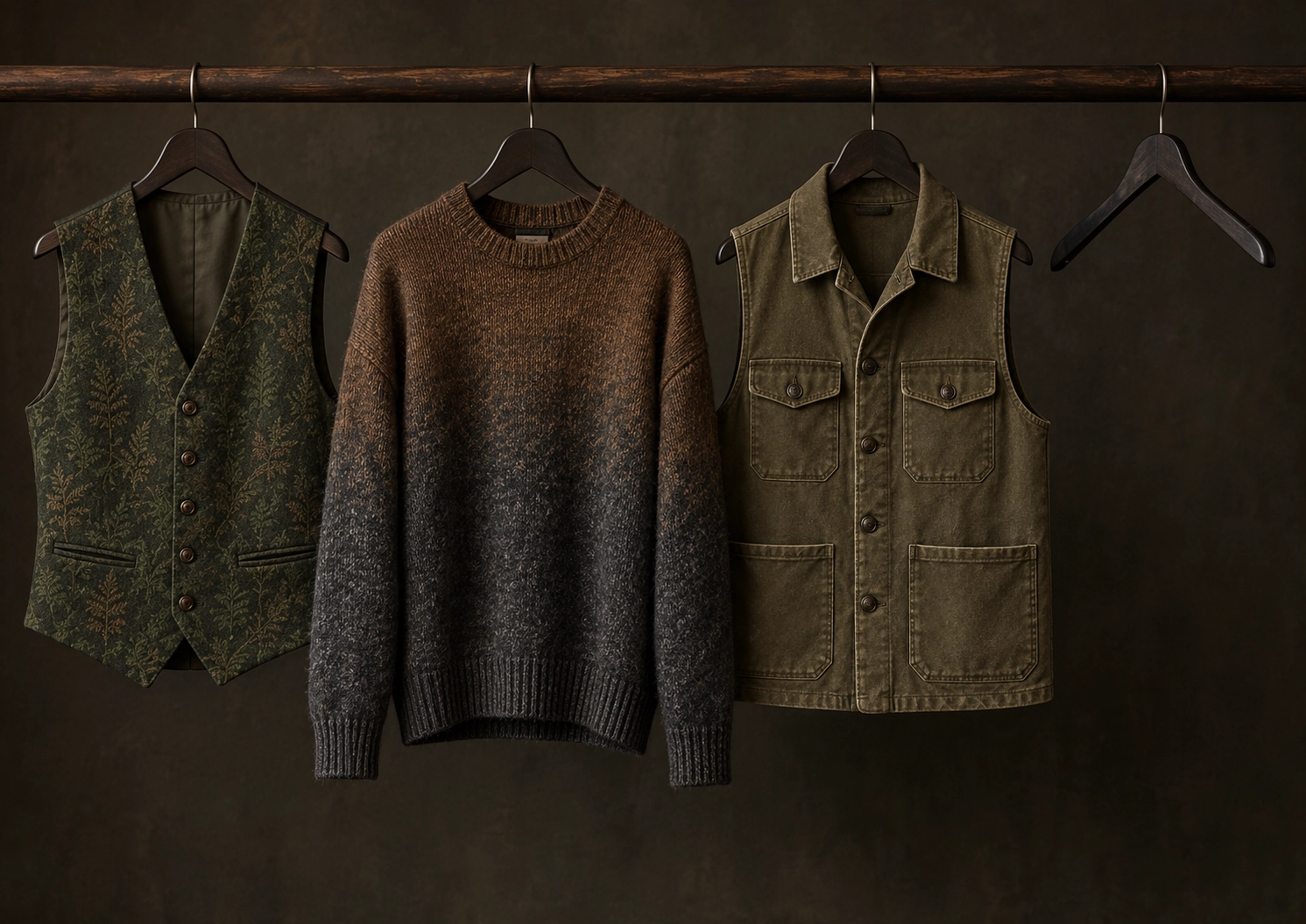
A few weeks ago I cleared out the narrow black blazers that had spent years slowly migrating towards the neglected end of my rail. There was nothing structurally wrong with them. They were simply clipped, office-shaped and unmistakably from a version of my wardrobe I no longer wear.
The annoying part is that I still want a black jacket. Not because every man needs one; I had several, and getting rid of them was the whole point. I want another because black tailoring still makes sense with my clothes. What no longer makes sense is buying it in the abstract and hoping the word versatile will sort everything out afterwards.
So I pulled out three of the less cooperative things I already own. If a new jacket can work with these, it has a chance with the rest of the wardrobe. If it only looks convincing beside a white shirt and an obliging pair of trousers, it is useful in much the same way as a dining chair you cannot sit on.
This is a taste problem rather than a fit problem. I have already covered shoulders, armholes, upper-back restriction and the alterations I would or would not take on in my second-hand wool coat guide. Here I am interested in what the jacket has to look like once it enters the room.
The green waistcoat asks for restraint
I bought the waistcoat second-hand on Vinted in April. It is deep moss green and cut with a low V, with five dark-brown buttons and two narrow slit pockets. Across the front is a small woven botanical pattern: fern-like leaves in darker green and dull bronze. From a few feet away it reads mostly as green; up close, it gets considerably more pleased with itself.
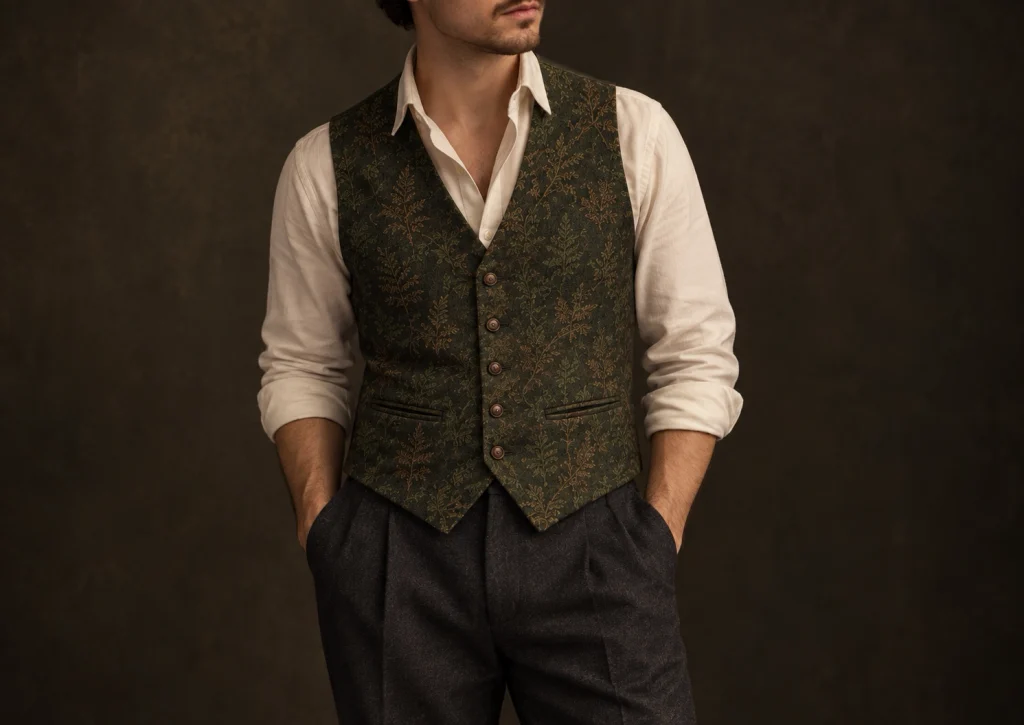
That is exactly why I like it, and why the jacket over it needs to calm down. The waistcoat already has colour, pattern and a slightly romantic edge. I want black tailoring to frame those things, not arrive with contrast piping, shiny buttons, embroidered lapels and a velvet collar because apparently everybody involved was afraid of silence.
Plain does not have to mean timid. The jacket can have generous lapels and enough shape to look deliberate. What it cannot do is demand a second conversation.
This rules out quite a lot of the black jackets I am instinctively drawn to in isolation. I like decorative clothes. I simply do not need every decorative thing I own to meet at once.
The jumper asks for scale
The second garment came from a Shrewsbury charity shop in February. It is a slouchy wool-blend round-neck jumper whose shoulder seams sit low on the upper arms, with full sleeves and deep ribbed cuffs. The knit begins tobacco brown around the neck, shoulders and upper chest, then darkens through a mottled transition into charcoal grey across the lower body and sleeves.
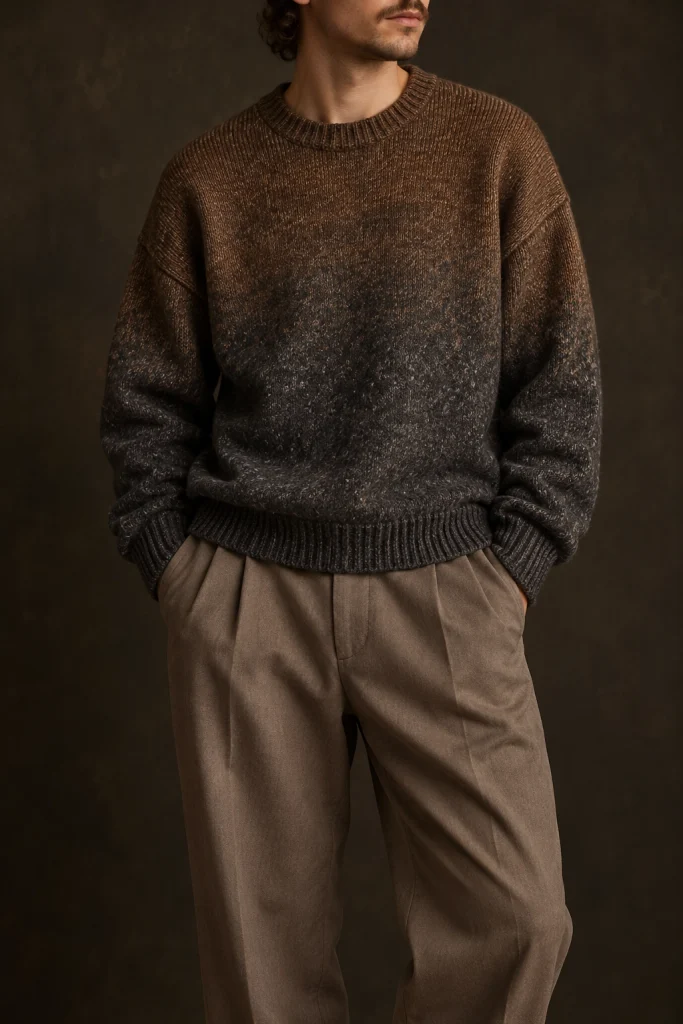
It is soft, bulky and visually broad. None of those qualities is a complaint; they do, however, make narrow tailoring look rather mean. A skimpy black blazer above that much knit has the effect of somebody trying to put a polite frame around a sofa.
For me, that points towards a fuller line than the old blazers, a little more length and lapels that do not disappear beside the jumper. It does not need to become oversized. It just cannot look as though all its proportions were decided during a period when menswear was frightened of using cloth.
The moleskin gilet asks for informality
The third piece came from a vintage stall at a local market in June. It is a faded olive-brown utility gilet, hip length and straight through the body, with a pointed collar, four dark metal buttons, two buttoned chest pockets and two lower pockets sewn visibly onto the front. The seams and pocket edges have worn slightly lighter than the rest.
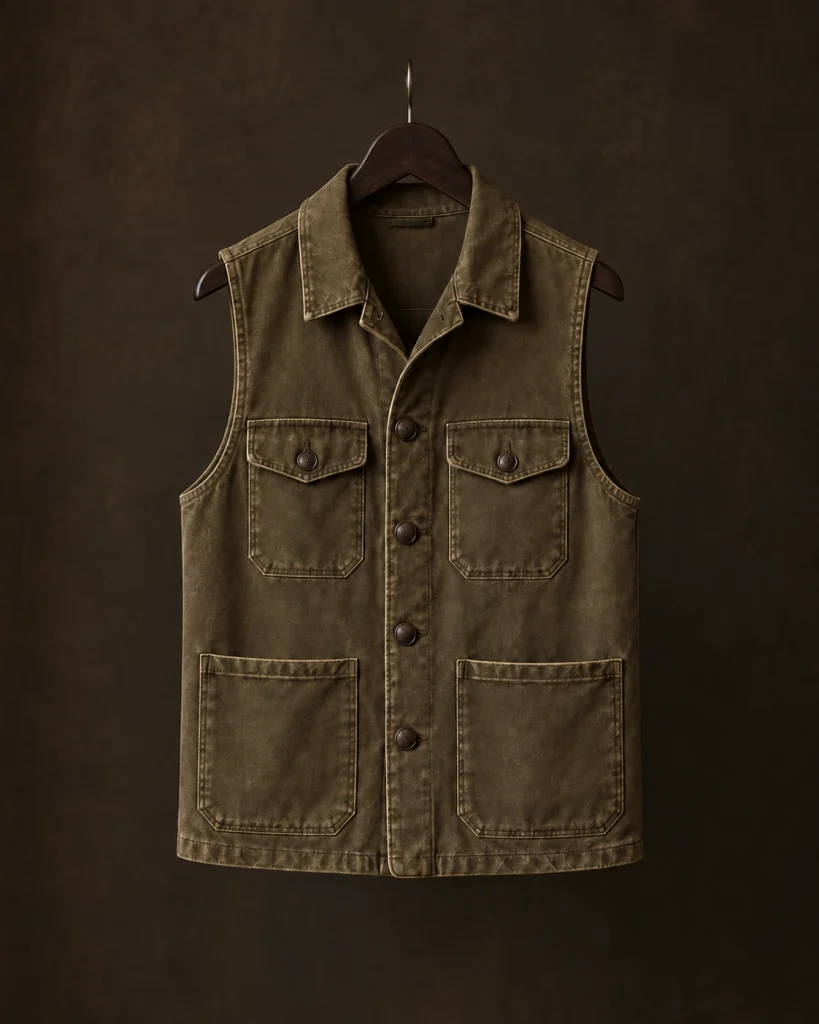
The cloth is moleskin, which Holland & Sherry describes as a dense cotton sheared to leave a short, soft pile on one side — which is why the surface looks matte and slightly velvety rather than crisp.
The gilet stands for a whole register of my wardrobe: boots, dark jeans, softer worn layers. The jacket has to survive that company too.
A black jacket that only works once I replace the boots, change the shirt and make the trousers behave themselves is not versatile for my wardrobe. It is merely very good at recruiting.
This is where smooth business suiting starts to lose me. I want black, but I do not particularly want slick. A dry wool, black moleskin or even black needlecord could all make more sense because their surfaces sit more comfortably beside worn leather, denim, knitwear and softer old clothes. I have already gone into needlecord in the wardrobe clear-out, so I will leave that particular rib alone here.
What the three garments agree on
The waistcoat rules out decorative noise. The jumper rules out skimpy proportions. The gilet rules out a jacket that can only speak office.
I am therefore looking for a black jacket with one row of buttons, a clean front, generous lapels, simple dark buttons and enough visual weight to sit above fuller or softer clothes. I want the surface matte or quietly textured rather than shiny, and I would rather it ran slightly longer than the cropped blazers I have already stopped wearing.
There is one tailoring term that helps me explain another part of it. Button stance is the height of the main fastening point on the jacket. Class Bespoke notes that changing it alters the apparent lapel length and the balance of the front: moving the fastening lower lengthens the visible lapel line.
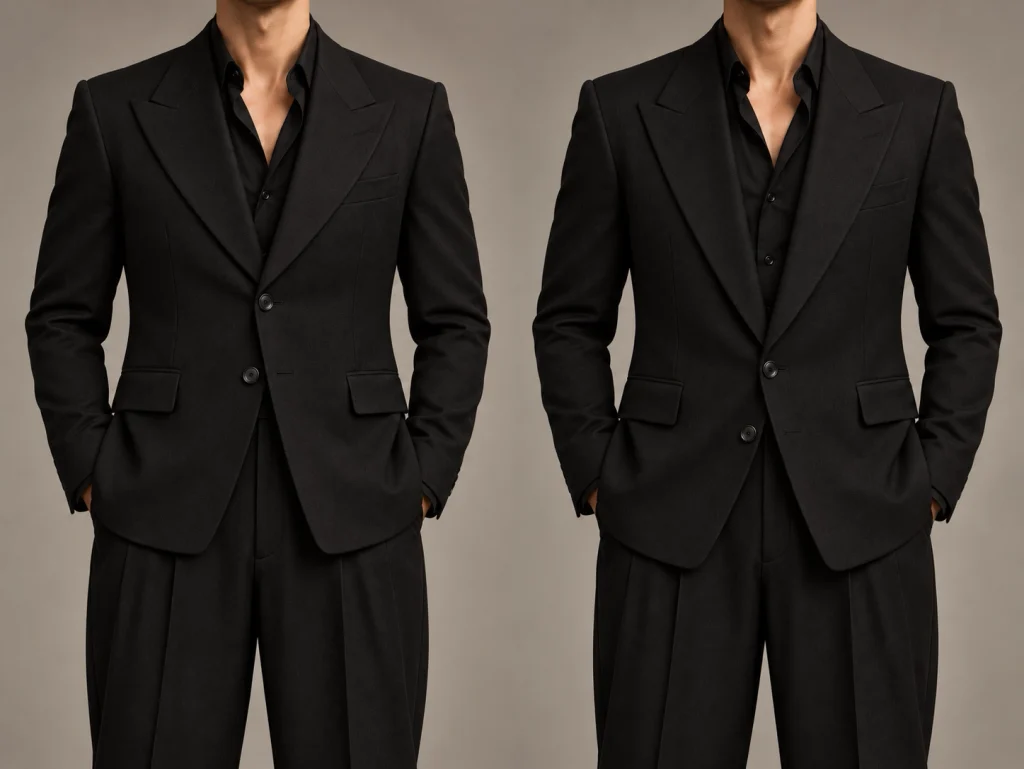
I am less interested in jackets where the working button sits high and the whole front feels cramped. A slightly lower-looking stance, with more open space above the fastening, belongs much more naturally with the proportions I am already wearing.
That term is useful because it names something I was otherwise going to describe as “the buttons are doing something annoying”, which is accurate in spirit but poor shopping information.
Finding that jacket online is a separate problem; The Search Box Is Not an Oracle covers what happens when the thing in your head and the words in a listing refuse to cooperate.
For this one, I already know enough. It has to stand beside a patterned green waistcoat without competing, a broad soft jumper without shrinking and a worn moleskin gilet without making the rest of the wardrobe look underdressed. That is a much more useful version of versatile than “goes with everything”.
I may not find it quickly. Good. The empty hanger is allowed to stay empty until one turns up that can survive the company.
Leave a Reply