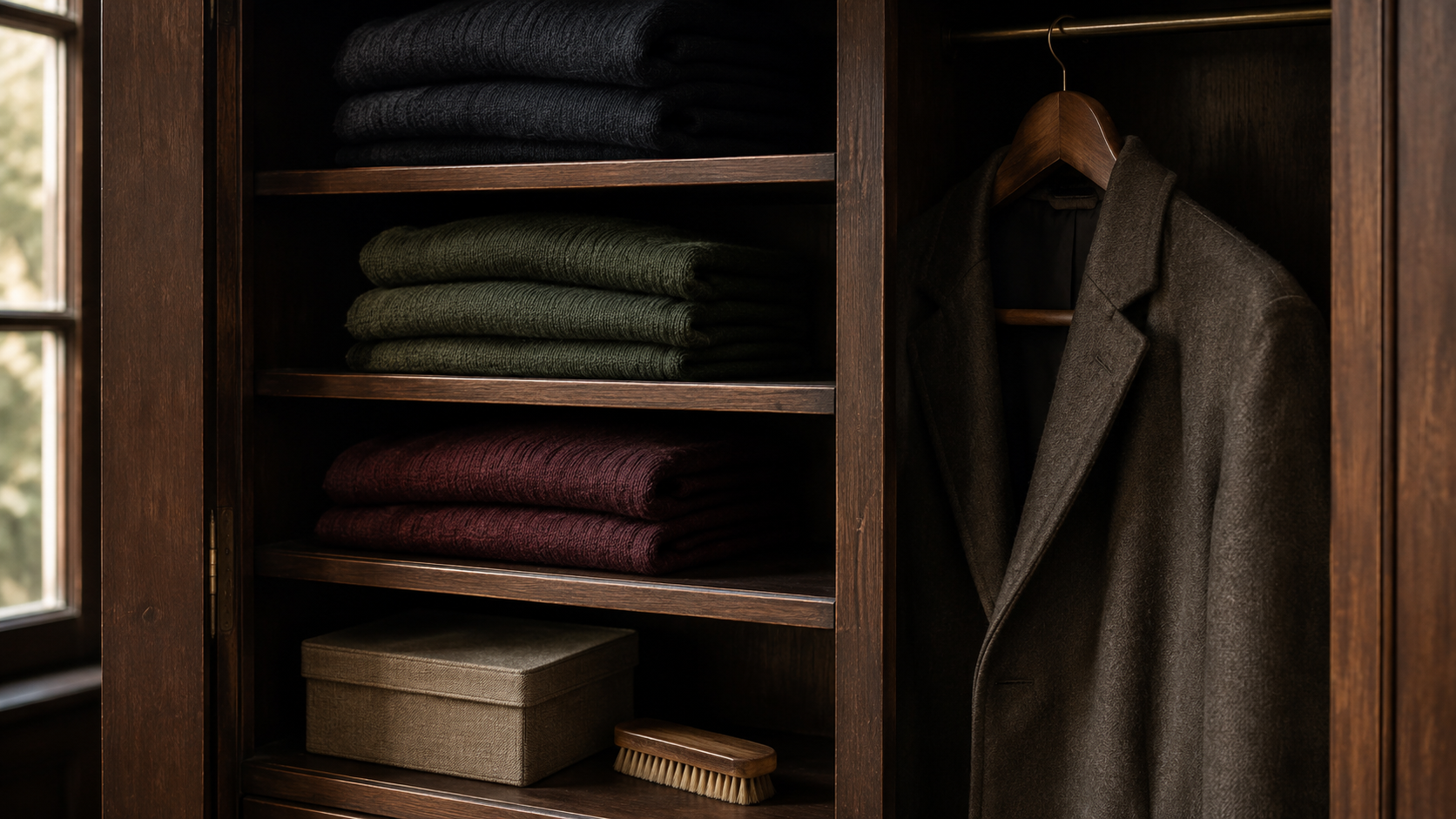
In stories, moths rarely arrive with entirely innocent intentions. A clothes moth is a very small animal capable of making an ordinary hole in a jumper feel like the opening scene of a curse.
The practical answer is much less dramatic. Wool stores best when it is clean, completely dry, properly supported or folded, and kept somewhere you can inspect it. Seasonal or rarely worn clothes benefit from a properly closed storage bag or lidded box, while regular handling and cleaning around the wardrobe make it harder for activity to continue unnoticed.
I do not have a dedicated storage cupboard or a picturesque wall of matching boxes. I have a small bedroom, a shared wardrobe and winter coats that are never very far out of reach because I live in England and get cold easily. Any system I use therefore has to work in an ordinary, slightly overcommitted wardrobe.
English Heritage’s guidance on preventing clothes moth infestations is reassuringly practical: store clothes clean, check folds and concealed areas, disturb stored garments regularly and vacuum around wardrobes and shelves. The useful domestic principle is to prevent what you can, inspect what you own and respond to evidence rather than treating every imperfect jumper as an emergency.
What clothes moths actually damage
The adult moth is not the stage eating your jumper. The damage is caused by the larvae, which feed on vulnerable animal-based materials. Wool is particularly susceptible because it is largely made from keratin, a structural protein also found in materials such as fur and feathers. English Heritage notes that common clothes moths lay eggs on wool, fur, feathers and skins, and that the larvae then feed across the material, leaving holes in clothing or patches of missing pile in carpets.
As a child, I briefly kept a pet moth named Minty and fed him chocolate biscuits. He did not live long, which was probably less an early experiment in textile conservation than a fairly damning assessment of my understanding of moth nutrition at the age of ten.
Clothes moths favour places where they can remain concealed and undisturbed. English Heritage recommends checking crevices, creases and folds as well as areas behind labels, while conservation guidance also points to pockets, seams, collars, linings and other hidden parts of clothing as useful inspection points.
Clothes moths are not the only insects capable of damaging wool. Carpet beetle larvae also feed on wool and other keratinous materials, and the two pests require proper identification rather than being treated as interchangeable. The Canadian Conservation Institute identifies both clothes moth and carpet beetle larvae as important textile pests and lists larvae, webbing, casings, cast skins, eggs and frass among the signs worth looking for.
How to store a wool coat over summer
Before a wool coat goes away for several months, clean it according to its care label, empty the pockets and make sure it is completely dry. Check beneath the collar, around the cuffs, inside pockets and along the lining before storing it; concealed folds and crevices are exactly the places worth inspecting for moth activity. English Heritage likewise recommends checking creases, folds and areas behind labels before storage.
A structured coat is usually best left on a broad, supportive hanger with enough room that the shoulders are not crushed. I would not vacuum-compress a tailored coat simply to save space.
If it will remain undisturbed for much of the summer, a properly closed storage bag or lidded container provides a stronger physical barrier. English Heritage recommends storing clean clothes in vacuum bags or boxes with tightly sealed lids. A cotton garment bag is useful against dust and rubbing, but it should not be assumed to be moth-proof.
Routine prevention: the habits that matter most
Routine prevention is what you do when there is no known moth activity. It should be manageable enough to become an ordinary part of looking after clothes.
Put wool away clean
Follow the garment’s care label and the manufacturer’s instructions. Wash, dry-clean or otherwise clean it using the safest suitable method, paying particular attention to collars, cuffs, underarms and pockets.
If you are unsure what the care label permits before storage, my beginner’s guide to clothing care covers washing, drying and the point at which a garment is better left to a professional.
If the problem is that a wool jumper has no readable care label at all, my guide to washing a wool jumper without a care label deals with that narrower problem.
A garment does not have to look visibly stained to carry perspiration, skin oils or traces of food. Empty the pockets too. A wool coat should not spend summer preserving crumbs, old tissues and three winters’ worth of receipts.
Allow everything to dry completely before placing it in an enclosed box or bag. Sealing a damp garment may replace an insect problem with a mould problem.
Fold knitwear rather than hanging it
Fold jumpers, cardigans, scarves and other knitted garments so that their own weight does not distort the shoulders.
Particularly delicate knitwear can be folded around clean tissue to soften a severe crease, but ordinary modern jumpers do not require an elaborate museum packing system.
Use the storage you actually have
Wool worn regularly can live perfectly well in a clean drawer or wardrobe. Regular handling reduces the chance of garments remaining forgotten for long periods and gives you more opportunities to notice fresh damage.
For seasonal clothes, rarely worn garments or homes with a previous moth problem, a clean lidded plastic box or properly closed storage bag offers a stronger physical barrier. Clothes must be clean and entirely dry before being enclosed.
Vacuum bags save space, which can be useful in a small home, but prolonged compression may flatten delicate knitwear, structured shoulders and soft finishes. They can also trap moisture if something is packed before it has dried fully.
A rigid lidded box avoids prolonged compression, but I am not going to pretend everyone has room for a stack of them. Use the storage your home can accommodate, with greater containment for clothes that will remain untouched for months or where there has been previous moth activity.
A cotton garment bag can keep dust away and reduce rubbing, but it should not automatically be treated as insect-proof.
Keep clothes moving
Regular movement helps prevent wool garments from sitting undisturbed for months and makes fresh evidence easier to notice.
You do not need to rearrange the wardrobe every Sunday. Simply wearing, handling and occasionally checking your woollens keeps them from disappearing completely from view.
The forgotten blanket behind a suitcase, the scarf at the bottom of a drawer and the winter coat that has not moved since February make better moth territory than the jumper you wear every week.
Clean the wardrobe as well as the clothes
At the change of season, or whenever the wardrobe begins to gather dust:
- vacuum the floor, corners and shelf supports;
- remove hair, lint and loose fibres;
- check carpet edges and nearby skirting boards;
- shake out garments that have been undisturbed;
- inspect the backs of drawers and the area beneath furniture.
Integrated pest management (IPM) is an approach built around prevention, monitoring, identification and targeted treatment rather than relying immediately on broad chemical control. English Heritage uses IPM across its historic properties. A domestic wardrobe does not need the same documentation or equipment, but the underlying logic is useful: remove what pests feed on, reduce hiding places and make changes easier to notice.
Empty the vacuum outside if you have found suspicious insect debris. Seal the contents before placing them in an outdoor bin.
Inspect second-hand clothes before mixing them in
A second-hand wool coat or cashmere jumper deserves a proper look before it joins the rest of the wardrobe.
Examine:
- collars and cuffs;
- pocket corners;
- seams and hems;
- trouser turn-ups;
- linings;
- folds and concealed areas.
Surface fuzz and bobbling are a different kind of evidence; what pilling actually tells you about a jumper is worth separating from signs of insect damage.
Clean the garment according to its care label and keep it separate temporarily if anything looks suspicious.
This is not because old clothing should be treated as inherently infested. Most second-hand garments are perfectly fine. It is simply easier to inspect and contain one incoming piece than to investigate the entire wardrobe later.
A hole is not the same thing as an active infestation
A hole tells you that a garment has been damaged at some point. It does not tell you when the damage happened, what caused it or whether anything is still living in the wardrobe.
What matters is the evidence around it.
If you find old damage but no other signs
Inspect the garment carefully in bright light, paying particular attention to folds, seams, collars, cuffs, pockets and other concealed areas. Then check the clothes stored beside it and the least disturbed parts of the wardrobe.
Look for:
- live or shed larval skins;
- fine silk webbing or tubes;
- portable larval cases;
- granular debris or frass;
- fresh damage appearing nearby;
- repeated sightings of small clothes moths.
English Heritage notes that clothes moth damage is commonly found in dark, hidden areas and recommends checking creases, collars, labels, pockets, turn-ups and folds. Its guidance also identifies silk webbing as characteristic evidence of webbing clothes moth larvae.
If all you have is an old hole and the rest of the inspection is clean, record or photograph the damage and keep an eye on it. There is no advantage in treating an entire wardrobe for an infestation you have not established.
If the evidence is suspicious but not conclusive
If you have found an unexplained new hole, a moth, possible insect debris or something you cannot confidently identify, contain the suspect garment while you investigate.
Place it in a strong clear plastic bag, close the bag securely and note where and when you found it. Then:
- examine the garment closely in good light;
- inspect the clothes immediately beside it;
- check the shelf, drawer, wardrobe floor and nearby carpet;
- photograph anything that may help with identification;
- consider using a suitable clothes-moth pheromone trap for monitoring.
Pheromone traps are useful evidence, not treatment. English Heritage says species-specific pheromone lures attract male clothes moths and can help locate activity, but because they attract males only, they do not control an infestation.
An empty trap after a few days does not clear a suspicious garment. Equally, one adult moth does not establish that every woollen thing in the house needs treating.
If you confirm active moth activity
Treat the problem as active when the evidence begins to join up: live larvae; characteristic cases or webbing; fresh damage accompanied by insect debris; repeated moth catches close to vulnerable textiles; or continuing new damage after the first inspection.
At that point there are two jobs:
- contain and treat the affected garments and other vulnerable textiles;
- clean, inspect and, where necessary, treat the surrounding storage area.
Doing only one leaves an obvious route back in. A treated jumper returned to a wardrobe containing larvae can be damaged again; cleaning the wardrobe while leaving affected textiles untreated allows the problem to continue inside the clothes.
Keep affected and untreated vulnerable items contained while moving them through the house.
Treating an individual garment
The garment still has to survive the cure. Check its care label and construction before choosing a treatment: killing insects is not much of a victory if the process also shrinks the wool, distorts the shape or damages leather, adhesives, dyes or trim.
Freezing
For ordinary clothing and other small textiles that can safely tolerate freezing, this is the clearest non-chemical treatment in the guidance I checked.
English Heritage recommends sealing affected items in plastic freezer bags and holding them at −18°C for at least two weeks to kill adult moths, eggs and larvae. After treatment, the item should remain sealed for at least 24 hours while it returns to room temperature, reducing the risk of condensation forming on the textile.
For a suitable wool garment:
- Make sure the garment is dry.
- Place it in a strong plastic freezer bag.
- Seal the bag securely and mark the date.
- Use a freezer that reliably maintains −18°C.
- Leave the garment frozen for at least two weeks.
- Remove it from the freezer but leave the bag closed for at least 24 hours while the contents return to room temperature.
- Inspect the garment before returning it to clean storage.
Freezing treats the object inside the bag. It does not treat larvae or eggs elsewhere in the wardrobe, carpet, upholstery or neighbouring clothes, which is why confirmed activity still requires attention to the surrounding area.
For fragile historic clothing, complicated mixed materials, painted or varnished elements, or pieces whose construction makes freezing doubtful, get specialist conservation advice rather than extending a domestic method by guesswork. The Canadian Conservation Institute notes that some materials become more brittle when cooled and also stresses moisture control, secure bagging and careful handling during low-temperature treatment.
Controlled heat treatment
Heat can also be used against textile pests, but this is one treatment I would leave controlled rather than inventive.
English Heritage recommends commercial freezing or a controlled heat process carried out by a reputable company for larger affected objects such as rugs, carpets and upholstery.
I would not attempt to recreate controlled treatment with an oven, radiator, hairdryer or improvised heated box. For a garment that cannot sensibly be frozen, or an object involving leather, adhesives, delicate trim or several different materials, ask a textile conservator, specialist cleaner or experienced pest professional which treatment is appropriate.
Cleaning the wider wardrobe and room
Once affected clothes have been contained, empty the wardrobe or drawer methodically. Keep untreated wool and other vulnerable items sealed while you work.
Vacuum:
- shelf corners and undersides;
- drawer joints and runners;
- the wardrobe floor and back;
- cracks near skirting boards;
- carpet edges;
- beneath nearby furniture;
- upholstery seams;
- the undersides of cushions.
Pay attention to hair, lint, feathers and dead insects. Textile pests may feed on more than the obvious wool jumper.
Inspect nearby wool carpets, felt furniture pads, feather-filled cushions, blankets and animal-fibre furnishings where relevant.
Use an ordinary cleaning product suitable for the wardrobe’s hard surfaces, then allow the area to dry completely. There is no need to soak the wood in perfume, essential oil or pesticide.
Empty the vacuum outside. Place the contents in a sealed bag before putting them in the outdoor bin, and clean reusable attachments before bringing them back indoors.
If activity is widespread rather than concentrated in one wardrobe, look beyond the clothes themselves. English Heritage advises checking lofts and attics for bird nests and having open chimneys checked and cleaned, because nests and animal remains can support textile pests. Leave inaccessible roof, flue or chimney work to somebody equipped to reach it safely.
Return garments only when they have been cleaned or treated and the storage area is dry.
What cedar, lavender and moth treatments can actually do
Cedar chests, lavender bags and mothballs have acquired such a domestic mythology that it is easy to treat them as variations on the same remedy. They are not.
Cleaning, inspection, containment and appropriate treatment remain the important parts of moth control. A pleasant-smelling wardrobe is not evidence that the larvae have received notice to quit.
Cedar and lavender
English Heritage lists both cedar balls and lavender as repellents for adult clothes moths. Their effect is temporary — its conservation guidance gives them a useful life of no more than about three months — and they work best in enclosed spaces. Crucially, neither has any effect on larvae already feeding inside clothes or carpets.
That makes them optional additions to a storage routine rather than treatment for an infestation. If you enjoy lavender sachets or cedar in a wardrobe, use them for that limited purpose and replace them as their effect fades. Do not let the smell of either substitute for moving clothes, inspecting folds and cleaning the storage area.
Lavender can make a drawer considerably nicer to open. It cannot negotiate with a larva already halfway through a sleeve.
Mothballs and other chemical treatments
Chemical moth treatments require a different level of care. Old formulations of mothballs include substances that English Heritage says are now banned or not recommended, so I would not use loose, unidentified or unlabelled mothballs inherited with a cupboard or bought from an uncertain source.
For a current biocidal product, follow the product rather than folklore. The Health and Safety Executive says members of the public should use products intended for general-public or non-professional use, choose a product suitable for the intended purpose and follow the label instructions carefully. The label also tells you what the product is approved or authorised to be used against and who is permitted to use it.
When to call a professional
Professional help becomes proportionate when the problem has moved beyond a few containable garments: fresh damage continues after cleaning and treatment, larvae or moths are appearing in several rooms, fitted wool carpets or upholstery are involved, or the likely source sits somewhere you cannot safely reach. I would also get specialist advice before experimenting on anything valuable, fragile or made from complicated mixed materials.
For a domestic infestation in the UK, one practical place to look is the British Pest Control Association’s directory of members. BPCA says its member companies are audited to the pest-management standard BS EN 16636, use professionally trained technicians and carry at least £2 million in public liability insurance. That does not remove the need to ask sensible questions, but it gives you a better starting point than choosing the first company whose website contains an unusually furious drawing of a moth.
Before agreeing to treatment, ask:
- what pest they believe is present and what evidence supports that identification;
- which garments, furnishings and parts of the room actually need treatment;
- what product or treatment method they intend to use;
- what preparation, ventilation or re-entry instructions apply to people and animals in the home;
- what follow-up inspection or monitoring they recommend.
A contractor should be able to explain the treatment plan in terms more precise than “we spray everything”.
Store wool calmly, not carelessly
Wool clothing does not need to be treated like a museum collection. It does need the fairly ordinary disciplines that museums happen to be very good at: keeping things clean, noticing changes and acting on evidence before a small problem becomes an expensive one.
A favourite jumper will probably never conceal a magic key. Your winter coat is unlikely to carry an ancient prophecy in its lining. They may, however, accompany you through dozens of winters, cold railway platforms, wet walks and years of ordinary life.
That feels like reason enough to look after them.
Leave a Reply