A drip of candle wax can lift neatly from a sleeve and still leave its colour behind. Fake blood can rinse out of a shirt while a faint pink stain stays exactly where it was. The obvious mess has gone, but the garment is not necessarily clean.
That distinction matters. Removing something sitting on the surface of a fabric is a different job from removing a dye, pigment or oily residue caught among its fibres. You can make quite a respectable start on one problem and achieve absolutely nothing with the other.
Before introducing heat, water or a cleaning product, work out what actually landed on the cloth.
| Halloween mess | What you’re dealing with | Least invasive first step |
|---|---|---|
| Candle wax | A deposit that hardens into a solid | Let it harden, then gently lift the raised wax |
| Fake blood | Usually colourants in a syrup, liquid or other cosmetic formulation | Blot away excess; rinse with cold water if the garment permits |
| Face paint | Dyes or pigments in a water-based or oily preparation | Lift excess paint and identify the type before choosing a treatment |
These are starting points, not instructions to override a care label. The beginner’s guide to clothing care covers the broader business of checking a garment, testing treatments and deciding when a professional cleaner is the sensible option.
Work out what landed on the fabric
Candle wax is the straightforward one, at least initially. It cools into a solid deposit, which means there is something physical you may be able to remove before washing or treating the cloth. Trying to wipe it away while liquid risks spreading it over a larger area.
Fake blood is less cooperative as a category. There is no single recipe. Mehron’s Stage Blood, for example, contains corn syrup, propylene glycol, water and colourants. It is deliberately syrupy and does not fully dry. Other theatrical-blood products behave differently: Kryolan describes some formulations that dry into abrasion- and water-resistant films.
That matters when deciding whether a cold-water rinse is likely to be useful. The product name and, ideally, the manufacturer’s instructions tell you considerably more than the fact that somebody was dressed as a vampire.
Face paint presents a similar problem. Snazaroo’s face paints are water-based, whereas Kryolan’s Cream Color Circle is a wax-and-oil-based make-up. Both put colour on skin. They do not necessarily surrender that colour to the same cleaning method when it reaches a shirt.
There is also a useful distinction between dyes and pigments. A dye dissolves in a suitable liquid; a pigment consists of insoluble coloured particles dispersed through a preparation. One example is a lake pigment — a dye chemically converted into an insoluble pigment, as defined by the US Food and Drug Administration.
You don’t need a chemistry qualification to wash a shirt, but recognising that colour can be dissolved or carried as particles helps explain why one stain responds to rinsing while another requires detergent or specialist treatment.
If the paint or fake blood is still available, check the packaging before doing anything ambitious to the garment.
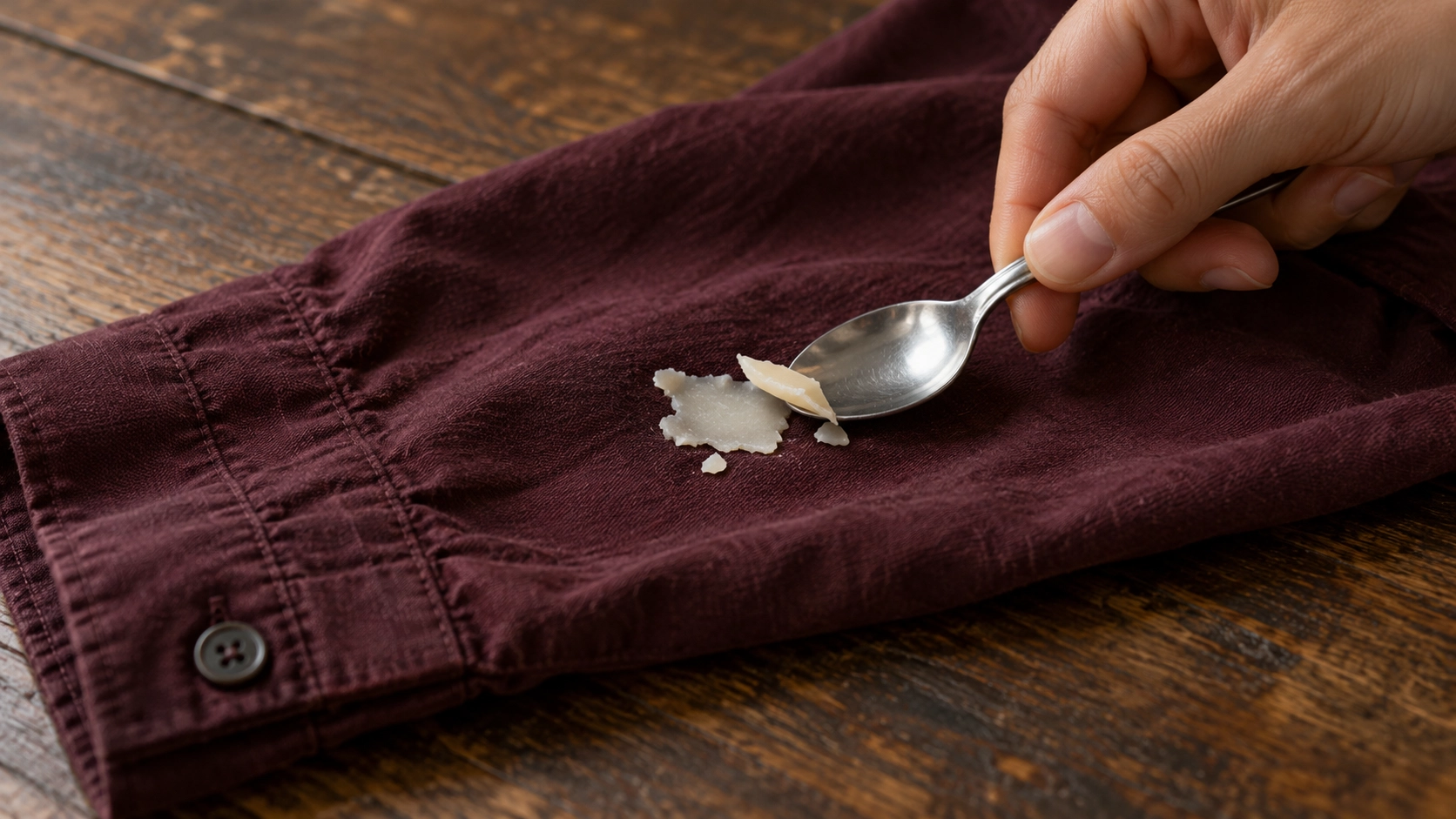
Candle wax: lift the solid before using heat
The temptation with candle wax is to reach immediately for an iron. There is a legitimate method involving heat, but it should not be the opening move.
Persil’s candle-wax guidance begins by allowing the wax to harden and removing as much of the raised material as possible. That is where I would start.
- Let the wax harden completely. Leave it undisturbed while it cools instead of rubbing at a soft deposit.
- Gently lift the raised wax. On a reasonably sturdy, smooth fabric, use the rounded edge of a spoon or another blunt implement. Work shallowly across the surface rather than digging into the weave.
- Inspect what remains. If you have removed the bulk of the wax, don’t automatically proceed to another treatment. Check whether there is still wax attached to the fibres.
- Consider controlled heat only if necessary. Where wax remains and the care label permits ironing, Persil describes placing clean absorbent paper above and below the affected area, covering it with a thin towel and using a warm iron to encourage the wax to transfer into the paper. Replace the paper as it absorbs the wax.
That fourth step has quite a few conditions attached, and deservedly so.
The GINETEX care-symbol guidance makes clear that ironing temperatures must follow the garment’s label; some garments must not be ironed at all. A smooth cotton sleeve and a velvet jacket are not interchangeable surfaces. Pressing can damage a delicate finish or flatten a raised pile.
Persil also advises against using paper towels on fluffy materials such as wool, fleece and velvet, because the paper fibres can become caught in the fabric. An iron is not an invitation to ignore either the surface or the construction of the garment.
If the label is missing, the fabric is uncertain or the item has heat-sensitive details, I would stop at the careful physical removal and ask a professional cleaner about anything further.
Any separate colour mark can be considered in the section on residual staining below.
Fake blood and face paint: the carrier decides what happens next
These are both cosmetic products, but the way they behave on fabric depends on their formulation.
Fake blood is not real blood
Real blood is a biological stain containing proteins. Artificial blood is manufactured to resemble it, often using a quite different mixture of ingredients. The distinction matters because instructions for treating actual blood, including protein-specific stain treatments, cannot simply be transferred to theatrical blood.
Mehron’s syrup-based Stage Blood is a useful example. The manufacturer’s ingredient list gives us a reason to consider water-based cleaning, while its warning that the product may stain prevents us from assuming that rinsing will finish the job.
For washable clothing, Kryolan recommends rinsing substantial amounts of theatrical blood with plenty of cold water before washing, then applying a suitable detergent directly to the affected area.
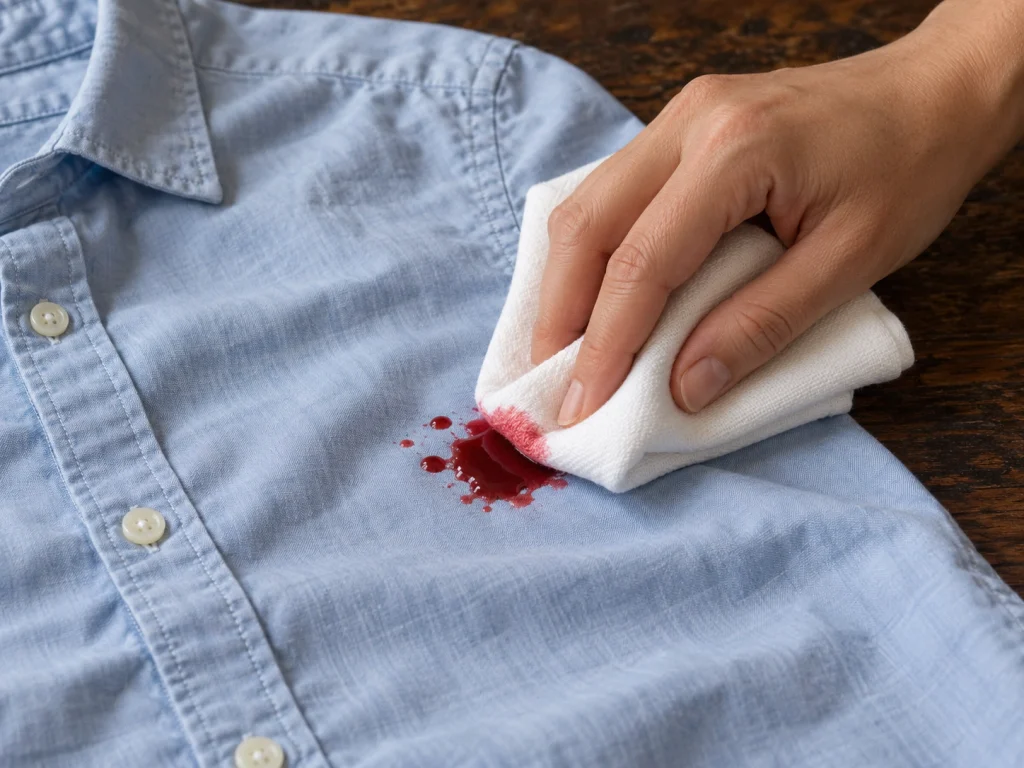
The practical sequence is to blot away surplus liquid gently with a clean cloth, without dragging it across the surrounding fabric. If the care label permits washing, rinse the affected area with cold water. Apply a garment-compatible laundry detergent according to its instructions, then rinse or launder as directed.
There is no advantage in scrubbing a red patch over twice the area it originally occupied. The American Cleaning Institute’s laundry advice recommends blotting rather than rubbing because rubbing can spread a stain or damage the material.
For artificial blood designed to dry into a resistant film, or for an unfamiliar formulation, do not assume that the same rinse will be sufficient. Check the product’s own removal guidance before progressing.
Persistent pink marks are dealt with below.
Face paint: water-based or greasy?
Face paint is an especially unhelpful label for cleaning purposes. It describes where the product was meant to go, not what is holding its colour together.
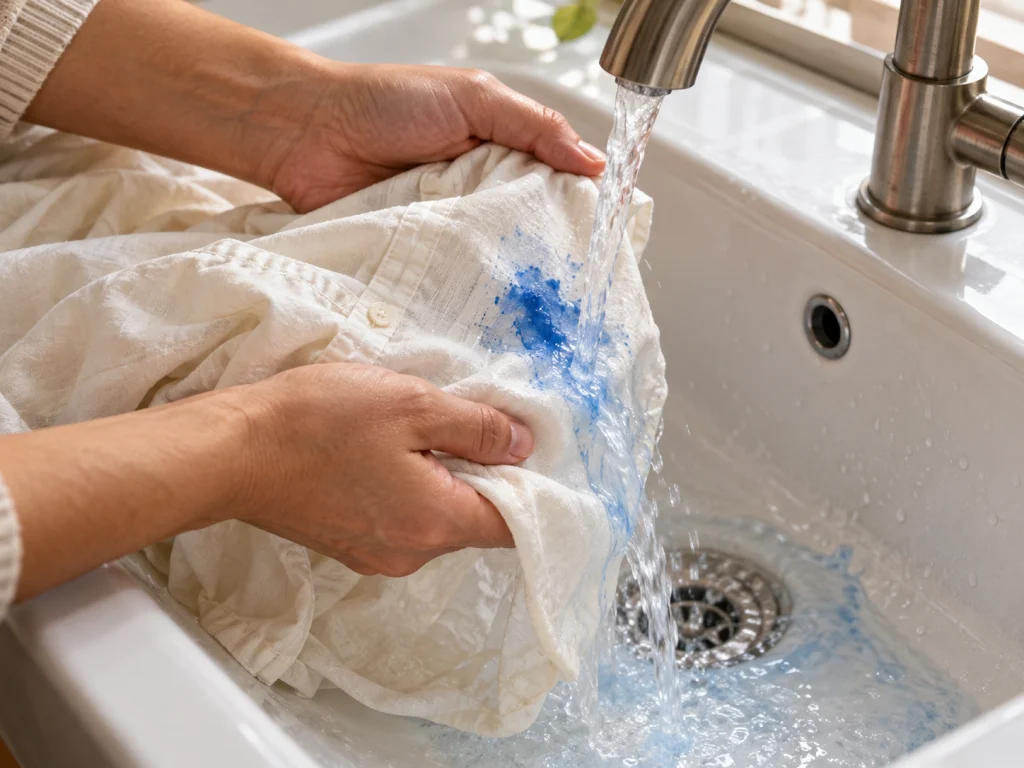
For a known water-based preparation such as Snazaroo, begin by gently lifting away any excess paint. On an ordinary washable garment, rinse the stain gently with cool running water from the reverse side of the fabric. This helps flush loosened paint back out through the stained surface rather than pushing it further into the cloth. Then follow the garment’s laundry instructions. Snazaroo says its products wash out of most fabrics.
An oily cream requires a different approach.
Kryolan describes its Cream Color Circle as wax-and-oil-based. Plain water is unlikely to remove that oily component effectively. Ariel’s guidance on greasy make-up stains recommends pretreatment with a suitable liquid laundry detergent, whose surfactants help remove oily material from fabric.
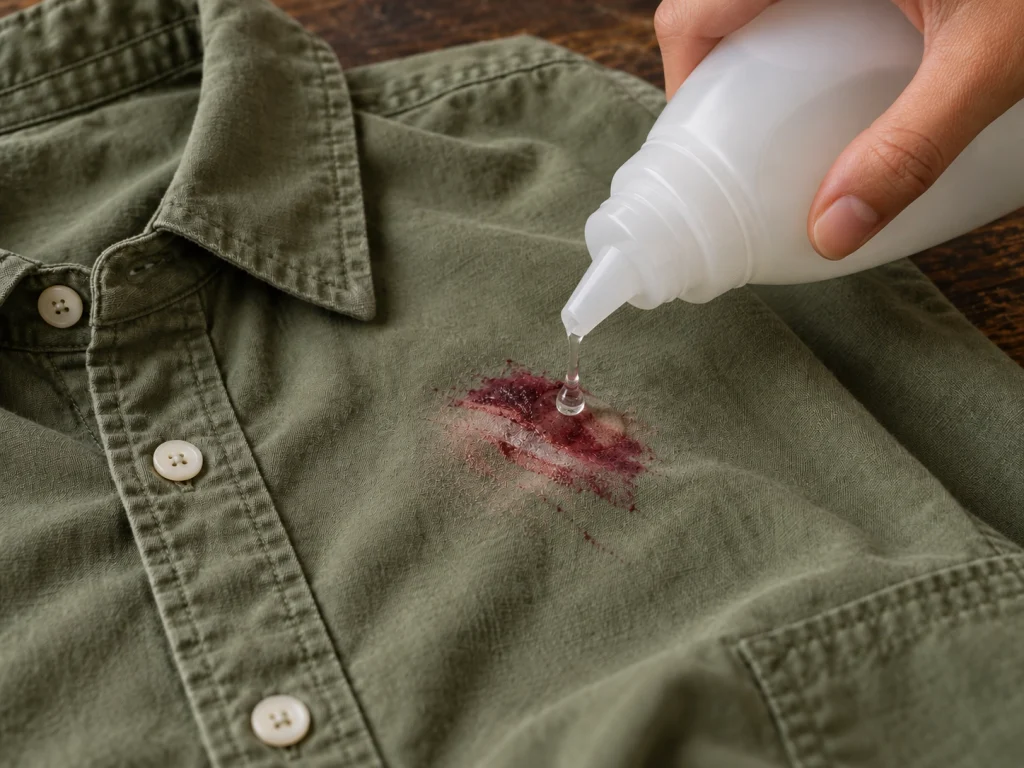
For a washable, colourfast garment, that gives us a reasonable next step after carefully removing excess make-up: test an appropriate detergent on a concealed area, apply it as directed and launder within the care label’s limits. Do not assume that warmer water or harder rubbing will improve the result.
I would also leave facial cleansing wipes, make-up remover and other products intended for skin out of the clothing-care cupboard. Being very good at cleaning a face is not evidence of being suitable for a wool jacket.
If you cannot identify the paint or its carrier, avoid experimenting with a succession of cleaning products.
What to do when the colour stays
This is where removing a deposit and removing a stain become separate tasks.
Once the bulk of the substance has gone, inspect the fabric in good light. Does the affected area still feel waxy, greasy or stiff? Or does the cloth feel normal while its colour remains altered? The answer helps distinguish material still attached to the fabric from a colourant that needs separate treatment.
Persil treats candle-wax removal as a sequence with a distinct later stage for colour removal. That means there is no reason to keep applying an iron merely because a visible stain survives. At that point, a suitable laundry pretreatment may be more relevant than further heat.
Kryolan likewise advises repeating an appropriate detergent treatment when artificial blood leaves discolouration after washing. For face paint, Snazaroo acknowledges that highly pigmented colours may stain despite the preparation being water-based.
For ordinary washable clothing, I would proceed in a controlled order. Check that the remaining mark warrants further treatment, choose a stain remover or laundry detergent suitable for the fabric, and test it on a concealed area. Follow the product’s instructions rather than inventing a stronger concentration or extending its contact time indefinitely.
Launder only as the garment permits, then inspect the result before drying. If the treatment has helped and both labels permit another attempt, repeating it may be reasonable. If nothing is changing, stronger chemicals are not automatically the answer.
Persil’s stain-removal guidance advises keeping stained clothing out of the tumble dryer until the stain is gone, because heat can set it. That is also a good reason to postpone ironing an unresolved mark, except where controlled heat is itself the appropriate, fabric-safe wax-removal treatment.
Complete removal cannot be promised. A pigment may resist ordinary laundering, a dye may be difficult to shift, and the treatment capable of attacking the mark may also be capable of changing the original fabric.
That is an inconvenient answer. It is still better than recommending a heroic chemical assault on somebody’s favourite shirt.
When the fabric changes the answer
So far, the procedures have concerned ordinary clothes whose care labels permit the relevant treatment. A cotton shirt you can machine-wash offers more options than a structured vintage jacket with an uncertain lining.
Velvet deserves particular caution. Its raised pile can be crushed or disturbed by pressure and abrasion, so neither scraping nor ironing should be treated as routine. Silk may have dyes or finishes that react badly to water, rubbing or spot treatments. These are garment-specific risks, not problems solved by choosing the washing machine’s delicate cycle.
Purpose-made Halloween costumes introduce another complication. Even where their main fabric looks washable, attached trims, bonded decoration, coatings and mixed materials may impose stricter limits. The entire garment has to survive the treatment.
I’ve covered those distinctions more fully in How to Look After Velvet, Silk and Other Fabrics That Ruin Easily.
For a valuable or irreplaceable garment, an uncertain dye, a dry-clean-only item or a stain that has resisted its first suitable treatment, a professional cleaner is a better next step than improvising with products from under the sink. Tell them what caused the mark and what, if anything, you have already applied.
And if the clothing is clean but smells of the bonfire, that is a different problem: the smoke-removal guide deals with airing and laundering rather than visible stains.
There is a point at which further cleaning becomes guesswork. If you reach it, stop. The garment has had quite enough Halloween for one weekend.
Leave a Reply