The internet has given charity shops an inventory problem.
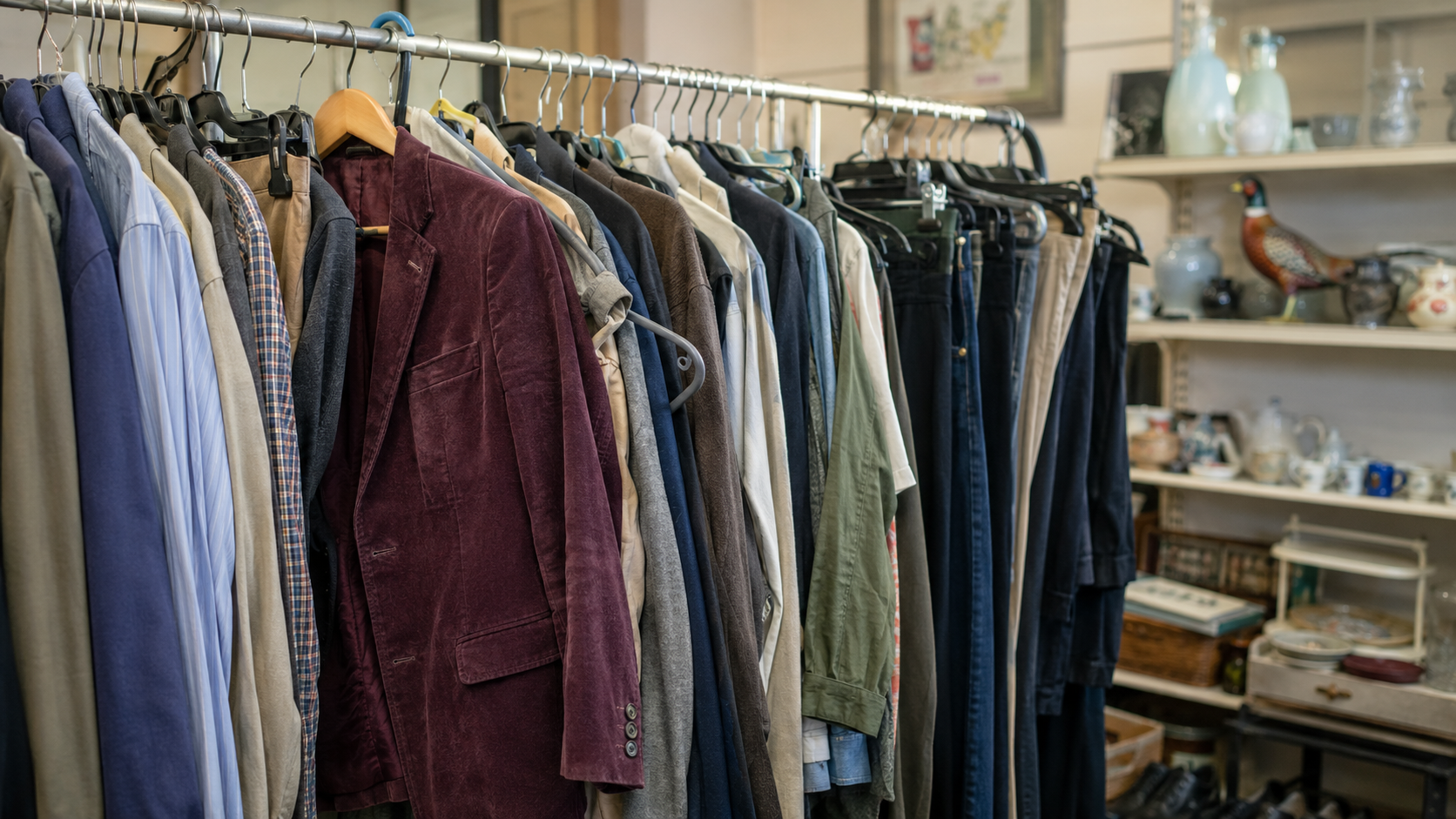
Watch enough second-hand shopping videos and you begin to suspect that every British high street contains a dimly lit room full of 1970s suede jackets, hand-knitted Aran jumpers, forgotten designer tailoring and one immaculate leather bag priced by somebody who has never heard of the internet.
Then you go in.
There are six pairs of skinny jeans, a supermarket blouse, three dresses from the same fast-fashion chain, a mug commemorating an event you did not attend and a suspicious number of copies of the same celebrity autobiography.
This is not evidence that you have found a bad charity shop. It is evidence that you have found a charity shop.
I was reminded of this recently after doing what I usually do when I have enough time to make a short journey take considerably longer: going into every charity shop that presented itself.
Not as a scientific survey. I did not bring a clipboard, and nobody was asked to defend the knitwear section.
I just looked properly.
I wanted to know whether the version of charity shopping I keep recommending on this site actually survives contact with the rails. Are there wool coats? Corduroy trousers? Interesting shirts? Useful boots? The sort of slightly excessive jacket that can carry an otherwise ordinary outfit?
Yes, sort of — just never in the neat order the internet leads you to expect.
The first thing charity shops actually have is ordinary clothes
The first rail I looked through was almost aggressively normal: high-street shirts, office trousers, recent dresses, jeans, a few jumpers and a lightweight jacket that had probably spent its previous life hanging beside somebody’s back door.
There was nothing wrong with most of it. That is important.
Charity-shop disappointment often begins with the expectation that second-hand clothing should somehow be more interesting than new clothing. The Charity Retail Association says more than 90% of charity-shop sales come from donations. That makes the ordinariness less mysterious: ordinary wardrobes contain ordinary things.
Most people have not spent the last twenty years quietly assembling an archive of rare British knitwear for your eventual benefit.
So yes, there is polyester. Quite a lot of it. There are supermarket labels, fast-fashion labels, forgotten mid-market brands and garments that were merely fine when somebody bought them and remain merely fine now.
The useful skill is learning to look through category rather than at label.
The rail may be unremarkable as a whole, but halfway along it there can be a dense wool jacket between two thin synthetic ones, a cotton shirt with a particularly good collar or a pair of trousers with enough cloth and structure to be worth trying on.
The interesting garment rarely has a spotlight.
Sometimes it has another hanger caught inside its sleeve.
Charity-shop browsing is not an interface
Charity-shop browsing has its own peculiar pace. Nobody is quite moving quickly enough for the space available.
At one point I spent what felt like ten minutes waiting to get near a rail because an elderly woman had positioned herself with the quiet authority of somebody inspecting every blouse since 1987.
There was no getting around her. Any attempt to move closer merely caused the shopping basket to rotate and seal the remaining gap.
So I went to look at the books.
This is also charity shopping.
You rarely move through the shop in the order you intended. Somebody is examining the exact section you want. A volunteer arrives with another rail. The changing room is occupied. You go downstairs because somebody has put a sign beside the staircase saying MORE MENSWEAR and discover four shirts and an impressive collection of jigsaws.
The shop is not an interface. It has people in it.
That unpredictability is part irritation and part pleasure. Your route changes, so your attention changes with it. You notice the books because somebody has blocked the shirts. You inspect the homeware because the changing room is occupied.
Which is how I found the ceramic pheasant.
Useful can be harder to find than unusual
Once I stopped expecting the rails to behave like a conventional shop, I kept noticing the same sort of things: blazers, smart trousers, patterned shirts, waistcoats, dresses that looked as though they had attended at least one wedding, ties and dinner jackets.
Clothes, in other words, with slightly more ambition than most Tuesday afternoons require.
I am not claiming every charity shop is secretly an occasionwear warehouse. This was simply what kept turning up on this particular wander.
What struck me was how much easier it sometimes was to find something unusual than something quietly useful.
There was patterned tailoring. There were brightly coloured shirts. There was an evening waistcoat I could imagine working if the rest of the outfit behaved itself. There was a jacket in a shade of green that had made a decision and was sticking to it.
What I did not keep finding were the boringly excellent things I would have been happiest to take home: a plain navy merino jumper, a straightforward pair of brown corduroy trousers in a useful size, a good dark wool coat without a problem, simple leather boots.
That is where second-hand shopping starts to feel backwards if you enter with normal retail expectations.
A lime-green satin dinner jacket can be unusual and still wait patiently for the one person who needs it. A good navy wool jumper in a common size feels as though it has a queue.
Rare is not always difficult to find. Useful can be difficult to find because somebody else wanted it first.
That is observation rather than census data, but it has changed the way I think about the supposedly spectacular charity-shop find.
I did find one jacket that would have suited me very nicely: dark, slightly glossy, somewhere between plum and burgundy, with enough texture to make a plain shirt look deliberate underneath it.
Wrong size, obviously.
Charity shops possess an extraordinary ability to produce the correct garment for somebody standing approximately three feet to your left.
The promising second-hand coat had a catch
Eventually there was a wool coat.
Of course there was.
Dark colour, decent weight, proper length: the kind of thing that looks promising before you even get close enough to read the label.
Then I lifted the sleeve and found wear at the cuff. The lining was tired. I tried it on and the shoulders were not quite right.
The shop has fulfilled the request in every way except the ones that decide whether you should actually buy it.
There is a particular danger in getting emotionally ahead of yourself here. You see wool, good lapels and a tempting price, and within ten seconds you have mentally brushed it, steamed it, repaired the lining and worn it through November.
The garment has not agreed to any of this.
Condition is not a minor obstacle merely because the item is second-hand. Nor is fit. A coat being almost right does not make it right.
If you want a fuller guide to judging fit, cloth, condition and repairability before buying, I’ve covered that in How to Buy a Second-Hand Coat That Survives More Than One Winter.
Some hems can be changed. Some sleeves can be shortened. Some alterations are entirely reasonable when the garment deserves the effort.
But a jacket whose shoulders are living independently of yours is somebody else’s jacket.
There were corduroy trousers too, incidentally: too narrow, too large, wrong colour, and one perfectly respectable pair that simply did nothing for me.
That last category matters. A garment can be good, affordable and capable of fitting you perfectly well. You can still leave it.
Second-hand shopping advice can become so focused on recognising quality that it forgets the final requirement: you need to want the thing.
Otherwise you have merely identified somebody else’s sensible trousers.
The ceramic pheasant did not need to come home with me
It was magnificent.
Not beautiful.
Magnificent.
A glazed ceramic pheasant of uncertain purpose and considerable confidence, standing among a collection of small vases as though it had personally donated them.
I picked it up.
This was a mistake.
The moment you pick up a strange charity-shop object, your brain begins drafting arguments on its behalf. It has character. It would look good on a shelf. It is only a few pounds. You will definitely know where to put it later.
This is how homes acquire things that eventually return to charity shops.
There is a distinction I have become increasingly good at making:
I like this.
and
I am delighted that this exists.
Those feelings are not interchangeable.
Sometimes the correct response to a ceramic pheasant is simply to spend thirty seconds with the ceramic pheasant and then put it back.
The same principle applies to clothes. Finding something good does not create an obligation to own it.
Keep the standards specific and the category flexible
On this particular wander, trousers were somewhere in the back of my mind.
Nothing urgent. Just the sort of vague brief that encourages you to inspect every pair of cords as though one of them may reveal itself as the answer.
They did not.
The better possibilities were elsewhere: the plum jacket, a shirt I had not gone in looking for, the coat that almost worked.
That is the balance I find most useful in second-hand shopping.
Keep the standards specific and the category flexible.
“I need a brown wool overcoat in my size today” gives the shop almost no room to succeed.
“I am looking for useful autumn clothes in wool, corduroy, leather or heavy cotton” gives you somewhere to go when the coat is wrong but the jacket is excellent.
Flexibility does not mean buying whatever the shop happens to offer. The standards stay put.
Does it fit? Is the cloth good enough? What is the condition? Can any fault realistically be repaired? Is the price sensible?
And, most importantly, do I actually want to wear it?
Only the noun is allowed to change.
The same flexibility applies to the shops themselves. After a few visits, you begin to learn what an individual branch tends to reward. One may repeatedly send me towards tailoring first. Another can consume ten minutes with books and homeware before I remember that I supposedly went in to look at clothes. Some produce nothing I seriously want for months.
That does not make them bad shops. It means their stock and my wardrobe have so far failed to reach an agreement.
The internet edits out the boring bits
The internet version of charity shopping edits out most of this.
Nobody uploads the twelve ordinary shirts, the coat with the tired lining, the perfectly decent trousers that inspired no feeling whatsoever or the fifteen minutes in which nothing particularly interesting happened.
You see the suede jacket after somebody found it, not the hundred garments they moved aside first.
Real charity shops are less spectacular and more interesting than that.
They contain changed sizes, changed jobs, changed tastes, abandoned hobbies, unwanted presents, clothes bought for events that ended, books somebody finished, books somebody never started, better replacements, failed experiments and the object nobody in the family was willing to inherit.
Occasionally, one of those lives leaves behind exactly what yours needs.
You do not have to make every visit successful. You do not need to rescue every good garment. You certainly do not need to buy something merely because it is strange, cheap or older than the thing beside it.
Most of the shop will not be for you. Occasionally, something will be. More often, it will be a plum jacket in the wrong size.
Leave a Reply