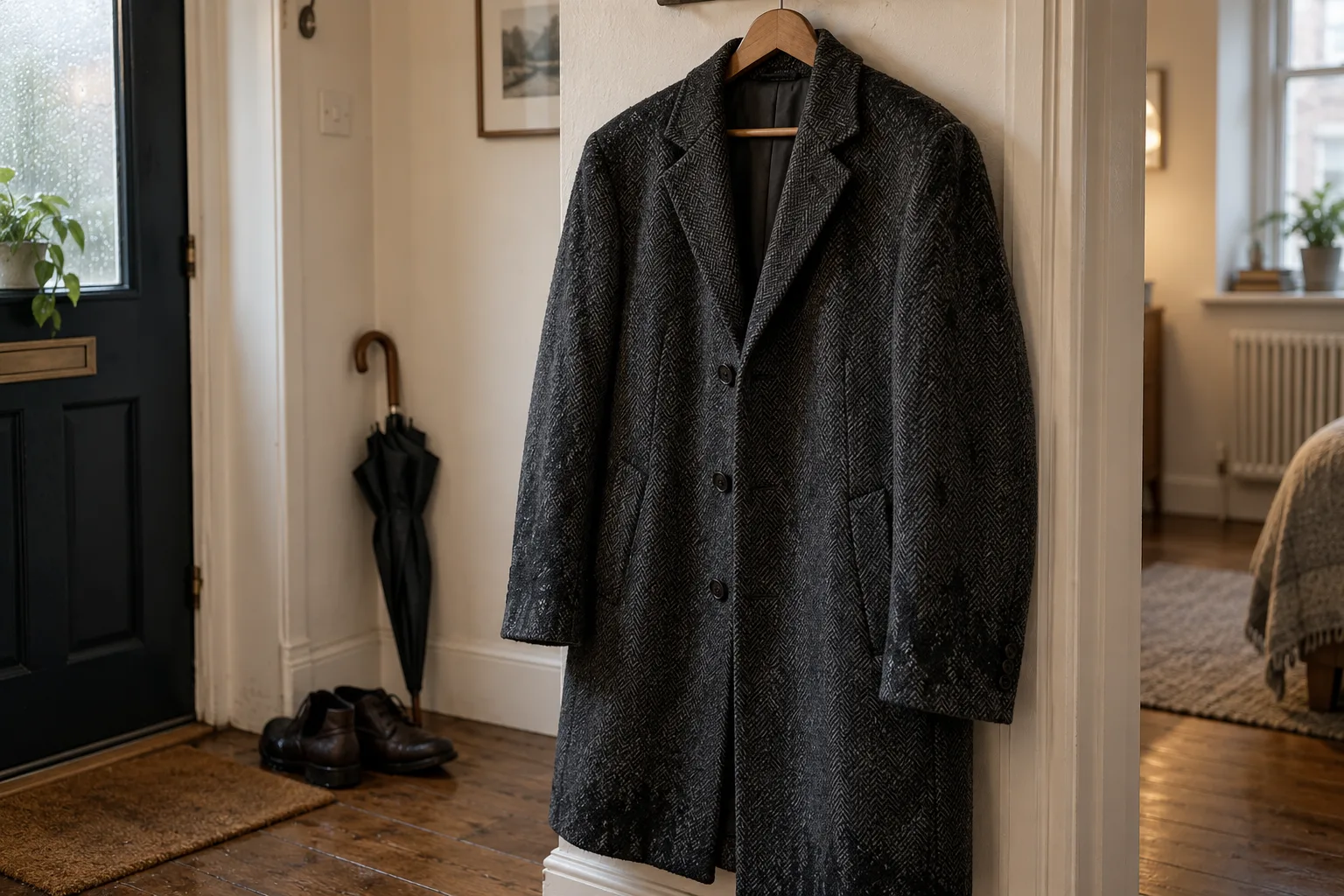
My charcoal herringbone wool-blend coat came through the door looking several shades darker than when it had left.
The shoulders were wet, the cuffs had caught more rain than I realised and there were beads of water sitting along the lapels. Nothing catastrophic had happened. It was still recognisably the second-hand coat I bought because the cloth was sound and the difficult parts fitted properly; it had merely encountered weather, which is one of the things coats are traditionally expected to cope with.
Unfortunately, a wet wool coat also produces an immediate urge to become useful. Brush it. Wipe it. Put it somewhere warm. Introduce it to the radiator, which is standing nearby looking considerably more qualified for the situation than it actually is.
Before doing any of that, I needed to know how wet the coat really was.
First decide whether the coat is damp or properly soaked
There is a useful difference between a coat that has caught ordinary rain and one that has taken on enough water for the garment itself to behave differently.
I do not think that distinction can honestly be reduced to a number of minutes outdoors or a particular shade of dampness. Instead, I look at the physical evidence. Is the surface merely wet in places, or has water travelled through the cloth? Has the coat become noticeably heavier? Does it still hold its usual shape when supported, or are soaked areas beginning to drag?
That matters because wool does not behave exactly the same way when it is wet. The Canadian Conservation Institute explains that wool fibres are relatively weak and become weaker when wet; its textile guidance also warns that water can add enough weight to contribute to stretching and tearing in vulnerable textiles. Water adds weight while the wet fibres have less strength to resist it, so movement asks the material to do more precisely when it is less equipped to oblige.
The mechanism is still useful because it tells me when to become less ambitious.
For an ordinarily rain-damp coat, I am comfortable moving on to careful drying. If the coat is saturated enough to have become conspicuously heavy, is losing its normal hang or has water throughout its structure rather than on the outer cloth, I stop treating it as an ordinary damp-coat problem and seek advice from a professional cleaner experienced with tailored garments.
I also empty the pockets. Keys, coins and everything else I apparently need to transport through winter can wait somewhere else while the coat dries; Woolmark recommends emptying pockets as part of wool care to prevent sagging and bulging.
The care label gets a look now as well. A wool or wool-blend outer does not tell you everything about a finished coat, which may also contain a lining, interfacing, padding, trims and other materials with their own opinions about water.
For the broader routine — airing, brushing, storing and deciding when home care has reached its limit — I have a beginner’s guide to clothing care; this article is deliberately narrower, because right now the coat is wet.
Let a damp coat dry without trying to improve the weather indoors
The Woolmark Company gives the clearest general instruction here: when wool gets wet, let it dry at room temperature away from direct sunlight or heat.
That also rules out trying to hurry one patch with concentrated heat. The aim is ordinary drying rather than forcing the cloth from wet to dry as quickly as the house can manage.
For my own ordinarily damp woven coat, I use the broad shaped hanger it normally lives on and give it space rather than wedging it immediately between other clothes. Woolmark separately recommends shaped or padded hangers for woven wool garments.
If the coat is saturated enough to have become conspicuously heavy or is starting to drag out of shape, I would take it off the hanger and support its weight flat while it dries at room temperature, rather than leave all that wet weight pulling from the shoulders.
While the wool is damp, I leave the surface alone
Once the coat is hanging and drying safely, there is remarkably little for me to contribute.
That is inconvenient because doing nothing feels suspiciously unlike clothing care.
Woolmark recommends using a soft garment brush on woven wool after wear. The Canadian Conservation Institute, separately, says wet wool is sensitive to mechanical damage. Neither organisation turns those two facts into the instruction “do not brush a damp coat”.
I do.
Routine brushing can wait until the cloth is dry. There is no useful prize for choosing the moment when the fibres are more mechanically vulnerable to conduct maintenance that could just as easily happen later.
The same logic keeps my hands off areas that look slightly creased or flattened while wet. I am not rubbing them back into shape, repeatedly smoothing the surface or deciding that one damp lapel needs a bit of energetic encouragement.
Mud, road salt and tide lines make it a different problem
Clean rain and dirty road splash are not the same thing.
If the water reaching the coat has carried grime, salt or another contaminant with it, drying may leave evidence behind. The Canadian Conservation Institute includes tide lines among the possible results of water damage: a tide line is the visible boundary left around a wetted area as it dries. It also notes that dirty water can leave soiling and that dyes may run when textiles become wet.
Look for a distinct edge or line around the area that became wet rather than assuming every mark will appear as one obvious central stain.
Road salt deserves particular attention because the obvious instruction is slightly wrong.
The Drycleaning & Laundry Institute says salt is not soluble in dry-cleaning solvent and has to be removed with water. A cleaner may therefore flush the affected area with water or steam after taking precautions such as checking colourfastness.
So if there is road-salt splash around the hem, my instruction is not simply “have the coat dry-cleaned”. I would hand it to a professional cleaner and tell them that the mark is salt.
The difference sounds pedantic until you remember that the whole point of taking something to a professional is to give them useful information about the problem you are asking them to solve.
This is where I would hand the coat to a professional
My threshold is simple: if drying is no longer merely returning the coat to normal, I stop trying to finish the job myself.
The one thing I check particularly carefully is whether the outer cloth and lining still seem to belong to the same garment.
The Western Australian Museum’s textile-conservation guidance notes, in the context of wet cleaning, that linings can have a different weave from the outer fabric and that combinations may shrink at different rates, creating tension between them.
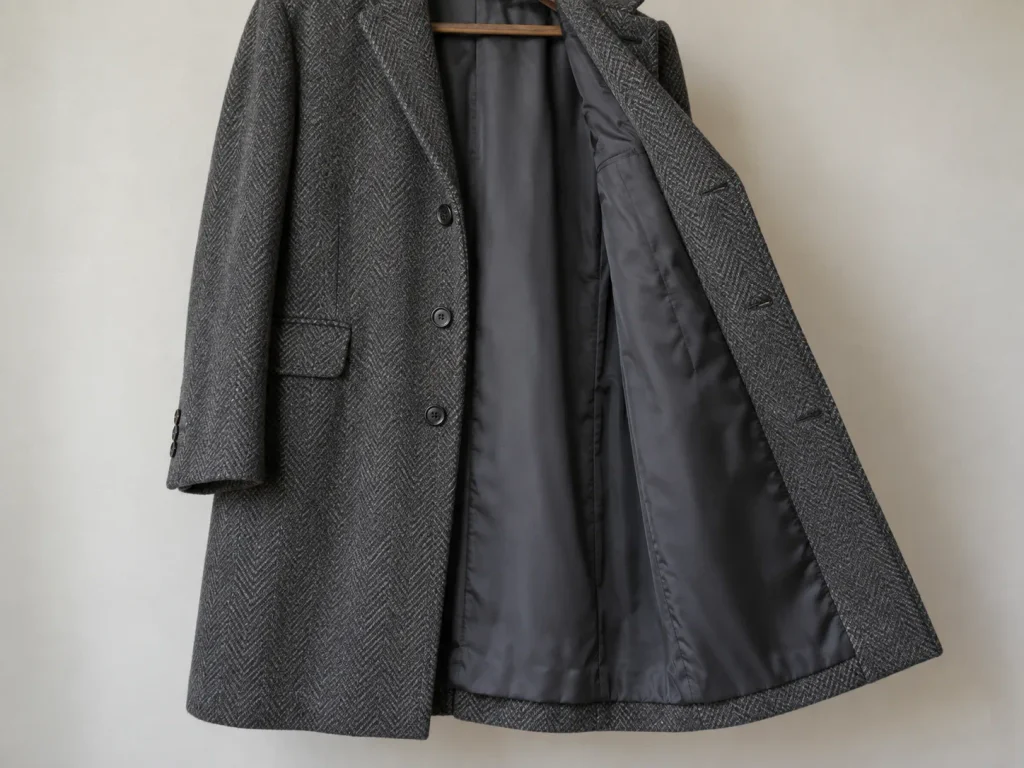
If the outer cloth seems to have returned to normal but the lining is puckering, pulling, protruding oddly at the hem or otherwise no longer sitting with the shell as it did before, I want somebody who cleans tailored garments to look at the whole coat rather than another domestic experiment aimed at the visible symptom.
The same applies whenever the care label, construction or condition leaves me without a clearly safe next move.
Once it is completely dry, inspect it before putting it away
A dry coat is much easier to judge than a wet one.
I look again at the shoulders, lapels, fronts, cuffs and hem. I check whether the coat still hangs as it normally does and whether the lining falls cleanly inside rather than pulling against the shell. I look for tide lines, colour change or marks that were difficult to see while the cloth itself was darkened by moisture.
Only once the coat is dry do I return to ordinary brushing.
If everything looks normal, there may be nothing else to do. A coat that got rained on does not automatically need cleaning simply because the weather touched it; sometimes the entire job is to dry it carefully, inspect it properly and resist creating a second problem while trying to solve the first.
By morning, the charcoal had gone back to charcoal, the lining hung where it belonged, and the radiator had contributed nothing.
Leave a Reply