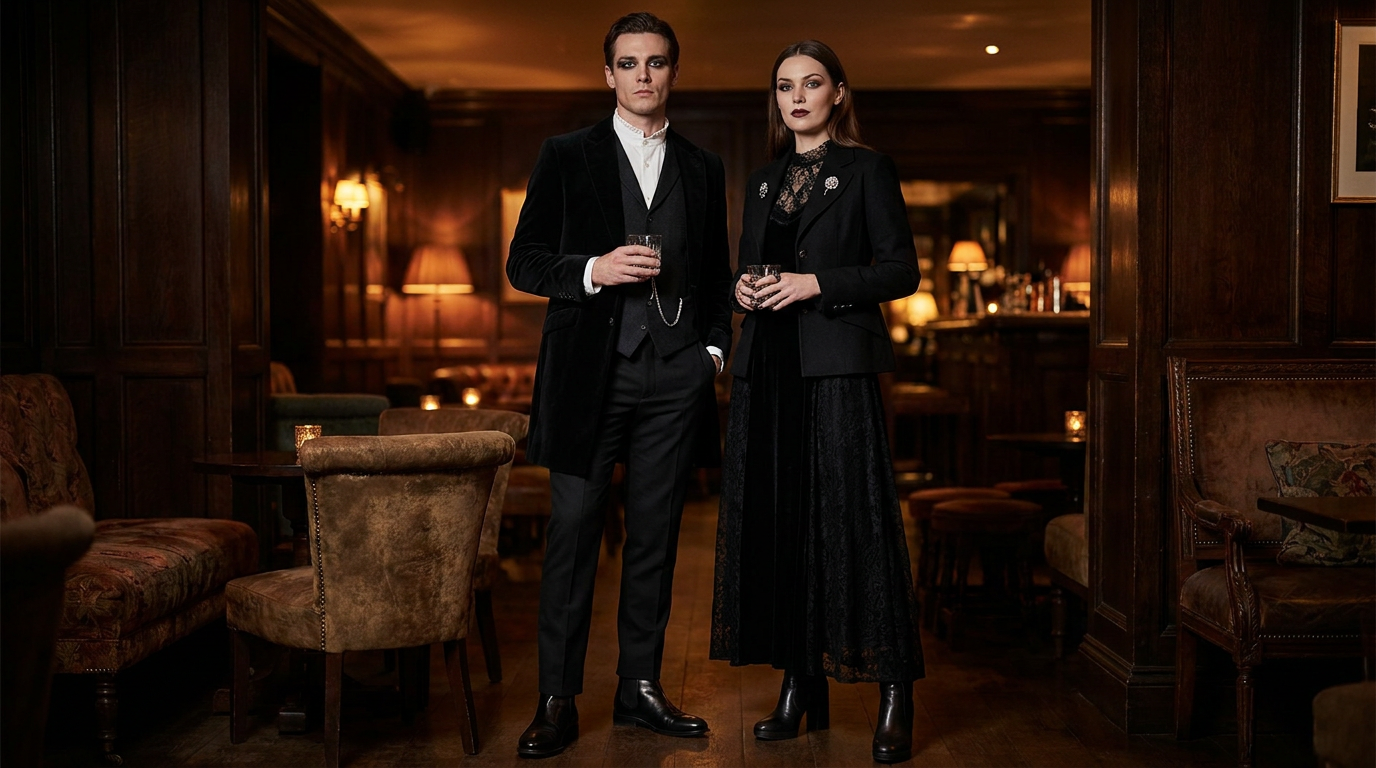
I’m going to a Halloween soirée at a local cocktail bar and restaurant this year, and I’ve been circling a gothic, butler-esque outfit for it. The current plan involves proper clothes bought for the occasion, dark eye makeup, quite a lot of eyeliner and possibly a dark lip. I am not planning to paint myself as a corpse. There are limits, although apparently lace cuffs are not among them.
My reference is an extravagantly gothic “Haunted Butler” mood board: tailcoat, waistcoat, lace at the throat, chains, gloves, polished boots, silver embroidery, skulls and enough graveyard scenery to affect the local property market. I do not actually want to copy it. Once I started pulling it apart, the useful question became much broader.
Work out what is carrying the look
A reference image usually contains two different kinds of information. Some details create the shape, texture and character you actually like; others are there principally to make sure nobody can possibly mistake the theme.
A vampire aristocrat might give you a long dark coat, severe tailoring, velvet, an extravagant shirt and polished boots. The fangs and theatrical blood are doing a different job. A witch might give you a long skirt, a blouse with full sleeves, boots, dark jewellery and several layers of black texture before the pointed hat has entered negotiations. Victorian-mourning-inspired styling might lead towards long dark lines, high necks, gloves and restrained jewellery.
My haunted butler survives particularly well once attacked with the same method. The tailcoat, waistcoat, white neckwear, watch chain and boots are doing most of what I liked. The skull embroidery is mostly there to make sure the man serving supernatural drinks cannot be mistaken for somebody attending an inconveniently formal wedding.
This is the same problem I ran into in How to Build a Storybook Wardrobe Without Looking Like Costume: naming an object more precisely only helps if the details you preserve are the ones carrying its character.
And this is not an argument against fancy dress. I have previously worn a full wood-elf ranger costume, including an enormous wool cape that was superb outdoors and essentially personal central heating once I went inside. Sometimes costume is exactly the point.
For this sort of Halloween outfit, start by taking away the literal symbols and looking at what survives. A vampire without fangs may still have a magnificent coat. A witch without a hat may still have sleeves worth stealing. That remainder is usually much easier to shop for.
Tailoring and coats establish the silhouette
A dark coat or jacket can do an enormous amount before you add anything overtly gothic. Black is the obvious route, but wine velvet, midnight navy or a deep chocolate brown can carry just as much weight.
For a masculine outfit, that could mean a sharp black blazer, dinner jacket, velvet jacket, long formal coat or an actual evening tailcoat. For a feminine outfit, the same job might be done by a sharply waisted blazer, fitted velvet jacket, sweeping evening coat or tailcoat over a dress or skirt. None of those garments needs to stay obediently in the department where the shop put it.
Length changes the effect quickly. A jacket ending around the hip keeps things relatively ordinary; something falling much further down the body adds movement and a stronger vertical line. Strong shoulders make an outfit more severe. A closely shaped waist makes it more theatrical. You can get quite a long way before anyone has embroidered a single bat.
It is worth knowing what the formalwear terms actually describe, particularly when shopping second-hand. Jasper Littman’s tailoring glossary defines a morning coat as a formal single-breasted coat with peak lapels and tails at the back, worn as part of morning dress; Richard Anderson describes its front as slightly rounded and cut away, curving back into the tails. An evening tailcoat, by contrast, is short at the front with split tails falling towards the knees behind.
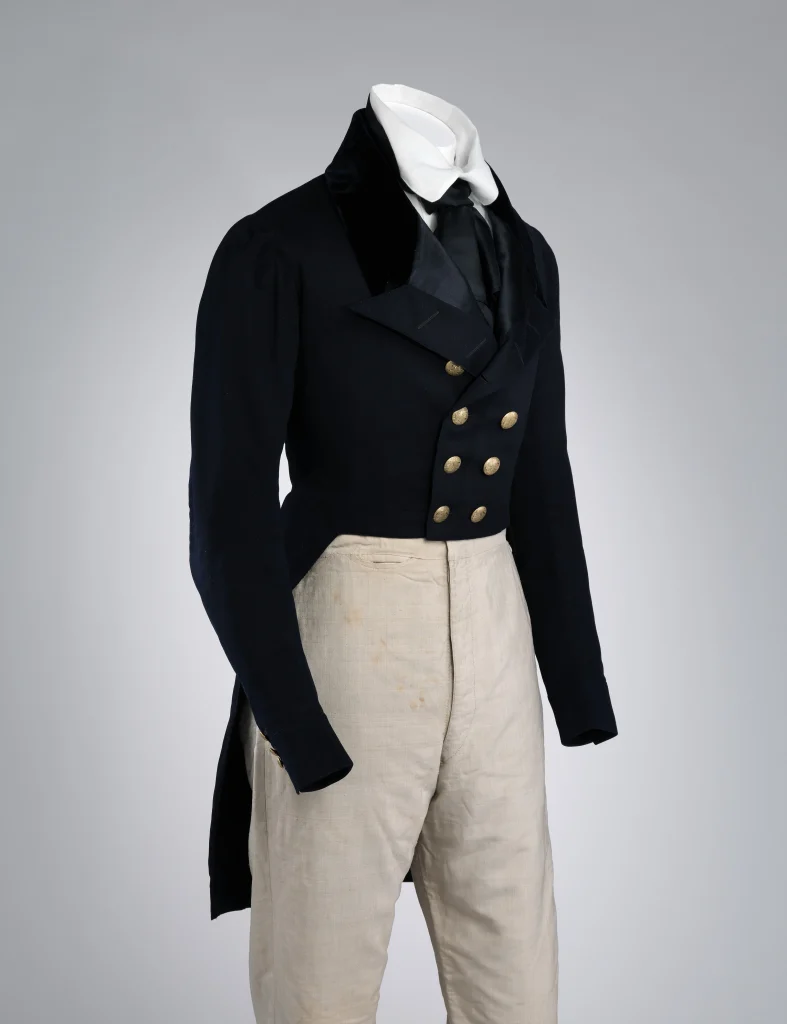
Tailcoat, probably British, 1840–50. Wool, silk, cotton and metal. The Metropolitan Museum of Art, New York. Public Domain.That distinction matters when a seller has called anything with extra fabric at the back a “tailcoat”. Look at the actual front edge and the shape of the tails rather than giving the listing title more authority than it deserves. In my own case, the reference has at least established that I want the long formal line much more than I want the cemetery embroidered on top of it.
Shirts and blouses provide the useful excess
If the coat sets the outline, the shirt or blouse is an excellent place to become unreasonable.
Ruffles at the neck or cuffs can turn plain tailoring into something much more theatrical. So can a high neck, a large soft bow, a sheer sleeve, a crisp white shirt under black tailoring or an unusually full sleeve gathered back at the wrist.
This works across masculine and feminine dressing because the useful information is shape rather than department. A man could put a ruffled blouse under a severe black suit. A woman could wear a stiff white dress shirt and dark waistcoat. Either could use lace at the collar or cuff and let that one pale detail take most of the attention.
The mood board that started this calls its falling lace neckwear a cravat, but jabot is the more useful term for what it depicts. The V&A describes a jabot as detachable ruffles worn at the front of a shirt, often made from finer linen or lace. The Metropolitan Museum of Art has surviving examples catalogued under that name, including a French cotton jabot from about 1882.
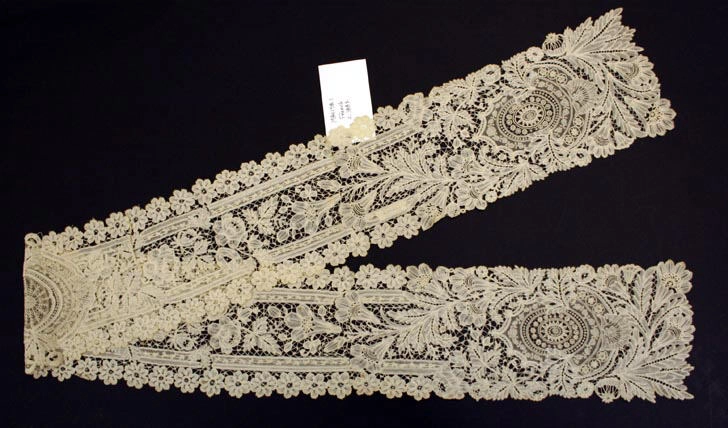
Jabot, French, c.1882. Cotton. The Metropolitan Museum of Art, New York. Public Domain.A wing collar — a stiff standing collar with its points turned down like small wings — can push a formal shirt in another direction entirely. I already went down that historical corridor while writing about detachable collars, so I will spare this article another piece of obsolete neckwear administration.
Dresses and skirts can carry the whole idea
A dress has one useful advantage here: one strong silhouette can establish most of the mood before you begin accessorising it to death.
A long black evening dress can be severe, romantic or glamorous depending on its cut, but plum, aubergine or deep teal can do the same job without losing the darkness. A fitted dark dress under a long coat behaves differently from a full skirt with a high-neck blouse. A sharply defined waist changes the character again without requiring a printed cobweb anywhere near the premises.
For women who want something more restrained, a simple column shape with strong jewellery and dramatic makeup may be enough. For somebody wanting more movement, a fuller skirt makes every walk across the room slightly more consequential than it strictly needs to be.
Men who wear skirts or dresses get exactly the same options. Men who do not can take the principle rather than the garment: length and uninterrupted vertical line create much of the presence. Fuller trousers and a long coat can bring sweep to a masculine outfit without pretending they are secretly a skirt.
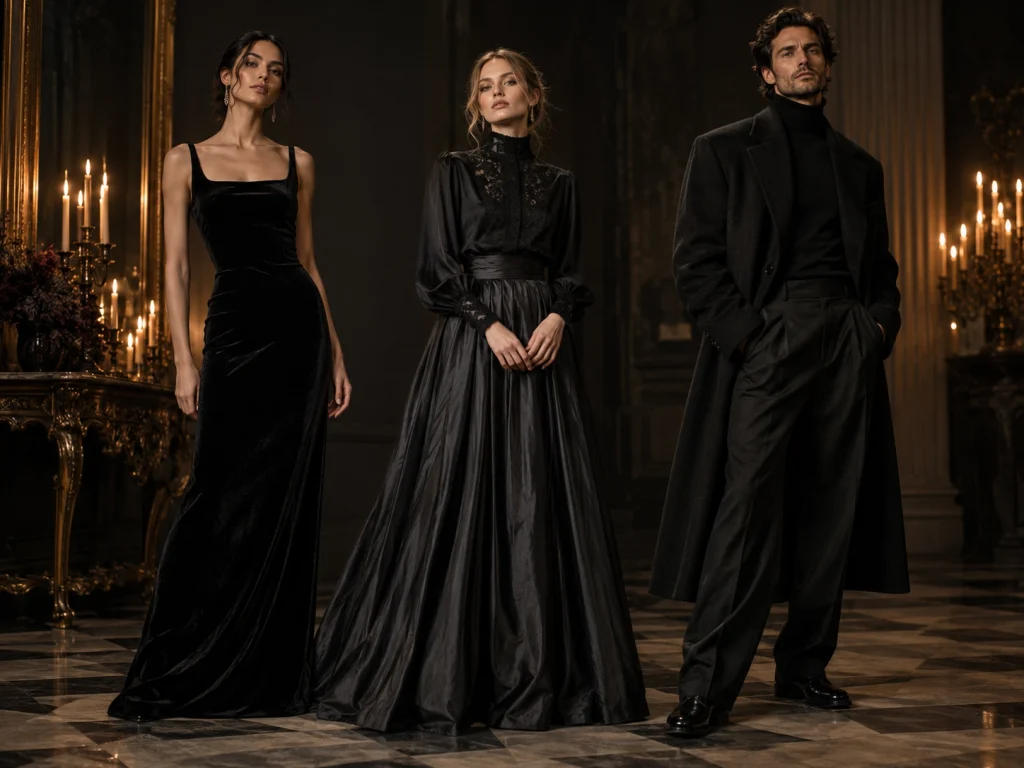
Long lines can carry the mood through dresses, skirts, fuller trousers or coats without relying on Halloween prints.Texture stops black becoming featureless
Black is useful. An outfit consisting of seven unrelated black things is not automatically interesting.
The difference often comes from putting surfaces against one another: velvet beside crisp cotton, lace over skin, polished leather under matte wool, a lustrous shirt under a dry-textured jacket. The colours may all sit close together while the light keeps separating them.
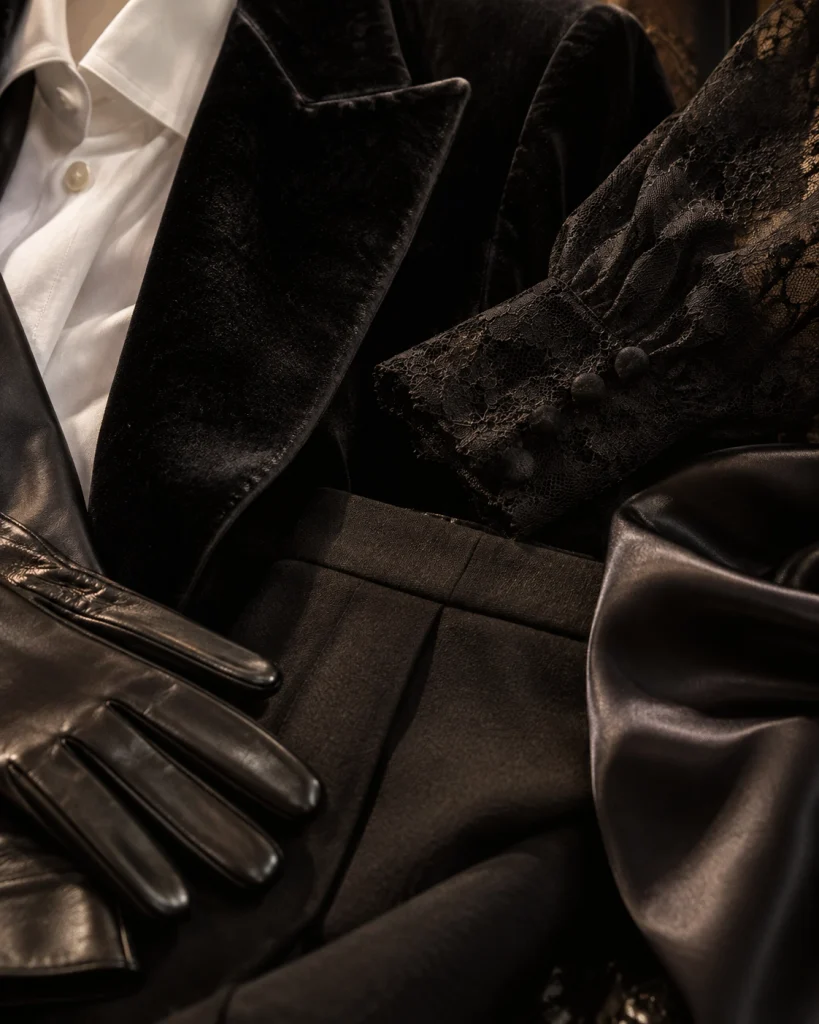
Black works harder when the surfaces change: velvet, lace, polished leather and matte cloth catch light differently.That works just as well on a man in a velvet jacket, white ruffled shirt and wool trousers as it does on a woman in a dark satin-finish dress under a matte coat. A patterned waistcoat can break up a tailored outfit; lace sleeves can do the same inside an otherwise simple dress.
Velvet is especially good at this because its raised pile changes the way the cloth catches light, but that surface is also the reason it needs particular care. I have a separate guide to velvet and the other delicate fabrics most capable of taking revenge on careless ironing.
Accessories should sharpen the idea
This is the point at which it becomes very easy to ruin perfectly good clothes with six necklaces, three rings, a spider brooch, a raven, a key, a velvet choker and some object involving a small fake bone.
Pick details that reinforce what is already happening. Gloves can extend a long formal line. Silver-toned rings and earrings look particularly good against black. A brooch can bring one point of detail to a severe coat. A pocket watch and chain can make a waistcoat considerably more interesting without requiring the watch to be cursed.
If you are using the traditional waistcoat arrangement, Albert chain is the useful term to know. Museums Victoria describes an Albert watch chain with a bar designed to fasten through a waistcoat buttonhole and a swivel attachment at the other end for the watch. That is more specific than a decorative chain clipped somewhere across the torso.
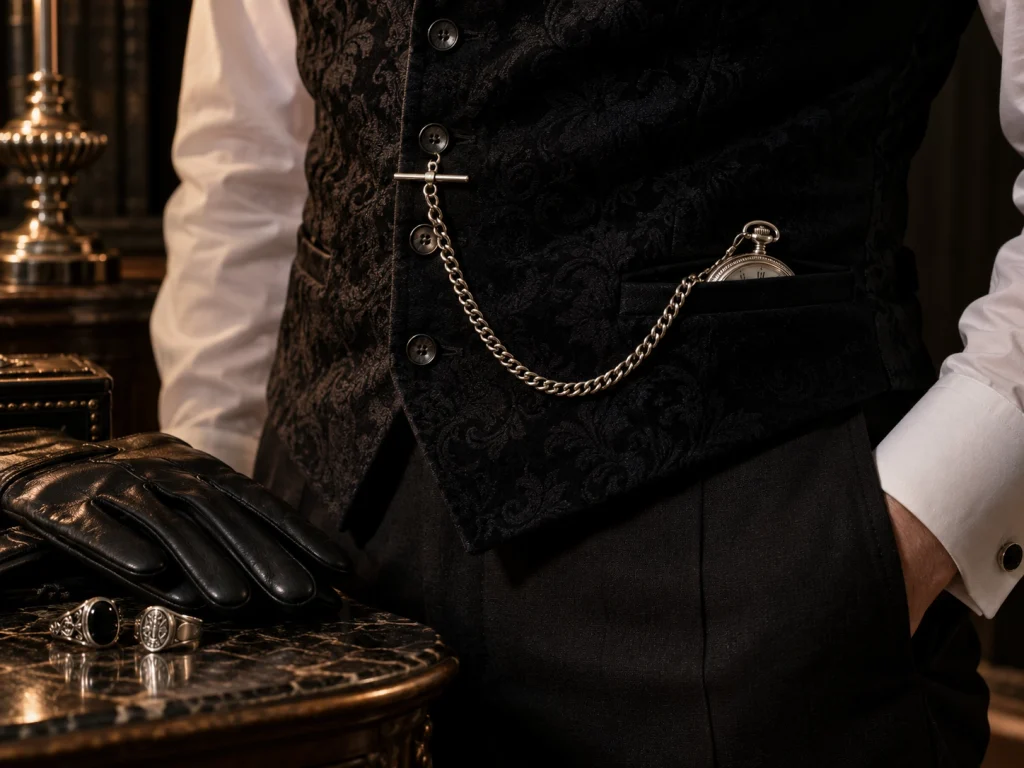
An Albert chain fastens through the waistcoat and runs to the pocket watch, adding a strong metallic detail without an overt Halloween motif.Women can use the same watch-chain arrangement with a waistcoat, or take the metallic detail into a brooch, earrings, rings or a chain belt depending on the clothes. Men can wear gloves and jewellery without having to pretend the watch is the only legal decorative object available to them.
One accessory with enough presence usually beats a committee.
Boots and shoes decide how the outfit ends
There is something depressing about building an extravagant outfit from the neck down and then allowing the shoes to give up.
A masculine outfit might end in polished lace-up boots, sleek ankle boots, sharper formal shoes or a heeled boot if the rest of the clothes support it. A feminine outfit might use pointed shoes, tall boots, heeled ankle boots, polished lace-ups or exactly the same severe ankle boot as the man standing beside her.
Look at the line more than the label. A narrower or pointed shape usually feels sharper; a substantial lace-up boot gives more weight. A polished surface can echo metal or lustrous cloth further up the outfit.
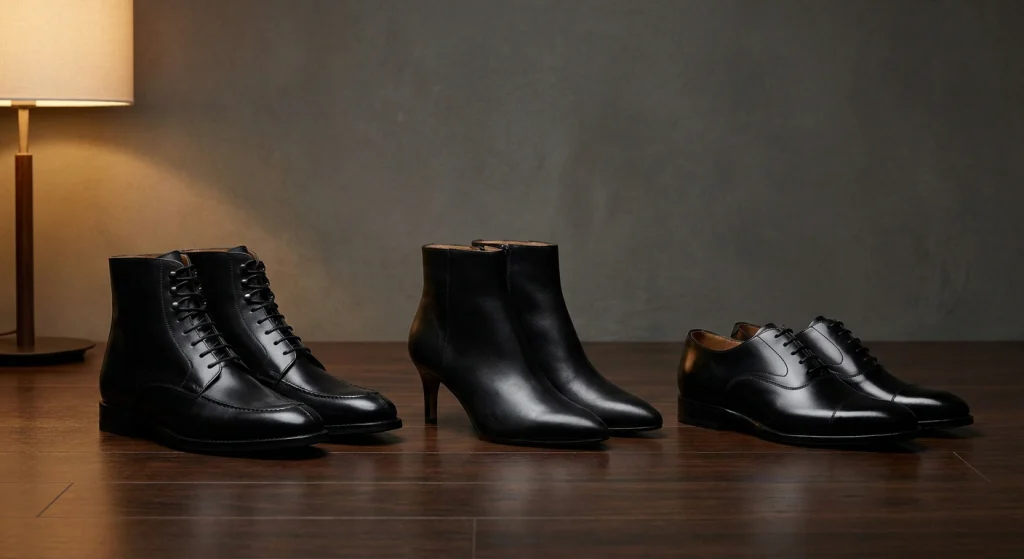
Polished boots and sharper formal shoes continue the line of the outfit without relying on novelty details.I would only use patent when the shoe is actually made with a patent finish. If what matters is simply that it shines like it has recently been threatened with inspection, polished is perfectly adequate. A good shoe does not need a buckle shaped like a coffin to prove commitment.
Makeup can move ordinary clothes much further
This is where somebody wearing recognisable evening clothes can push the whole result firmly towards Halloween without attaching anything else to them.
Dark eyeshadow and heavier eyeliner work on men and women. A dark lip can make the contrast stronger again. The exact shapes depend on the person and the rest of the outfit; this is not a makeup tutorial, and I am not going to prescribe one universal gothic face as though cheekbones were issued from a central office.
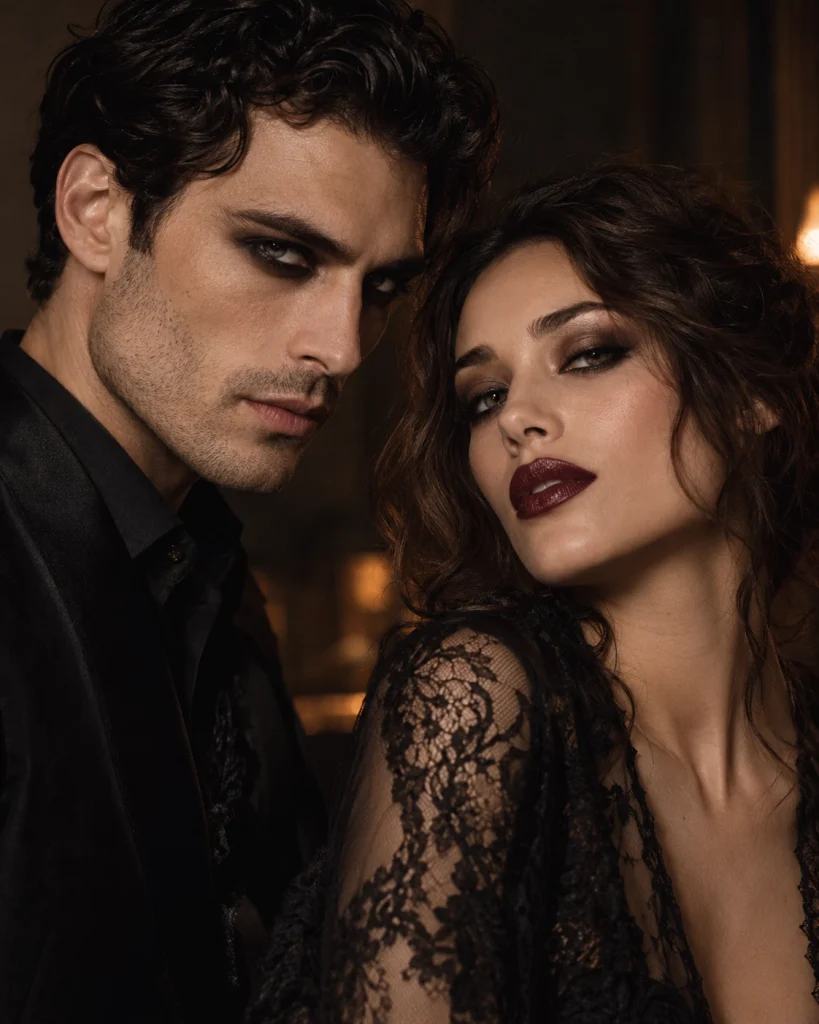
Dark eyeshadow, heavier liner and a deep lip can push ordinary eveningwear further into Halloween without becoming character makeup.My current plan is dark shadow, plenty of eyeliner and possibly a dark lip. No skull makeup. The clothes are supposed to remain clothes rather than become the torso section of a character design.
A man in a black suit and ruffled white shirt can therefore go considerably darker through makeup alone. So can a woman in an otherwise simple black dress. An already extravagant velvet-and-lace outfit may need very little before everybody has understood the assignment.
Look for the garment, not only the Halloween version
Once you have taken the reference apart, second-hand shopping becomes much less mysterious.
Look through charity shops, vintage shops, Vinted, Depop and eBay. For formal pieces, also try sellers dealing in ex-hire formalwear. Stock changes, sizes disappear and there is no ancient national reserve of tailcoats waiting patiently for October.
Useful searches might include:
- dark velvet jacket
- black formal coat
- evening tailcoat
- waistcoat
- patterned waistcoat
- white ruffle shirt
- jabot blouse
- high-neck lace blouse
- wing-collar shirt
- black maxi dress
- long black skirt
- formal wide-leg trousers
- pocket watch chain
- black leather gloves
- polished lace-up boots
Do not become too devoted to the supposedly correct term. The Search Box Is Not an Oracle came out of testing precisely that assumption: sometimes the ordinary garment description finds the character perfectly; sometimes removing the fantasy word also removes the thing you liked. Start with the language you have, inspect the results, change one element and look again.
Physical shops make this easier in one respect because nobody needs to have named the garment correctly before you find it. A blouse can have the right ruffle while being listed under nothing more exciting than “blouse”. A long coat can have the right movement despite nobody having thought to call it gothic. A waistcoat does not need to know that you are planning to put eyeliner next to it.
The reference is allowed to be ridiculous
A good reference image does not need to be historically coherent, commercially available or remotely sensible as a complete outfit. It only needs to show you something worth noticing.
Take the vampire’s coat. Take the witch’s sleeves. Take the mourning-inspired long line, the butler’s watch chain, the absurd lace, the velvet and the polished boots. Leave behind whatever does nothing except announce the character more loudly than you wanted.
The Party City end of Halloween has its own pleasures.
It just does not have a monopoly on drama.
Leave a Reply